Moroccan Roasted Chicken with Olives: 12 Chef Secrets for Crispy Skin
Table of Contents
Moroccan Roasted Chicken with Olives
A whole chicken rubbed under the skin with cilantro, garlic, ginger, and preserved lemon behaves differently in a hot oven than it does in a simmering pot. The skin tightens and browns instead of softening in liquid, and the sauce that collects underneath concentrates instead of stretching into a stew. That difference is the whole premise of this recipe: it keeps the preserved lemon-and-olive flavor Morocco is known for, but builds it around a roasting method rather than a braise.
This is not a stovetop tagine, and it doesn’t try to be one. It’s an oven-roasted chicken carrying the same aromatic base — cilantro, parsley, garlic, ginger, turmeric, preserved lemon, and green olives — that defines Moroccan mqualli-style cooking, adapted so a home cook with a roasting pan and no clay tagine can still land on crisp skin, juicy meat, and a sauce worth spooning over the plate.
What Is Moroccan Roasted Chicken With Olives?
Moroccan roasted chicken with olives is a whole chicken seasoned with a Moroccan herb-and-spice marinade — cilantro, parsley, garlic, ginger, turmeric, and preserved lemon — then roasted until the skin is deeply golden and finished with green olives and preserved lemon in a reduced pan sauce. It takes its flavor identity from the preserved lemon-and-olive tradition of Moroccan chicken cooking, while trading the covered, liquid-based braise for dry oven heat.
That distinction matters more than it might seem. The dish most Americans picture when they hear “Moroccan chicken with olives” is usually djaj mqualli — chicken braised in a tagine or Dutch oven with onions, spices, preserved lemon, and olives, cooked low and slow under a lid until the meat falls off the bone. This recipe borrows that dish’s flavor foundation and applies it to a different cooking method. The result is a chicken with crackling, well-browned skin — something a covered braise can’t really produce — carrying the same salty, aromatic, citrus-bright character.
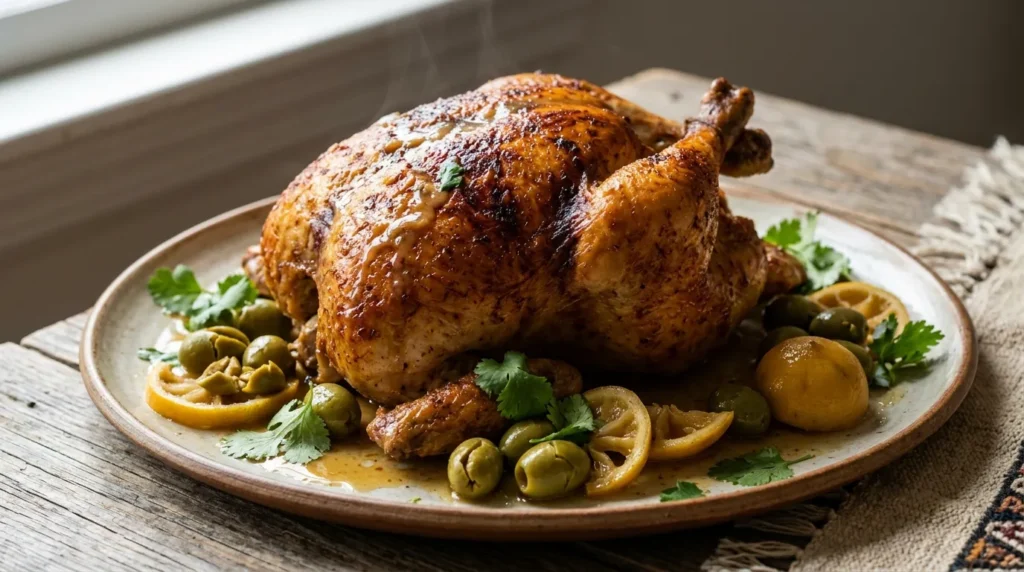
IMAGE PROMPT: A whole roasted chicken with deep golden-brown, crackling skin, resting on a rustic ceramic platter, surrounded by cracked green olives, sliced preserved lemon rind, a few whole preserved lemons, and scattered fresh cilantro and parsley leaves. Thin, glossy pan sauce is pooled around the base of the chicken and lightly drizzled over one side. Shot from a 45-degree angle at eye level with the platter, showing the full bird and the garnish spread around it on a weathered wooden table with a woven Moroccan textile partially visible at the edge of frame. Natural window light coming from the left, soft directional shadows, shallow depth of field with the front of the chicken in sharp focus and the background softly blurred. Shot on a full-frame camera with an 85mm lens look, f/2.8, warm but accurate color balance emphasizing the burnished skin and the deep green of the olives. Editorial cookbook photography style, true-to-life food styling, realistic steam suggestion rising faintly from the chicken. No text, no logos, no watermarks, no illustration or CGI look. 16:9 aspect ratio, 1344 x 768 px.
FILENAME: moroccan-roasted-chicken-with-olives-hero.jpg
ALT TEXT: Whole Moroccan roasted chicken with crisp golden skin, green olives, and preserved lemon
IMAGE TITLE: Moroccan Roasted Chicken with Olives and Preserved Lemon
CAPTION: Crisp-skinned roasted chicken finished with green olives, preserved lemon, and a concentrated pan sauce.
IMAGE DESCRIPTION: A golden-brown whole roasted chicken on a ceramic platter, garnished with green olives, sliced preserved lemon, and fresh herbs, with glossy pan sauce pooling around the base.
The Moroccan Tradition Behind Chicken With Olives and Preserved Lemon
Preserved lemon and olives show up across a wide range of Moroccan dishes, but they’re most closely tied to mqualli — a category of tagine defined by turmeric, ginger, and saffron rather than the darker, paprika-and-cumin-based m’hammer style. Chicken mqualli is a household staple, not a special-occasion dish, and the version that lands on a Moroccan table on any given Tuesday looks different from one family’s kitchen to the next. Some cooks lean harder on ginger, some use more saffron than turmeric, some rinse the olives first and some don’t bother.
What stays constant is the reliance on preservation. Salt-cured lemons and brined olives were part of Moroccan pantries long before anyone thought of them as a “flavor profile” — they were a practical way to carry acidity, salt, and savoriness through the year without needing fresh produce on hand. That practical origin is part of why the combination works so well: it isn’t a garnish, it’s the backbone of the sauce.
This recipe respects that backbone while changing the vessel. Roasting a whole chicken instead of braising cut pieces is a legitimate way to bring those same ingredients to the table — it’s just not the traditional way, and it shouldn’t be presented as identical to it. If you want the classic braised version with its deeper, more integrated sauce, a stovetop or Dutch-oven tagine built the traditional way is the better route; this roasted version is for when you want that flavor with crisp skin and a shorter, more hands-off cooking process on a weeknight.
Why Preserved Lemon and Olives Work So Well With Chicken
Chicken is a mild, fat-carrying protein, and it needs something assertive to keep it from tasting flat. Preserved lemon brings salt and a fermented, slightly bitter citrus note that’s sharper and deeper than fresh lemon juice. Green olives bring their own salt plus a briny, vegetal sharpness. Together they cut through the richness of the skin and dark meat the way a good vinaigrette cuts through a fatty cut of meat — not by adding more fat, but by giving the palate something bright to bounce against.
Turmeric and ginger do a quieter job in the background. Turmeric adds a mild earthiness and a warm golden color to the skin and pan juices; ginger adds a light, sharp warmth that keeps the dish from tasting one-dimensionally salty. Garlic and the herb stems build a savory base under all of it, and fresh cilantro and parsley leaves, added at the very end, keep the finished dish tasting bright rather than muddy.
None of these ingredients is doing the same job. That’s the point — a good Moroccan chicken doesn’t taste like “Moroccan spice,” it tastes like several specific things working in the same direction.
The Moroccan Spices You’ll Need
This recipe keeps its spice list short on purpose. A long ingredient list doesn’t make a dish more authentic — it usually just muddies the flavor.
- Turmeric — earthy, mildly bitter in large amounts, and responsible for the marinade’s golden color. Used in a supporting role, not a dominant one.
- Ground ginger — warm and slightly sharp, one of the two spices (with turmeric) that define the base flavor of mqualli-style cooking.
- Black pepper — steady, low-grade heat that ties the spices together without adding sharp spiciness.
- Saffron (optional but traditional) — a pinch, steeped in warm water before adding, for a floral note and deeper gold color. It’s expensive, so treat it as an accent, not a requirement.
Cumin, paprika, and cinnamon show up in other Moroccan chicken preparations, particularly the reddish-brown m’hammer style or sweet-savory dishes with dried fruit. They’re left out here to keep this dish’s flavor clean and true to the preserved lemon-and-olive profile.
Choosing the Best Chicken
A whole chicken in the 4½ to 5½ pound range is the right size for most US grocery stores and roasts evenly in a standard home oven without drying out before the thighs finish cooking. Look for a bird labeled “fresh” rather than “previously frozen” if you can — it tends to have better skin texture — though a properly thawed frozen chicken will still roast well.
Bone-in, skin-on is non-negotiable here. The bones hold moisture in the meat during roasting, the skin protects the breast from drying out, and the rendered fat under the skin is what carries a good portion of the marinade’s flavor into the meat. If you’d rather skip a whole bird, this same marinade and roasting approach works well on bone-in, skin-on chicken quarters or thighs — reduce the roasting time to 40–50 minutes and check for doneness earlier. Spatchcocking (removing the backbone and flattening the bird) is a legitimate modern shortcut that roasts faster and more evenly, but it changes the presentation from “whole roasted chicken” to “flattened chicken,” so this recipe sticks with a traditional whole-bird roast.
Ingredients You’ll Need
(Serves 4–6)
For the chicken:
- 1 whole chicken, 4½–5½ lbs, patted very dry
- 2 tablespoons kosher salt
- 1 lemon, halved (for the cavity)
- 1 small onion, quartered (for the cavity)
- A few sprigs of cilantro and parsley (for the cavity)
For the Moroccan marinade:
- ½ cup fresh cilantro, roughly chopped
- ¼ cup fresh flat-leaf parsley, roughly chopped
- 5 garlic cloves
- 1 tablespoon fresh ginger, grated (or 1½ tsp ground ginger)
- ⅓ cup extra virgin olive oil
- 1 preserved lemon, pulp removed, rind roughly chopped
- 1 teaspoon ground turmeric
- ½ teaspoon black pepper
- A pinch of saffron threads, steeped in 1 tablespoon warm water (optional)
- 1 teaspoon kosher salt
For the roasting pan and sauce:
- 1 large onion, sliced into thick rounds
- 4 garlic cloves, smashed
- ½ cup low-sodium chicken stock or water
- 1 cup green olives (Moroccan or brined green olives, pitted or unpitted)
- Rind of 1 additional preserved lemon, sliced
- 2 tablespoons fresh cilantro and parsley leaves, chopped, for finishing
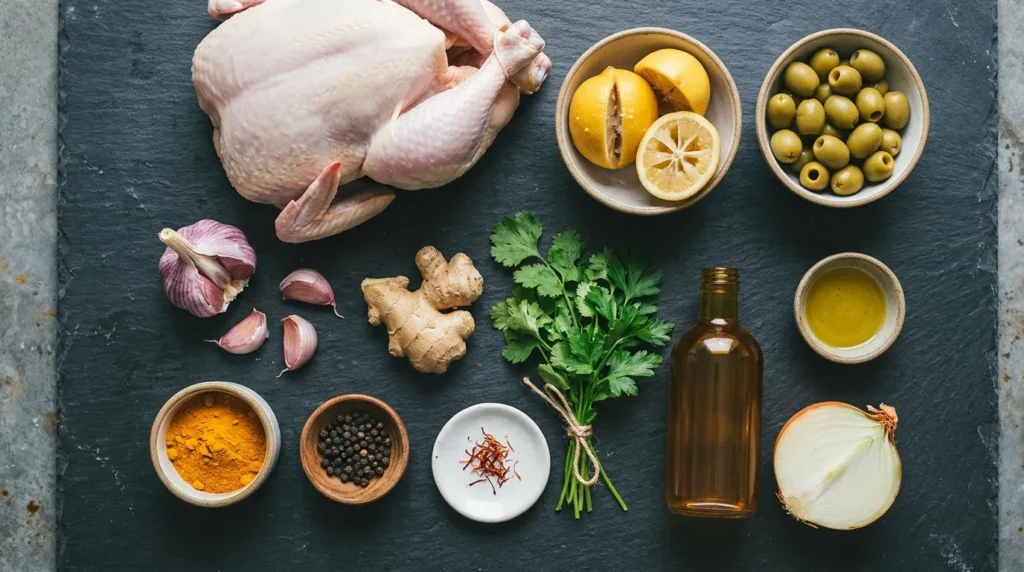
IMAGE PROMPT: An overhead flat-lay of raw ingredients for Moroccan roasted chicken with olives arranged on a dark slate or weathered wood surface: a whole raw chicken positioned at the top of the frame, a small bowl of whole preserved lemons cut open showing the salted rind and pulp, a bowl of unpitted green olives, a head of garlic with several cloves peeled, a knob of fresh ginger, a small bundle of fresh cilantro and flat-leaf parsley tied with twine, a ramekin of ground turmeric, a small dish of black peppercorns, a few saffron threads scattered on a tiny plate, a bottle or small dish of olive oil, and a halved yellow onion. Natural, slightly diffused overhead daylight, soft shadows, muted earthy color palette with the golden turmeric and green olives as color accents. No text, no labels, no packaging visible. Editorial recipe-development photography, realistic textures, shallow ambient depth of field. 16:9 aspect ratio, 1344 x 768 px.
FILENAME: moroccan-chicken-ingredients.jpg
ALT TEXT: Raw whole chicken with preserved lemon, green olives, garlic, and Moroccan spices laid out for roasting
IMAGE TITLE: Ingredients for Moroccan Roasted Chicken with Olives
CAPTION: Everything the marinade and pan sauce need: preserved lemon, green olives, fresh herbs, garlic, ginger, and turmeric.
IMAGE DESCRIPTION: Overhead flat-lay of a whole raw chicken surrounded by preserved lemons, green olives, garlic, ginger, fresh cilantro and parsley, and ground turmeric.
How to Make Moroccan Roasted Chicken With Olives
1. Make the Moroccan Herb and Spice Marinade
Combine the cilantro, parsley, garlic, ginger, olive oil, chopped preserved lemon rind, turmeric, black pepper, saffron with its soaking water, and salt in a food processor or blender. Pulse until you have a coarse, spoonable paste — you’re not making a smooth purée, just breaking everything down enough that it spreads easily and clings to the chicken.
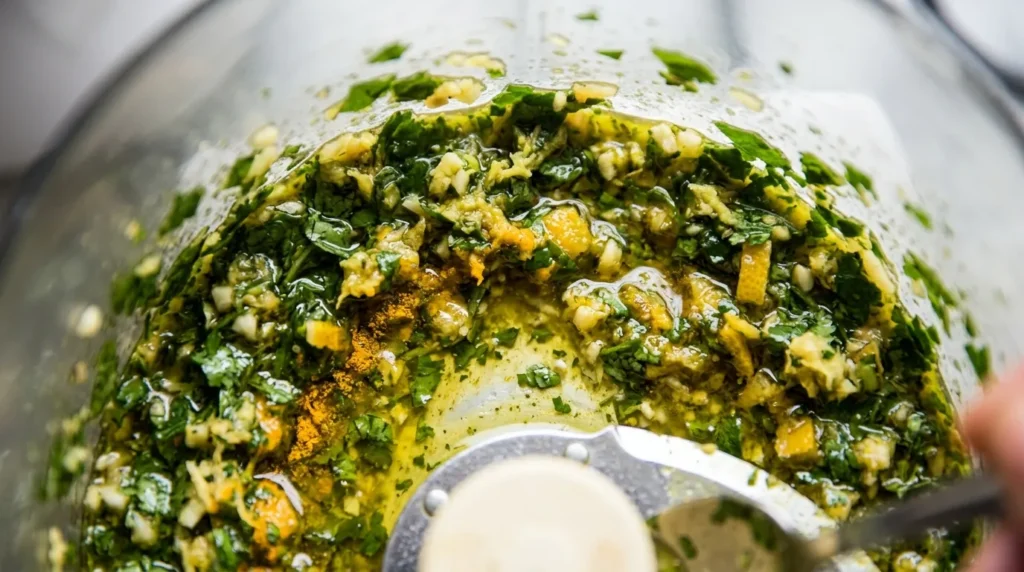
IMAGE PROMPT: A close-up shot looking into a food processor bowl mid-pulse, showing a vivid green-gold Moroccan herb marinade being blended: visible flecks of chopped cilantro and parsley, minced garlic, grated ginger, small pieces of preserved lemon rind, and a dusting of golden turmeric swirled through pale olive oil. The texture should look coarse and rustic, not perfectly smooth, with visible ingredient variation. Shot from directly above at a slight angle, natural kitchen lighting from a window, shallow depth of field with the marinade in sharp focus and the blurred edge of the processor blade visible at the bottom. Realistic food texture, slightly glossy from the olive oil, steam-free since it’s raw. Editorial food preparation photography, no hands or people fully in frame — at most a partial wrist or spoon edge. No text, no logos, no watermarks. 16:9 aspect ratio, 1344 x 768 px.
FILENAME: moroccan-chicken-marinade.jpg
ALT TEXT: Green and gold Moroccan herb marinade with preserved lemon and turmeric being blended
IMAGE TITLE: Moroccan Chermoula-Style Marinade for Roasted Chicken
CAPTION: Cilantro, parsley, garlic, ginger, turmeric, and preserved lemon blended into a coarse marinade paste.
IMAGE DESCRIPTION: Close-up of a chunky green-gold herb and spice marinade in a food processor, flecked with preserved lemon rind and turmeric.
2. Prepare and Season the Chicken
Pat the chicken completely dry, inside and out, with paper towels — this is the single most important step for crisp skin later. Season the cavity with 1 teaspoon of the kosher salt, then stuff it with the halved lemon, quartered onion, and herb sprigs.
Using your fingers, gently separate the skin from the breast and thigh meat, working from the neck opening, without tearing it. Push about two-thirds of the marinade directly under the skin, massaging it evenly over the breast and thigh meat. Rub the remaining marinade over the outside of the skin. Season the outside all over with the remaining kosher salt. If you have time, let the chicken sit uncovered in the refrigerator for 1–8 hours (or at least 30 minutes at room temperature) before roasting — this dries the skin further and lets the salt and spices penetrate the meat instead of just sitting on the surface.
Applying marinade under the skin matters more than applying it on top of the skin. Seasoning on the surface flavors the skin itself, which is good, but it doesn’t reach the meat underneath. Getting the paste directly against the flesh is what actually seasons the chicken all the way through.
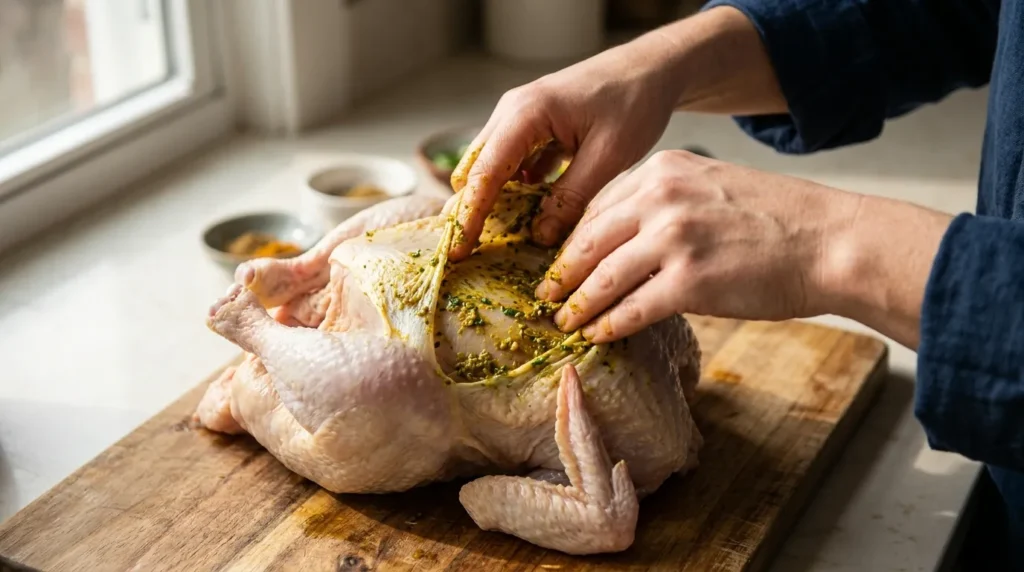
IMAGE PROMPT: A close-up, slightly overhead shot of hands gently working golden-green Moroccan marinade paste underneath the loosened skin of a raw whole chicken breast, showing the marinade visible through the translucent, lifted skin. The chicken sits on a clean cutting board or roasting rack, natural directional light from one side creating soft shadows that emphasize the texture of the skin and the glistening marinade. Focus is sharp on the point of contact between fingers and skin, with the rest of the chicken slightly softer in focus. Realistic raw poultry texture and color, warm but natural color grading. Editorial hands-on food preparation photography, no visible face, just hands and forearms in frame. No text, no logos, no watermarks. 16:9 aspect ratio, 1344 x 768 px.
FILENAME: moroccan-chicken-seasoning-under-skin.jpg
ALT TEXT: Hands rubbing Moroccan marinade under the skin of a raw whole chicken
IMAGE TITLE: Seasoning Chicken Under the Skin Before Roasting
CAPTION: Working the marinade directly under the skin so the seasoning reaches the meat, not just the surface.
IMAGE DESCRIPTION: Close-up of hands massaging green-gold herb marinade beneath the loosened skin of a raw whole chicken before roasting.
3. Build the Aromatic Roasting Base
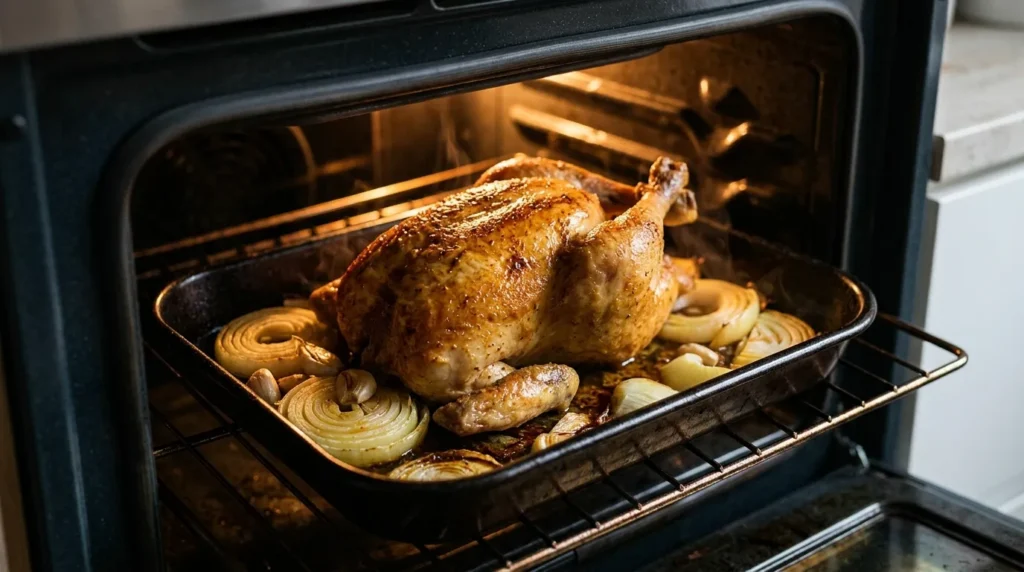
Heat your oven to 425°F. Scatter the sliced onion and smashed garlic across the bottom of a roasting pan or heavy oven-safe skillet, and pour in the chicken stock or water. This layer does two things: it keeps the pan drippings from scorching directly on hot metal, and it becomes the foundation of your finished sauce.
Set the chicken on top of the onions, breast-side up. If you have a roasting rack, use it — it lets air circulate underneath and helps the skin crisp evenly, though setting the bird directly on the onion bed also works and adds more flavor to the vegetables.
4. Roast the Chicken
Roast at 425°F for 20 minutes to kick-start browning and rendering, then reduce the oven to 375°F and continue roasting for another 55–70 minutes, until the skin is deeply golden and a thermometer inserted into the thickest part of the thigh reads 165°F. According to the <cite index=”34-1″>USDA Food Safety and Inspection Service, whole chicken should be cooked to a safe minimum internal temperature of 165°F as measured with a food thermometer, checked in the innermost part of the thigh and wing and the thickest part of the breast</cite>.
Baste the chicken with the pan juices once or twice during the second stage of roasting, but don’t overdo it — opening the oven repeatedly lets heat escape and slows browning. If the skin is browning faster than the interior is cooking, loosely tent the breast with foil.
IMAGE PROMPT: A whole chicken roasting inside an open oven, viewed from a slightly low angle looking into the oven cavity, skin already turning golden-brown with visible rendered fat glistening on the surface, sitting on a bed of sliced onions and whole garlic cloves in a dark roasting pan. Warm interior oven light casting an amber glow across the chicken and pan, with the oven door open just enough to show the scene and a hint of rising heat shimmer. Slightly moody, warm-toned lighting typical of an oven interior, shallow depth of field with the chicken skin in crisp focus. Realistic browning and fat rendering detail on the skin. Editorial food photography style capturing an authentic mid-cooking moment, no hands or people in frame. No text, no logos, no watermarks. 16:9 aspect ratio, 1344 x 768 px.
FILENAME: moroccan-chicken-roasting-oven.jpg
ALT TEXT: Whole chicken roasting in the oven over sliced onions with skin turning golden-brown
IMAGE TITLE: Roasting Moroccan Chicken Until Golden and Crisp
CAPTION: High heat first, then moderate heat, builds deep color on the skin while the onions turn into sauce underneath.
IMAGE DESCRIPTION: A whole chicken mid-roast in the oven, skin browning over a bed of sliced onions and garlic in a roasting pan.
5. Add the Olives and Preserved Lemon
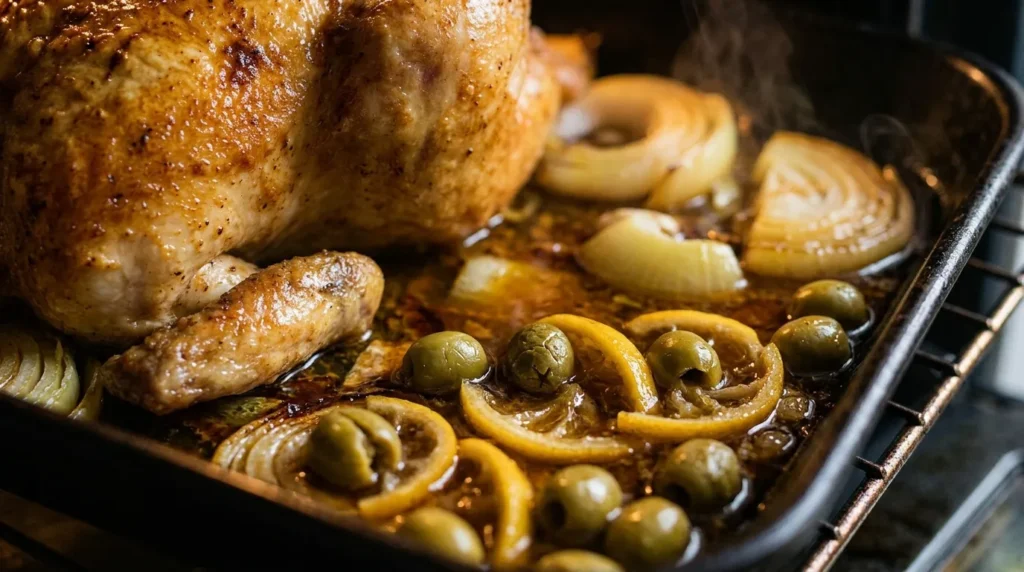
About 15 minutes before the chicken is done, scatter the olives and sliced preserved lemon rind into the pan juices around the chicken, not on top of the skin — you want them warming through in the sauce, not sitting on the bird where they’ll block browning. This late addition matters: olives and preserved lemon added earlier in a long roast can turn flat and overly salty, while adding them near the end keeps their brightness intact.
IMAGE PROMPT: A close-up shot looking into a roasting pan beside a partially roasted whole chicken, showing green olives and sliced preserved lemon rind being scattered into the glossy, deep amber pan juices pooled around the base of the bird. Steam rising faintly from the hot pan juices, the chicken’s golden-brown skin visible at the edge of frame, softened onions partially submerged in the sauce below. Warm, slightly low kitchen or oven-adjacent lighting, realistic reflective sheen on the pan juices and olives. Shallow depth of field with the olives and preserved lemon in sharp focus in the foreground. Editorial food photography, no hands or people. No text, no logos, no watermarks. 16:9 aspect ratio, 1344 x 768 px.
FILENAME: moroccan-chicken-preserved-lemon-olives.jpg
ALT TEXT: Green olives and preserved lemon rind added to pan juices around a roasting chicken
IMAGE TITLE: Adding Olives and Preserved Lemon to the Pan Sauce
CAPTION: Olives and preserved lemon go in during the last stretch of roasting, so they stay bright instead of turning flat.
IMAGE DESCRIPTION: Green olives and sliced preserved lemon scattered into glossy pan juices around a partially roasted chicken.
6. Reduce the Pan Sauce
Once the chicken reaches 165°F, transfer it to a cutting board to rest. Place the roasting pan directly over medium heat on the stovetop (or transfer the juices, onions, olives, and preserved lemon to a saucepan) and simmer for 5–8 minutes, stirring occasionally and scraping up any browned bits. The sauce is ready when it coats the back of a spoon rather than running off it thinly — you’re concentrating the liquid, not thickening it with flour or cornstarch. Taste before adding any additional salt; between the preserved lemon and the olives, the sauce often needs none.
7. Rest, Carve, and Serve
Let the chicken rest, loosely tented with foil, for 15 minutes before carving. This isn’t optional — cutting into the bird immediately lets the juices run out onto the board instead of redistributing through the meat. Carve as you would any roasted chicken: remove the legs and thighs, separate the breasts from the carcass, and slice against the grain. Arrange the pieces on a platter, spoon the reduced onion, olive, and preserved lemon sauce over the top, and finish with the chopped fresh cilantro and parsley.
IMAGE PROMPT: A fully roasted whole Moroccan chicken with deep golden, crisp skin resting on a wooden carving board, surrounded by warm caramelized onions, green olives, and preserved lemon rind, with glossy reduced pan sauce spooned generously over the top and pooling on the board. Fresh chopped cilantro and parsley scattered across the chicken as a final garnish. Shot at a three-quarter angle from slightly above, warm late-afternoon light from one side creating rich highlights on the crisp skin and soft shadows across the board. Shallow depth of field, sharp focus on the glistening skin and sauce, background softly blurred kitchen counter. Realistic food styling, natural steam suggestion. Editorial cookbook photography, no text, no logos, no watermarks. 16:9 aspect ratio, 1344 x 768 px.
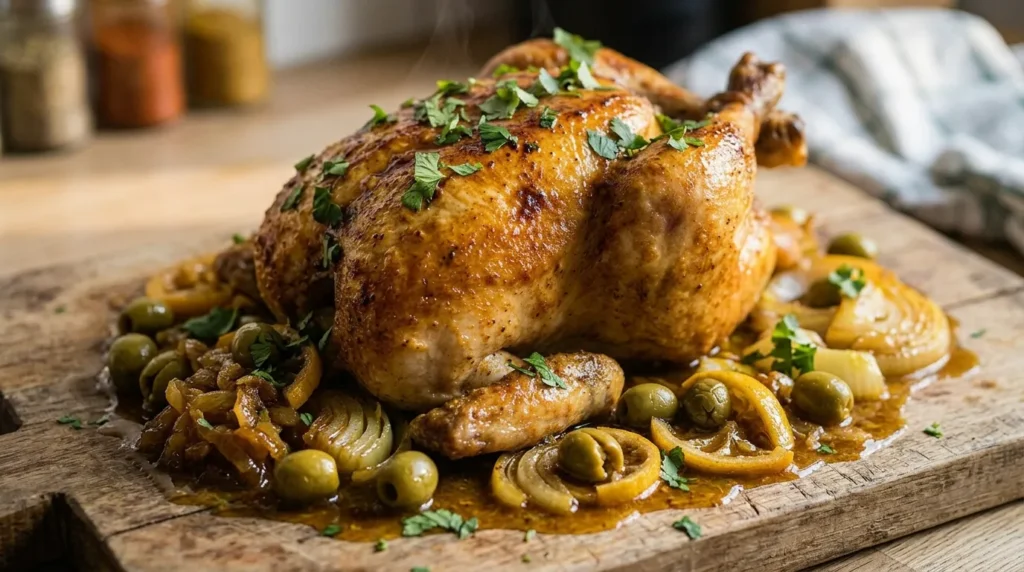
FILENAME: moroccan-roasted-chicken-finished.jpg
ALT TEXT: Finished Moroccan roasted chicken with crisp skin, olives, and reduced pan sauce on a carving board
IMAGE TITLE: Finished Moroccan Roasted Chicken with Olives and Sauce
CAPTION: The finished chicken, sauced with reduced pan juices, caramelized onions, olives, and preserved lemon.
IMAGE DESCRIPTION: A whole roasted chicken with crisp golden skin on a carving board, topped with glossy sauce, green olives, preserved lemon, and fresh herbs.
How to Get Crispy Skin and Juicy Meat
Crisp skin and juicy meat come from a handful of specific mechanisms, not luck.
Dry the skin thoroughly before roasting. Surface moisture turns to steam in a hot oven, and steam prevents browning. Patting the chicken dry — and letting it air-dry uncovered in the fridge beforehand, if you have time — removes that moisture before it becomes a problem.
Start hot, then moderate the heat. The initial 425°F blast jump-starts browning and rendering; dropping to 375°F afterward lets the interior catch up without burning the skin before the meat is done.
Don’t overcrowd the pan. A whole chicken needs airflow around it to brown evenly. If your roasting pan is too small, the trapped steam will soften the skin on the sides touching the pan walls.
Use a thermometer, not a clock. Oven variance, chicken size, and starting temperature all shift roasting time. A thermometer reading 165°F in the thigh is the only reliable signal that the meat is both safe and done — <cite index=”34-1″>the USDA recommends checking the innermost part of the thigh and wing along with the thickest part of the breast</cite>.
Rest before carving. Resting isn’t just about juiciness — it also gives the skin a few minutes to set, so it stays crackling rather than going soft under trapped steam the moment you tent it.
Moroccan Tagine vs. Oven-Roasted Chicken
| Traditional Tagine (Braised) | This Oven-Roasted Version | |
|---|---|---|
| Cooking environment | Moist, covered, gentle heat | Dry, uncovered, higher heat |
| Skin texture | Soft, not crisp — skin isn’t the focus | Crisp, deeply browned |
| Sauce | Built into the dish throughout cooking; thicker, more integrated | Built separately at the end from pan drippings; lighter, brighter |
| Vessel | Traditionally a clay tagine, or a Dutch oven as a substitute | A standard roasting pan |
| Time investment | Long, low, mostly hands-off simmer | Shorter overall, with active browning stages |
| Best for | A deeply melded, stew-like dish, classic presentation | A weeknight-friendly roast with dramatic presentation and crisp skin |
Neither method is “more Moroccan” than the other in an absolute sense, but the braised tagine is the traditional form of this flavor combination, and the roasted version is a modern adaptation. Both are legitimate ways to cook — they just deliver a different eating experience from the same core ingredients. If you want the classic braised dish with cut chicken pieces simmered directly in a spiced, olive-and-lemon sauce, our Chicken Tagine recipe walks through that traditional method step by step, including the same preserved lemon and olive timing principles used here.
Common Mistakes and How to Fix Them
Soggy chicken skin. Cause: Moisture left on the skin before roasting, or a pan too crowded for air to circulate. Fix: Pat the bird bone-dry, and air-dry it uncovered in the fridge for an hour or more if you have time.
Dry chicken. Cause: Overcooking past 165°F, usually from guessing doneness by time instead of temperature. Fix: Pull the chicken at 165°F in the thigh and let carryover heat plus resting finish the job.
Bland chicken. Cause: Marinade applied only to the skin surface, or too little marinade worked under the skin. Fix: Push a generous amount of the herb paste directly against the breast and thigh meat, not just onto the exterior.
Chicken browning too quickly. Cause: Oven running hot, or too much sugar/salt on the surface caramelizing fast. Fix: Tent the breast loosely with foil once it reaches a deep color, and let the interior finish cooking underneath.
Sauce too salty. Cause: Adding salt to the marinade or pan without accounting for the sodium already in the preserved lemon and olives. Fix: Season lightly at first and taste the finished sauce before adding more salt.
Sauce too watery. Cause: Skipping the stovetop reduction step, or using too much liquid in the pan to start. Fix: Simmer the pan juices uncovered until they visibly coat a spoon.
Preserved lemon too strong. Cause: Using too much rind, or leaving in the bitter pulp. Fix: Scrape out and discard the pulp, and use the rind sparingly — one preserved lemon is usually enough for a whole chicken.
Olives too salty. Cause: Very briny olives added straight from the jar without tasting first. Fix: Give them a quick rinse under cold water before adding them to the pan if they taste aggressively salty on their own.
Burned garlic. Cause: Smashed garlic cloves sitting directly against hot metal without enough liquid or onion cushioning them. Fix: Nestle garlic among the sliced onions rather than in a dry corner of the pan.
Chicken cooked unevenly. Cause: A cold chicken going straight from the fridge into the oven, or an off-center oven rack. Fix: Let the chicken sit at room temperature for 30–45 minutes before roasting, and roast on a center rack.
Skin not crisp. Cause: Basting too frequently, which re-wets the skin every time the oven door opens. Fix: Baste once or twice at most, and only during the second, lower-heat stage of roasting.
Sauce too oily. Cause: Too much marinade oil dripping into the pan, or skimming skipped after reducing. Fix: Spoon off visible surface fat before serving, or reduce the oil slightly in the marinade next time.
Fresh Lemon vs. Preserved Lemon
Preserved lemon is a whole lemon packed in salt and left to cure for several weeks, which softens the rind and turns its flavor tangy, salty, and slightly fermented rather than sharply sour. It is not simply a saltier version of fresh lemon — the curing process changes its character entirely, giving it a floral, slightly bitter depth that fresh citrus doesn’t have.
Rind vs. pulp: In most Moroccan cooking, the rind is the valuable part. It’s thinly sliced or chopped and holds most of the aromatic character, while the pulp is often scraped out and discarded, or used more sparingly since it carries most of the sourness and salt.
How to use it: Rinse the rind briefly if you want to soften its saltiness, remove any seeds, and slice or mince it depending on how prominent you want the pieces to look in the finished dish.
Substituting fresh lemon: If you can’t find preserved lemon, use the zest of one lemon plus a small splash of its juice, and add an extra pinch of salt to compensate for what the preserved rind would have contributed. This substitute gives you brightness and acidity, but it will not replicate the fermented, savory depth that makes preserved lemon distinctive. Treat it as a reasonable stand-in, not an equivalent.
How to Store and Reheat Moroccan Chicken
Refrigerate leftover chicken and sauce in an airtight container within two hours of cooking. According to <cite index=”43-1″>FSIS guidance, leftovers should be placed in shallow containers for quick cooling and refrigerated at 40°F or below within two hours</cite>, since bacteria multiply quickly in the range between 40°F and 140°F.
Store the meat and sauce together if possible — the sauce helps keep the chicken from drying out in the fridge. Refrigerated leftovers are best used within 3–4 days. To reheat, warm gently in a covered dish in a 325°F oven, or in a covered skillet on the stovetop with a splash of water or stock, until the chicken is <cite index=”43-1″>reheated thoroughly to an internal temperature of 165°F or until hot and steaming throughout</cite>.
To freeze, let the chicken and sauce cool completely, then store in a freezer-safe container for up to 3 months. Thaw overnight in the refrigerator rather than at room temperature. The sauce may separate slightly after freezing — a gentle reheat with occasional stirring brings it back together.
What to Serve With Moroccan Roasted Chicken
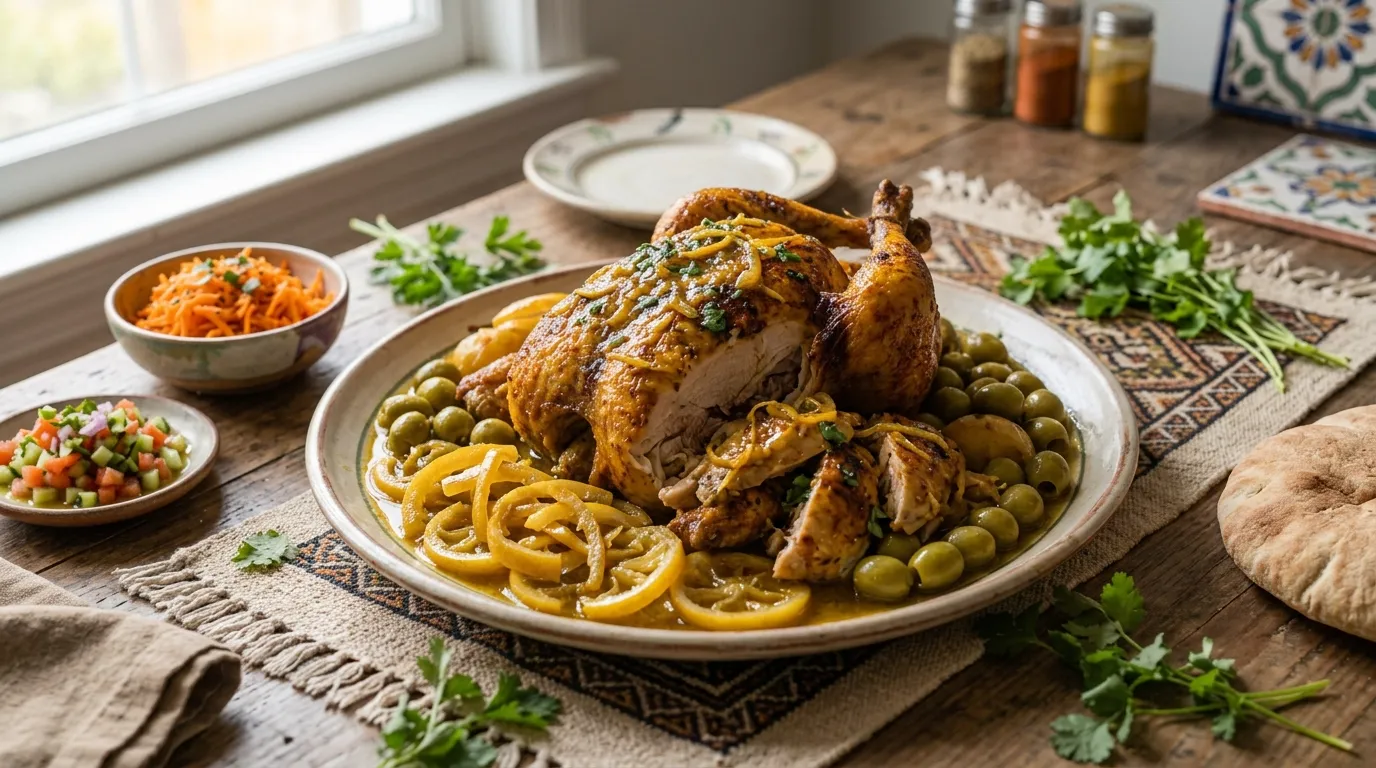
Moroccan bread (khobz) is the most natural pairing — a round, slightly chewy loaf built for tearing off pieces and scooping up sauce. Couscous works well too, since it soaks up the pan sauce without competing with the chicken’s flavor; if you want to go deeper on that side of the meal, our Moroccan Couscous recipe covers the traditional technique in detail.
A shredded carrot salad with cumin and a little lemon juice offers a cool, faintly sweet contrast to the warm spices and salt in the chicken. A simple tomato-and-cucumber salad does something similar with fresher, more acidic notes. A light green salad dressed simply in olive oil and lemon rounds out the plate without competing for attention. Avoid heavy, cream-based sides — the chicken and its sauce are already rich enough that the rest of the meal should stay light and bright.
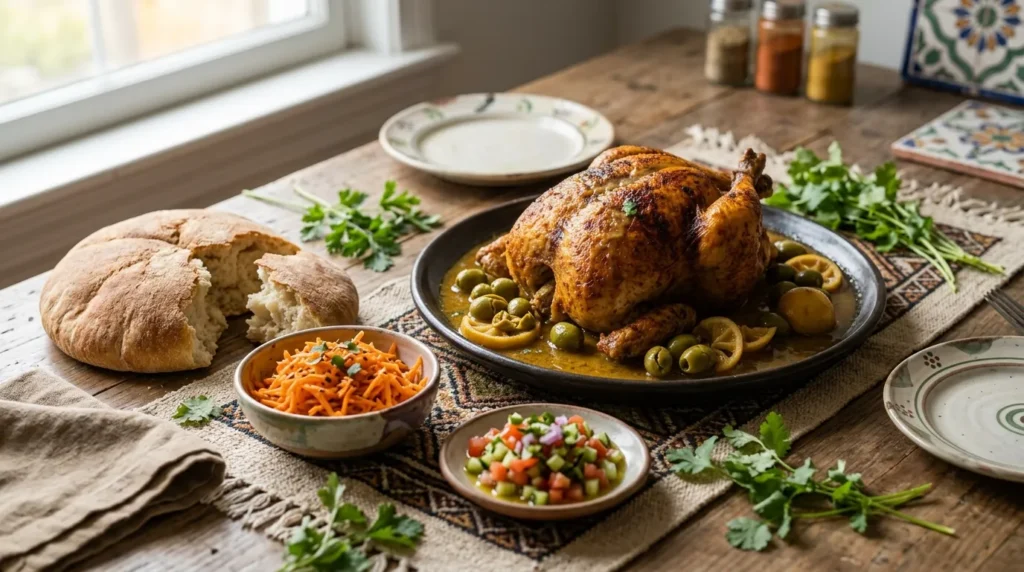
IMAGE PROMPT: A rustic dinner table scene from a slightly elevated angle showing carved pieces of Moroccan roasted chicken arranged on a serving platter with sauce, green olives, and preserved lemon, alongside a round loaf of Moroccan bread torn open, a small bowl of shredded carrot salad, and a simple tomato-cucumber salad in a side dish. Fresh cilantro scattered across the table. Warm natural daylight from a side window, a woven textile runner beneath the dishes, mismatched ceramic plates suggesting a lived-in home kitchen rather than a staged studio. Shallow depth of field with the chicken platter in the sharpest focus and the side dishes softly rendered in the foreground and background. Realistic food styling and natural table clutter (a stray herb sprig, a folded napkin). Editorial lifestyle food photography, no people, no text, no logos, no watermarks. 16:9 aspect ratio, 1344 x 768 px.
FILENAME: moroccan-chicken-served-with-bread-salad.jpg
ALT TEXT: Carved Moroccan roasted chicken served with bread, carrot salad, and tomato-cucumber salad
IMAGE TITLE: Serving Moroccan Roasted Chicken with Traditional Sides
CAPTION: Carved chicken with sauce, olives, and preserved lemon, served alongside bread and light Moroccan salads.
IMAGE DESCRIPTION: A table spread showing carved Moroccan roasted chicken with sauce, next to Moroccan bread, carrot salad, and tomato-cucumber salad.
Moroccan Chicken Variations
- Chicken quarters instead of whole chicken: Use the same marinade on bone-in, skin-on leg quarters and breasts; roast at 425°F for about 40–50 minutes, checking each piece individually since breasts finish faster than thighs.
- Spatchcocked version: Remove the backbone and press the chicken flat before marinating; it roasts faster and more evenly, at the cost of the traditional whole-bird presentation.
- Extra saffron: If you want a more pronounced golden color and floral aroma, double the saffron — it’s the one ingredient here where more genuinely changes the character of the dish rather than just intensifying salt.
- With olives only, no preserved lemon: If preserved lemon isn’t available and you’d rather skip the substitute, olives alone still bring real flavor, though the dish will taste noticeably less complex.
- Mixed olives: A combination of green and kalamata olives isn’t traditional, but it’s a reasonable variation if that’s what’s on hand — kalamata’s stronger flavor means using less than you would of green olives alone.
Frequently Asked Questions
What is Moroccan roasted chicken with olives? It’s a whole chicken seasoned with a Moroccan herb-and-spice marinade of cilantro, parsley, garlic, ginger, turmeric, and preserved lemon, then oven-roasted and finished with green olives and preserved lemon in a reduced pan sauce.
Is Moroccan chicken with olives the same as chicken mqualli? Not exactly. Djaj mqualli is the traditional braised version, cooked in a tagine or Dutch oven. This recipe uses the same core flavors — preserved lemon, olives, ginger, turmeric — but roasts the chicken in the oven instead of braising it, which produces crisp skin rather than the soft, stewed texture of a traditional tagine.
What is preserved lemon? A whole lemon cured in salt for several weeks until the rind softens and turns tangy, salty, and slightly fermented. It’s distinct from fresh lemon in both texture and flavor.
Can I use fresh lemon instead of preserved lemon? You can, using lemon zest, a little juice, and extra salt as a substitute, but it will taste noticeably different — brighter and more acidic, without preserved lemon’s fermented depth.
What olives are best for Moroccan chicken? Green olives — Moroccan green olives or standard brined green olives — are the traditional choice. Pitted or unpitted both work; unpitted olives generally hold their texture and flavor slightly better.
How do you make Moroccan roast chicken? Marinate a whole chicken under and over the skin with a cilantro, parsley, garlic, ginger, turmeric, and preserved lemon paste, roast at 425°F for 20 minutes, then at 375°F until the thigh reaches 165°F, adding olives and preserved lemon to the pan near the end.
What spices are used in Moroccan chicken? Turmeric, ginger, black pepper, and often a small amount of saffron are the core spices in the preserved lemon-and-olive style of Moroccan chicken.
Can I use chicken thighs instead of a whole chicken? Yes. Bone-in, skin-on thighs work well with this same marinade and roasting method; reduce the cooking time to roughly 35–45 minutes and check for 165°F internally.
How do I get crispy skin on Moroccan roast chicken? Dry the skin thoroughly before roasting, start at a high oven temperature to jump-start browning, avoid crowding the pan, and don’t over-baste, since repeated basting re-wets the skin.
Why is my chicken dry? It’s almost always overcooking. Use a food thermometer and pull the chicken at 165°F in the thigh rather than relying on cooking time alone.
Why is my olive sauce too salty? Preserved lemon and olives both carry significant salt on their own. Add little to no additional salt to the marinade or pan, and taste the finished sauce before seasoning further.
Can I make Moroccan chicken without saffron? Yes. Saffron adds color and a floral note, but the dish is still complete and flavorful without it — turmeric and ginger carry most of the flavor load.
Can I make this recipe in a tagine? This particular roasting method is built for an oven and roasting pan. If you want a true tagine-cooked version with these same flavors, our Chicken Tagine recipe is written specifically for that braising method.
What should I serve with Moroccan chicken and olives? Moroccan bread, couscous, a shredded carrot salad, or a light tomato-and-cucumber salad all pair well without overwhelming the chicken.
Can Moroccan chicken with olives be made ahead? The marinade can be made a day ahead and refrigerated. The chicken itself is best roasted fresh, though leftovers reheat well within a few days.
Can I freeze Moroccan chicken? Yes. Cool it completely, then freeze the meat and sauce together in an airtight container for up to 3 months; thaw in the refrigerator before reheating.
How long does Moroccan chicken keep in the refrigerator? Properly refrigerated within two hours of cooking, it keeps for 3–4 days.
Final Thoughts
The flavor in this dish comes from restraint as much as from any single ingredient — a short spice list, preserved lemon and olives added late instead of early, and a marinade worked under the skin instead of piled on top of it. Roasting instead of braising changes the texture you end up with, not the reason the dish tastes like it does. Once the skin is crisp and the sauce is reduced to something you’d actually want to spoon over the meat, the rest of the meal is just bread, something bright on the side, and people at the table.
Recipe Card
Moroccan Roasted Chicken with Olives
An oven-roasted whole chicken carrying the classic Moroccan combination of preserved lemon, green olives, garlic, ginger, and fresh herbs, finished with a reduced pan sauce.
- Prep Time: 25 minutes (plus optional 1–8 hour skin-drying rest)
- Cook Time: 1 hour 30 minutes
- Rest Time: 15 minutes
- Total Time: About 2 hours 10 minutes (active)
- Yield: 4–6 servings
- Category: Main Dish
- Cuisine: Moroccan-inspired
- Method: Roasting
Ingredients
For the chicken:
- 1 whole chicken, 4½–5½ lbs, patted dry
- 2 tablespoons kosher salt
- 1 lemon, halved
- 1 small onion, quartered
- A few sprigs cilantro and parsley
For the marinade:
- ½ cup fresh cilantro, chopped
- ¼ cup fresh flat-leaf parsley, chopped
- 5 garlic cloves
- 1 tablespoon fresh ginger, grated
- ⅓ cup extra virgin olive oil
- 1 preserved lemon, pulp removed, rind chopped
- 1 teaspoon ground turmeric
- ½ teaspoon black pepper
- Pinch of saffron, steeped in 1 tablespoon warm water (optional)
- 1 teaspoon kosher salt
For the pan and sauce:
- 1 large onion, sliced into rounds
- 4 garlic cloves, smashed
- ½ cup low-sodium chicken stock or water
- 1 cup green olives
- Rind of 1 additional preserved lemon, sliced
- 2 tablespoons chopped fresh cilantro and parsley
Instructions
- Blend the marinade ingredients into a coarse paste.
- Pat the chicken dry, season the cavity, and stuff with lemon, onion, and herb sprigs.
- Loosen the skin and rub two-thirds of the marinade underneath; rub the rest over the exterior. Salt the outside. Rest, uncovered, in the fridge for up to 8 hours if time allows.
- Heat oven to 425°F. Scatter the sliced onion and smashed garlic in a roasting pan, add stock, and set the chicken on top.
- Roast 20 minutes at 425°F, then reduce to 375°F and roast 55–70 minutes more, until the thigh reads 165°F.
- Add olives and preserved lemon rind to the pan juices during the last 15 minutes of roasting.
- Rest the chicken 15 minutes. Reduce the pan juices on the stovetop for 5–8 minutes until they coat a spoon.
- Carve, sauce, and finish with chopped fresh herbs.
Notes: Preserved lemon and olives both carry salt — taste the sauce before adding more. Pull the chicken at 165°F, not by clock time alone.
Storage: Refrigerate within 2 hours of cooking; use within 3–4 days.
Freezing: Freeze cooled chicken and sauce together for up to 3 months; thaw in the refrigerator.