Moroccan Lamb Tagine with Prunes: 12 Tips for Tender Lamb
Moroccan Lamb Tagine with Prunes
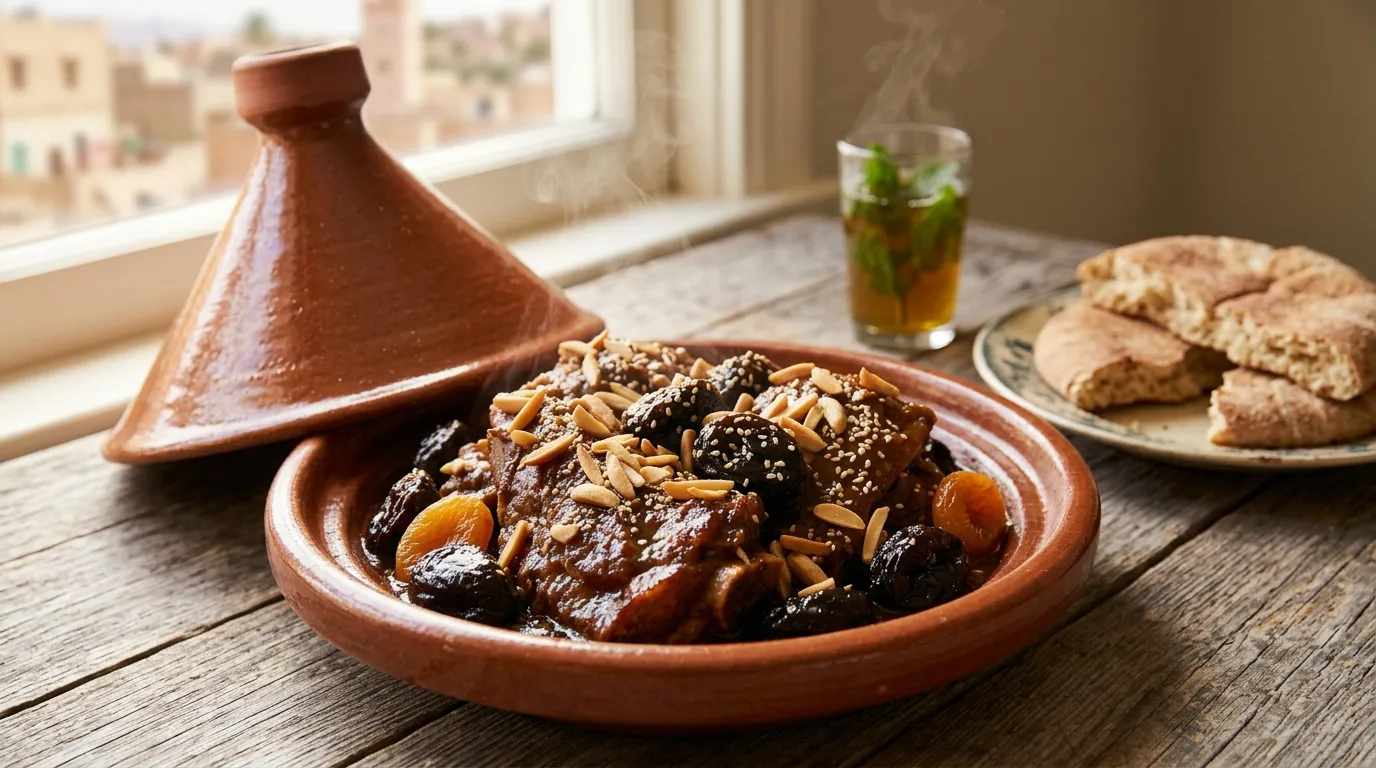
Lamb shoulder braised until it gives way at the touch of a fork, a sauce reduced down to something glossy and dark, prunes that have gone soft and sweet without turning to mush, a scattering of toasted almonds and sesame seeds on top — that’s what a good Moroccan lamb tagine with prunes looks like when it comes off the stove. It isn’t a sweet dish, and it isn’t a plain braise either. It sits in between, and getting that balance right is the whole point of this recipe.
Table of Contents
What Is Moroccan Lamb Tagine with Prunes?
Moroccan lamb tagine with prunes — sometimes called mrouzia-style tagine in its richer, spiced form — is a slow-braised lamb dish built on an onion and spice base, simmered until the meat is fork-tender, then finished with prunes that have been softened and glazed in the same aromatic liquid. Cinnamon, ginger, and saffron carry the dish; toasted almonds and sesame seeds go on at the very end for crunch and a bit of nuttiness.
It belongs to a broad family of Moroccan tagines that pair meat with dried fruit — apricots, quince, and dates show up in similar preparations depending on the region and the household. The prune version is one of the most widely made, and it’s the one most home cooks in Morocco and abroad reach for when they want a dish that reads as celebratory without being complicated to execute.
What Makes This Moroccan Tagine Special?
The lamb, prunes, cinnamon, ginger, saffron, onion, and a little honey or sugar work together to build a savory-sweet sauce that’s distinct from either a plain stew or a dessert. The sweetness is there to round out the spice and the richness of the lamb — it should never make the dish taste like a fruit compote with meat in it.
A finished sauce should be:
- Concentrated, not thin
- Glossy, with visible sheen from the reduced fat and juices
- Aromatic from the spices, not dominated by any single one
- Savory first, with a gentle sweetness underneath
- Deeply colored from the cinnamon, saffron, and reduced onions
If your sauce tastes more like stewed fruit than braised lamb, something in the balance has gone wrong — usually too much sugar added too early, or not enough reduction time.

The Moroccan Tradition Behind Lamb and Prunes
Moroccan cuisine draws on a long mix of influences — Amazigh (Berber) cooking traditions, Arab-Andalusian techniques brought over centuries of exchange across the Mediterranean, and contributions from Moroccan Jewish households, among others. Pairing meat with dried fruit and warm spice is a thread that runs through several of these traditions, and it shows up across many North African and eastern Mediterranean kitchens in different forms.
Within Morocco, tagines built on meat and dried fruit — lamb with prunes, chicken with apricots, beef with quince — are strongly associated with festive cooking: family gatherings, religious holidays, and special-occasion meals. That doesn’t mean they’re reserved only for those days; plenty of households make a version of this dish on an ordinary weekend. But the richness of the sauce and the use of dried fruit and toasted nuts do tend to signal something a little more special than a weeknight dinner.
It’s worth being honest about the history here: there isn’t a single documented origin story for lamb and prune tagine, and regional and family variations are the norm rather than the exception. Some cooks lean sweeter, some barely add sugar at all and let the prunes and onions provide all the sweetness; some finish with sesame seeds, others skip them entirely. None of these is more “correct” than another — they’re regional and family preferences that have developed over generations.
Choosing the Best Lamb for Tagine
This dish depends on a cut with enough fat and connective tissue to survive a long braise. Lean cuts dry out; tougher, well-marbled cuts turn tender and give the sauce body.
Bone-in lamb shoulder is the best all-around choice. The bone adds flavor to the braising liquid, and the shoulder’s collagen breaks down slowly into gelatin, which is what gives the finished sauce its slight body and richness.
Lamb shank works well too, especially if you want individual portions with a dramatic presentation. Shanks need roughly the same cooking time as shoulder pieces.
Lamb neck, where available, is another traditional option — it’s inexpensive, well-marbled, and holds up to long cooking.
Boneless shoulder is the practical substitute when bone-in isn’t available. You’ll lose a little depth in the sauce, but it’s a fair trade-off for convenience, and you can compensate by using a well-flavored stock instead of water.
Whatever cut you choose, look for visible marbling and don’t trim away all the fat before cooking — it renders down and becomes part of what makes the sauce rich rather than watery.
Why Prunes Work So Well With Lamb
Prunes bring a concentrated, wine-like sweetness and a soft, jammy texture that holds together during a long braise better than fresh fruit would. As they cook, their sugars start to caramelize slightly in the reduced sauce, and they take on the spices around them — cinnamon and ginger in particular cling well to their texture.
The technique matters more than people expect. There’s a real difference between:
- Soaking prunes in warm water or tea before cooking, which softens them and can round out any excess tartness
- Simmering prunes directly in the braising liquid, which lets them absorb the meat’s flavor but risks breaking them down if left too long
- Glazing prunes separately in a small amount of the cooking liquid with a touch of honey or sugar, which is how you get that dark, glossy finish without turning them to mush
Most home versions of this dish simmer the prunes in the sauce for the final 20 to 30 minutes of cooking, then reduce a portion of the liquid separately with the prunes at the end to build the glaze. Adding them too early, especially into a hard simmer, is the most common reason prunes fall apart before the lamb is even tender.
The Spices and Aromatics You’ll Need
This tagine doesn’t need a long spice list to taste authentic — a handful of well-used aromatics does more than a dozen thrown in without direction.
Ginger gives the dish its warm backbone; it’s present in nearly every version of this tagine and works alongside the cinnamon without competing with it.
Saffron should be used for its floral, earthy complexity, not as a dominant flavor. A small pinch bloomed in a spoonful of warm water or broth is enough to color and perfume the whole pot.
Cinnamon is the bridge between the lamb and the prunes — it belongs in the braising liquid and often gets a final dusting at serving time as well.
Black pepper adds background heat and depth without turning the dish spicy.
Turmeric, where used, contributes color and a subtle earthiness, though many home cooks rely on saffron alone for both color and aroma.
Resist the urge to add every spice in your cabinet. A tagine built around ginger, cinnamon, saffron, and black pepper — used with a light hand — tastes more authentically Moroccan than one loaded with a dozen competing spices.
Do You Need a Traditional Tagine Pot?
Not to make this dish well, but it’s worth understanding what the vessel actually does.
A traditional Moroccan tagine is a wide, shallow clay or ceramic base with a tall, conical lid. As the dish cooks, steam rises, condenses against the cool inner surface of the cone, and drips back down onto the food — a slow, self-basting cycle that keeps the meat moist over hours of low, gentle heat.
If you don’t own one, a heavy Dutch oven with a tight-fitting lid is the closest practical substitute. It won’t replicate the exact moisture cycle of a conical lid, but it holds heat evenly and keeps enough moisture in the pot to braise lamb properly. The main difference you’ll notice is that a Dutch oven traps slightly more liquid, so you may need a few extra minutes of uncovered reduction at the end to get the sauce to the right consistency.
One practical warning: unglazed or traditional ceramic tagines are often not built for the direct high heat of a modern stovetop burner and can crack if heated too quickly or too aggressively. If you’re using a ceramic tagine on the stove, start on the lowest heat setting and increase gradually, or use a heat diffuser. Many home cooks use the tagine only for serving and do the actual cooking in a Dutch oven or heavy pot — that’s a completely reasonable approach.
Ingredients You’ll Need
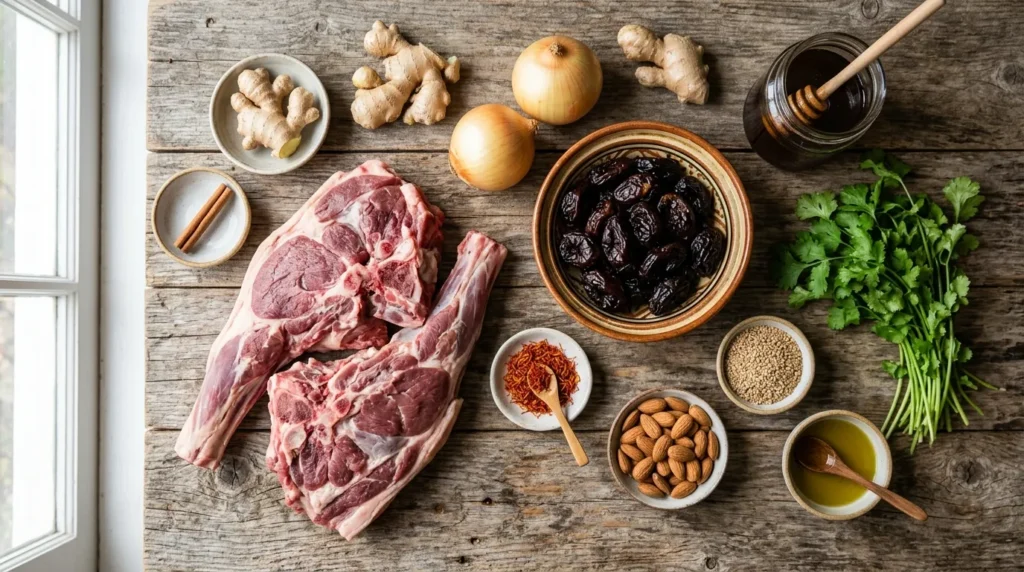
- 3 lb (1.4 kg) bone-in lamb shoulder, cut into large pieces
- 2 large yellow onions, grated or very finely chopped
- 3 tablespoons olive oil
- 2 tablespoons butter (or smen, if you have it)
- 4 garlic cloves, minced
- 1 tablespoon fresh ginger, grated (or 2 teaspoons ground ginger)
- 1 teaspoon ground cinnamon, plus more for finishing
- 1/2 teaspoon ground black pepper
- Large pinch of saffron threads, bloomed in 2 tablespoons warm water
- 2 cups (475 ml) water or lamb/chicken stock
- 1 1/2 cups (about 8 oz / 225 g) pitted prunes
- 2 tablespoons honey
- 1/3 cup (about 45 g) whole almonds, toasted
- 2 tablespoons sesame seeds, toasted
- Salt, to taste
- Fresh cilantro or parsley, for garnish (optional)
How to Make Moroccan Lamb Tagine with Prunes
1. Prepare the Lamb
Pat the lamb pieces dry and season generously with salt and black pepper. Drying the surface first helps it brown rather than steam when it hits the pot.
2. Build the Moroccan Aromatic Base
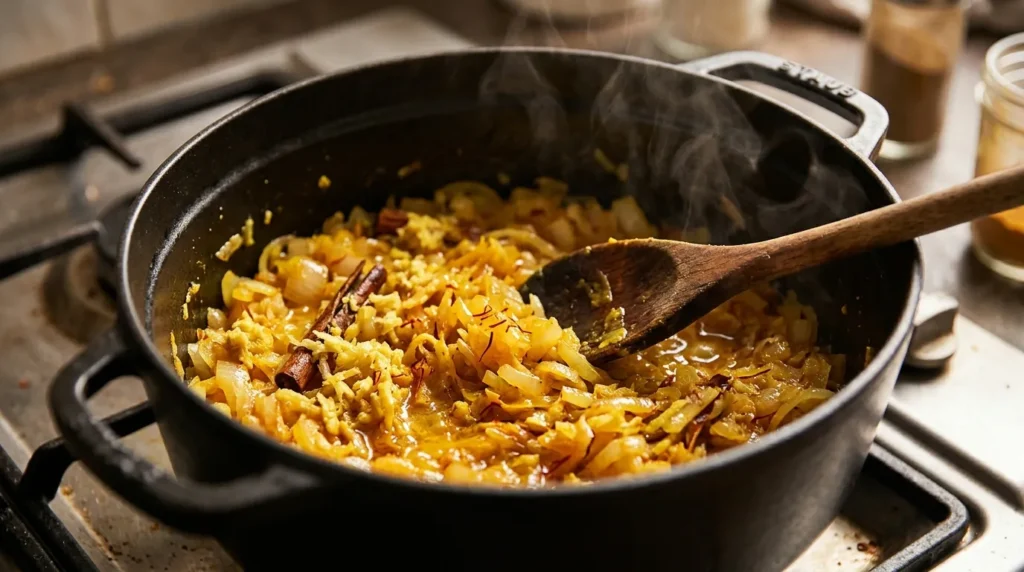
Warm the olive oil and butter in a heavy pot or Dutch oven over medium heat. Add the grated onion, garlic, ginger, cinnamon, and bloomed saffron. Cook gently, stirring often, for 8 to 10 minutes, until the onion has softened and turned translucent and the kitchen smells distinctly of the spices rather than raw onion. This base is what carries the flavor through the entire dish, so don’t rush it.
3. Add the Lamb and Begin Slow Cooking
Nestle the lamb pieces into the pot along with the water or stock. The liquid should come about halfway up the meat, not fully submerge it — a tagine reduces as it cooks, so starting with too much liquid just means more time reducing later. Bring to a gentle simmer, then cover and lower the heat so the pot barely bubbles. Cook for 1 1/2 to 2 hours, checking occasionally and adding a splash of water if the pot looks dry. The lamb is ready for the next step when it’s tender enough to pull apart easily with a fork but still holding its shape.
4. Prepare the Prunes
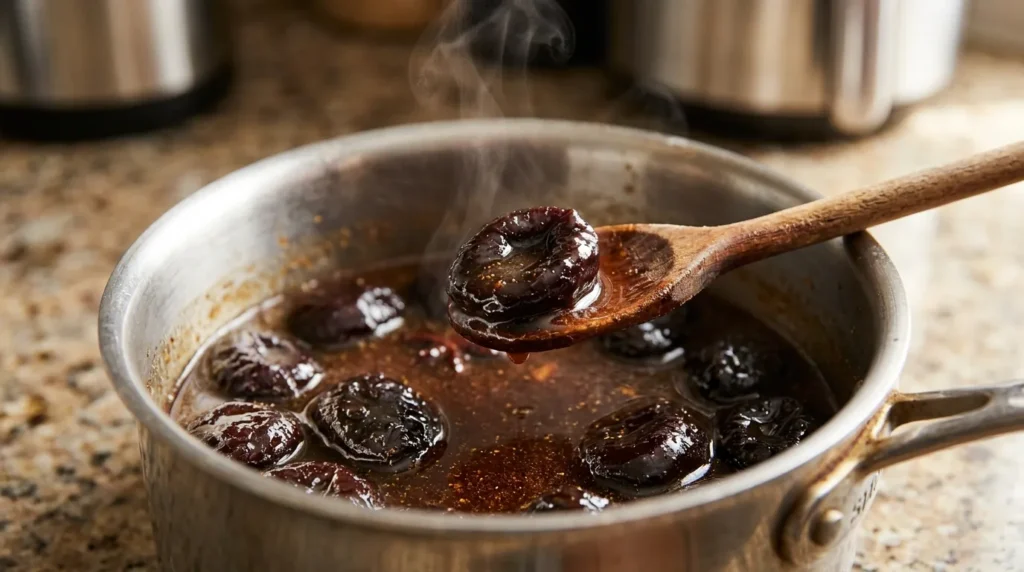
While the lamb cooks, place the prunes in a small saucepan with about 1/2 cup of the braising liquid (spoon some out partway through cooking) and the honey. Simmer gently for 10 to 15 minutes, until the prunes are soft and the liquid has reduced into a light syrup that coats them. Set aside.
5. Finish the Tagine
Once the lamb is tender, uncover the pot and raise the heat slightly. Let the sauce reduce, stirring occasionally, until it thickens and clings lightly to the meat rather than pooling like broth. This usually takes 15 to 25 minutes depending on how much liquid remains. Taste and adjust salt, cinnamon, or a touch more honey if the balance needs it.
6. Add the Almonds and Garnishes
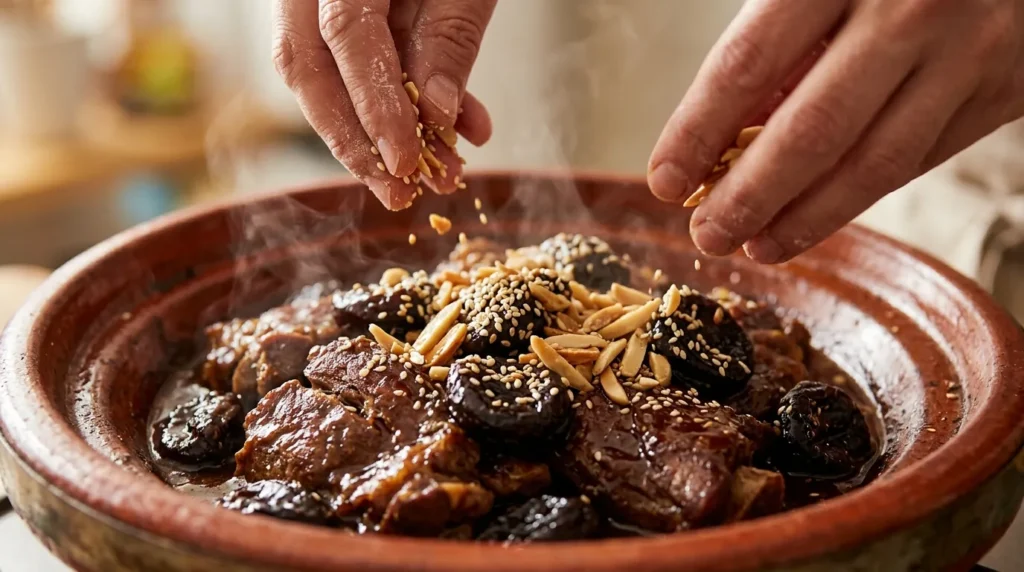
Gently fold the glazed prunes into the pot, or arrange them over the top of the lamb — either works. Scatter the toasted almonds and sesame seeds over the tagine just before serving so they stay crisp rather than softening in the sauce.
7. Rest and Serve
Let the tagine rest, covered, for 5 to 10 minutes off the heat before serving. This gives the sauce a moment to settle and the flavors to come together. Serve directly from the pot if you’re using a traditional tagine dish, or transfer to a warmed serving platter.
Chef’s Tips for a Better Lamb Tagine
- Grate the onion instead of chopping it finely — it breaks down faster and disappears into the sauce, which is what you want here rather than visible onion pieces.
- Bloom saffron in warm liquid for at least 10 minutes before adding it; dry saffron threads dropped straight into the pot give up much less color and aroma.
- Don’t salt the prunes’ glazing liquid — the sweetness and the meat’s seasoning should stay in separate lanes until they meet in the final pot.
- If your sauce isn’t reducing fast enough, remove the lamb pieces temporarily and reduce the liquid alone over higher heat, then return the meat to warm through.
- Toast almonds and sesame seeds in a dry skillet over medium-low heat, shaking often — they go from golden to burnt quickly once they start to color.
Common Mistakes and How to Fix Them
Tough lamb. Usually means the pot was simmered too hard or not cooked long enough. Keep the heat low enough that the liquid barely bubbles, and give the meat the full 1 1/2 to 2 hours it needs — shoulder and shank don’t shortcut well.
Dry lamb. Almost always caused by using a lean cut, or overcooking it dry once the sauce has reduced too far before the meat is tender. Keep enough liquid in the pot until the lamb itself is fork-tender, and add water as needed during the covered simmer.
Watery sauce. The pot wasn’t given time to reduce uncovered at the end. Remove the lid for the last 15 to 25 minutes and let the liquid actually cook down.
Burned spices. Ground spices scorch fast in hot oil. Add them with the onions, not directly into empty hot oil, and keep the heat moderate during that first stage.
Bitter sauce. Often from scorched onions or burnt spices at the base of the pot. Stir the aromatic base frequently in step 2 and don’t let it catch on the bottom.
Prunes falling apart. They were added too early or simmered too hard in the main pot. Glaze them separately, as described above, and add them near the end.
Tagine too sweet. Too much honey or sugar added too early, before you could taste how the reduction concentrated it. Add sweetener gradually and taste again after the final reduction.
Lamb lacks flavor. The aromatic base wasn’t cooked long enough, or the lamb wasn’t seasoned before browning. Give the onion-spice base its full 8 to 10 minutes and season the meat directly, not just the liquid.
Sauce lacks concentration. Too much liquid was added at the start. Start with the water or stock coming only halfway up the meat — you can always add more, but you can’t easily remove it without also removing flavor.
Ceramic tagine cracking. Caused by direct high heat or rapid temperature changes. Use low heat, a heat diffuser, or reserve the ceramic tagine for serving only.
Almonds burning. They’re toasted too long or over heat that’s too high. Toast in a dry pan on medium-low and remove them from the hot pan the moment they color, since residual heat keeps cooking them.
Sauce becoming greasy. Too much fat wasn’t skimmed from a very fatty cut. Spoon off excess fat from the surface once the lamb is tender, before the final reduction.
How to Store and Reheat Lamb Tagine
Let the tagine cool before refrigerating, and get it into the refrigerator within two hours of cooking. Store it in a shallow, airtight container — this helps it cool faster and more evenly, which matters for food safety. According to the USDA’s Food Safety and Inspection Service guidance on lamb, cooked lamb dishes should be refrigerated within two hours and reheated to an internal temperature of 165°F, or until hot and steaming throughout, before serving again.
Refrigerated tagine keeps well for three to four days. Reheat gently on the stovetop over low heat with a splash of water or stock to loosen the sauce, stirring occasionally so it heats evenly rather than scorching on the bottom. Many cooks find the flavor is actually better the next day, once the spices have had time to settle into the sauce.
Can You Freeze Moroccan Lamb Tagine?
Yes. Lamb tagine freezes well because the long braise and reduced sauce hold up better than most stews to the texture changes freezing can cause. Cool the tagine completely, then transfer it to an airtight, freezer-safe container, leaving a little headroom for expansion. According to USDA guidance, cooked lamb dishes keep well in the freezer, though quality is best within a few months rather than indefinitely.
Thaw overnight in the refrigerator rather than at room temperature, then reheat gently on the stovetop as described above. If the sauce looks slightly separated after thawing, a few minutes of gentle simmering while stirring will usually bring it back together.
What to Serve With Moroccan Lamb Tagine
Moroccan bread, or khobz, is the traditional accompaniment, and it’s genuinely useful here — torn pieces are made for scooping up the concentrated sauce, which is too good to leave behind on the plate. If you’d rather serve it over a grain, a simple Moroccan couscous works well and gives the sauce somewhere to soak in without adding much competing flavor.
On the side, keep things light: a citrus and olive salad, a simple cooked carrot or zucchini dish, or a plate of raw vegetables cuts through the richness of the sauce without fighting it. Moroccan mint tea at the end of the meal is traditional and genuinely fits the occasion this dish tends to mark.
Avoid pairing it with anything heavy or overly rich — a second braised or fatty dish will just compete with the tagine’s own richness rather than complementing it.

Moroccan Lamb Tagine Variations
Families and regions vary this dish in small but meaningful ways. Some versions lean toward the richer, more heavily spiced style known as mrouzia, which can include more honey and a broader spice mix and is traditionally associated with certain holiday meals. Others keep the sauce lighter and let the onions provide most of the sweetness, with only a touch of honey at the end.
Dried apricots or a mix of dried fruit sometimes stand in for or join the prunes. Some households add a small amount of orange blossom water at the very end for aroma, though this is a personal touch rather than a requirement. None of these variations makes a version more or less authentic — they reflect the range of home cooking across Moroccan households rather than a single fixed recipe.
If you’re also interested in other slow-cooked Moroccan dishes, our Moroccan chicken tagine uses a similar braising technique with a lighter, brighter flavor profile, and our Moroccan lamb meatballs (kefta) is a good next dish if you want to keep cooking with lamb and Moroccan spices. You can find more dishes like these in our full collection of Moroccan recipes.
Frequently Asked Questions
What is Moroccan lamb tagine with prunes? It’s a slow-braised lamb dish cooked with onions, ginger, cinnamon, and saffron, finished with prunes glazed until soft and glossy, and topped with toasted almonds and sesame seeds.
What cut of lamb is best for tagine? Bone-in lamb shoulder is the most reliable choice. Shank and neck also work well; all three have enough fat and connective tissue to become tender during a long braise.
Can I make lamb tagine without a tagine pot? Yes. A heavy Dutch oven with a tight-fitting lid works as a practical substitute and produces very similar results, though you may need a few extra minutes of uncovered reduction at the end.
What does Moroccan lamb tagine taste like? Savory and warmly spiced first, with a gentle sweetness from the prunes and honey underneath. It shouldn’t taste like a dessert with meat in it.
Why are prunes used in Moroccan tagine? Prunes hold their shape well during long cooking, take on the spices around them, and bring a concentrated sweetness that balances the richness of the lamb.
Are Moroccan lamb tagines sweet? They have a noticeable sweetness, but it’s meant to round out the spice and richness of the lamb rather than dominate the dish.
How do you make lamb tender in a tagine? Use a well-marbled cut like shoulder, keep the heat low enough that the liquid barely simmers, and give it the full cooking time — usually 1 1/2 to 2 hours — before checking for doneness.
Can I use lamb shoulder? Yes, it’s the best all-around cut for this dish, whether bone-in or boneless.
Can I use lamb shanks? Yes. Shanks work well and cook in roughly the same amount of time as shoulder pieces.
Can I make this tagine in a Dutch oven? Yes, a Dutch oven is a practical and widely used substitute for a traditional tagine pot.
How do you stop prunes from becoming mushy? Glaze them separately in a small amount of the braising liquid with honey, rather than simmering them for the full cooking time in the main pot.
What spices are used in Moroccan lamb tagine? Ginger, cinnamon, saffron, and black pepper form the core of the spice profile, sometimes with a touch of turmeric.
What should I serve with lamb tagine? Moroccan bread (khobz) is traditional for scooping up the sauce. Couscous, a light citrus salad, or simple cooked vegetables also work well as sides.
Can lamb tagine be made ahead? Yes, and many cooks prefer it — the flavor often improves after a day in the refrigerator as the spices settle into the sauce.
Can Moroccan lamb tagine be frozen? Yes. Cool it completely, store it in an airtight container, and thaw in the refrigerator before reheating gently on the stovetop.
Why is my tagine sauce watery? The pot likely needs more time uncovered at the end to reduce. Remove the lid for the final 15 to 25 minutes of cooking and let the liquid concentrate.
Is Moroccan lamb tagine gluten-free? The tagine itself is naturally gluten-free. If you’re serving it with bread, choose a gluten-free option, or serve it over rice or a gluten-free grain instead.
Final Thoughts
Moroccan lamb tagine with prunes rewards patience more than technique. Almost every real risk in this recipe — tough meat, a thin sauce, prunes that fall apart — comes down to rushing one of a few key steps: the aromatic base, the low simmer, or the final reduction. Give each of those the time it needs, and the dish does most of the work for you.
Recipe Card
Moroccan Lamb Tagine with Prunes
Slow-braised lamb shoulder in a spiced onion sauce, finished with glazed prunes, toasted almonds, and sesame seeds.
- Prep time: 25 minutes
- Cook time: 2 hours 15 minutes
- Total time: 2 hours 40 minutes
- Yield: 4–6 servings
- Category: Main course
- Cuisine: Moroccan
- Method: Braising
Ingredients
- 3 lb (1.4 kg) bone-in lamb shoulder, cut into large pieces
- 2 large yellow onions, grated
- 3 tbsp olive oil
- 2 tbsp butter
- 4 garlic cloves, minced
- 1 tbsp fresh ginger, grated
- 1 tsp ground cinnamon, plus more for finishing
- 1/2 tsp ground black pepper
- Large pinch saffron threads, bloomed in 2 tbsp warm water
- 2 cups (475 ml) water or stock
- 1 1/2 cups (8 oz / 225 g) pitted prunes
- 2 tbsp honey
- 1/3 cup (45 g) whole almonds, toasted
- 2 tbsp sesame seeds, toasted
- Salt, to taste
- Fresh cilantro or parsley, for garnish (optional)
Instructions
- Season the lamb generously with salt and pepper.
- Warm the oil and butter in a heavy pot over medium heat. Cook the onion, garlic, ginger, cinnamon, and bloomed saffron for 8–10 minutes, until fragrant and softened.
- Add the lamb and water/stock. Bring to a gentle simmer, cover, and cook on low heat for 1 1/2 to 2 hours, until the lamb is fork-tender.
- Meanwhile, simmer the prunes with 1/2 cup of the braising liquid and the honey for 10–15 minutes, until soft and glazed.
- Uncover the pot and reduce the sauce over slightly higher heat for 15–25 minutes, until glossy and thickened.
- Fold in the glazed prunes.
- Scatter toasted almonds and sesame seeds over the top just before serving.
- Rest 5–10 minutes, then serve warm.
Notes: Grating the onion rather than chopping it helps it melt into the sauce. Glazing the prunes separately keeps them from breaking apart in the main pot.
Storage: Refrigerate in an airtight container within 2 hours of cooking; keeps 3–4 days. Reheat gently on the stovetop to 165°F (74°C).
Freezing: Cool completely, store airtight, and freeze. Thaw in the refrigerator before reheating.