
Chicken Tagine Recipe: 7 Secrets to Authentic Moroccan Flavor
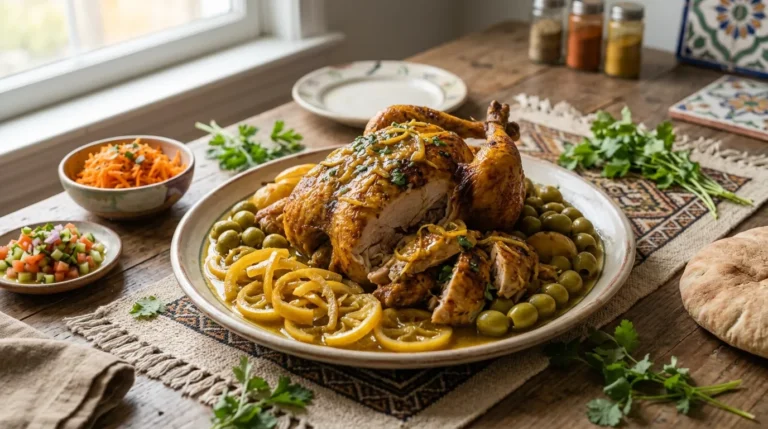
Chicken tagine is a slow-braised Moroccan chicken stew built on bone-in chicken, softened onions, warm spices, and the sharp, salty punch of preserved lemon and olives. It’s named for the clay pot it’s traditionally cooked in, but you don’t need that pot to make it well — a Dutch oven does the job just as effectively. This version leans on bone-in thighs, a proper spice bloom, and a slow simmer that pulls moisture out of the onions and turns it into sauce. You’ll come away knowing not just the steps, but why each one matters, so you can adjust the dish with confidence the next time you make it.
What Is Chicken Tagine?
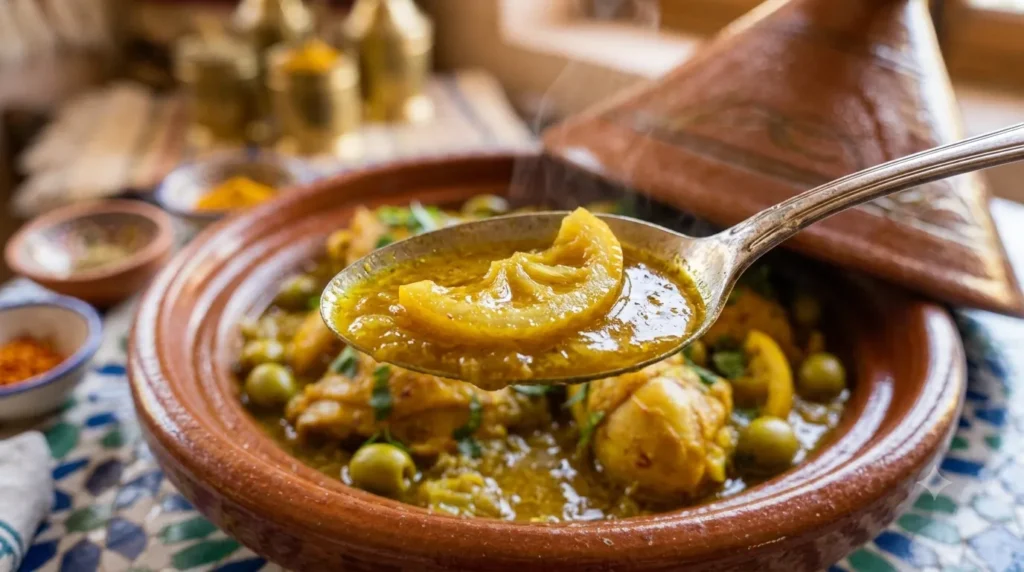
Chicken tagine is a Moroccan braise of bone-in chicken simmered slowly with onions, garlic, ginger, turmeric, and saffron, then finished with preserved lemon and olives. The conical lid of the traditional clay pot traps rising steam and returns it to the base, which keeps the chicken moist while concentrating the sauce. You can replicate the same effect in a heavy Dutch oven with a tight-fitting lid.
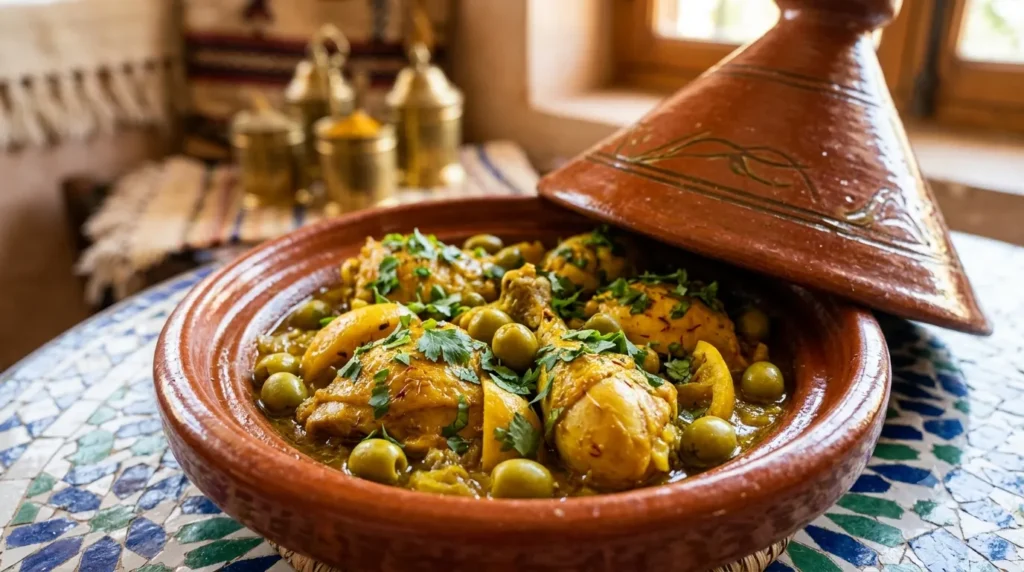
Table of Contents
The word “tagine” refers to both the earthenware cooking vessel — a shallow round base topped with a tall conical lid — and the dish cooked inside it. <cite index=”76-1″>The vessel and the stews cooked in it are a staple across Morocco, Tunisia, and Algeria</cite>. According to Britannica, <cite index=”76-2,76-3″>the design likely originated with nomadic Berbers who used it as a portable oven, and the shape is built specifically for low-temperature simmering that develops complex flavor while keeping moisture in</cite>. That’s the whole logic of the dish: gentle heat, a sealed environment, and time.
<cite index=”76-1,76-2″>Tagines are also grouped into a few recognized styles based on their fat and spicing</cite> — a yellow version built on olive oil, turmeric, saffron, and ginger; a reddish-brown version built on ghee, paprika, and cumin; and a version based on chermoula, the herb-and-lemon marinade. The recipe below follows the first style, which is the version most home cooks in Morocco associate with chicken.
The Moroccan Tradition Behind This Dish
Tagine cooking is home cooking. In Moroccan households, it’s an everyday method — not a special-occasion dish — built around whatever bone-in meat, vegetables, and pantry spices are on hand that week. Every family, and every region, adjusts the ratio of ginger to turmeric, how many olives go in, whether raisins or dried apricots show up, and how far the onions get cooked down. There’s no single “correct” chicken tagine any more than there’s a single correct chili or a single correct roast chicken — there’s a shared technique with a lot of room for a cook’s own hand.
What stays consistent is the reliance on preserved ingredients and slow cooking. Preserved lemon, cured olives, and dried spices were practical long before they were fashionable — they let a household build deep flavor without needing fresh produce every single day. Tagine is traditionally served communally, straight from the pot, with everyone at the table tearing off pieces of bread to scoop up the sauce. That’s also how couscous fits into the picture: it’s a separate, equally central part of Moroccan and broader Maghrebi food culture, recognized in 2020 when <cite index=”68-1″>UNESCO inscribed the knowledge, know-how, and practices behind producing and consuming couscous on its Representative List of the Intangible Cultural Heritage of Humanity</cite>, in a joint submission from Morocco, Algeria, Tunisia, and Mauritania. Many households serve tagine alongside couscous rather than on top of it, especially at larger gatherings.
Why This Recipe Works
Chef Tip: The sauce in a good chicken tagine isn’t thickened with flour or cream — it’s built from the onions themselves breaking down over low heat, plus rendered chicken fat and the natural gelatin released from bone-in pieces.
A few things are doing real work here:
- Gentle braising. Chicken simmered below a boil stays tender because the muscle fibers don’t seize up the way they do over high, dry heat.
- Bone-in collagen. Thighs and legs contain connective tissue that slowly converts to gelatin, which is what gives the sauce body without any added thickener.
- Fat-soluble spices. Turmeric, saffron, and ginger release more of their flavor compounds when they bloom in warm oil before any liquid is added — this is the same principle behind blooming spices in Indian or Middle Eastern cooking.
- Onion breakdown. A long, low simmer turns sliced onions into a soft, almost jammy base that thickens the sauce naturally.
- Preserved lemon timing. Added too early, its rind can turn bitter; added at the right point, it perfumes the sauce without dominating it.
Ingredients
(Serves 4–6)
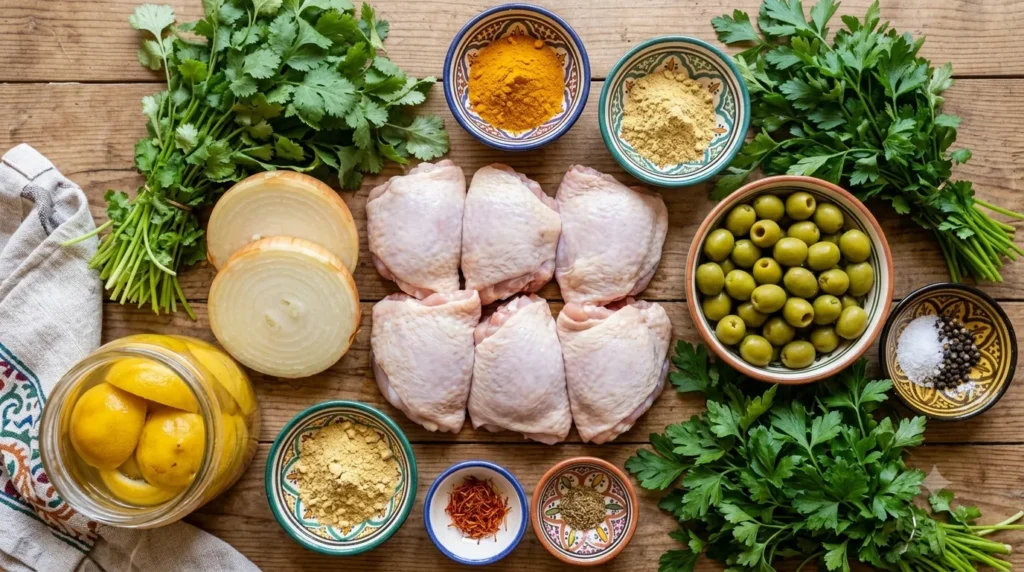
- Bone-in, skin-on chicken thighs and drumsticks (about 3 lbs): Dark meat holds up to a long braise far better than breast meat, which dries out. Buying advice: look for pieces with the skin intact, even though you’ll render some of it off — skin adds flavor to the browning stage.
- Onions (2 large, thinly sliced): The backbone of the sauce. Yellow onions are standard; white onions work as a substitute with a slightly sharper bite.
- Garlic (4–5 cloves, minced): Added after the onions have softened so it doesn’t scorch.
- Extra virgin olive oil (¼ cup): Used both for browning the chicken and for blooming the spices. A fruity, everyday olive oil is fine — save anything delicate for finishing.
- Fresh cilantro and flat-leaf parsley (1 bunch each, roughly chopped, stems and leaves separated): The stems go in early for backbone flavor; the leaves go in at the end for brightness.
- Ground ginger (1½ tsp): Warming, slightly sharp — one of the two spices that define the dish’s color and base flavor.
- Ground turmeric (1 tsp): Earthy and mildly bitter in large amounts, which is why it’s used in a supporting role here, not a starring one.
- Saffron threads (a generous pinch, about ¼ tsp): Optional but traditional in the yellow-style tagine. Steep it in a tablespoon of warm water for 10 minutes before adding, which draws out more color and aroma than adding the threads dry.
- Freshly ground black pepper (½ tsp): Adds a low, steady heat that ties the other spices together.
- Preserved lemon (1 whole, or the rind of 2): The defining sour note. See the dedicated section below for buying and substitution advice.
- Moroccan or green olives (1 cup, pitted or unpitted): Traditionally left unpitted for better texture and flavor, though pitted is easier to eat. Rinse briefly if they’re very salty.
- Salt, to taste: Go easy at first — preserved lemon and olives both bring significant salt on their own.
- Water or low-sodium chicken stock (1½–2 cups): Enough to come about a third of the way up the chicken; the tagine shape (or a lid) does the rest of the moisture retention.
Choosing the Best Chicken
| Chicken | Advantages | Disadvantages | Recommendation |
|---|---|---|---|
| Bone-in thighs | High collagen, stays moist over a long braise, rich flavor | Slightly more fat to skim | Best choice — the standard for tagine |
| Bone-in drumsticks | Same collagen benefits as thighs, good presentation | Less meat per piece | Great mixed in with thighs |
| Whole chicken, cut into pieces | Traditional, mix of light and dark meat | Breast pieces risk drying out before dark meat is done | Good if breast pieces are added later in cooking |
| Boneless thighs | Faster cooking, easier to eat | Less gelatin released, thinner sauce | Acceptable shortcut, not traditional |
| Chicken breast | Lean, cooks quickly | Dries out badly over a long braise; not suited to this method | Avoid for a true tagine |
Bone-in, skin-on dark meat is the standard for a reason: the connective tissue needs time and moisture to break down into gelatin, and only bone-in cuts have enough of it to noticeably thicken the sauce. If you only have boneless thighs, the dish will still taste good — it just won’t have quite the same body.
Preserved Lemon, Explained
Preserved lemon is a whole lemon packed in salt (sometimes with its own juice or a bit of water) and left to cure for several weeks, which softens the rind and turns it tangy, salty, and slightly floral rather than sharply sour like a fresh lemon. It’s not the same ingredient as fresh lemon zest or juice, and the two aren’t interchangeable in a tagine — fresh lemon brings acidity, but it doesn’t have the fermented depth that makes preserved lemon distinctive.
In most tagines, it’s the rind that gets used, thinly sliced or chopped, since it carries most of the flavor and has a pleasant, slightly chewy texture once it’s simmered. The pulp is often scraped out and either discarded or stirred into the sauce for extra salt and tang — home cooks vary on this, and either approach is fine.
Preserved lemon can be salty enough that it changes how much additional salt the dish needs, so taste before adding more. If you can’t find it, a reasonable (if imperfect) substitute is a mix of lemon zest, a splash of lemon juice, and an extra pinch of salt added near the end of cooking — it won’t replicate the fermented flavor, but it gets you closer than using nothing. This kind of salt-curing is a form of food preservation that predates refrigeration by centuries; the National Center for Home Food Preservation notes that <cite index=”59-1,59-6″>salt plays a role beyond flavor in these processes — it favors the growth of desirable microorganisms while inhibiting others</cite>, which is part of what makes preserved lemon safe to keep at room temperature or in the fridge for months.
The Moroccan Spices That Matter
This recipe keeps the spice list intentionally short, because a chicken tagine isn’t meant to taste like every Moroccan spice at once — it’s built around two or three that work together clearly.
- Ginger gives the dish its base warmth and a little sharpness that cuts through the richness of the chicken fat.
- Turmeric contributes color and a mild earthiness, but in excess it turns bitter, which is why it’s used at roughly half the quantity of ginger here.
- Black pepper rounds out the spicing with steady, low-grade heat rather than sharp spiciness.
- Saffron, when used, adds a floral note and a deeper golden color — it’s expensive, so it’s treated as an accent rather than a requirement.
Cumin and paprika show up in other tagine styles (the reddish-brown m’hammer version, for instance), but they’re left out here to keep this particular flavor profile clean and traditional to the preserved lemon-and-olive style.
The Secret to Deep Moroccan Flavor
Most of what separates a flat chicken tagine from a genuinely good one comes down to timing and technique rather than ingredients:
- Season the chicken directly, not just the sauce. Salt and a portion of the spice blend should go on the chicken itself before it’s browned, not only added to the liquid later.
- Brown the chicken properly. A hard sear isn’t necessary, but skipping browning entirely means skipping a real layer of flavor.
- Cook the onions low and slow. Rushed onions stay crunchy and never build the jammy base the sauce depends on.
- Bloom the spices in oil before adding liquid. This is the single most-skipped step, and it’s the one with the biggest payoff.
- Position the chicken skin-side up during the simmer. This keeps the skin from turning soggy in the liquid and lets the meat baste itself in rendered fat.
- Reduce the sauce at the end, uncovered. The last 10–15 minutes with the lid off is what concentrates the sauce instead of leaving it thin.
- Add preserved lemon in the back half of cooking. Early addition can make the rind taste bitter instead of bright.
- Add olives shortly before serving. They only need to warm through — extended simmering makes them taste flat.
- Finish with fresh herbs off the heat. Cooking cilantro and parsley for too long mutes their brightness.
If you like this kind of slow, low-heat approach to chicken, it’s the same underlying idea behind Coq au Vin — a different spice profile and a different braising liquid, but the same principle of building a sauce from the aromatics and the chicken itself rather than a separate thickener.
Tagine Pot vs. Dutch Oven
| Feature | Traditional Tagine | Dutch Oven |
|---|---|---|
| Heat distribution | Even, gentle — clay diffuses heat slowly | Very even with enameled cast iron, but heavier and faster to heat |
| Moisture retention | Conical lid actively recirculates steam back onto the food | Tight-fitting flat lid retains moisture well, though without the same recirculation |
| Cooking time | Similar to Dutch oven when used correctly | Similar; slightly faster searing due to better stovetop contact |
| Practical differences | Can crack with sudden temperature changes; many need a heat diffuser on gas or electric stovetops | Goes directly from stovetop to oven with no special handling |
| Safety considerations | Unglazed or poorly glazed clay tagines can pose a lead-exposure risk — buy from a reputable source and check it’s rated for cooking, not just serving | No special concerns beyond standard cookware care |
If you don’t own a tagine, a Dutch oven with a heavy lid will give you a very close result. Brown the chicken directly in the pot, build the sauce in the same vessel, then cover and simmer on the stovetop over low heat, or transfer to a 325°F oven if you’d rather not babysit the stovetop. If you do use a traditional clay tagine on a gas or electric burner, use a heat diffuser and bring the temperature up gradually — clay can crack under sudden heat.
Step-by-Step Instructions
1. Season and rest the chicken. What to do: Pat the chicken dry and season all sides with salt, black pepper, and about a third of the ginger and turmeric. Let it sit for 15–20 minutes at room temperature. Why it matters: Seasoning early lets salt penetrate past the surface instead of just sitting on the skin. Visual cue: The skin should look matte and dry, not wet, before it goes into the pot. Common mistake: Seasoning only right before cooking, which leaves the interior of the meat bland. Chef Tip: If you have time, salt the chicken up to a few hours ahead and leave it uncovered in the fridge — it dries the skin further, which helps browning.
2. Brown the chicken. What to do: Heat the olive oil in your tagine base or Dutch oven over medium-high heat. Brown the chicken in batches, skin-side down first, about 4–5 minutes per side, then remove. Why it matters: Browning builds a layer of savory compounds (via the Maillard reaction) that plain simmering can’t replicate. Visual cue: Skin should be a deep golden-brown, not pale, before you flip it. Common mistake: Crowding the pot, which steams the chicken instead of browning it. Chef Tip: Don’t clean the pot between batches — those browned bits become part of the sauce.
3. Soften the onions and bloom the spices. What to do: Lower the heat to medium, add the sliced onions and cilantro/parsley stems to the same pot, and cook, stirring occasionally, for 12–15 minutes until soft and translucent. Add garlic, remaining ginger and turmeric, and the saffron with its soaking water. Stir for 30–60 seconds until fragrant. Why it matters: This is where fat-soluble flavor compounds in the spices actually dissolve into the oil, rather than just floating in the liquid later. Visual cue: Onions should be soft and golden, not browned or crisp; spices should smell toasted, not scorched. Common mistake: Rushing the onions on high heat, which leaves them undercooked and thin-tasting. Chef Tip: If the spices start to stick or smoke, add a splash of water immediately to stop them from burning.
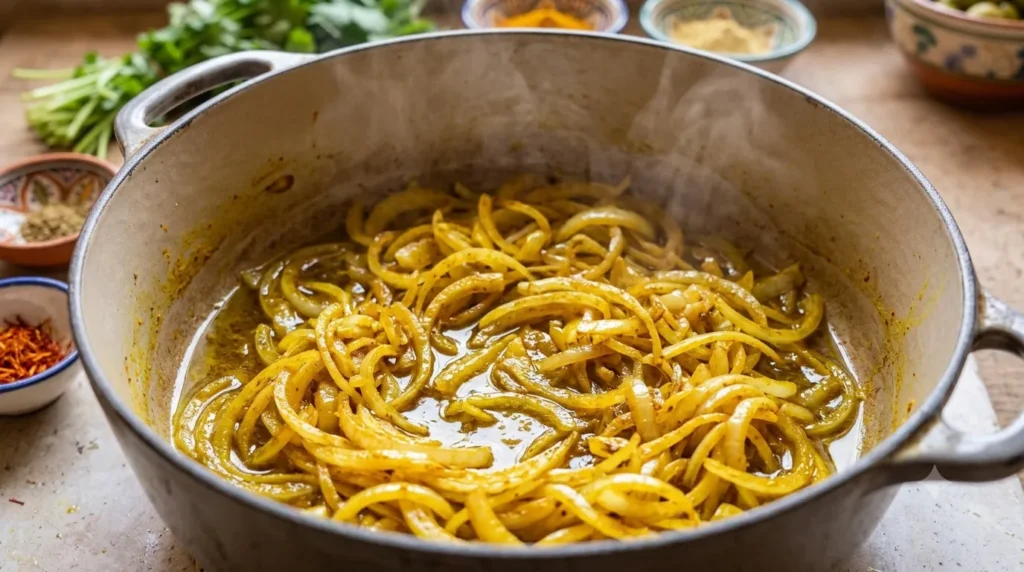
4. Return the chicken and add liquid. What to do: Nestle the browned chicken back into the pot, skin-side up. Add water or stock until it comes about a third of the way up the chicken pieces. Why it matters: You’re not trying to submerge the chicken — the goal is a braise, not a boil, so the top of the chicken stays out of the liquid and closer to steam heat. Visual cue: You should still see the top of the chicken skin above the liquid line. Common mistake: Adding too much liquid, which dilutes the sauce and prevents proper reduction later. Chef Tip: Tuck any loose onions around the chicken rather than on top of it, so the skin stays exposed.
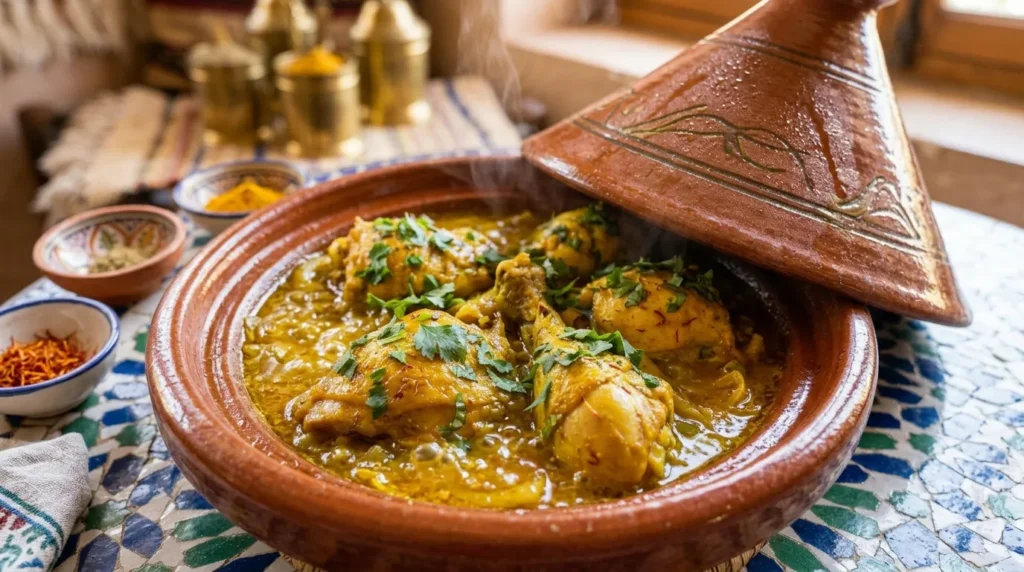
5. Simmer, covered, until tender. What to do: Bring to a gentle simmer, cover, and cook on low heat for 45–55 minutes, until the chicken is fork-tender and reaches a safe internal temperature. Why it matters: This is where collagen breaks down into gelatin and the meat becomes properly tender rather than just cooked through. Visual cue: The meat should pull away from the bone with light pressure from a fork. Common mistake: Simmering too hard, which toughens the muscle fibers even as the collagen breaks down. Chef Tip: Check the liquid level occasionally — if it’s reducing too fast, add a splash of water; if it’s not reducing at all, crack the lid slightly.
Poultry should reach a minimum internal temperature of 165°F, as measured with a food thermometer — the FoodSafety.gov safe minimum temperature chart is a reliable reference if you want to double-check doneness on any cut.
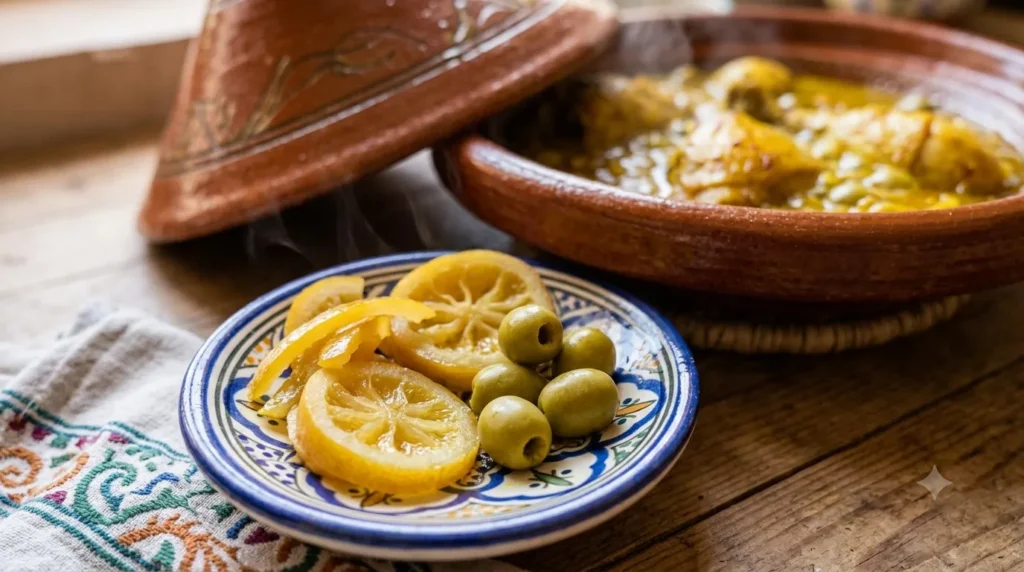
7. Finish and rest briefly. What to do: Stir in the chopped cilantro and parsley leaves, remove from heat, and let the tagine rest, covered, for 5 minutes before serving. Why it matters: Resting lets the sauce settle and the flavors even out; adding herbs off the heat keeps them bright rather than dull. Visual cue: The sauce should look glossy, not watery or separated. Common mistake: Serving immediately off high heat, before the sauce has had a chance to settle. Chef Tip: Reserve a small handful of herbs to scatter on top just before serving, for color and a fresher hit of flavor.
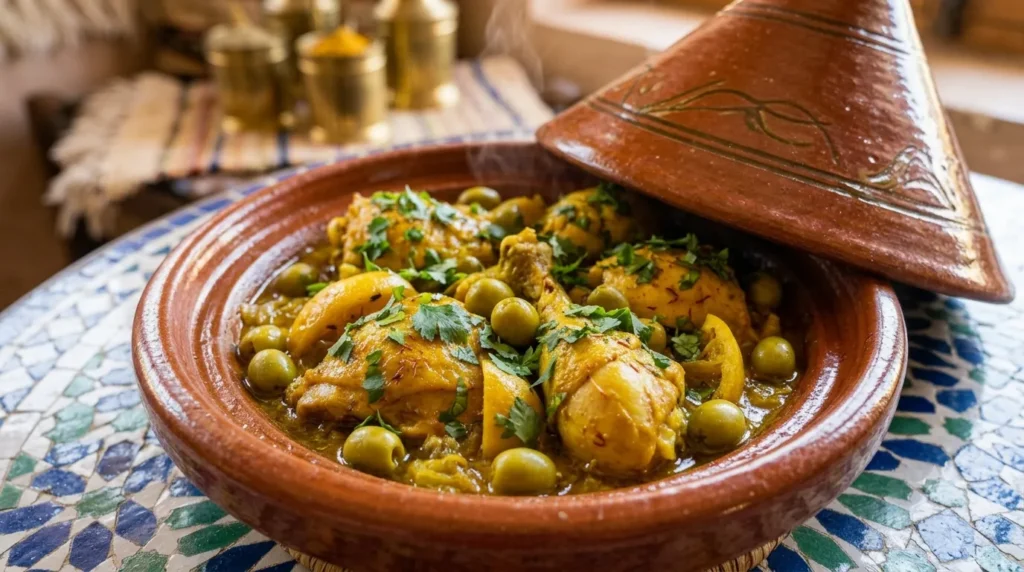
Cooking Timeline
| Stage | Approximate Time |
|---|---|
| Prep and seasoning | 20 minutes |
| Browning the chicken | 15 minutes |
| Softening onions and blooming spices | 15 minutes |
| Simmering, covered | 45–55 minutes |
| Preserved lemon and olives, uncovered | 10–15 minutes |
| Resting | 5 minutes |
| Total | About 2 hours |
15 Chef Tips
- Dry the chicken thoroughly before browning — moisture on the skin steams instead of sears.
- Season the chicken in advance if you can; even 30 minutes makes a difference.
- Brown in batches rather than crowding the pot.
- Keep the fond (browned bits) in the pot — it’s flavor, not mess.
- Cook onions low and slow; don’t rush past 12 minutes.
- Bloom spices in warm oil, not directly in liquid.
- Steep saffron in warm water before adding for better color extraction.
- Keep the liquid level low — a third of the way up the chicken, not fully submerged.
- Position chicken skin-side up during the simmer.
- Use a thermometer to confirm 165°F rather than guessing by time alone.
- Add preserved lemon in the back half of cooking, not the front.
- Rinse very salty olives briefly if you’re sensitive to sodium.
- Add fresh herbs at the very end so they stay bright, not dull.
- Let the tagine rest for a few minutes before serving — the sauce settles and thickens slightly.
- Skim excess fat from the surface if the sauce looks greasy rather than glossy.
15 Common Mistakes to Avoid
- Using boneless, skinless chicken breast. It dries out over a long braise and lacks the collagen that thickens the sauce. Fix: use bone-in thighs and drumsticks instead.
- Skipping the browning step. This happens when cooks want to save time, but it costs real flavor. Fix: always sear the chicken first, even briefly.
- Crowding the pot while browning. This causes steaming instead of searing. Fix: brown in two or more batches.
- Rushing the onions. Cranking the heat to soften onions faster leaves them raw-tasting. Fix: keep the heat at medium and give them a full 12–15 minutes.
- Adding spices directly to the liquid instead of blooming them in oil. This mutes their flavor. Fix: always bloom spices in the fat before adding water or stock.
- Over-salting before tasting. Preserved lemon and olives are both salty, so early over-seasoning is easy. Fix: salt lightly at first, then adjust after the lemon and olives go in.
- Adding preserved lemon at the beginning. This can make the rind taste bitter after a long simmer. Fix: add it in the last 15–20 minutes.
- Overcooking the olives. Long simmering flattens their brightness. Fix: add them at the same time as the preserved lemon, not earlier.
- Using fresh lemon as a full substitute for preserved lemon. It brings acidity but not the fermented depth. Fix: if substituting, add zest plus a little extra salt to approximate the flavor.
- Drowning the chicken in liquid. Too much water dilutes the sauce and prevents proper reduction. Fix: keep liquid at about a third of the way up the chicken.
- Simmering too hard. A rolling boil toughens the meat even as collagen breaks down. Fix: keep it at a gentle simmer, just a few bubbles at a time.
- Not checking for doneness with a thermometer. Guessing by time alone can undercook or overcook the chicken. Fix: confirm 165°F internally.
- Adding herbs too early. Cooking cilantro and parsley for the full simmer time dulls their flavor. Fix: stir them in at the very end, off the heat.
- Skipping the uncovered reduction stage. Without it, the sauce stays thin and watery. Fix: always finish with 10–15 minutes uncovered.
- Serving immediately without resting. This can leave the sauce looking separated rather than glossy. Fix: let the dish rest, covered, for 5 minutes before serving.
Variations
- Chicken Tagine with Apricots (traditional-adjacent): Dried apricots are added with the onions for a sweet-savory contrast common in Moroccan cooking, though this version leans further from the strictly savory preserved lemon-and-olive style.
- Chicken Tagine with Prunes (traditional-adjacent): Similar concept to apricots, often paired with a touch of cinnamon and honey — more common in celebratory tagines than everyday ones.
- Chicken Tagine with Almonds (traditional): Toasted almonds scattered on top at serving add crunch and are a common finishing touch across tagine styles.
- Chicken Tagine with Vegetables (traditional): Carrots, zucchini, or potatoes are added partway through the simmer, extending the dish into a more substantial one-pot meal.
- Spicy Chicken Tagine (modern adaptation): A spoonful of harissa or extra black pepper adds heat that isn’t part of the classic preserved lemon-and-olive profile.
- Chicken Tagine with Chickpeas (traditional-adjacent): Chickpeas add heartiness and are common in home versions meant to stretch the dish further.
- Chicken Tagine with Caramelized Onions (traditional): Cooking the onions further, until deeply golden rather than just soft, is a technique some households use for a sweeter, richer base.
What to Serve With Chicken Tagine
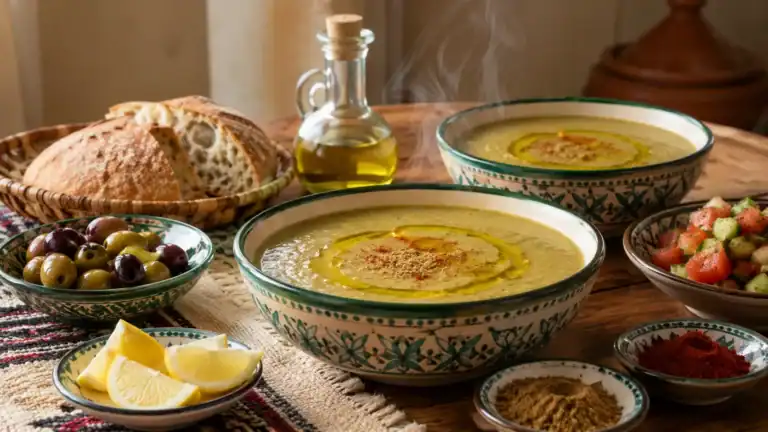
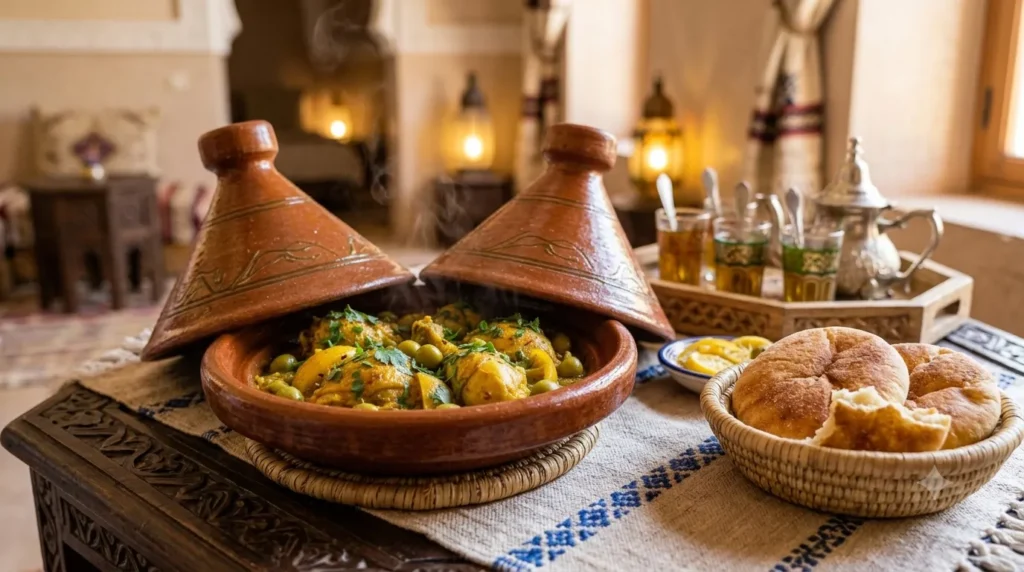
Bread is the most traditional pairing — a round, slightly chewy Moroccan loaf is built specifically for scooping up sauce. Couscous is equally common, especially for larger meals, since it soaks up the sauce without competing with it. If you want a bright, herby rice side instead, Greek Lemon Rice works well alongside a tagine even though it isn’t Moroccan — the lemon notes complement the preserved lemon in the sauce rather than clashing with it.
A simple shredded carrot salad with cumin and lemon is a common Moroccan side, offering a cool, slightly sweet contrast to the warm spices in the tagine. An orange salad with a touch of cinnamon and orange blossom water is another classic pairing, especially at the end of a meal. If you’d rather serve a heartier composed salad, Classic Salade Niçoise isn’t a traditional match, but its olives and briny character echo the tagine’s flavor profile if you’re building a Mediterranean-leaning spread.
For a different weeknight chicken option built around similar bright, lemony flavors, One Pot Greek Chicken and Lemon Rice and One-Pot Greek Chicken Risoni (Orzo) are worth keeping in your regular rotation alongside this tagine.
Storage & Make-Ahead
Chicken tagine keeps well and often tastes better the next day, once the spices have had time to settle into the sauce. Refrigerate leftovers in an airtight container within two hours of cooking, and use them within 3–4 days. The USDA’s food safety guidance notes that <cite index=”55-2″>leftovers should be refrigerated at 40°F or below within two hours of cooking to prevent bacterial growth</cite>, and that <cite index=”55-1″>reheated food should reach 165°F or be hot and steaming throughout</cite> — the same Food Safety and Inspection Service danger zone guidance applies here as it would to any braised dish.
To freeze, cool the tagine completely, then store in a freezer-safe container for up to 3 months. The sauce may separate slightly after freezing and thawing — this is normal, and a gentle reheat with occasional stirring brings it back together. For make-ahead meal prep, the dish can be fully cooked up to two days in advance and reheated gently on the stovetop; add a splash of water or stock if the sauce has thickened more than you’d like.
FAQ
What is Chicken Tagine? Chicken tagine is a Moroccan braise of bone-in chicken, onions, and warm spices, finished with preserved lemon and olives, traditionally cooked in a conical clay pot.
What does “tagine” mean? Tagine refers to both the North African conical cooking vessel and the slow-simmered stew cooked inside it.
Is Chicken Tagine Moroccan? Yes, though tagine cooking more broadly is also common in Tunisia and Algeria, each with its own regional variations.
What makes Chicken Tagine authentic? Bone-in chicken, a slow braise, warm spices like ginger and turmeric bloomed in oil, and the addition of preserved lemon and olives are the core markers of an authentic version.
What chicken pieces are best? Bone-in, skin-on thighs and drumsticks are best, since their connective tissue breaks down into gelatin over the long braise.
Should you use bone-in chicken? Yes — bone-in cuts hold moisture better and produce a fuller sauce than boneless cuts.
What is preserved lemon? It’s a whole lemon cured in salt for several weeks until the rind softens and turns tangy and slightly fermented, distinct from fresh lemon.
Why are olives used? Olives add a briny, savory counterpoint to the sweetness of the cooked-down onions and the warmth of the spices.
Which Moroccan spices are traditional? Ginger, turmeric, black pepper, and saffron are the core spices in the preserved lemon-and-olive style of tagine.
Should you brown the chicken? Yes — browning builds a layer of flavor through the Maillard reaction that a plain simmer can’t replicate on its own.
How long should Chicken Tagine cook? The chicken typically needs 45–55 minutes of gentle simmering, plus another 10–15 minutes uncovered to reduce the sauce.
Can you make it without a traditional tagine? Yes — a Dutch oven with a tight-fitting lid produces a very similar result.
Can you use a Dutch oven? Yes, a Dutch oven is a practical and widely used substitute for a clay tagine.
Can Chicken Tagine be made ahead? Yes, it can be fully cooked up to two days ahead and reheated gently on the stovetop.
How should leftovers be stored? Refrigerate in an airtight container within two hours of cooking and use within 3–4 days; it can also be frozen for up to 3 months.
4. Recipe Card
Chicken Tagine Recipe: Authentic Moroccan Chicken with Preserved Lemon & Olives
- Prep Time: 20 minutes
- Cook Time: 1 hour 25 minutes
- Rest Time: 5 minutes
- Total Time: About 1 hour 50 minutes
- Servings: 4–6
- Cuisine: Moroccan
- Course: Main Dish
- Difficulty: Moderate
- Calories: Approximately 420 kcal per serving (estimate; varies by portion size and chicken cut)
Ingredients
- 3 lbs bone-in, skin-on chicken thighs and drumsticks
- 2 large onions, thinly sliced
- 4–5 garlic cloves, minced
- ¼ cup extra virgin olive oil
- 1 bunch cilantro, stems and leaves separated, chopped
- 1 bunch flat-leaf parsley, stems and leaves separated, chopped
- 1½ tsp ground ginger
- 1 tsp ground turmeric
- ¼ tsp saffron threads, steeped in 1 tbsp warm water (optional)
- ½ tsp black pepper
- 1 preserved lemon, rind sliced
- 1 cup Moroccan or green olives
- Salt, to taste
- 1½–2 cups water or low-sodium chicken stock
Instructions
- Season the chicken with salt, pepper, and a third of the ginger and turmeric; rest 15–20 minutes.
- Brown the chicken in olive oil in batches, skin-side down first; remove and set aside.
- Soften the onions and herb stems in the same pot, 12–15 minutes; add garlic, remaining spices, and saffron; stir until fragrant.
- Return the chicken to the pot, skin-side up; add water or stock to about a third of the way up the chicken.
- Cover and simmer gently for 45–55 minutes, until the chicken reaches 165°F and is fork-tender.
- Stir in preserved lemon and olives; simmer uncovered for 10–15 minutes to reduce the sauce.
- Stir in fresh herb leaves, remove from heat, and rest 5 minutes before serving.
Chef Notes: Bloom the spices in oil rather than adding them straight to the liquid — this is the step that separates a flat tagine from a genuinely flavorful one. Taste before adding extra salt, since preserved lemon and olives both contribute significant sodium.
Storage Notes: Refrigerate within 2 hours of cooking; use within 3–4 days, or freeze for up to 3 months. Reheat to 165°F.
Nutrition (estimated per serving): Calories: 420 | Protein: 32g | Fat: 26g | Carbohydrates: 9g | Sodium: 680mg (Estimates only — actual values depend on specific ingredients and portion size.)
5. Conclusion
Chicken tagine rewards patience more than precision. Once you understand why the onions need to cook down slowly, why the spices go into the oil before the liquid, and why the preserved lemon goes in near the end rather than the beginning, you can adjust the dish to your own taste without losing what makes it work. Whether you’re cooking it in a clay tagine or a Dutch oven, the result is the same kind of dish it’s always been in Moroccan homes — a braise built from a handful of pantry staples, a low flame, and enough time to let them come together.