Moroccan Couscous Recipe: 7 Secrets to Authentic Flavor
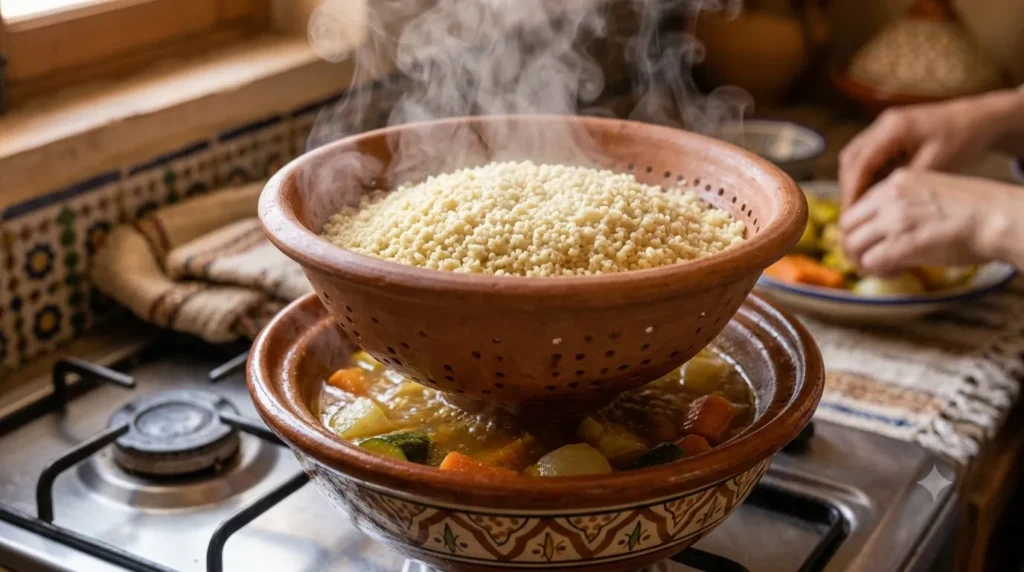
Moroccan couscous is a dish of steamed semolina granules served with a broth of meat, chickpeas, and vegetables, traditionally cooked in a couscoussier — a two-part pot where the broth simmers below while the couscous steams above. Unlike instant couscous, which is pre-steamed and dried at the factory, traditional couscous is moistened, separated by hand, and steamed in stages, which produces a lighter, less clumped texture.
The semolina grains — the endosperm of durum wheat — are traditionally hand-rolled and steamed several times in a couscoussière, a covered pot with a lower compartment for the broth and a perforated upper section where the couscous steams, according to Britannica. While the couscous steams, a stew of lamb, chicken, chickpeas, and vegetables cooks below it, and the two are typically served together with harissa on the side. That two-part cooking process — broth below, grain above, both finishing at roughly the same time — is the defining structure of the dish, more than any single ingredient list.
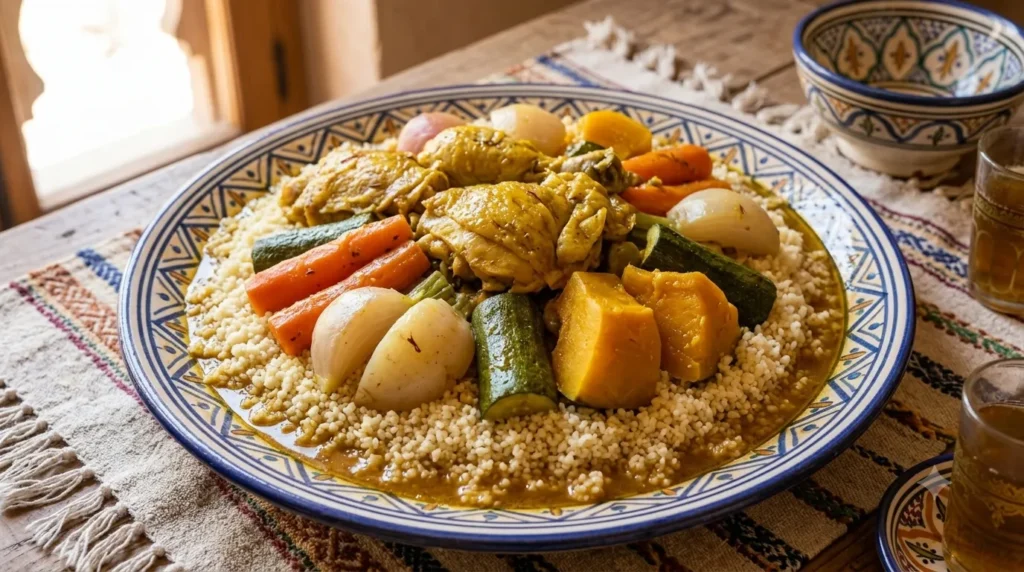
Table of Contents
Moroccan couscous is steamed semolina served with a slow-cooked broth of meat, chickpeas, and vegetables — built through a process, not just a recipe you dump into one pot. The couscous itself is steamed multiple times over the simmering broth, which is what gives it that light, separated texture instead of the gummy result you get from soaking instant couscous in hot water. This version uses chicken and a mix of vegetables in the style commonly served on Fridays in Moroccan households, and walks through the actual steaming technique — not a shortcut version — so you understand why each stage matters.
Couscous in Moroccan Culture
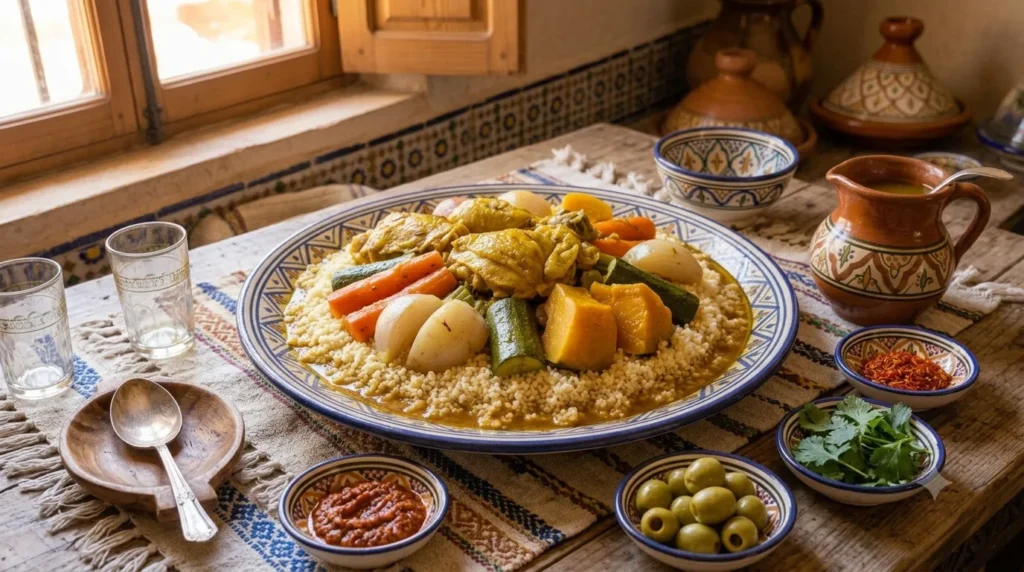
Couscous holds a different place in Moroccan cooking than most other dishes — it’s closely associated with Friday meals, when families gather after midday prayers to eat together, though it’s also served at other times, including celebrations and everyday family dinners. It’s a dish built for a table, not a single plate: the couscous is mounded on a large communal platter, the meat and vegetables arranged on top, and everyone eats from the same dish, often with bread rather than utensils in more traditional settings.
Like chicken tagine, couscous varies significantly by region, family, and season. A coastal Moroccan household might lean on different vegetables than one further inland; a family in Fez might season the broth differently than a family in Marrakech. In 2020, this dish’s cultural weight was formally recognized when Algeria, Mauritania, Morocco, and Tunisia jointly inscribed the knowledge, know-how, and practices behind producing and consuming couscous on UNESCO’s Representative List of the Intangible Cultural Heritage of Humanity, a rare instance of the four countries collaborating on a single cultural submission. You can read the full listing on UNESCO’s Intangible Cultural Heritage site. The joint inscription is itself a useful reminder that couscous isn’t owned by one country or one household recipe — it’s a shared regional tradition with a lot of internal variation.
The Traditional Couscous Technique
This is the part that separates real Moroccan couscous from the five-minute instant version, and it’s worth understanding even if you eventually choose a shortcut.
Preparing the grains. Dry couscous starts in a wide, shallow bowl. You sprinkle it with cold water, a little at a time, and work it through with your fingertips, breaking up clumps as they form. Then a small amount of olive oil is worked in the same way, which helps keep the grains separated once they hit steam.
First steaming. The moistened couscous goes into the perforated top of the couscoussier, uncovered, set over the simmering broth below. Steam rises through the holes and begins to cook the outer layer of each grain. This first steaming typically takes 15–20 minutes.
Rehydrating. The partially steamed couscous is tipped back into the wide bowl, sprinkled with more water, and worked through by hand again — separating any grains that have started to clump and letting them absorb a bit more moisture before the next round.
Second steaming. Back into the couscoussier for another 15–20 minutes. By this point, the grains are mostly cooked through but still slightly firm at the core.
Final steaming. A last round, sometimes with a bit of melted butter or smen (Moroccan preserved butter) worked through beforehand, finishes the couscous and gives it a glossy, tender texture.
Fluffing. Once out of the steamer, the couscous is spread out and fluffed with a fork or by hand, breaking up any last clumps and letting steam escape so the grains don’t turn gummy as they cool slightly before serving.
Steaming in stages, rather than once, matters because it lets moisture penetrate each grain gradually. Steaming once with too much water at the start produces mushy, clumped couscous on the outside while the centers stay underdone; the multi-stage method builds hydration evenly instead.
Ingredients
(Serves 6, using chicken and seven vegetables)
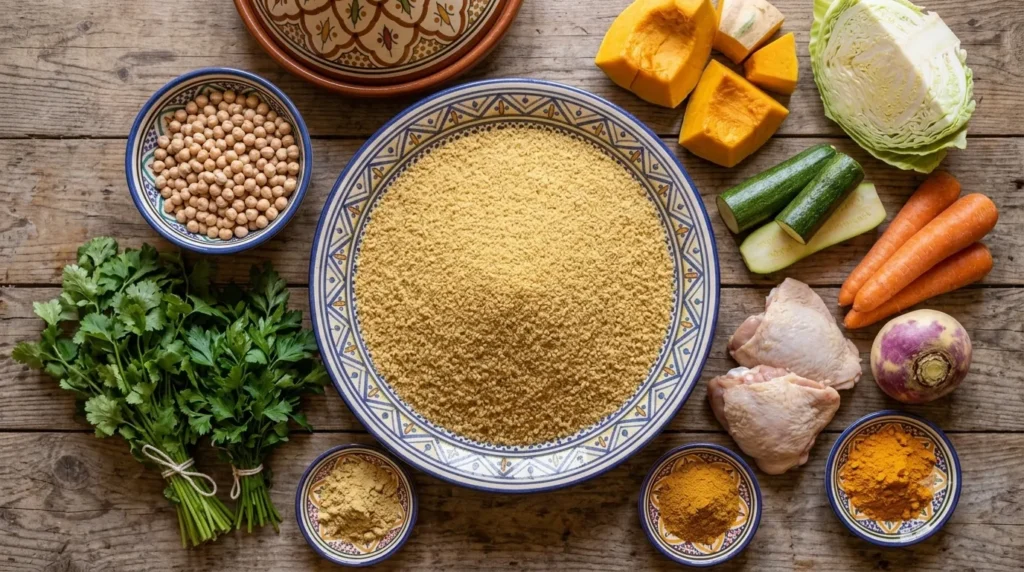
- Medium-grain Moroccan couscous (3 cups dry): Look specifically for “medium grain” rather than the very fine or the large pearl (Israeli-style) varieties, which behave differently and aren’t suited to traditional steaming.
- Bone-in chicken thighs and drumsticks (2½–3 lbs): Provides body and gelatin for the broth. See the Choosing the Protein section for lamb and beef alternatives.
- Chickpeas (1½ cups, soaked overnight if using dried, or 1 can drained): Adds heartiness and a slightly nutty flavor to the broth.
- Onions (2, one sliced for the broth and one for tfaya if using): The base aromatic for the broth.
- Garlic (3–4 cloves, minced): Added early to build depth in the broth.
- Carrots (3, peeled, halved lengthwise): Sweetness and color; one of the most common vegetables across regional versions.
- Turnips (2, peeled and quartered): A slightly peppery, earthy note that balances the sweeter vegetables.
- Zucchini (2, halved lengthwise): Added later in cooking since it cooks quickly and turns mushy if added too early.
- Pumpkin or butternut squash (1 lb, cut into large chunks): Breaks down slightly during cooking, adding natural sweetness and thickening the broth.
- Cabbage (¼ head, cut into wedges): A traditional addition in many households, adding a mild, slightly sweet vegetal note.
- Tomatoes (2, or 2 tbsp tomato paste): Adds acidity and color to the broth.
- Fresh cilantro and parsley (1 bunch each, tied with kitchen string): Traditionally added as a bundle so it can be removed before serving, flavoring the broth without leaving loose leaves throughout.
- Ground ginger (1 tsp) and ground turmeric (1 tsp): The core spicing for the broth.
- Black pepper (½ tsp): Rounds out the spice base.
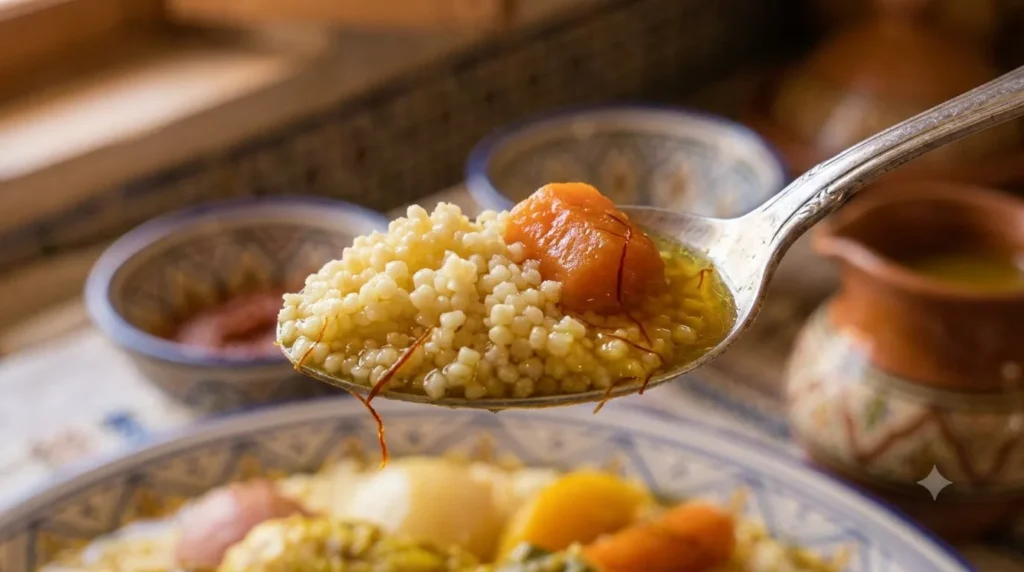
- Saffron threads (a small pinch, optional): Adds color and a floral note; not every household uses it for the everyday version.
- Olive oil (¼ cup, plus more for the couscous): Used both to start the broth and to work through the dry couscous grains.
- Salt, to taste
- Water (6–8 cups): Enough to fully cover the meat and vegetables in the lower pot.
The Seven Vegetables
“Seven-vegetable couscous” is a well-known style, but it isn’t a fixed, universal recipe — the specific seven vegetables vary by region, household, and season, and some cooks use more or fewer than seven depending on what’s available. The name refers more to the idea of a generous, varied vegetable mix than to an exact checklist.
| Vegetable | Flavor Contribution | Texture | Typical Cooking Time in Broth |
|---|---|---|---|
| Carrots | Sweet, earthy | Firm, holds shape | 30–35 minutes |
| Turnips | Mildly peppery, slightly bitter | Firm, slightly softer than carrots | 30–35 minutes |
| Zucchini | Mild, mellow | Soft, breaks down if overcooked | 12–15 minutes (add later) |
| Pumpkin or squash | Sweet, slightly nutty | Very soft, some breakdown expected | 20–25 minutes |
| Cabbage | Mild, slightly sweet when cooked | Soft, wedge holds together | 25–30 minutes |
| Tomatoes | Acidic, adds color | Breaks down into the broth | Added early, dissolves mostly |
| Onions | Savory base flavor | Softens into the broth | Added at the start |
The staggered cooking times matter: root vegetables like carrots and turnips need the full simmer time to soften properly, while zucchini turns to mush if it goes in too early. Adding vegetables in stages, rather than all at once, is one of the more overlooked techniques in a good vegetable couscous.
Choosing the Protein
Chicken is a practical, everyday choice — it cooks faster than lamb or beef and produces a lighter broth. Bone-in thighs and drumsticks hold up better than boneless cuts over the simmer time needed to also cook the vegetables through. This is roughly the same logic behind why chicken tagine relies on bone-in cuts, and if you want a side-by-side look at how a similar braise comes together, Coq au Vin uses the same bone-in, low-and-slow logic, just with a French wine-based broth instead of a Moroccan spiced one.
Lamb, often on the bone (shoulder or shank), is the more traditional and celebratory choice, especially for larger gatherings. It needs a longer simmer — often 1.5 to 2 hours — for the connective tissue to fully break down, but the payoff is a richer, more full-bodied broth. If you’re building intuition for how a long, slow braise transforms a tougher cut of lamb, the technique overlaps conceptually with Authentic Greek Slow Roasted Leg of Lamb — a different method (roasting rather than braising in liquid) and a different flavor profile, but the same underlying goal of turning collagen into tenderness over time.
Beef, typically a well-marbled cut like short rib or chuck, is less traditional than chicken or lamb in most Moroccan households but does appear in some regional and family versions. It needs a similarly long simmer to lamb. If you’re comparing techniques for a long beef braise, Classic Beef Bourguignon demonstrates the same collagen-breakdown principle in a French context.
Vegetarian couscous skips the meat entirely and leans more heavily on chickpeas for protein and body, along with a slightly more generous vegetable mix. The broth won’t have quite the same depth without meat, so a slightly stronger spice presence and a splash of good olive oil at the end can help compensate.
Moroccan Spices
The spicing for a vegetable-and-meat couscous broth is intentionally restrained:
- Ginger provides warmth without heat, and is one of the two defining spices in this style of broth.
- Turmeric contributes color and a mild earthiness — used at a similar ratio to ginger here, rather than dominating.
- Black pepper adds a low, steady background heat.
- Saffron, when used, deepens the color and adds a floral top note, though it’s treated as optional rather than essential for an everyday version.
This is a noticeably shorter list than what you’d find in a generic “curry powder” blend, which usually stacks in cumin, coriander, cinnamon, and several other spices at once. Moroccan cooking tends to use fewer spices per dish, chosen deliberately for how they interact, rather than a large all-purpose blend used the same way in everything.
The Couscous Broth
The broth is doing double duty — it’s cooking the meat and vegetables, and it’s also the liquid that eventually gets ladled over the finished couscous, so it needs real depth on its own.
Start by browning the chicken (or searing the lamb or beef, if using) in olive oil, then softening the onions and garlic in the same pot. Add the spices and let them bloom briefly before adding water — this is the same principle used in a chicken tagine, just scaled up for a larger pot. Add the tomatoes, tied herb bundle, and enough water to fully cover the meat, then bring to a simmer.
Add the root vegetables (carrots, turnips) partway through, once the meat has had 20–30 minutes to start softening. Hold back the faster-cooking vegetables — zucchini especially — until the last 12–15 minutes, so they don’t disintegrate. Skim any excess fat or foam from the surface as it cooks, which keeps the broth cleaner rather than greasy.
A common cause of bland broth is under-seasoning early and only adjusting at the very end — spices and aromatics need time in the liquid to actually infuse it, so season in stages rather than all at once at the finish. A watery, thin broth is usually a sign of too much water relative to the meat and vegetables in the pot; if this happens, you can simmer uncovered for the last 10–15 minutes to concentrate it before serving.
Tfaya — The Optional Sweet Topping
Tfaya is a topping of slowly caramelized onions, raisins, and a touch of cinnamon and honey, cooked down until soft, sticky, and deeply sweet. It’s not part of every Moroccan couscous — it’s specific to certain celebratory or chicken-based versions, most associated with a dish sometimes called couscous tfaya, where the sweet onion topping is served over the couscous alongside the chicken and broth.
The technique is a slow, patient caramelization — cooking the onions over low heat for a long stretch until their natural sugars concentrate and darken, similar in principle to the long caramelization used for Classic French Onion Soup, just finished with warm spices and raisins instead of stock and cheese. If you want to add tfaya to this recipe, prepare it separately while the broth simmers, then spoon it over the chicken and couscous at serving rather than mixing it into the main broth — it’s meant to be a distinct sweet-savory contrast, not blended evenly through the dish.
Tfaya pairs specifically well with the chicken version of this couscous. It’s less commonly paired with the seven-vegetable-only or beef versions, where the flavor balance works differently.
Step-by-Step Instructions
1. Build the broth base. What to do: Brown the chicken in olive oil in your lower couscoussier pot (or a large stockpot). Remove, then soften the sliced onion and garlic in the same pot. Why it matters: Browning the chicken first builds a savory foundation the plain broth wouldn’t have on its own. Visual cue: Chicken skin should be golden, not pale, before removing it. Common mistake: Skipping this step to save time, which results in a flatter-tasting broth. Chef Tip: Don’t discard the browned bits stuck to the pot — they dissolve into the broth as it simmers.
2. Bloom the spices and add liquid. What to do: Stir in ginger, turmeric, black pepper, and saffron (if using) into the softened onions for 30–60 seconds, then add the tomatoes, herb bundle, water, and the browned chicken back into the pot. Why it matters: Blooming spices in the oil before adding water extracts more of their flavor than adding them directly to the liquid. Visual cue: Spices should smell fragrant, not scorched. Common mistake: Adding spices directly to the water, which mutes their impact. Chef Tip: If the spices start sticking, add a splash of water immediately to stop them from burning.
3. Simmer the meat and add root vegetables. What to do: Bring to a simmer, cover partially, and cook for 25–30 minutes before adding the carrots and turnips. Why it matters: Giving the meat a head start ensures it’s fully tender by the time the vegetables finish. Visual cue: The broth should be at a gentle, steady simmer — small bubbles, not a rolling boil. Common mistake: Adding all the vegetables at once, which leaves some undercooked and others falling apart. Chef Tip: Taste and adjust salt at this stage, not just at the end — the vegetables need time in a properly seasoned broth.
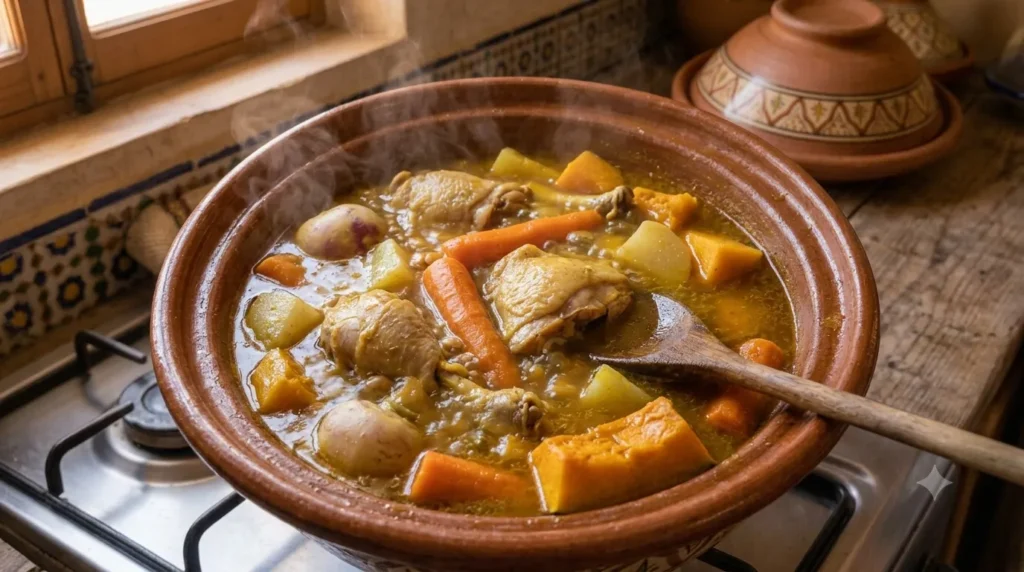
5. Filename: moroccan-couscous-broth-vegetables.webp ALT text: Chicken and vegetables simmering in Moroccan spiced broth Title: Vegetables and Chicken Simmering in the Broth Description: Bone-in chicken and colorful vegetables simmering together in the lower pot of aromatic, spiced Moroccan broth. Prompt: Overhead shot of a wide pot filled with simmering golden broth, bone-in chicken pieces, carrots, turnips, and pumpkin chunks visible beneath the surface, gentle steam rising, a wooden spoon resting at the pot’s edge. Warm natural light, rich earthy colors. No text, no logos, no watermarks. 16:9, 1344x768px.
4. Prepare and first-steam the couscous. What to do: While the broth simmers, moisten the dry couscous with water and a little olive oil, working it through by hand. Steam it uncovered over the broth (or a separate pot of simmering water if your broth pot doesn’t have a steamer top) for 15–20 minutes. Why it matters: This is the first of several stages that gradually hydrate the grains without making them gummy. Visual cue: Steam should be visibly rising through the grains; they’ll look slightly swollen after this stage. Common mistake: Adding too much water at once, which clumps the grains before they even reach the steamer. Chef Tip: Work the water in a small amount at a time — you can always add more, but you can’t easily fix couscous that’s gone from moist to wet.
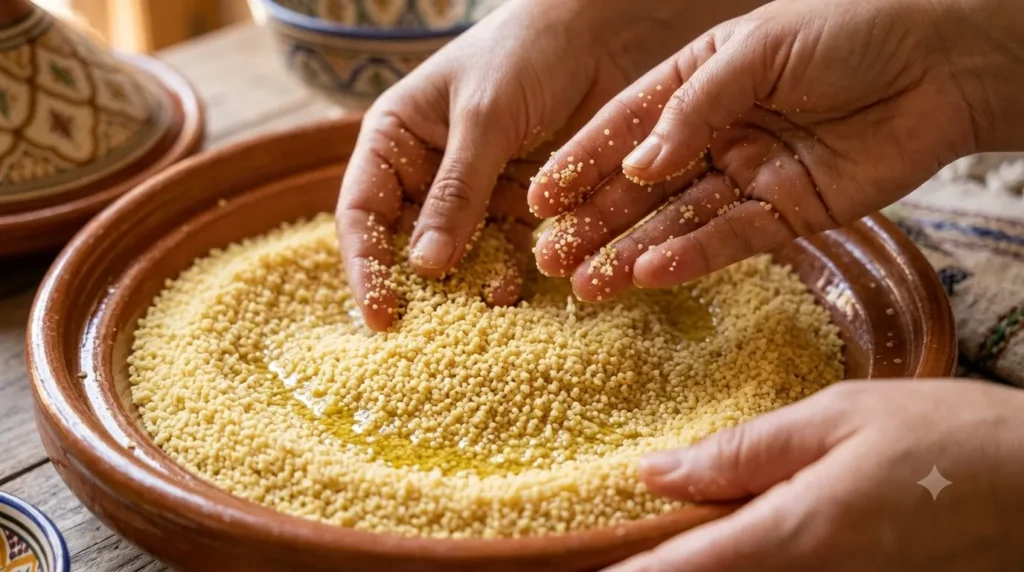
5. Rehydrate, second-steam, and add remaining vegetables. What to do: Tip the couscous back into the bowl, sprinkle with more water, and work through again. Return to steaming for another 15–20 minutes. Meanwhile, add the cabbage, pumpkin, and chickpeas to the broth, followed by the zucchini in the final 12–15 minutes. Why it matters: The second steaming continues the gradual hydration process while the broth finishes cooking its remaining vegetables in the right order. Visual cue: Couscous grains should look separate and slightly translucent, not sticky or clumped. Common mistake: Adding the zucchini too early, which turns it to mush by serving time. Chef Tip: If the broth looks like it’s reducing too fast, add a splash of water; if it’s too thin, simmer uncovered.
6. Final steam and fluff. What to do: Steam the couscous a third time, this time working in a little melted butter or smen partway through. Once done, spread it out and fluff thoroughly with a fork. Why it matters: The final steaming and fat addition gives the grains their finished glossy, tender texture. Visual cue: Grains should look light and separated, not heavy or wet. Common mistake: Skipping the fluffing step, which lets residual steam turn the grains gummy as they sit. Chef Tip: Fluff with your hands if you’re comfortable with the heat — it separates the grains more thoroughly than a fork alone.
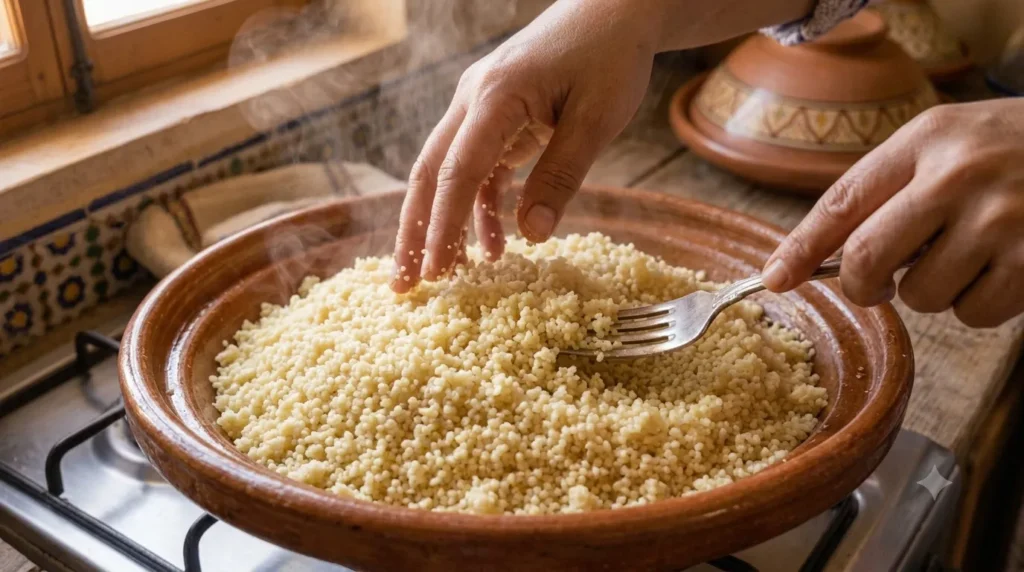
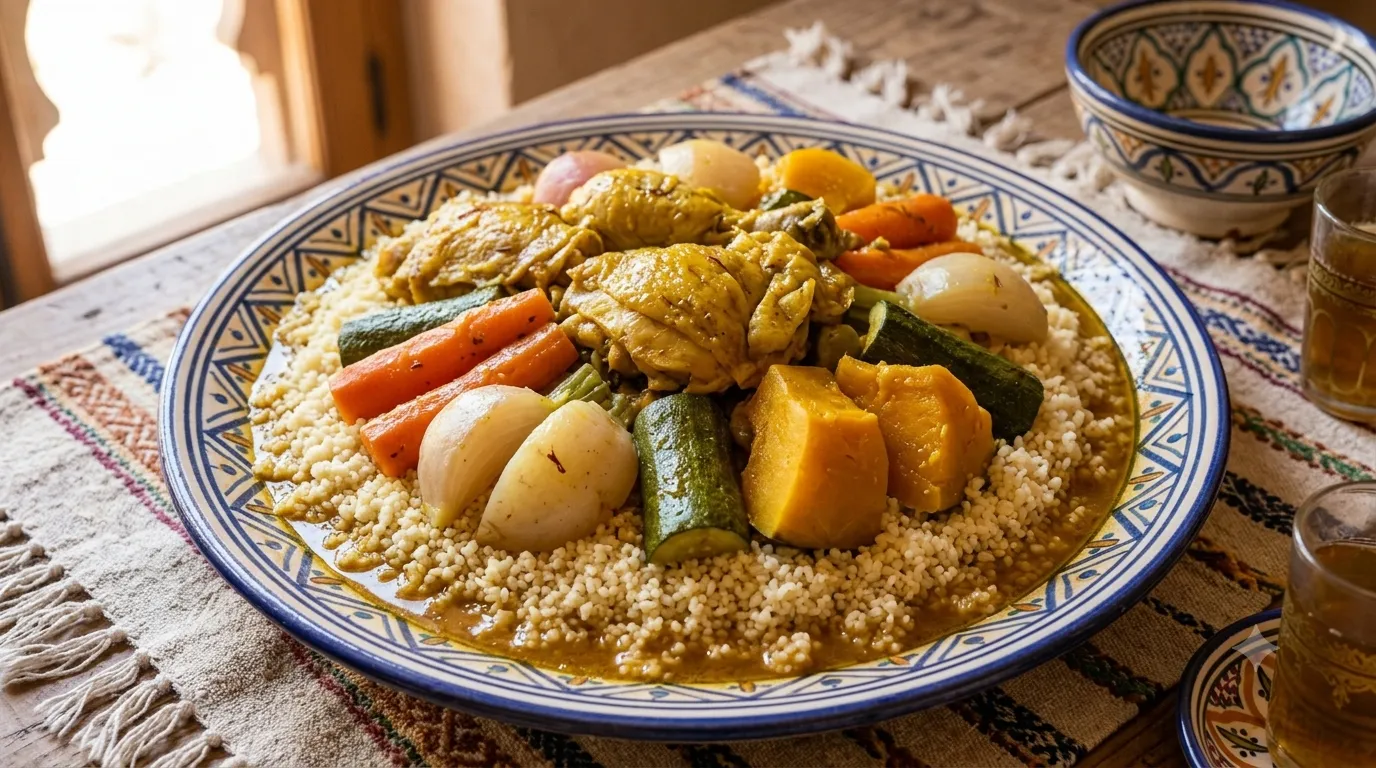
7. Assemble and serve. What to do: Mound the fluffed couscous on a large platter, arrange the chicken and vegetables on top, and ladle broth generously over everything. Add tfaya now if using. Why it matters: The couscous should be moistened by the broth at serving, not dry underneath the toppings. Visual cue: The couscous should look glossy and slightly darkened where the broth has soaked in, not pale and dry. Common mistake: Serving the couscous with too little broth, leaving it dry in the middle of the platter. Chef Tip: Reserve extra broth on the side so the table can add more as needed — couscous absorbs liquid quickly once served.
Couscous Steaming Timeline
| Stage | Action | Approximate Time | Visual Cue |
|---|---|---|---|
| First preparation | Moisten and separate dry couscous | 10 minutes | Grains look evenly damp, not wet |
| First steaming | Steam uncovered over broth | 15–20 minutes | Grains appear slightly swollen |
| Second hydration | Rehydrate and separate again | 5–10 minutes | Grains remain loose and separated |
| Second steaming | Steam again | 15–20 minutes | Grains look translucent, not sticky |
| Final steaming | Steam with butter or smen | 10–15 minutes | Grains look glossy and light |
| Fluffing | Break up clumps by hand or fork | 5 minutes | Grains fall loosely, not in clumps |
| Serving | Mound on platter, top with broth | Immediate | Couscous looks moist but not soggy |
How to Keep Couscous Fluffy
- Add water gradually, not all at once. It’s easy to add more; it’s very hard to fix couscous that’s already turned wet and pasty.
- Separate clumps by hand between each hydration round, rather than relying on steam alone to break them up.
- Don’t skip a steaming stage to save time. Each round hydrates the grains a little more evenly; skipping one usually leaves the centers underdone.
- Fluff immediately after the final steam, while the grains are still hot — residual steam trapped in a pile will turn the bottom layer gummy.
- Avoid pressing or packing the couscous into a bowl or platter — mound it loosely instead.
- If it clumps after cooling, a very brief re-steam with a light hand-fluffing partway through can usually rescue it.
Couscoussier vs. Steamer Basket vs. Modern Shortcuts
A traditional couscoussier is the correct traditional tool for this dish — not a tagine pot, which is a different vessel entirely, built for braising rather than steaming. The couscoussier’s two-part design (broth below, perforated steaming basket above) is specifically what allows the couscous to pick up flavor from the rising steam while cooking separately from the liquid itself.
If you don’t own one, a large pot with a fitted steamer basket works as a substitute, as long as the basket sits above the liquid line and the lid (or a cloth wrapped around the rim) traps enough steam. A fine-mesh colander set over a pot, with a damp cloth wrapped around the rim to seal the gap, is a workable improvised version many home cooks use.
Instant couscous, which is pre-steamed and dried, is a legitimate modern shortcut for a weeknight version — you rehydrate it with hot liquid rather than steaming it in stages. It won’t have quite the same light, separated texture as properly steamed couscous, and it’s a different enough result that it’s worth knowing you’re making a shortcut version rather than a traditional one, not a lesser version of the same technique.
15 Common Mistakes to Avoid
- Using instant couscous and expecting traditional texture. It’s pre-steamed and behaves differently. Fix: treat it as its own quick-method dish, not a substitute technique.
- Adding all the water at once when moistening the grains. This clumps the couscous before steaming even starts. Fix: add water gradually, working it through by hand each time.
- Skipping a steaming stage. This leaves the centers of the grains undercooked. Fix: steam in the full multi-stage process, even if it takes longer.
- Overcrowding the steamer basket. A too-thick layer of couscous steams unevenly. Fix: steam in a wide, shallow layer.
- Not fluffing immediately after steaming. Trapped steam turns the bottom layer gummy. Fix: spread and fluff right away.
- Adding all seven vegetables to the broth at the same time. Fast-cooking vegetables turn to mush while slow-cooking ones stay firm. Fix: stagger the additions based on cooking time.
- Using boneless chicken for the broth. It produces a thinner broth with less body. Fix: use bone-in cuts for meaningful gelatin.
- Under-seasoning the broth early and over-salting at the end. This leaves the vegetables bland even if the broth tastes fine. Fix: season in stages throughout cooking.
- Letting the broth boil hard instead of simmering. This can break down vegetables unevenly and toughen the meat. Fix: keep it at a gentle simmer.
- Adding zucchini too early. It disintegrates well before serving. Fix: add it in the final 12–15 minutes only.
- Using too little broth at serving. Dry couscous under wet toppings looks and tastes unfinished. Fix: ladle broth generously, and reserve extra on the side.
- Assuming a tagine pot is the traditional couscous steamer. It’s a different vessel for a different cooking method. Fix: use a couscoussier or improvised steamer, not a tagine.
- Rushing the caramelization for tfaya. High heat browns the onions unevenly instead of caramelizing them. Fix: keep the heat low and be patient.
- Packing couscous tightly onto the serving platter. This compacts the grains and undoes the fluffing work. Fix: mound it loosely.
- Reheating leftover couscous without added moisture. It dries out fast without its broth. Fix: reheat with a splash of broth or water, covered.
15 Chef Tips
- Work water into dry couscous with your fingertips, not a spoon — you’ll feel clumps forming before you can see them.
- Tie your herb bundle tightly; loose stems floating in the broth are hard to fish out later.
- Brown the meat before building the broth, even if you’re short on time.
- Keep a kettle of hot water nearby while steaming, for quick top-ups if the broth level drops.
- Taste the broth at each stage of seasoning, not just at the end.
- Stagger vegetable additions based on their individual cooking times, not a single dump-in moment.
- Use a wide, shallow bowl for moistening couscous — a deep bowl makes it harder to work water through evenly.
- If you don’t have a couscoussier, wrap a damp cloth around the rim where your colander meets the pot to seal in more steam.
- Add butter or smen to the couscous during the final steaming stage, not after fluffing, so it melts through evenly.
- Skim the broth periodically rather than all at once at the end.
- Reserve a portion of plain broth separately if serving guests who prefer it milder.
- Let the couscous rest for a minute or two after fluffing before mounding it, so residual steam fully escapes.
- If making tfaya, cook it in a separate pan while the broth simmers, so the onions get true low-heat caramelization time.
- Use bone-in, skin-on chicken thighs if you want a richer broth without the longer cook time lamb requires.
- Keep your spice measurements modest at first — you can always add more heat or warmth, but it’s hard to correct an over-spiced broth.
Variations
- Moroccan Chicken Couscous (traditional): The everyday version most common for a Friday family meal.
- Lamb Couscous (traditional): More common for celebrations, using a longer-cooking bone-in cut.
- Beef Couscous (traditional-adjacent): Less universal than chicken or lamb, but present in some regional and family recipes.
- Seven-Vegetable Couscous (traditional): A vegetable-forward version, sometimes made with a lighter meat presence or none at all.
- Vegetarian Moroccan Couscous (modern adaptation, though close to traditional principles): Skips meat, leans on chickpeas and a fuller vegetable mix.
- Tfaya Couscous (traditional): The sweet caramelized-onion-and-raisin topping, most associated with the chicken version.
- Seasonal Vegetable Couscous (traditional): Swaps in whatever vegetables are in season rather than a fixed list.
What to Serve With Moroccan Couscous
Moroccan couscous is typically a complete meal on its own — grain, protein, vegetables, and broth all in one dish — so sides tend to be light rather than substantial. Some households serve it as one of two mains at a larger gathering, alongside a Chicken Tagine — the two dishes share a spice profile, so they sit comfortably on the same table without competing. Harissa on the side lets each person adjust their own heat level without changing the flavor of the broth for everyone else. A simple herb salad or a lightly dressed vegetable salad works well if you want something fresh alongside the warm dish; Classic Salade Niçoise isn’t a traditional Moroccan pairing, but its briny olives and fresh vegetables offer a similar kind of bright contrast if you’re rounding out a larger spread.
If you’re serving a bigger gathering and want an additional protein alongside the couscous rather than folded into it, Greek Kofta Kebabs bring a different but complementary spiced-meat option to the table — not traditional to a Moroccan meal, but a reasonable addition if you’re building a broader Mediterranean-style spread for guests. Buttermilk or a lightly fermented dairy drink is a traditional accompaniment in some households, offering a cool, tangy contrast to the warm, spiced broth.
Storage & Reheating
Couscous and its broth store best separately, since the couscous absorbs liquid over time and can turn mushy if left sitting in the broth for days. Refrigerate both in airtight containers within two hours of cooking. The USDA’s food safety guidance notes that leftovers should go into shallow containers for quick cooling and be refrigerated within two hours, then reheated to 165°F or until hot and steaming throughout— the same standard applies to couscous, broth, and meat here as it would to any cooked dish.
Use refrigerated leftovers within 3–4 days. To reheat couscous without drying it out, sprinkle it with a little water or broth, cover, and warm gently in a low oven or on the stovetop, fluffing partway through. The broth reheats easily on the stovetop; bring it back to a full simmer before serving, especially if it contains meat. Couscous and broth both freeze reasonably well for up to 2–3 months — thaw in the refrigerator overnight, then reheat as above. Vegetables that were fully cooked the first time around will soften further on reheating, so don’t expect the same texture as the day it was made.
FAQ
Is Moroccan couscous the same as regular couscous? Not exactly — “regular” couscous in most US grocery stores is usually the instant, pre-steamed kind, while traditional Moroccan couscous is dry semolina that’s steamed multiple times by hand.
What are the seven vegetables in Moroccan couscous? There’s no single fixed list — carrots, turnips, zucchini, pumpkin or squash, cabbage, tomatoes, and onions are common choices, but the exact mix varies by region and household.
How do you steam Moroccan couscous? The couscous is moistened, worked by hand to separate the grains, and steamed uncovered over broth in two or three stages, with rehydration between each round.
Can I use instant couscous? Yes, as a practical shortcut, though it won’t have the same light, separated texture as traditionally steamed couscous.
What meat is best for Moroccan couscous? Chicken is the most common everyday choice; lamb is more traditional for celebrations; beef appears in some regional and family versions.
Why is my couscous soggy? Usually too much water added at once, or not enough steaming stages to hydrate the grains gradually.
Why is my couscous dry? Either not enough water was worked in before steaming, or it wasn’t moistened with broth or butter at the finishing stage.
Can Moroccan couscous be made vegetarian? Yes — skip the meat, lean more on chickpeas, and use a slightly fuller vegetable mix to compensate for the lighter broth.
What spices are used in Moroccan couscous? Ginger, turmeric, and black pepper form the base; saffron is a common but optional addition.
What is tfaya? Tfaya is a topping of slowly caramelized onions, raisins, cinnamon, and honey, traditionally served over the chicken version of couscous.
Can I freeze Moroccan couscous? Yes — store the couscous and broth separately, and freeze for up to 2–3 months.
Should you use a tagine pot to steam couscous? No — a tagine is built for braising, not steaming; a couscoussier or an improvised steamer basket is the correct tool.
How long does Moroccan couscous take to make? Including the broth and multi-stage steaming, plan for roughly 2 to 2.5 hours for the chicken version.
Is Moroccan couscous healthy? It includes lean protein, vegetables, and legumes, and can fit into a balanced diet, though portion size and added fats like butter affect the overall nutrition.
What’s the difference between Moroccan couscous and Israeli (pearl) couscous? They’re different products — Moroccan couscous is fine-grain semolina, while Israeli couscous is a larger, toasted pasta-like pearl, and the two aren’t direct substitutes in this recipe.
4. Recipe Card
Moroccan Couscous Recipe: Traditional Couscous with Vegetables
- Prep Time: 30 minutes
- Cook Time: 1 hour 45 minutes
- Total Time: About 2 hours 15 minutes
- Servings: 6
- Cuisine: Moroccan
- Course: Main Dish
- Difficulty: Moderate to Advanced
- Calories: Approximately 480 kcal per serving (estimate; varies with protein and portion size)
Ingredients
- 3 cups medium-grain Moroccan couscous, dry
- 2½–3 lbs bone-in chicken thighs and drumsticks
- 1½ cups chickpeas (soaked dried, or canned and drained)
- 2 onions
- 3–4 garlic cloves, minced
- 3 carrots, halved lengthwise
- 2 turnips, quartered
- 2 zucchini, halved lengthwise
- 1 lb pumpkin or butternut squash, chunked
- ¼ head cabbage, cut into wedges
- 2 tomatoes, or 2 tbsp tomato paste
- 1 bunch each cilantro and parsley, tied
- 1 tsp ground ginger
- 1 tsp ground turmeric
- ½ tsp black pepper
- Pinch of saffron threads (optional)
- ¼ cup olive oil, plus more for the couscous
- Salt, to taste
- 6–8 cups water
Instructions
- Brown the chicken in olive oil; remove, then soften onion and garlic in the same pot.
- Bloom the spices, then add tomatoes, herb bundle, water, and the chicken back into the pot; bring to a simmer.
- Simmer 25–30 minutes, then add carrots and turnips.
- While the broth cooks, moisten the dry couscous and first-steam for 15–20 minutes.
- Rehydrate and second-steam the couscous while adding cabbage, pumpkin, and chickpeas to the broth, followed by zucchini in the last 12–15 minutes.
- Final-steam the couscous with a little butter or smen worked through; fluff thoroughly.
- Mound the couscous on a platter, top with chicken and vegetables, and ladle broth generously over everything.
Chef Notes: Stagger the vegetables by cooking time — root vegetables go in early, zucchini goes in last. Don’t skip a steaming stage on the couscous; each round hydrates the grains a bit more evenly than a single long steam would.
Storage Notes: Store couscous and broth separately; refrigerate within 2 hours and use within 3–4 days, or freeze up to 2–3 months. Reheat couscous with added moisture, covered.
Nutrition (estimated per serving): Calories: 480 | Protein: 34g | Fat: 16g | Carbohydrates: 52g | Sodium: 610mg (Estimates only — actual values depend on specific ingredients and portion size.)
5. Conclusion
Moroccan couscous rewards the same kind of patience as a good tagine, just spread across two tracks at once — a broth that needs staggered timing to cook every vegetable properly, and a grain that needs several rounds of hydration and steam to turn out light instead of clumped. None of the individual steps are difficult on their own; it’s the sequencing that takes some getting used to. Once you’ve made it through the process once, you’ll have a much better sense of how to adjust it — more or less broth, a different vegetable mix, chicken one week and lamb the next — the way Moroccan households actually treat this dish, as a flexible technique rather than a fixed formula.