
Moroccan Lamb Meatballs: 15 Tips for delicious Kefta
Moroccan Lamb Meatballs — known in Morocco as kefta — are seasoned balls of minced lamb built on a base of fresh cilantro, parsley, garlic, and warm ground spices like cumin, paprika, and ginger. You’ll find them pan-fried and served with bread, simmered gently in a spiced tomato sauce, or cooked in a tagine until the sauce turns thick and glossy. What sets them apart from a generic meatball is the seasoning logic: fresh herbs worked directly into the meat, warm spices rather than hot ones, and a texture that stays loose and tender instead of tightly packed.
In this guide, you’ll learn how Moroccan home cooks actually build a kefta mixture, why fat content matters more than most recipes admit, how to keep lamb meatballs from drying out, and how to choose between pan-frying, baking, or simmering them in sauce. You’ll also get a full walk-through of kefta tagine, the classic simmered variation, along with the food science behind why certain techniques work and others don’t.

Table of Contents
What Are Moroccan Lamb Meatballs?
Quick definition: Moroccan Lamb Meatballs, or kefta, are seasoned balls of minced lamb blended with fresh cilantro, parsley, garlic, onion, and warm spices such as cumin and paprika, then pan-fried, grilled, or simmered in a spiced tomato sauce — a home-style dish found across Moroccan kitchens with countless family variations.
“Kefta” is the Moroccan Arabic term for finely minced or hand-chopped meat mixed with herbs and spices — it isn’t the name of one fixed recipe. <cite index=”52-1″>The word traces back to the Classical Persian “kōfta,” meaning ground or pounded meat</cite>, a root shared across many Middle Eastern and South Asian meatball traditions. In Morocco, that shared root took on its own identity: lamb or beef mixed with a generous amount of chopped cilantro and parsley, plus onion, garlic, and a spice blend that leans toward cumin, sweet paprika, and sometimes ginger.
You’ll see kefta prepared in more than one way depending on the household and the region:
- Grilled kefta skewers — shaped onto skewers and cooked over charcoal, sold at street stalls and grill houses across Morocco.
- Pan-fried kefta patties or balls — cooked in a skillet and served with bread, olives, and a simple salad.
- Kefta simmered in tomato sauce — meatballs poached gently in a spiced tomato sauce until they finish cooking in the liquid.
- Kefta tagine — the same simmered approach, finished in a traditional clay tagine, sometimes with eggs cracked over the top at the end.
What ties these together isn’t one master recipe — it’s the seasoning approach: fresh herbs folded into the meat rather than sprinkled on top, and a spice profile that’s warm and aromatic rather than fiery.
Moroccan Kefta vs. Other Kofta Recipes
Kofta (also spelled kefta, kufta, kafta, or köfte depending on the region) exists across the Middle East, the Balkans, the Caucasus, and South Asia — it’s a shared culinary idea with distinct regional expressions. <cite index=”53-1″>In its simplest form, kofta consists of balls of minced or ground meat, usually beef or lamb, mixed with spices and onions</cite>, and different regions build on that base in different directions.
| Feature | Moroccan Kefta | Levantine Kafta | South Asian Kofta |
|---|---|---|---|
| Primary meat | Lamb (sometimes beef) | Lamb or beef | Lamb, beef, chicken, or vegetarian (paneer, potato) |
| Herbs | Heavy cilantro and parsley | Parsley, sometimes mint | Often none, or coriander leaf |
| Spices | Cumin, paprika, ginger, black pepper | Allspice, sumac, seven-spice blends | Garam masala, coriander, chili |
| Cooking method | Pan-fried, grilled, or simmered in tomato sauce/tagine | Grilled on skewers, often with onion and parsley pressed in | Simmered in a spiced curry gravy |
| Typical serving | With bread, olives, salad, or over couscous | With flatbread, hummus, or rice | With rice or naan, gravy-forward |
The biggest practical difference for a home cook is texture and sauce style: Moroccan kefta usually meets a tomato-based, cumin-and-paprika sauce, while South Asian kofta usually meets a creamier, curry-spiced gravy, and Levantine kafta more often stays dry, grilled, and skewer-based. None of these traditions is “more authentic” than another — they’re distinct culinary lineages that share a linguistic root.
If you want a side-by-side sense of how differently that shared root plays out, Greek Kofta Kebabs lean on oregano, mint, and parsley and are shaped onto skewers for the grill, while Authentic Greek Meatballs (Keftedes) are the rounder, pan-fried cousin — closer in format to Moroccan kefta, but built on a different herb and spice base.

The Moroccan Flavor Profile
A good kefta mixture isn’t about stacking spices — it’s about a small number of ingredients doing clear, specific jobs.
- Ground lamb — the base. Its natural fat carries flavor and keeps the meatballs from drying out.
- Fresh cilantro — brings a bright, slightly citrusy top note that’s central to Moroccan cooking generally.
- Fresh parsley — adds a grassier, more savory herbal layer alongside the cilantro; the two are almost always used together, not as substitutes for one another.
- Garlic — minced fine or grated, for a savory backbone.
- Onion — grated or very finely minced so it melts into the mixture rather than creating pockets of raw onion.
- Ground cumin — the dominant warm spice in most kefta blends, earthy and slightly peppery.
- Sweet paprika — for color and a mellow, slightly sweet pepper flavor (not the same as smoked paprika).
- Ground ginger — a common addition in Moroccan spice blends, giving a warm, slightly sharp background note.
- Black pepper and salt — for basic seasoning balance.
- Cayenne or chili — optional, and only in households that prefer a spicier kefta. Traditional kefta is not typically a “spicy-hot” dish; the heat, when present, is a personal or regional choice rather than a defining trait.
Some cooks also work a small amount of ground coriander seed into the mix for a citrusy undertone alongside the cumin, and a few add a pinch of cinnamon for warmth — both are regional or family choices rather than fixed requirements.
Choosing the Right Ground Lamb
Fat content is the single most important ingredient decision you’ll make for this recipe.
| Lamb Type | Fat Content | Result in Meatballs | Best Use |
|---|---|---|---|
| Lean ground lamb (90/10) | Low | Can turn dry and crumbly without added fat or moisture | Only with added olive oil or a panade |
| Standard ground lamb (80/20) | Moderate | Juicy, holds shape well, browns nicely | Best all-around choice for kefta |
| Fatty ground lamb (75/25) | High | Very tender but can shrink more and release excess grease | Good for grilling, where extra fat drips away |
| Freshly ground (butcher-ground) | Varies | Better texture control, less oxidized flavor | Ideal when available |
| Pre-packaged ground lamb | Varies | Convenient but can be over-processed or inconsistent in fat ratio | Fine if fat content is labeled clearly |
An 80/20 lean-to-fat ratio is the most reliable target for kefta. Fat renders slowly as the meatballs cook, basting the meat from the inside and keeping it moist. Extremely lean lamb (90/10 or leaner) tends to seize up and dry out quickly because there isn’t enough fat to buffer against overcooking. If lean lamb is all you can find, work in a tablespoon or two of olive oil by hand before shaping.
Cut-wise, kefta is traditionally made from shoulder or a mix of shoulder and leg trimmings — cuts with enough intramuscular fat to stay tender when ground and cooked quickly. If you’re curious how the same animal behaves in a completely different cooking method, Authentic Greek Slow Roasted Leg of Lamb uses a whole bone-in leg and leans on slow, low heat to break down connective tissue — useful context for understanding how fat and collagen behave in lamb generally, even though it’s a whole-muscle roast rather than ground meat.
How to Keep Lamb Meatballs Tender
Tenderness in ground meat comes down to a handful of variables working together, not a single trick.
- Fat does the heavy lifting. As it melts during cooking, it keeps muscle fibers separated and moist.
- Salt, mixed in early, dissolves a small amount of protein on the surface of the meat, which helps the mixture bind — but too much mixing after salting overdoes this and makes the texture springy and dense instead of tender.
- Gentle mixing matters more than any spice. Every time you knead or overwork ground meat, you develop more protein bonds, and the final texture gets tighter and more sausage-like. Combine the ingredients only until they’re evenly distributed.
- Moisture from grated onion and fresh herbs adds a small but real amount of liquid that steams inside the meatball as it cooks.
- Cooking temperature and time matter as much as the mixture itself — meatballs cooked too hot on the outside before the inside catches up will dry out at the edges long before the center is done.
- Resting the shaped meatballs briefly before cooking (10–15 minutes, refrigerated) helps them hold their shape and lets the salt finish its work.
Chef Tip: Test your seasoning and texture before you shape the whole batch. Cook one small spoonful of the mixture in a hot pan, taste it, and adjust salt or spice before committing the rest of the meat to shape.
Preparing the Kefta Mixture
- Prepare the herbs. Wash and thoroughly dry the cilantro and parsley, then chop them finely — big pieces create uneven texture and can tear the meatballs apart as they cook.
- Prepare the aromatics. Grate the onion on the fine side of a box grater rather than dicing it; this releases moisture and avoids raw, crunchy bits in the finished meatball. Mince or grate the garlic finely.
- Measure the spices. Level, not heaping, spoonfuls of cumin, paprika, and ginger. It’s easy to over-season ground lamb because the fat carries flavor efficiently — start moderate and adjust after a taste test.
- Combine the ingredients. Add the lamb, herbs, aromatics, spices, salt, and pepper to a wide bowl.
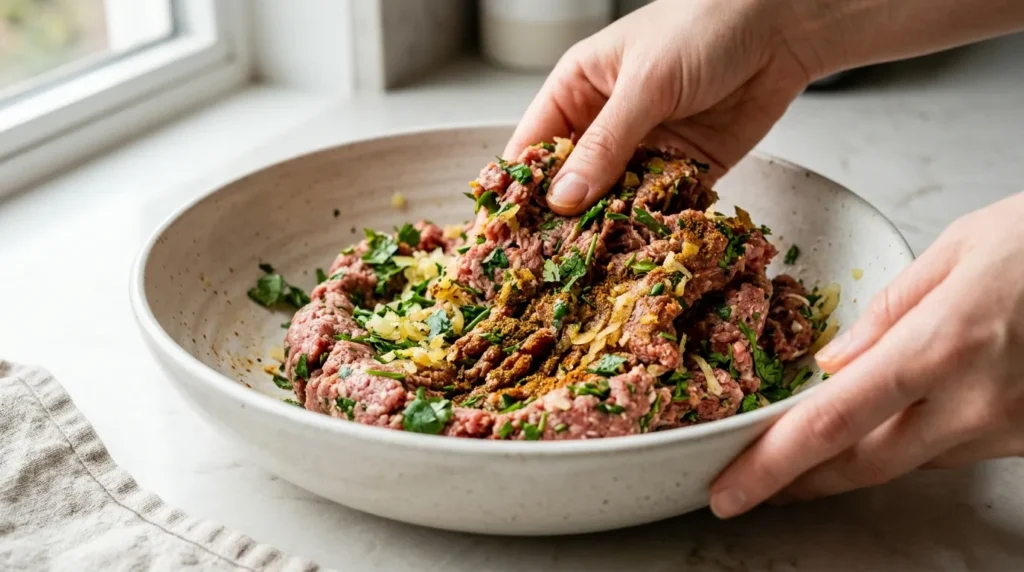
- Mix gently, using your fingertips rather than your palms, turning the mixture over on itself just until everything is evenly distributed. Stop as soon as you no longer see streaks of unmixed spice.
- Test the seasoning by cooking a small patty before shaping the full batch.
- Shape the meatballs, handling the meat as little as possible once you’re happy with the seasoning.
Visual cue: the mixture should look evenly speckled with green herbs and hold together loosely when you close your hand around a portion — not sticky or pasty.
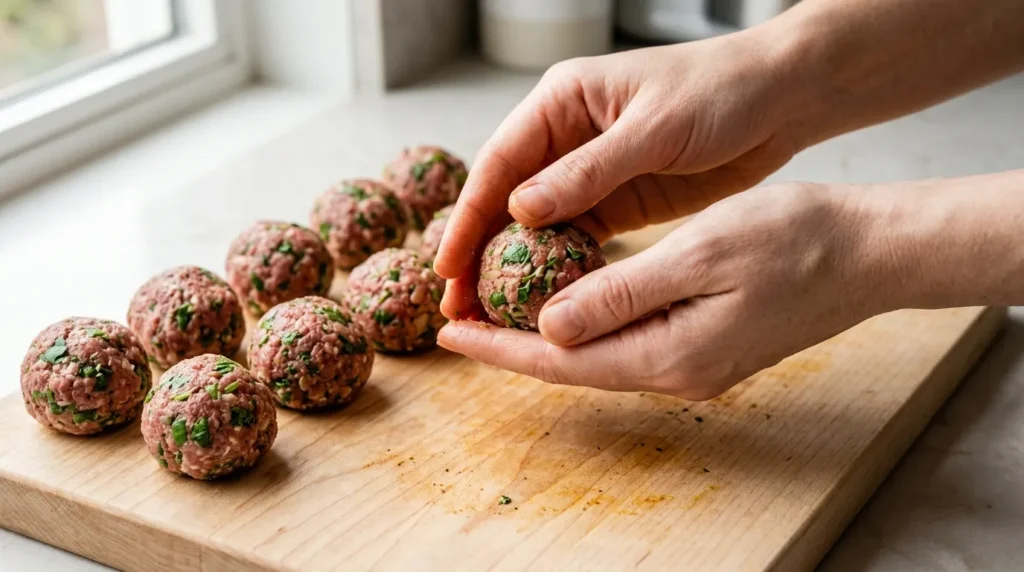
How to Shape Moroccan Meatballs
- Size: aim for roughly 1.5 inches (about the size of a golf ball) for meatballs destined for tomato sauce or tagine; slightly larger, flattened ovals work well for grilling or pan-frying.
- Consistency matters. Uniform size means uniform cooking time — a batch with mismatched sizes will always have some meatballs overdone before the others finish.
- Roll gently, using light pressure. Squeezing too hard compacts the meat and can cause cracking as it cooks, since the surface tightens faster than the interior.
- Wet or oiled hands prevent the mixture from sticking and reduce the temptation to overwork the meat while shaping.
- Refrigerate for 15–20 minutes before cooking if your kitchen is warm or the mixture feels soft — this firms the fat slightly and helps the meatballs hold their shape in the pan or sauce.
Cooking Methods Compared
| Method | Flavor | Texture | Ease | Best For | Potential Problems |
|---|---|---|---|---|---|
| Pan-Frying | Deep, browned, caramelized crust | Firm exterior, tender interior | Easy, quick | Serving with bread and salad | Can dry out if overcooked or pan is too hot |
| Baking | Even, mild, less caramelization | Softer, more uniform | Very easy, hands-off | Large batches | Less browning/flavor development than a pan |
| Grilling | Smoky, charred edges | Firmer, slightly drier | Moderate (needs attention) | Skewered kefta, outdoor cooking | Can dry out fast over high heat |
| Simmering in Sauce | Sauce-infused, softer overall | Very tender, almost braised | Easy, mostly hands-off | Tomato sauce and tagine preparations | Meatballs can fall apart if stirred too roughly |
For the primary tomato-sauce version of this recipe, a quick sear in a hot pan followed by a gentle simmer in the sauce gives the best of both worlds: a browned exterior for flavor, and a tender interior from finishing in liquid.
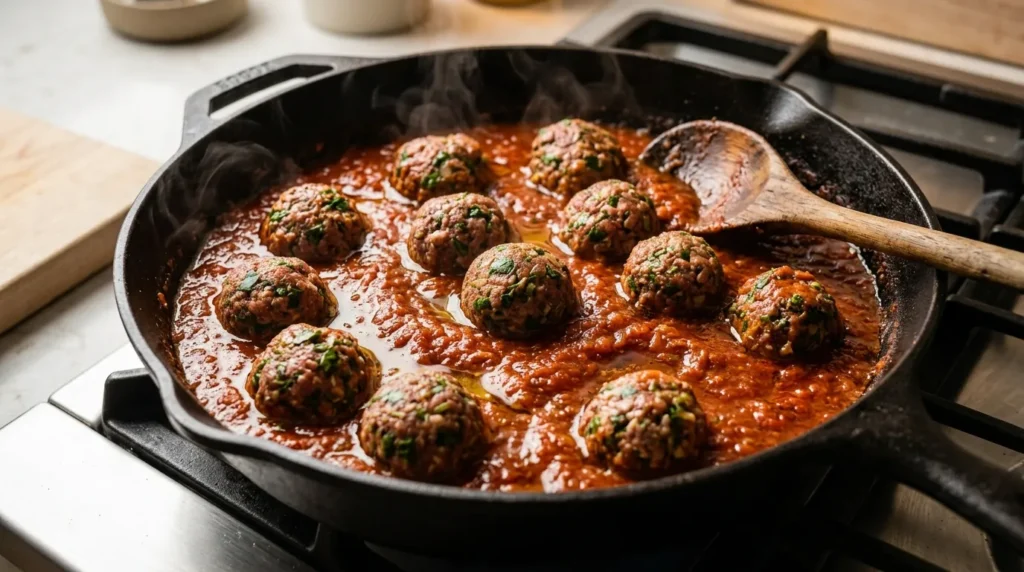
Moroccan Lamb Meatballs in Tomato Sauce
The sauce for Moroccan kefta is built differently from an Italian marinara — it leans on cumin and paprika rather than basil and oregano, and it’s usually simpler and more concentrated.
- Tomatoes — fresh, grated, or canned crushed tomatoes form the base.
- Garlic — added early, cooked gently so it doesn’t turn bitter.
- Olive oil — the cooking fat, and often finished with a small drizzle at the end.
- Paprika and cumin — the same warm spices used in the meat itself, tying the sauce and meatballs together.
- Fresh herbs — a small handful of chopped cilantro or parsley stirred in near the end for brightness.
- Seasoning — salt and pepper, adjusted after the sauce has reduced, since flavors concentrate as it simmers.
Simmer the sauce until it thickens slightly and turns a deep brick-red, then slide the seared meatballs in and let them finish cooking gently, uncovered or partly covered, for about 12–15 minutes. The sauce should coat a spoon lightly, not run watery, and it should smell distinctly of cumin and warm paprika rather than sweet, herby tomato sauce.

Kefta Tagine
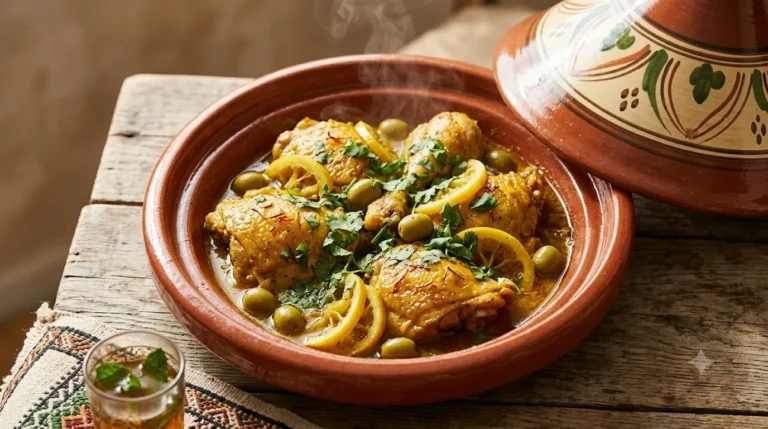
Kefta tagine takes the tomato-sauce preparation one step further by finishing everything in a traditional conical clay tagine, which concentrates steam and slowly thickens the sauce against the meatballs. The dish is closely associated with home cooking and small restaurants across Morocco, and it’s one of the more recognizable kefta preparations outside the country as well.
In many households, raw or lightly cooked eggs are cracked directly over the top of the simmering sauce during the final few minutes of cooking, then covered so the eggs poach gently in the residual heat and steam — a variation sometimes called kefta mkaouara. This egg addition is optional and not universal; plenty of families and cooks make kefta tagine without it.
The key difference between “meatballs with sauce” and true kefta tagine is the vessel and the slower, more contained heat: a tagine’s shape traps moisture and returns it to the dish, producing a sauce that reduces more gently and a texture that’s noticeably more tender than a wide, open skillet would give you. If you don’t own a tagine, a heavy lidded skillet or shallow Dutch oven gets you close, though the reduction will happen a bit faster since more steam escapes.
Step-by-Step Instructions
Step 1 — Make the kefta mixture What to do: Combine ground lamb, grated onion, minced garlic, chopped cilantro and parsley, cumin, paprika, ginger, salt, and pepper in a bowl. Why it matters: Even distribution of herbs and spices is what gives every bite consistent flavor. Visual cue: The mixture looks uniformly green-flecked with no dry spice pockets. Common mistake: Overmixing, which compacts the meat and makes the final texture dense. Chef tip: Mix with fingertips, not a spoon or stand mixer — you’ll feel when it’s evenly combined.
Step 2 — Shape the meatballs What to do: Roll into uniform 1.5-inch balls using light, even pressure. Why it matters: Uniform size ensures they finish cooking at the same time. Visual cue: Meatballs hold a round shape without cracking on the surface. Common mistake: Packing them too tightly, which produces a dense, rubbery bite. Chef tip: Keep a small bowl of water or oil nearby to keep your hands from sticking.
Step 3 — Sear the meatballs What to do: Heat olive oil in a wide pan over medium-high heat and brown the meatballs on two or three sides, about 4–5 minutes total. Why it matters: Browning builds flavor through the Maillard reaction and helps the meatballs hold together in sauce. Visual cue: A deep golden-brown crust, not yet cooked through in the center. Common mistake: Crowding the pan, which steams instead of sears the meatballs. Chef tip: Work in batches if needed — a crowded pan drops the temperature and prevents browning.
Step 4 — Build the tomato sauce What to do: In the same pan, sauté garlic briefly, then add crushed tomatoes, paprika, cumin, salt, and a splash of water. Why it matters: Using the same pan picks up the browned bits left from searing, adding depth to the sauce. Visual cue: The sauce turns a deep red and begins to bubble gently. Common mistake: Rushing the sauce before the raw tomato flavor has cooked off. Chef tip: Let the sauce simmer uncovered for 5 minutes before adding the meatballs so it has a chance to concentrate.
Step 5 — Simmer the meatballs in sauce What to do: Nestle the seared meatballs into the sauce, cover partially, and simmer gently for 12–15 minutes. Why it matters: Gentle simmering finishes cooking the meatballs without drying them out, while they absorb flavor from the sauce. Visual cue: Meatballs reach 160°F (71°F) at the center and the sauce has thickened to coat a spoon. Common mistake: Boiling hard, which toughens the meat and breaks the meatballs apart. Chef tip: Spoon sauce over the tops of the meatballs occasionally instead of stirring, so they stay intact.
Step 6 — Finish and rest What to do: Remove from heat, scatter fresh herbs over the top, and let the dish rest for 3–5 minutes before serving. Why it matters: Resting allows juices to redistribute and the sauce to settle. Visual cue: The surface glistens with a thin layer of released oil, and the sauce has stopped actively bubbling. Common mistake: Serving immediately, which can mean thinner sauce and drier meatballs. Chef tip: A final drizzle of good olive oil right before serving brightens the whole dish.
Cooking Timeline
| Stage | Action | Approximate Time | Visual Cue |
|---|---|---|---|
| Preparation | Chop herbs, grate onion and garlic | 10 minutes | Herbs finely chopped, onion released liquid |
| Mixing | Combine lamb with herbs and spices | 3–5 minutes | Evenly speckled, no dry spots |
| Resting | Refrigerate shaped meatballs | 10–15 minutes | Meatballs firm to the touch |
| Shaping | Roll into uniform balls | 5–10 minutes | Consistent 1.5-inch size |
| Searing | Brown meatballs in oil | 4–5 minutes | Deep golden crust |
| Sauce building | Simmer tomato base | 5–7 minutes | Deep red, slightly thickened |
| Simmering | Cook meatballs in sauce | 12–15 minutes | Internal temp of 160°F, sauce coats a spoon |
| Finishing | Add herbs, rest | 3–5 minutes | Sauce settled, aroma of cumin and herbs |
| Serving | Plate with bread or couscous | — | Sauce glossy, meatballs tender when pressed |
Common Mistakes
- Dry meatballs — usually from lean lamb with no added fat. Fix by using 80/20 lamb or working in a spoonful of olive oil.
- Dense, rubbery texture — caused by overmixing. Fix by combining ingredients only until evenly distributed.
- Overmixing during shaping — repeatedly reshaping the same meatball compacts it further. Shape once and move on.
- Too much salt — easy to do since herbs and spices can mask saltiness while raw. Always taste-test a cooked sample first.
- Too many competing spices — stacking cinnamon, chili, extra cumin, and ras el hanout all at once muddies the flavor. Keep the core profile simple.
- Uneven meatball sizes — leads to some pieces overcooked while others are underdone. Weigh or eyeball portions consistently.
- Burning the spices — adding paprika or cumin directly to very hot oil can scorch them bitter within seconds. Add spices to the sauce base at a lower heat, or bloom them briefly before the tomatoes go in.
- Overcooking in the pan before saucing — searing too long dries the exterior before the meatballs ever hit the sauce. Sear just until browned, not cooked through.
- Watery sauce — using tomatoes with excess liquid without reducing. Simmer uncovered longer, or drain excess liquid from canned tomatoes first.
- Bland sauce — under-salting or skipping the initial garlic sauté, which builds a flavor base. Taste and adjust as the sauce reduces.
- Excessive oil — using too much oil for searing leaves a greasy finished dish. A thin, even coating in the pan is enough.
- Cold meat straight from mixing to a hot pan — can cause uneven cooking. Let shaped meatballs sit at room temperature for a few minutes before searing.
- Crowding the pan — drops the pan’s temperature and steams rather than sears the meatballs. Cook in batches if needed.
- Skipping the taste test — committing an entire batch to shape before confirming seasoning wastes the whole mix if it’s off. Always cook a small spoonful first.
- Stirring the sauce roughly once meatballs are in — breaks them apart. Spoon sauce over the top instead of stirring vigorously.
Chef Tips
- Grate the onion instead of dicing it — it disappears into the mixture and adds moisture.
- Chill your mixing bowl beforehand if your kitchen runs warm; cold fat holds its texture better.
- Use fresh herbs, not dried — dried cilantro and parsley don’t replicate the same brightness.
- Bloom your spices briefly in warm oil before adding tomatoes to deepen their flavor.
- Always cook a test patty before shaping the full batch.
- Wet your hands lightly before shaping to prevent sticking without adding extra oil to the meat.
- Don’t skip the sear — even meatballs headed for a long simmer benefit from browning first.
- Use a food thermometer rather than guessing doneness by color; ground lamb needs to reach 160°F.
- Let the sauce reduce before adding the meatballs so it doesn’t turn watery around them.
- Spoon, don’t stir, once the meatballs are simmering in sauce.
- Rest the finished dish for a few minutes before serving to let the sauce settle.
- Keep spice measurements level, not heaping — ground lamb carries flavor efficiently.
- If doubling the recipe, sear in batches rather than crowding one large pan.
- A splash of water in a too-thick sauce revives it without diluting the flavor much.
- Save a few whole herb leaves to scatter on top just before serving for a fresher finish than fully-cooked herbs.
Variations
- Moroccan Lamb Kefta Tagine — the meatballs finished slowly in a traditional clay tagine, producing a thicker, more concentrated sauce.
- Kefta with Tomato Sauce — the everyday skillet version, quicker and just as satisfying.
- Kefta with Eggs — eggs cracked over the simmering sauce near the end and gently poached in the residual heat, a well-known but optional addition.
- Grilled Moroccan Lamb Kefta — shaped onto skewers and grilled, closer to Morocco’s street-food kefta than the sauced version.
- Baked Moroccan Lamb Meatballs — a hands-off oven method, useful for larger batches or meal prep.
- Spicy Moroccan Lamb Meatballs — a modern adaptation adding cayenne or harissa for households that prefer more heat than the traditional profile typically carries.
- Lamb Kefta with Preserved Lemon — a few chopped preserved lemon pieces stirred into the sauce, common in households that keep preserved lemons on hand for other Moroccan dishes.
- Lamb Kefta with Vegetables — bell peppers, zucchini, or peas added to the simmering sauce, stretching the dish and adding texture.
Traditional preparations center on the herb-and-spice mixture described above; the egg, preserved lemon, vegetable, and spicy versions are common household adaptations rather than fixed historical requirements.
What to Serve With Moroccan Lamb Meatballs
- Moroccan bread (khobz) — a round, slightly dense loaf that’s the traditional way to scoop up sauce and meatballs, since utensils aren’t always used at the table.
- Couscous — steamed semolina couscous is a natural pairing, especially for the tomato-sauce or tagine versions, where the grains soak up extra sauce; our Moroccan Couscous Recipe walks through the traditional multi-stage steaming technique if you want to build a full spread.
- Moroccan salads — simple tomato-and-onion or cooked vegetable salads (zaalouk, taktouka) balance the richness of the lamb with acidity and freshness.
- Roasted vegetables — lightly spiced roasted carrots, zucchini, or eggplant echo the same warm spice profile without competing with it.
- Rice, where preferred — not traditional to Morocco specifically, but a practical, widely available option for readers who don’t have bread or couscous on hand.
If you’re feeding a larger table, kefta sits comfortably alongside our Chicken Tagine Recipe — the two dishes share a cumin-and-warm-spice backbone, so they don’t compete on the same spread.
Yogurt-based sauces are more closely associated with Levantine and South Asian kofta traditions than with Moroccan kefta, so they’re not included here as a primary pairing — though a simple dollop of plain yogurt on the side is a reasonable, non-traditional addition if you enjoy that combination.
Storage & Reheating
- Refrigerator: Store cooked meatballs and sauce in an airtight container for up to 3–4 days, which aligns with general USDA guidance for cooked ground meat dishes.
- Freezing cooked meatballs: Cool completely, then freeze in sauce for best texture, for up to 2–3 months for best quality.
- Freezing uncooked meatballs: Shape and freeze on a tray until solid, then transfer to a freezer bag; <cite index=”41-1″>the USDA recommends using ground lamb within 3 to 4 months of freezing for best quality</cite>.
- Reheating: Warm gently in a covered pan over low-medium heat with a splash of water or extra sauce to prevent drying out; reheat until steaming hot throughout.
- Sauce storage: Extra sauce keeps separately for the same 3–4 day refrigerator window and freezes well on its own.
- Food safety: <cite index=”42-1″>Ground meats including lamb should be cooked to a minimum internal temperature of 160°F as measured with a food thermometer</cite>, and leftovers should be reheated to a similar internal temperature before serving.
FAQ
What are Moroccan Lamb Meatballs? They’re seasoned balls of minced lamb, known as kefta, built with fresh cilantro, parsley, garlic, onion, and warm spices like cumin and paprika, cooked by pan-frying, grilling, or simmering in tomato sauce.
What is Moroccan kefta? Kefta is the Moroccan term for seasoned minced meat, most often lamb or beef, and it refers to a style of preparation rather than one single fixed recipe.
What spices are used in Moroccan meatballs? Cumin and sweet paprika are the two most common, often joined by ground ginger, black pepper, and sometimes a touch of ground coriander or cinnamon.
Can I use ground beef instead of lamb? Yes — ground beef with a similar fat content (around 80/20) works well and is a common substitution in households that prefer it or don’t have access to lamb.
How do I keep lamb meatballs tender? Use lamb with enough fat (around 80/20), mix the ingredients gently rather than kneading, and avoid overcooking; a food thermometer helps you stop at the right internal temperature.
Can I bake Moroccan Lamb Meatballs? Yes — baking at around 400°F for 15–18 minutes works well, especially for larger batches, though it browns the exterior less than pan-frying.
Can I freeze Moroccan Lamb Meatballs? Yes, both cooked and uncooked meatballs freeze well; uncooked meatballs are best used within 3–4 months for quality.
What should I serve with Moroccan Lamb Meatballs? Moroccan bread, couscous, and simple vegetable salads are the most traditional pairings, with roasted vegetables as another good option.
What is kefta tagine? It’s the version of this dish finished in a traditional Moroccan clay tagine, where the shape of the vessel traps steam and slowly thickens the sauce; eggs are sometimes added near the end in some households.
Can I add eggs to kefta tagine? Yes — cracking eggs over the sauce during the final few minutes and covering the dish to let them gently poach is a well-known variation, though not every family makes it this way.
Are Moroccan Lamb Meatballs spicy? Not typically. The flavor profile is warm and aromatic from cumin and paprika rather than hot; cayenne or chili is an optional addition for households that prefer more heat.
What herbs are used in Moroccan kefta? Fresh cilantro and fresh parsley are the two herbs most consistently used, almost always together rather than as substitutes for one another.
What is the difference between Moroccan kefta and kofta? “Kofta” is the broader term for this family of seasoned ground-meat dishes across the Middle East, the Balkans, and South Asia; “kefta” is the Moroccan expression of that tradition, distinguished by its heavy use of cilantro and parsley and its typical pairing with cumin-and-paprika tomato sauce.
What cut of lamb is best for meatballs? Ground lamb from the shoulder, or a shoulder-and-leg blend, gives the best balance of tenderness and fat content for kefta.
Can Moroccan Lamb Meatballs be made ahead? Yes — the mixture can be shaped and refrigerated up to a day ahead, or the full cooked dish can be made a day in advance and reheated gently, since the flavor often deepens overnight.

Conclusion
Moroccan Lamb Meatballs come down to a short list of things done well: lamb with enough fat, fresh herbs worked gently into the mix, a spice profile built on cumin and paprika rather than piled-on heat, and a cooking method — pan-fried, simmered, or finished in a tagine — that matches how you plan to serve them. None of it requires special equipment, and the techniques in this guide (grating the onion, testing the seasoning before shaping, spooning instead of stirring once the meatballs are in sauce) are the same small habits that separate a dry, dense batch from a tender one. With the mixture, sauce, and timing covered here, you have what you need to make kefta that holds together, tastes balanced, and reheats just as well the next day.
4. RECIPE CARD
Recipe Name: Moroccan Lamb Meatballs (Kefta) in Tomato Sauce Prep Time: 25 minutes Cook Time: 25 minutes Total Time: 50 minutes Servings: 4 (about 16–18 meatballs) Cuisine: Moroccan Course: Main Dish Difficulty: Easy–Moderate Calories: Approximately 380 kcal per serving (estimate)
Ingredients
For the meatballs:
- 1 lb (450g) ground lamb, 80/20 fat ratio
- 1/2 cup finely chopped fresh cilantro
- 1/4 cup finely chopped fresh parsley
- 1 small onion, grated
- 3 garlic cloves, minced
- 1 1/2 tsp ground cumin
- 1 tsp sweet paprika
- 1/2 tsp ground ginger
- 1/2 tsp black pepper
- 3/4 tsp salt
For the tomato sauce:
- 2 tbsp olive oil
- 3 garlic cloves, minced
- 1 can (14 oz) crushed tomatoes
- 1 tsp sweet paprika
- 1/2 tsp ground cumin
- 1/2 cup water
- Salt, to taste
- 2 tbsp chopped fresh cilantro or parsley, for finishing
Instructions
- In a bowl, gently combine ground lamb, cilantro, parsley, grated onion, garlic, cumin, paprika, ginger, black pepper, and salt. Mix just until evenly distributed.
- Cook a small spoonful of the mixture in a hot pan to taste-test the seasoning; adjust if needed.
- Shape the mixture into 1.5-inch meatballs and refrigerate for 10–15 minutes.
- Heat olive oil in a wide pan over medium-high heat. Sear the meatballs in batches until browned on two or three sides, about 4–5 minutes total. Remove and set aside.
- In the same pan, sauté garlic briefly, then add crushed tomatoes, paprika, cumin, and water. Simmer uncovered for 5–7 minutes until slightly thickened.
- Return the meatballs to the sauce, cover partially, and simmer gently for 12–15 minutes, spooning sauce over the tops occasionally, until the meatballs reach an internal temperature of 160°F.
- Remove from heat, scatter fresh herbs over the top, and rest for 3–5 minutes before serving.
Chef Notes
- Sear in batches rather than crowding the pan for better browning.
- A splash of water can loosen the sauce if it reduces too far.
- Spoon sauce over the meatballs instead of stirring to keep them intact.
Storage
Refrigerate in an airtight container up to 3–4 days. Freeze cooked meatballs in sauce up to 2–3 months for best quality; freeze uncooked shaped meatballs up to 3–4 months.
Nutrition (Estimate Per Serving)
Nutrition values are estimates and will vary based on exact ingredients and portion sizes.
- Calories: ~380 kcal
- Protein: ~24g
- Fat: ~28g
- Carbohydrates: ~7g
- Fiber: ~2g
- Sodium: ~520mg