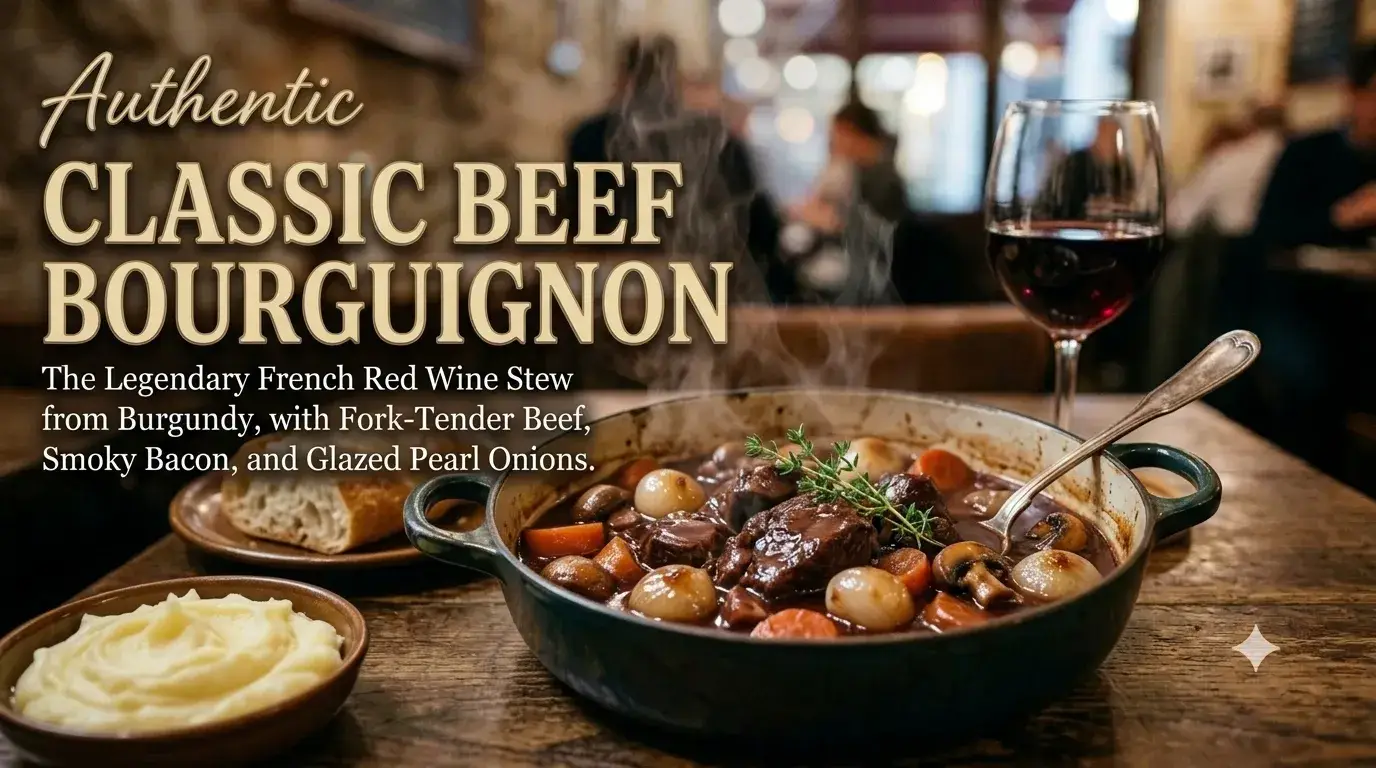
Classic Beef Bourguignon: The Legendary French Red Wine Beef Stew That Defines Burgundy Cuisine
Lift the lid off a pot of properly made Beef Bourguignon and the smell alone tells you it’s been cooking for hours. Deep, winey, a little smoky from the bacon, with the sweetness of slow-cooked carrots underneath. By the time it hits the table, the beef doesn’t need a knife. A fork does the whole job.
Beef Bourguignon is proof that a cheap cut of meat, cooked with patience and a decent bottle of wine, can outclass almost anything on a fine-dining menu. It started as farmhouse cooking in Burgundy, using tough beef and local Pinot Noir because that’s what was on hand, and it’s ended up as one of the most recognized French dishes in the world.
This guide covers where Beef Bourguignon actually comes from, why braising turns tough beef silky, which cut of meat and which wine actually make a difference, and the exact technique for building a sauce with real depth. By the end, you’ll understand this dish well enough to make it without leaning on a recipe card.
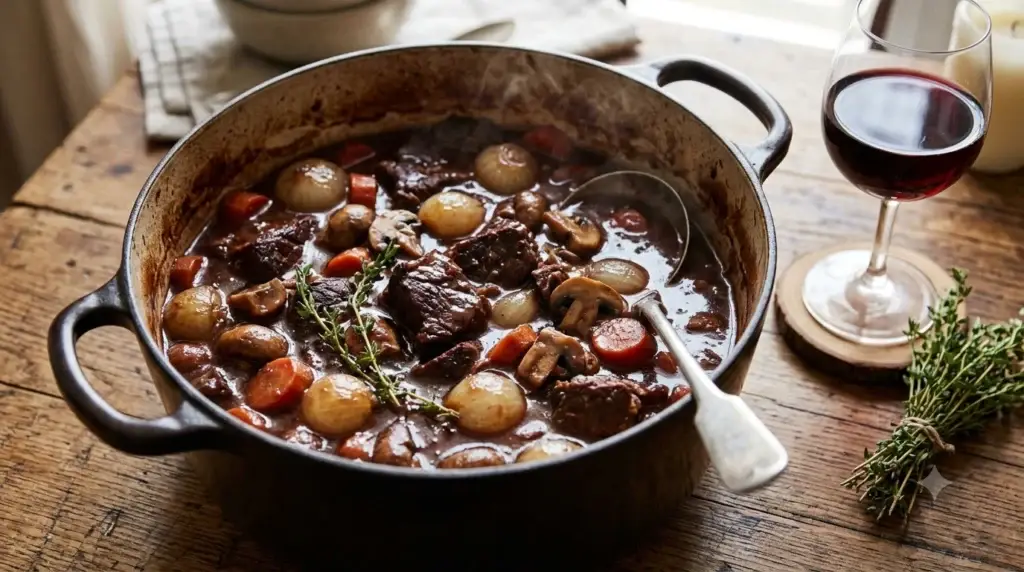
Table of Contents
- What Is Beef Bourguignon?
- The History of Beef Bourguignon
- Why Beef Bourguignon Is So Special
- The Science of Braising
- Choosing the Best Beef
- The Wine Debate
- Ingredients Explained
- Step-by-Step Technique
- Why Mushrooms and Pearl Onions Are Cooked Separately
- Equipment Needed
- Common Mistakes
- Pro Chef Tips
- Variations
- Storage & Reheating
- What to Serve with Beef Bourguignon
- Frequently Asked Questions
- Recipe Card
- Conclusion
What Is Beef Bourguignon?
Beef Bourguignon, or boeuf bourguignon, is a slow-braised beef stew cooked in red Burgundy wine with bacon, mushrooms, pearl onions, and carrots. The name simply means “beef in the style of Burgundy,” the wine-producing region in east-central France where the dish originated.
It’s one of France’s most famous exports, recognized well beyond French cooking circles, largely because it delivers so much flavor from genuinely humble ingredients. There’s no expensive cut of meat involved and no complicated technique beyond patience. What makes the dish is time, a good wine, and a proper sear.
Burgundy farmhouses built this dish out of necessity. Beef cuts too tough to roast, combined with local wine, made an economical meal that fed a family for days. Slow braising was simply the only way to make that tough beef edible, and it turned out to produce something far better than tender meat cooked quickly ever could. That transformation, from cheap and tough to rich and fork-tender, is the whole reason this dish has survived and traveled as far as it has.
The History of Beef Bourguignon
Burgundy has been producing wine for well over a thousand years, and Pinot Noir is the region’s defining red grape, known for its earthy, fruit-forward character and relatively high acidity compared to heavier reds. That acidity matters enormously in a braise, since it helps tenderize the meat and balances the richness of a long-cooked sauce.
Long before Beef Bourguignon became a restaurant dish, it was farmhouse cooking, built around whatever wine and beef a household already had. Braising tough cuts in wine over low heat for hours was a practical solution to feeding a family well without needing an expensive cut of meat.
In the United States, Julia Child is largely responsible for introducing the dish to a wide home-cooking audience, featuring a detailed recipe for it in “Mastering the Art of French Cooking” in 1961 and later on her television program. Her version, with its emphasis on proper searing, technique, and real French method, helped establish Beef Bourguignon as a benchmark dish for home cooks aiming to learn serious French cooking, and it remains one of the dishes most associated with her legacy today.
Why Beef Bourguignon Is So Special
Tender, fork-soft beef. Hours of slow braising break down tough connective tissue until the meat needs almost no chewing at all.
Rich, wine-infused sauce. The braising liquid reduces and thickens as it cooks, concentrating the wine’s flavor into a deep, glossy sauce that coats each bite.
Smoky lardons. Bacon, cooked until crisp and rendered, adds a smoky, savory backbone that runs through the entire dish.
Pearl onions. Cooked separately until glazed and slightly caramelized, they bring a pop of sweetness against the savory sauce.
Mushrooms. Browned in a separate pan, they add an earthy depth and a distinct textural contrast to the soft beef.
Layered flavors. Nothing in this dish happens all at once. The bacon, the sear, the wine reduction, and the slow braise all build on top of each other, which is exactly why the finished dish tastes so much deeper than the sum of its ingredients.
The Science of Braising
Understanding what’s actually happening in the pot makes it far easier to get consistent, restaurant-quality results.
Collagen breaking down into gelatin. Tough cuts of beef are full of connective tissue, mostly collagen, which is chewy and unpleasant when raw or quickly cooked. Held at a low, steady simmer for hours, that collagen slowly dissolves into gelatin, which is soft, silky, and part of why braised beef feels so tender.
Why chuck roast is ideal. Chuck has a high concentration of connective tissue and decent marbling, both of which reward long, slow cooking. Leaner cuts don’t have enough collagen to break down and tend to dry out instead of turning tender.
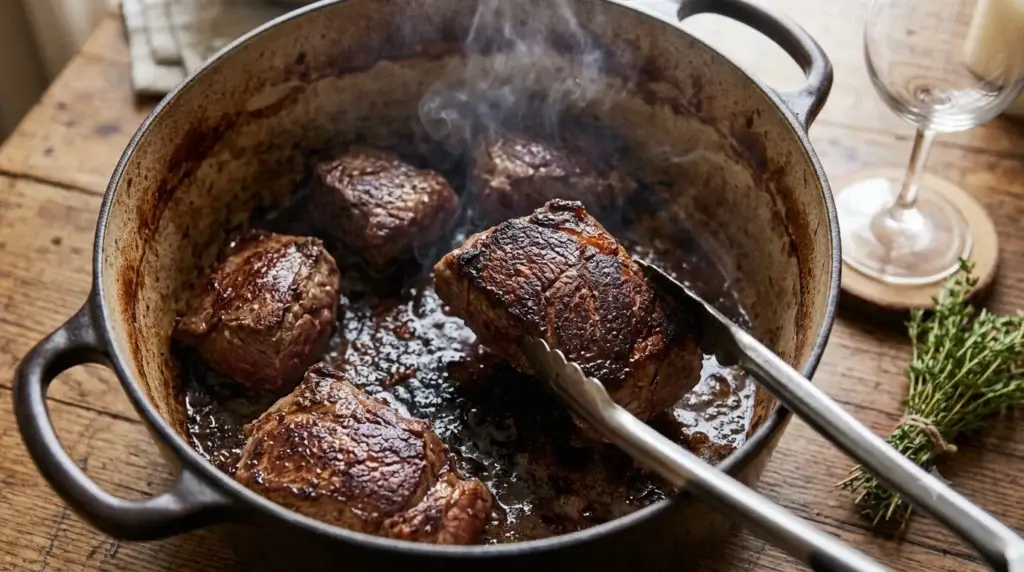
Why searing builds flavor. Browning the beef before braising triggers the Maillard reaction, a chemical process between proteins and sugars that creates hundreds of new flavor compounds and a deep brown color. Skipping this step leaves the final dish tasting flat, no matter how long it braises afterward.
Why low and slow cooking produces tender beef. A hard boil cooks meat too fast, tightening the proteins before the collagen has time to convert. A gentle simmer, well below a boil, gives that conversion time to happen fully without drying out the meat.
Alcohol evaporation and flavor concentration. As the wine simmers over hours, much of its alcohol content cooks off, while the flavor compounds it carried remain and concentrate. What’s left is a sauce with all of the wine’s depth and none of its raw, sharp alcohol bite.
Why reducing the wine creates a silky sauce. As liquid evaporates during the long braise, the sauce naturally thickens and its flavors intensify, turning what started as a fairly thin liquid into something glossy and substantial enough to coat the meat properly.
Choosing the Best Beef
| Cut | Fat & Collagen | Texture After Braising | Best For |
|---|---|---|---|
| Chuck roast | High collagen, good marbling | Extremely tender, holds shape well | The classic, most reliable choice |
| Boneless short ribs | High fat and collagen | Very rich, almost falls apart | Excellent, slightly richer result |
| Brisket | Moderate collagen, leaner | Tender but can dry out if overcooked | Works, needs careful attention |
| Beef shank | Very high collagen | Extremely tender, very rich sauce from bone marrow | Great for extra body in the sauce |
| Generic stew meat | Inconsistent, mixed cuts | Uneven texture, some pieces dry | Least reliable option |
Chuck roast, cut into large chunks yourself rather than buying pre-cut “stew meat,” is the best choice for most home cooks. Pre-packaged stew meat is often a mix of different cuts and trimmings, which cook unevenly, some pieces turning tender while others stay tough. Boneless short ribs make an excellent, slightly richer alternative if you don’t mind the higher cost.
The Wine Debate
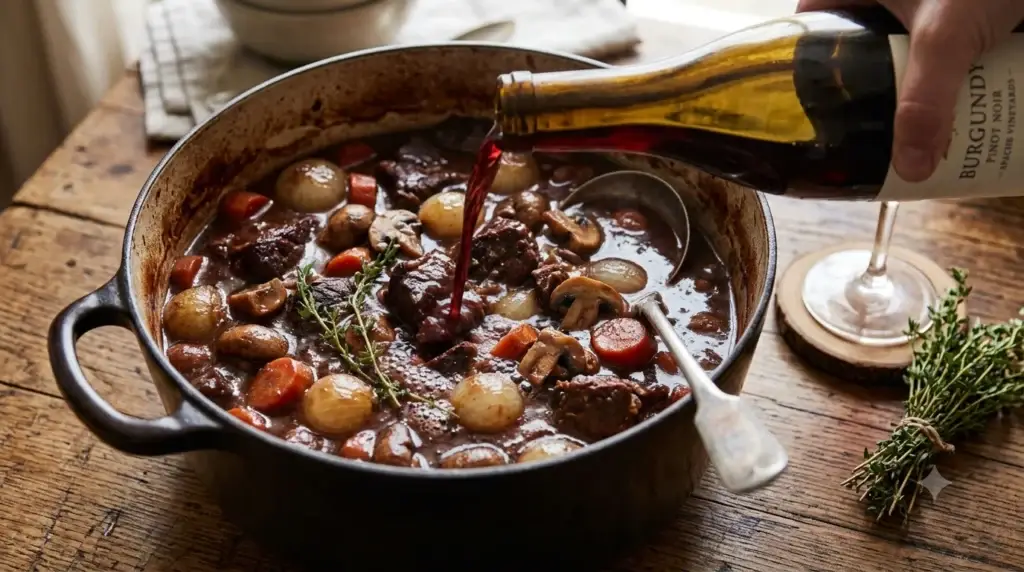
Traditional Beef Bourguignon calls for red Burgundy wine, made from Pinot Noir, since that’s the wine actually produced in the region the dish is named after. Its bright acidity and moderate tannins make it especially well-suited to a long braise.
Affordable alternatives that work well include other Pinot Noir bottlings from outside Burgundy, Côtes du Rhône, and, for a slightly bolder result, Merlot or Cabernet Sauvignon. Any of these can produce an excellent braise, especially since the wine’s character mellows and changes considerably over hours of cooking.
Wines to avoid are anything labeled “cooking wine” from the grocery store, which typically contains added salt and lower-quality grapes, producing a flat, overly salty sauce. Very sweet wines and anything heavily oaked can also throw off the balance of the finished dish.
Cooking wine myths. The old saying “never cook with a wine you wouldn’t drink” holds up here, but that doesn’t mean you need an expensive bottle. A solid, mid-range bottle in the fifteen to twenty-five dollar range is plenty for an excellent result, since the wine’s character will change substantially over the course of a multi-hour braise regardless of price point.
Is expensive wine necessary? No. Once wine spends hours simmering with beef, bacon, and aromatics, subtle differences that matter in a glass of wine on its own become far less noticeable. Spend your money on quality beef instead, and use a decent, drinkable mid-range bottle for the sauce.
Ingredients Explained
Beef (chuck roast, cut into large chunks) is the centerpiece and provides the collagen that turns silky over hours of braising. Bacon or lardons, rendered until crisp, add smokiness and a savory fat that starts the whole flavor base. Carrots, cut into thick pieces, hold their shape through the long braise and add sweetness. Pearl onions, cooked separately and added near the end, contribute a glazed sweetness and visual appeal. Mushrooms, browned separately, bring earthy depth and a firmer texture against the soft beef. Garlic rounds out the aromatic base. Tomato paste, cooked briefly to deepen its flavor, adds a subtle sweetness and helps build the sauce’s color and body. Flour, used to lightly coat the beef before searing, helps thicken the finished sauce as it braises. Beef stock supplements the wine, giving the braising liquid more savory depth than wine alone could provide. Red wine is the primary braising liquid and the dish’s defining flavor. Bouquet garni (typically thyme, bay leaf, and parsley tied together) infuses the braise with herbal depth without leaving loose herb bits in the finished sauce. Butter, used to finish the sauce, adds a final layer of richness and a glossy sheen.
Step-by-Step Technique
1. Prepare the beef. Cut chuck roast into large, even chunks, roughly two inches across, so they cook at a consistent rate.
2. Dry the meat. Pat the beef completely dry with paper towels. Any surface moisture will steam instead of sear, preventing proper browning.
3. Season. Season the beef generously with salt and pepper, then dust lightly with flour.
4. Sear. Working in batches so you don’t crowd the pan, sear the beef in hot fat until deeply browned on all sides. Crowding the pot drops the temperature and steams the meat instead of browning it.
5. Cook the bacon. In the same pot, render diced bacon until crisp, then set it aside with the seared beef.
6. Build the flavor base. Sauté onions, carrots, and garlic in the rendered fat until softened, then stir in tomato paste and cook briefly to deepen its flavor.
7. Deglaze. Pour in a portion of the wine, scraping up all the browned bits stuck to the bottom of the pot. That fond carries enormous flavor.
8. Add the remaining wine and stock. Return the beef and bacon to the pot, add the bouquet garni, and bring to a gentle simmer.
9. Slow braise. Cover and cook low and slow, either in a 325°F oven or on the stovetop at a bare simmer, for 2.5 to 3.5 hours, until the beef is completely fork-tender.
10. Cook the pearl onions. Separately, glaze pearl onions in butter and a splash of stock until golden and tender.
11. Cook the mushrooms. Separately, sear mushrooms in a hot pan until deeply browned, since crowding them in the braising liquid would only steam them.
12. Finish the sauce. Once the beef is tender, remove the bouquet garni, stir in the browned mushrooms and glazed pearl onions, and finish with a knob of butter for gloss and richness.
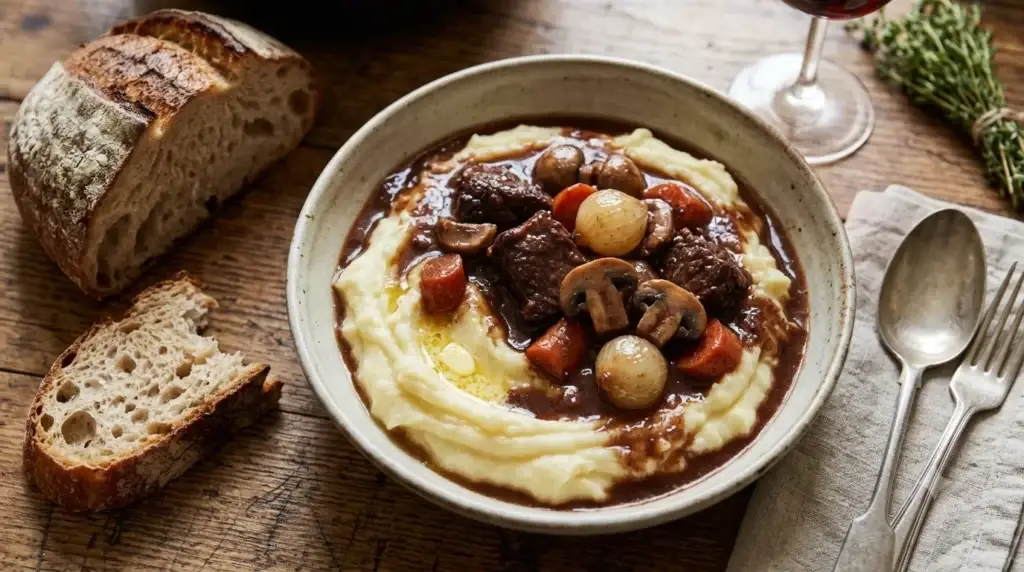
13. Serve. Ladle over mashed potatoes or buttered noodles, and serve hot, with the sauce visibly clinging to every piece of beef.
Visual cues: the sauce should look deep garnet in color and glossy, never cloudy or thin. Texture cues: beef should offer no resistance to a fork, and the sauce should coat the back of a spoon. Color cues: the beef itself should be deeply browned from the initial sear, not grey, which would signal it was steamed rather than seared.
Why Mushrooms and Pearl Onions Are Cooked Separately
Cooking mushrooms and pearl onions apart from the main braise isn’t extra fuss for no reason. Mushrooms release a great deal of water when cooked, and if added directly to the braising liquid, they’d simmer rather than brown, missing out on the deep, savory flavor that comes from a proper sear in a hot, dry pan.
Pearl onions cooked directly in the braise for hours would turn mushy and lose their shape entirely. Cooked separately and glazed in butter, they hold their form and develop a light caramelized sweetness that a long simmer would destroy.
This is standard French technique: components that need different cooking conditions are cooked separately, then combined at the end. It takes an extra pan and a few more minutes, but the difference in both texture and flavor is immediately noticeable, and it’s part of what separates a truly great Bourguignon from an average one.
Equipment Needed
- Dutch oven — heavy, oven-safe, and essential for even heat during the long braise
- Heavy skillet — for browning mushrooms and pearl onions separately
- Wooden spoon — for scraping up fond without scratching the pot
- Fine mesh strainer — useful if you want a perfectly smooth sauce, straining out solids before serving
- Chef’s knife — for cutting the beef and vegetables into even pieces
- Instant-read thermometer — helpful for confirming a gentle simmer rather than a hard boil
Common Mistakes
- Crowding the pan while searing. Drops the temperature and steams the meat instead of browning it. Fix: sear in small batches.
- Skipping the sear entirely. Produces a flat-tasting stew missing the depth the Maillard reaction provides. Fix: always brown the beef properly first, even though it takes extra time.
- Using pre-cut “stew meat.” Often a mix of different cuts that cook unevenly. Fix: cut a chuck roast yourself into even pieces.
- Braising at too high a temperature. Boils rather than gently simmers the meat, resulting in tough, dry texture despite the long cook time. Fix: keep the liquid at a bare simmer throughout.
- Not deglazing the pan. Leaves behind concentrated flavor stuck to the bottom of the pot. Fix: always deglaze with wine and scrape thoroughly.
- Using low-quality cooking wine. Often overly salty and flat-tasting. Fix: use a decent, drinkable mid-range bottle instead.
- Adding mushrooms directly to the braise. Steams them instead of browning them, missing out on flavor. Fix: always sear mushrooms separately.
- Cooking pearl onions in the braising liquid for hours. Turns them mushy and shapeless. Fix: glaze them separately and add near the end.
- Rushing the braise time. Pulling the beef too early leaves tough, chewy meat. Fix: give it the full 2.5 to 3.5 hours, testing for fork-tenderness rather than watching the clock alone.
- Not tasting and adjusting the sauce before serving. Can leave the dish under-seasoned or too acidic. Fix: taste at the end and adjust with salt or a touch more stock if needed.
- Using too little liquid. Leaves the beef partially exposed and cooking unevenly. Fix: make sure the meat is mostly submerged throughout the braise.
- Skipping the flour step. Produces a noticeably thinner sauce. Fix: dust the beef lightly with flour before searing to help thicken the finished sauce naturally.
- Not removing the bouquet garni before serving. Leaves stray herb stems in the final dish. Fix: tie the herbs together for easy removal, and take them out once their job is done.
- Serving the dish immediately after cooking. Misses the flavor development that comes from resting. Fix: whenever possible, let it rest, or better yet, refrigerate overnight and reheat.
- Overcooking the vegetables in the base. Carrots and onions cooked too long in the initial sauté turn mushy by the time the dish is fully braised. Fix: cook the base vegetables just until softened, since they’ll continue cooking throughout the braise.
Pro Chef Tips
- Pat the beef completely dry before searing for the best possible crust.
- Sear in batches, never crowding the pot, even if it takes longer.
- Use a heavy-bottomed Dutch oven for the most even heat throughout the braise.
- Reserve some rendered bacon fat to sear the beef in for extra flavor.
- Deglaze thoroughly, scraping every bit of fond off the bottom of the pot.
- Cook the tomato paste briefly before adding liquid to deepen its flavor and remove any raw taste.
- Use a wine you’d actually enjoy drinking, even if it’s a modestly priced bottle.
- Keep the braise at the barest simmer, just a few small bubbles at a time.
- Check the beef for tenderness starting around the 2.5-hour mark rather than assuming a fixed time.
- Make the dish a day ahead whenever possible — the flavor improves significantly overnight.
- Skim excess fat off the top of the sauce before serving for a cleaner finish.
- Sear mushrooms in a very hot, dry pan for the best browning and least moisture retention.
- Glaze pearl onions with a touch of sugar and butter for a classic French finish.
- Finish the sauce with a small knob of cold butter, swirled in off the heat, for extra shine.
- Use a fine mesh strainer if you want an ultra-smooth sauce without the solid aromatics.
- Warm your serving bowls before plating so the dish doesn’t cool too quickly.
- Add a splash of fresh wine at the very end if the sauce tastes like it’s lost some brightness.
- Taste the sauce at multiple stages, not just at the end, to track how the flavor develops.
- Use bone-in beef shank alongside chuck for an even richer, more gelatinous sauce.
- Let the finished dish rest for at least 15 minutes before serving so the sauce settles and thickens slightly.
Variations
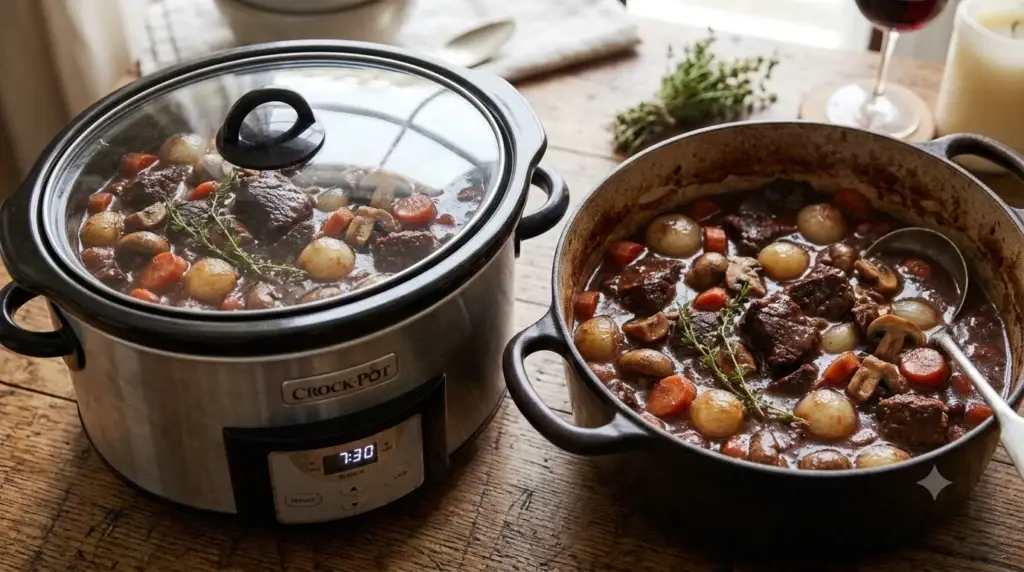
Slow Cooker Beef Bourguignon: Sear the beef and build the flavor base on the stovetop first, then transfer everything to a slow cooker and cook on low for 7 to 8 hours.
Instant Pot Beef Bourguignon: Use the sauté function for searing and building the base, then pressure cook on high for about 35 minutes with a natural release.
Oven-only version: After searing and building the base on the stovetop, transfer the covered pot to a 325°F oven for the entire braising time, which produces even, hands-off heat.
Gluten-free version: Substitute a gluten-free flour blend or cornstarch slurry for the flour used to coat the beef and thicken the sauce.
Bourguignon with short ribs: Substitute boneless short ribs for chuck roast for an even richer, more decadent version of the dish, with a slightly shorter braising time due to the higher fat content.
Storage & Reheating
Refrigeration: Beef Bourguignon keeps well in an airtight container in the refrigerator for up to 4 days, and the flavor genuinely improves after a day or two as the ingredients continue to meld. Freezing: The dish freezes exceptionally well for up to 3 months, since braised beef holds up far better in the freezer than most dishes. How flavors improve overnight: As the dish rests, the wine, aromatics, and rendered fat continue to redistribute through the sauce and meat, producing a rounder, deeper flavor than it has straight off the stove. Best reheating methods: Reheat gently on the stovetop over low heat, or in a covered dish in a 300°F oven, stirring occasionally, until warmed through. Food safety: Cool the dish promptly and refrigerate within two hours of cooking, and reheat to a full simmer before serving.
What to Serve with Beef Bourguignon
Mashed potatoes and pommes purée (a silkier, more buttery version of mashed potatoes) are classic choices that soak up the sauce beautifully. Buttered egg noodles offer a lighter alternative that still catches plenty of sauce. Crusty French bread is essential for mopping up whatever’s left in the bowl. Roasted root vegetables and simple green beans add color and a lighter counterpoint to the rich stew. A simple green salad with a sharp vinaigrette helps cut through the dish’s richness at the end of the meal.
Wine pairings: Serve the same style of wine used in the braise, whether that’s a red Burgundy Pinot Noir, a Côtes du Rhône, a structured Bordeaux, or a lighter, fruitier Beaujolais for a less heavy pairing.
Frequently Asked Questions
1. What is Beef Bourguignon? It’s a slow-braised beef stew cooked in red Burgundy wine with bacon, mushrooms, pearl onions, and carrots, originating from the Burgundy region of France.
2. Can I make Beef Bourguignon ahead of time? Yes, and it’s actually recommended. The flavor improves significantly after resting overnight in the refrigerator.
3. Can I freeze Beef Bourguignon? Yes, it freezes very well for up to about 3 months, making it a great make-ahead dish for busy weeks.
4. Can I use white wine instead of red? Traditional Beef Bourguignon relies on red wine for its color, body, and flavor. White wine would produce a fundamentally different, much lighter dish, closer to a coq au vin blanc than a true Bourguignon.
5. Can I skip the bacon? You can, though it will lose some of the smoky depth that bacon contributes. A splash of smoked paprika or extra browned beef fat can partially compensate.
6. Can I use regular stew meat instead of chuck roast? You can, but pre-cut stew meat often contains a mix of different cuts that cook unevenly. Cutting your own chuck roast into even pieces gives more consistent results.
7. Why is my beef tough after braising? This usually means the braise didn’t cook long enough for the collagen to fully break down, or the liquid was kept at too hard a boil instead of a gentle simmer.
8. Why is my sauce too thin? This often points to skipping the flour-dusting step before searing, or not reducing the braising liquid long enough. Simmer uncovered near the end to thicken it further if needed.
9. How do restaurants make their Bourguignon so rich? Careful searing, a proper deglaze to capture all the fond, a good ratio of wine to stock, and often a longer rest before serving all contribute to that deeper, restaurant-style richness.
10. What’s the difference between Beef Bourguignon and a regular beef stew? Beef Bourguignon specifically uses red Burgundy-style wine as its primary braising liquid, along with bacon, pearl onions, and mushrooms cooked separately, which distinguishes it from a general beef stew made mostly with stock.
11. Do I need an expensive bottle of wine? No. A decent, drinkable mid-range bottle works very well, since the wine’s character mellows considerably over hours of braising.
12. Can I make this dish in a slow cooker? Yes, after searing the beef and building the flavor base on the stovetop, the braise itself can be finished in a slow cooker on low for 7 to 8 hours.
13. What cut of beef works best? Chuck roast is the most reliable choice due to its collagen content and marbling, though boneless short ribs make an excellent, richer alternative.
14. Can I make Beef Bourguignon gluten-free? Yes, by substituting a gluten-free flour blend or a cornstarch slurry in place of the regular flour used to coat the beef and thicken the sauce.
15. Why are the mushrooms and onions cooked separately? Cooking them apart from the braise prevents them from turning mushy or steaming instead of browning, preserving both their texture and their flavor.
Recipe Card
Classic Beef Bourguignon
| Prep Time | 30 minutes |
| Cook Time | 3.5 hours |
| Total Time | 4 hours |
| Servings | 6 |
| Cuisine | French |
| Course | Main Dish |
| Calories (estimated) | 540 per serving |
Ingredients
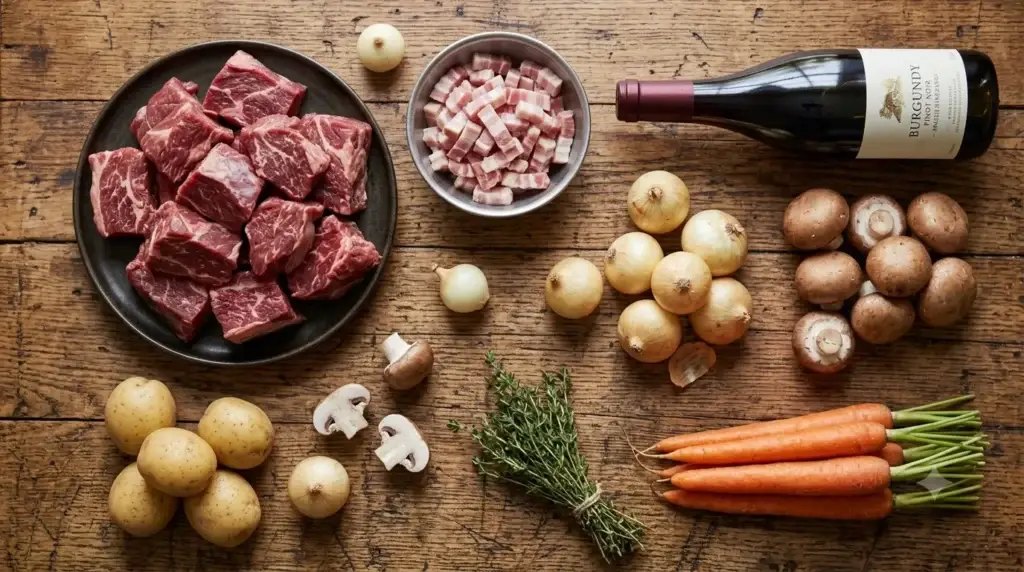
- 3 pounds chuck roast, cut into 2-inch chunks
- Salt and black pepper, to taste
- 3 tablespoons all-purpose flour
- 6 ounces bacon or lardons, diced
- 2 tablespoons olive oil, as needed
- 1 large onion, chopped
- 3 carrots, cut into thick pieces
- 4 garlic cloves, minced
- 2 tablespoons tomato paste
- 1 bottle (750 ml) red Burgundy wine or Pinot Noir
- 2 cups beef stock
- 1 bouquet garni (thyme, bay leaf, and parsley tied together)
- 1 pound pearl onions, peeled
- 1 pound mushrooms, quartered
- 2 tablespoons butter, divided
Instructions
- Pat the beef dry, season generously with salt and pepper, and toss lightly with the flour.
- In a Dutch oven over medium-high heat, cook the bacon until crisp. Remove and set aside, leaving the rendered fat in the pot.
- Working in batches, sear the beef in the bacon fat (adding olive oil if needed) until deeply browned on all sides. Remove and set aside with the bacon.
- In the same pot, sauté the chopped onion and carrots until softened, then add the garlic and tomato paste, cooking for 1 to 2 minutes.
- Deglaze the pot with a portion of the wine, scraping up all the browned bits from the bottom.
- Return the beef and bacon to the pot. Add the remaining wine, beef stock, and bouquet garni. Bring to a gentle simmer.
- Cover and braise in a 325°F oven, or on the stovetop at the lowest simmer, for 2.5 to 3.5 hours, until the beef is completely fork-tender.
- While the beef braises, glaze the pearl onions in 1 tablespoon of butter with a splash of stock until golden and tender. In a separate hot skillet, sear the mushrooms until deeply browned.
- Once the beef is tender, remove the bouquet garni. Stir in the glazed pearl onions and browned mushrooms.
- Finish the sauce with the remaining tablespoon of butter, swirled in off the heat. Taste and adjust seasoning.
- Serve hot over mashed potatoes or buttered noodles.
Chef Notes: This dish tastes noticeably better the next day, once the sauce has had time to fully develop overnight in the refrigerator.
Storage Notes: Refrigerate up to 4 days or freeze up to 3 months. Reheat gently on the stovetop or in a covered dish in a 300°F oven.
Nutrition Disclaimer: Calorie and nutrition estimates are approximate and will vary based on specific ingredients and portion sizes used.
Conclusion
Beef Bourguignon doesn’t ask for anything exotic. It asks for a tough cut of beef, a decent bottle of wine, and the patience to let both do what time and low heat do best. Sear properly, braise low and slow, and keep the mushrooms and onions off to the side until the very end, and you’ll end up with a dish that tastes like it came out of a Burgundy farmhouse kitchen a hundred years ago.
Make it once, let it rest overnight before you serve it, and you’ll understand exactly why this stew turned into one of the most respected dishes in all of French cooking. That’s Beef Bourguignon done right, and it’s worth every hour it takes.