
Mushroom Lasagne : Creamy Italian delicious Food
This mushroom lasagne recipe layers deeply browned mushrooms, a silky béchamel, and golden melted cheese between sheets of tender pasta, and you don’t need meat to get a lasagne this satisfying. The mushrooms bring an earthy, savory depth that stands in beautifully for a traditional ragù, while the creamy white sauce ties every layer together. It’s the kind of dish that fills the kitchen with the smell of butter and garlic long before it hits the table, and once you understand a few key techniques, you’ll be able to build a restaurant-quality pasta bake at home. If you love dishes like this one, you’ll find plenty more in our collection of Italian recipes.
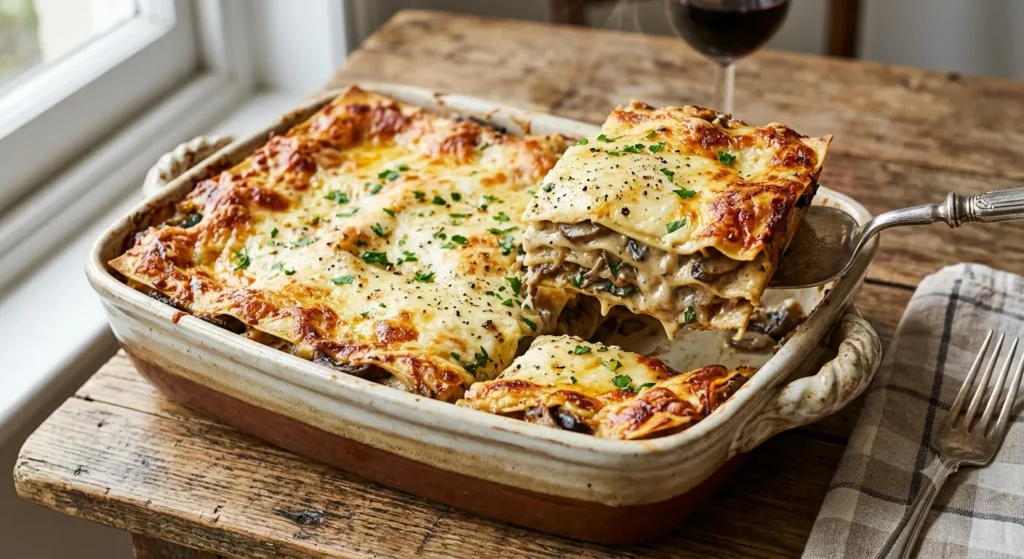
Table of Contents
What Is Mushroom Lasagne?
Mushroom lasagne is a layered baked pasta dish built from wide sheets of pasta, sautéed mushrooms, a creamy béchamel sauce, and cheese, baked until bubbling and golden on top. It’s a vegetarian take on Italy’s classic layered pasta bake, swapping the traditional meat ragù for deeply browned mushrooms that bring a similar savory richness. You may notice the dish is spelled two different ways: “lasagne” refers to the pasta sheets themselves in Italian and is the term used across most of Italy and the UK, while “lasagna” is the singular Americanized spelling commonly used in the United States to describe the finished baked dish. Both refer to the same style of layered pasta bake, so you’ll see the terms used interchangeably depending on where a recipe comes from.
Traditional Italian lasagne, particularly the version associated with Emilia-Romagna, relies on a rich meat ragù layered with béchamel and Parmesan. The vegetarian mushroom version follows the same structural logic — layers of sauce, pasta, and cheese, built up and baked until set — but leans on the natural umami of well-browned mushrooms instead of meat. For more on how Italy’s culinary institutions document and preserve dishes like this one, see the Accademia Italiana della Cucina, the country’s leading cultural authority on traditional Italian cuisine. Done well, mushroom lasagne holds its own next to any meat-based version, offering the same comforting richness with a lighter, more vegetable-forward character.
Why You’ll Love This Recipe
You’ll find plenty of reasons to make this creamy mushroom lasagne a regular part of your dinner rotation:
- Genuinely creamy texture. The béchamel coats every layer, so you never end up with a dry bite.
- Deep, rich mushroom flavor. Properly browned mushrooms deliver a savory depth that rivals meat-based lasagne.
- A satisfying family dinner. One pan feeds a crowd and reheats well for leftovers.
- Freezer friendly. You can assemble it ahead and freeze it unbaked or baked for a future meal.
- Meal-prep friendly. Components can be made a day or two in advance and assembled just before baking.
- Easy to customize. You can swap in different mushroom varieties, cheeses, or add greens without losing the structure of the dish.
This lasagne also fits neatly alongside our other Mediterranean recipes if you’re building out a full Italian-inspired menu, since it pairs so well with lighter, vegetable-forward sides.
Ingredients
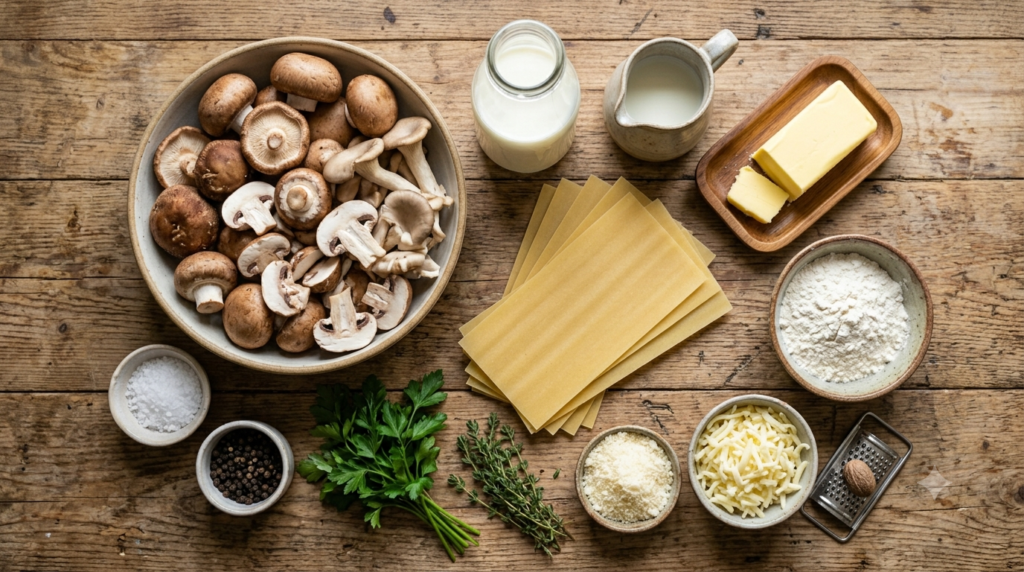
Every ingredient in this vegetarian lasagna recipe earns its place. Here’s what you’ll need and why.
- Lasagne sheets (about 12): Fresh or dried both work. Fresh sheets give a more tender, delicate bite, while dried sheets hold their structure a bit better for beginners. No-boil dried sheets save time since they soften fully in the oven using moisture from the sauce.
- Mixed mushrooms (about 2 pounds): A combination of varieties gives you more complex flavor than a single type (see the mushroom section below).
- Onion (1 medium, finely diced): Builds a sweet, aromatic base for both the mushroom filling and the béchamel.
- Garlic (3–4 cloves, minced): Adds sharpness and depth; add it after the onion has softened so it doesn’t burn.
- Butter (4 tablespoons, divided): Used for both sautéing the mushrooms and building the béchamel roux.
- Olive oil (2 tablespoons): Combined with butter for sautéing, since oil raises the smoke point and helps the mushrooms brown rather than steam.
- All-purpose flour (1/4 cup): The base of your roux, which thickens the béchamel.
- Whole milk (3 cups, warmed): Warming the milk before adding it to the roux helps prevent lumps and speeds up thickening.
- Parmesan cheese (1 cup, freshly grated): Adds salty, nutty depth to both the béchamel and the top layer. If you want guidance on sourcing a quality aged Parmesan, Gambero Rosso publishes respected rankings of Italy’s top food and dairy producers.
- Mozzarella cheese (1.5 cups, shredded): Provides the classic stretchy, melty top layer.
- Ricotta cheese (1 cup, optional): Adds extra creaminess between layers if you want a richer texture, though it’s not required for an authentic result.
- Fresh thyme (1 tablespoon, chopped): Complements mushrooms particularly well; use fresh if you can, since dried thyme is more muted.
- Fresh parsley (2 tablespoons, chopped): Brightens the finished dish and balances the richness of the cheese and cream.
- Nutmeg (a pinch, freshly grated if possible): A traditional béchamel seasoning that rounds out the sauce without tasting distinctly “spiced.”
- Salt and black pepper: Season each component individually — the mushrooms, the béchamel, and the cheese layer — rather than relying on one round of salt at the end.
Choosing the Best Mushrooms
Your mushroom choice shapes the entire character of this dish, since mushrooms are standing in for the meat in a traditional lasagne.
- Cremini (baby bella) mushrooms offer a deep, earthy base flavor and hold their texture well after cooking, making them the backbone of most mushroom lasagne recipes.
- White button mushrooms are milder and more neutral, useful for bulking up the mixture without overwhelming other flavors.
- Portobello mushrooms are mature cremini with a meatier, denser texture and a more pronounced umami flavor, though they release more liquid and need thorough browning.
- Shiitake mushrooms bring a distinctive savory, almost smoky depth and a slightly chewy texture that adds contrast.
- Oyster mushrooms are delicate and slightly sweet, with a tender texture that breaks down nicely into the filling.
- Wild mushrooms (chanterelles, porcini, morels, depending on season) add complexity and a more distinctly “forest” flavor, though they’re pricier and less consistently available.
For the best results, use a combination of at least two or three varieties — cremini as your base, with shiitake or portobello added for depth. Whichever mushrooms you choose, slice them a similar thickness so they cook evenly, and don’t crowd the pan, since overcrowded mushrooms steam instead of browning.
The Secret to Rich Mushroom Flavor
Mushrooms are mostly water, and how you handle that water determines whether your filling tastes rich and savory or thin and steamed.
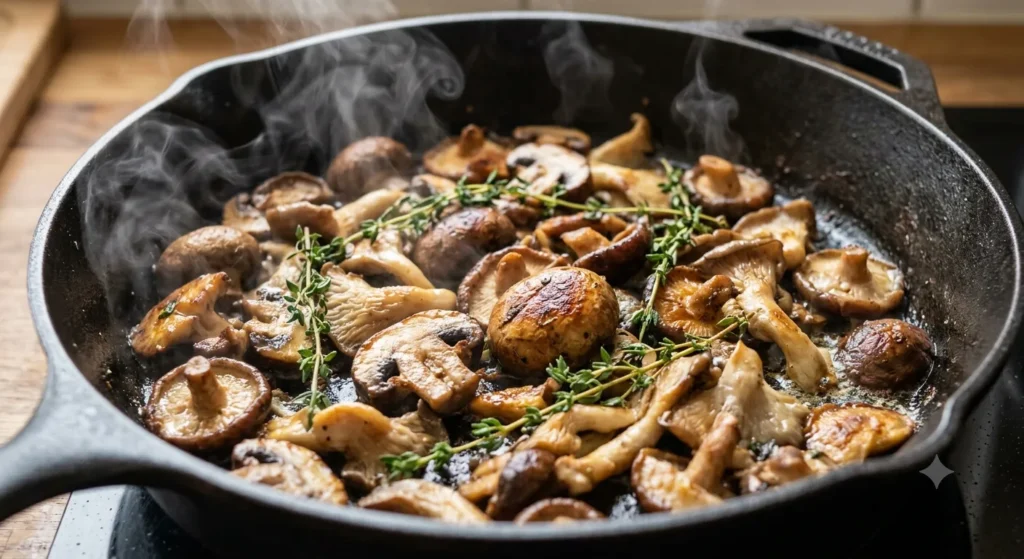
When mushrooms hit a hot pan, they first release their internal moisture, which pools around them. If there’s too much liquid in the pan at once, the mushrooms essentially poach in their own juices instead of browning, and you lose the deep, savory flavor that makes mushrooms worth using in the first place. You want to cook them in batches if needed, giving each piece enough space to make direct contact with the hot pan surface. Once the released liquid evaporates, the mushrooms will start to brown — this is when the Maillard reaction kicks in, the same chemical process responsible for the crust on a seared steak or the color on toasted bread. It’s this browning, not the mushrooms themselves, that produces the deep umami flavor people associate with well-made mushroom dishes.
Season the mushrooms with salt partway through cooking rather than at the very start. Salting too early draws out moisture faster, which can slow down browning. A splash of white wine or a spoonful of soy sauce toward the end of cooking can also deepen the umami character, though neither is required for a great result. Once your mushrooms are browned and any excess liquid has cooked off, stir in the garlic, thyme, salt, and pepper, and cook for another minute before setting the filling aside.
How to Make Perfect Béchamel Sauce
Béchamel is one of the foundational sauces in both French and Italian cooking, and it’s what gives this white sauce lasagne its signature creamy texture.
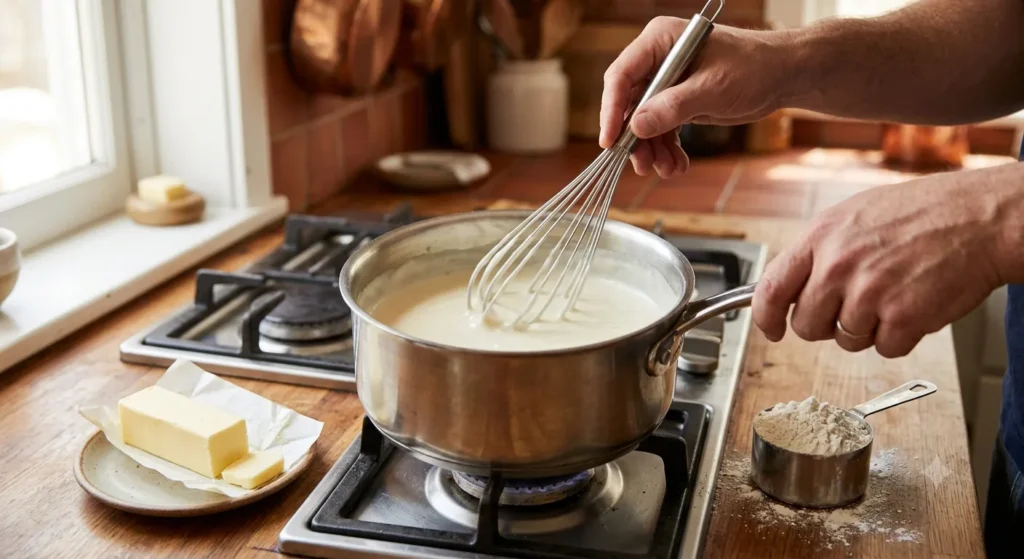
Start by melting butter in a saucepan over medium heat, then whisk in flour to form a roux. Cook the roux for about 1–2 minutes, stirring constantly — this cooks out the raw flour taste without letting the mixture brown, since a pale roux is what you want for a classic béchamel. Gradually whisk in warmed milk, a little at a time at first, whisking continuously to prevent lumps from forming. Adding cold milk to a hot roux can cause the mixture to seize and clump, which is why warming the milk beforehand makes the process much smoother.
Continue whisking as the sauce thickens, which usually takes 8–10 minutes over gentle heat. You’re looking for a consistency that coats the back of a spoon without running off immediately — thin enough to spread easily between lasagne layers, but thick enough to hold its structure once baked. Season with salt, pepper, and a pinch of nutmeg, which is traditional in béchamel and adds subtle warmth without tasting overtly spiced. If your sauce turns out too thick, whisk in a splash more warm milk; if it’s too thin, let it simmer a few minutes longer, stirring frequently so it doesn’t scorch on the bottom of the pan.
Step-by-Step Instructions
- Sauté the mushrooms. Heat butter and olive oil in a wide skillet over medium-high heat. Add the mushrooms in batches, without crowding the pan, and cook until deeply browned, 8–10 minutes per batch. Add the onion partway through, then the garlic near the end, along with thyme, salt, and pepper. Set the filling aside.
- Make the béchamel. In a separate saucepan, melt butter and whisk in flour to form a roux. Cook for 1–2 minutes, then gradually whisk in warmed milk until smooth. Simmer, whisking often, until thickened, about 8–10 minutes. Season with salt, pepper, and nutmeg.
- Preheat the oven. Set your oven to 375°F (190°C) so it’s fully heated by the time your lasagne is assembled.
- Prepare the pasta sheets. If using dried (not no-boil) lasagne sheets, cook them according to the package instructions until just al dente, then lay them flat on a clean towel to prevent sticking. No-boil sheets can go in straight from the box.
- Layer the lasagne. Spread a thin layer of béchamel on the bottom of a baking dish. Add a layer of pasta sheets, followed by a layer of the mushroom filling, a drizzle of béchamel, and a sprinkle of Parmesan. Repeat the layering process, finishing with a generous layer of béchamel and a combination of mozzarella and Parmesan on top.
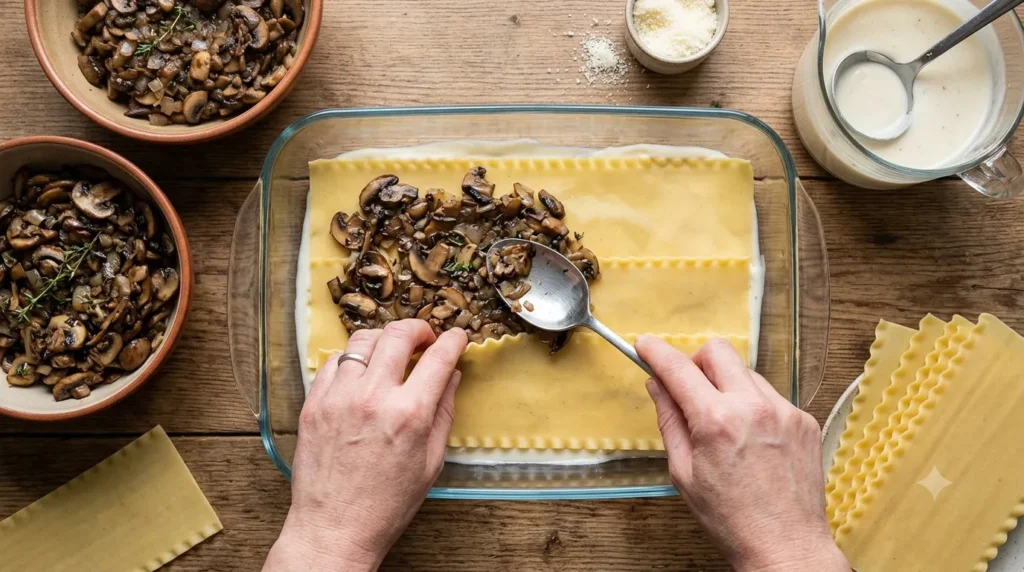
- Bake. Cover the dish loosely with foil and bake for 25 minutes. Remove the foil and bake for another 15–20 minutes, until the top is golden and bubbling and a knife inserted into the center meets little resistance.
- Rest before slicing. Let the lasagne rest for 10–15 minutes before cutting. This allows the layers to set, so your slices hold together instead of sliding apart.
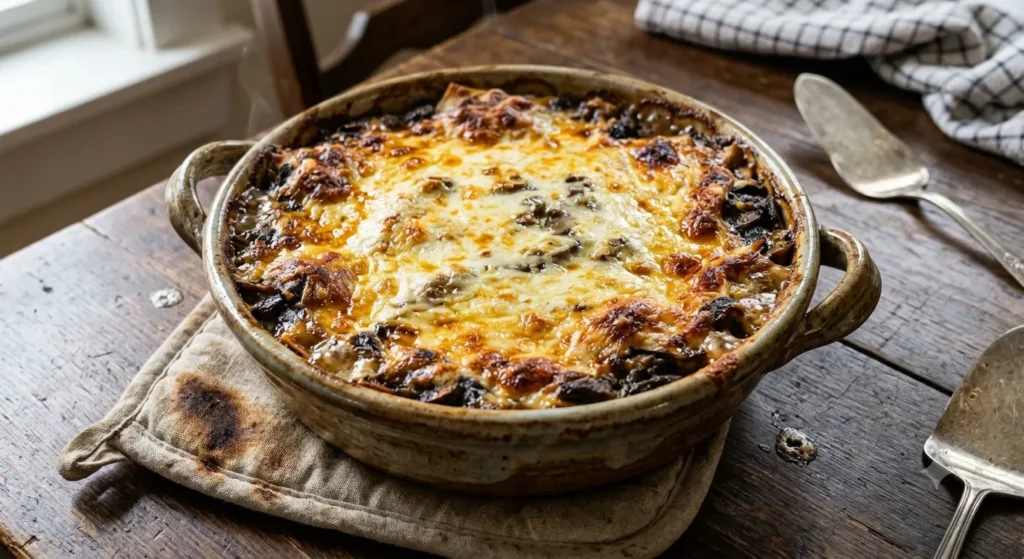
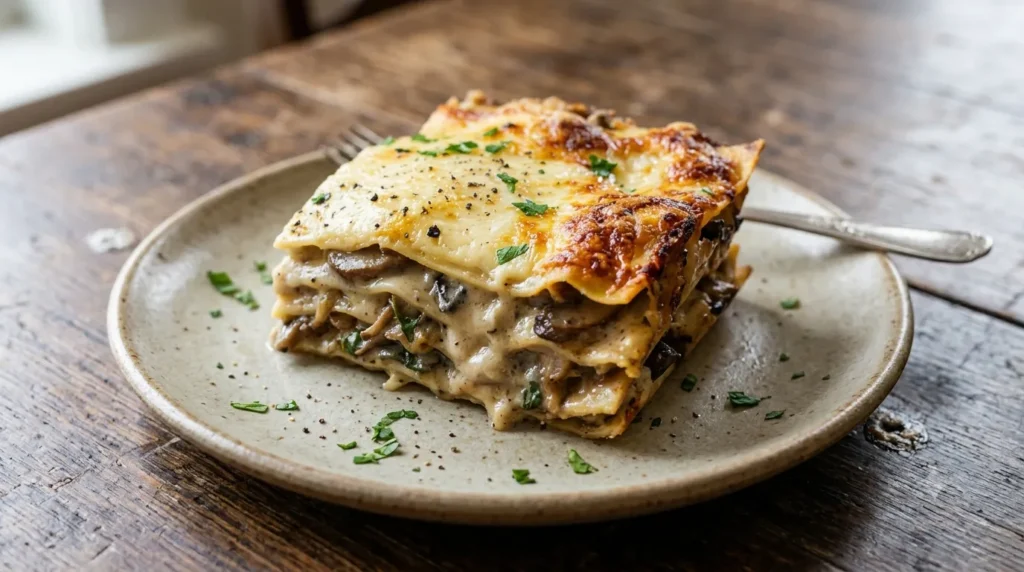
- Slice and serve. Cut into squares and serve warm, garnished with fresh parsley.
Chef Tips
- Don’t crowd the mushrooms. Cook them in batches so they brown instead of steaming.
- Warm your milk before adding it to the roux. This prevents lumps and speeds up thickening.
- Season each component separately. The mushrooms, béchamel, and cheese layer all need their own seasoning.
- Use a mix of mushroom varieties. Combining two or three types builds more complex flavor than one alone.
- Let the lasagne rest before slicing. Ten to fifteen minutes allows the layers to set properly.
- Grate your own Parmesan. Pre-shredded cheese contains anti-caking agents that can affect how smoothly it melts.
- Don’t skip the nutmeg in the béchamel. It’s a small addition that rounds out the flavor of the sauce.
- Use no-boil sheets carefully. They need enough sauce coverage to soften fully in the oven, so don’t skimp on the béchamel.
- Cook off excess mushroom liquid completely. Any leftover moisture will make your lasagne watery once baked.
- Cover with foil for the first part of baking. This prevents the top from browning too quickly before the inside is fully cooked through.
- Use a wide, heavy skillet for the mushrooms. More surface area means better browning and less steaming.
Common Mistakes
- Overcrowding the mushroom pan. This causes steaming instead of browning and results in bland, watery filling.
- Adding cold milk to a hot roux too quickly. This causes lumps; add it gradually while whisking.
- Skipping the resting time after baking. Slicing too soon causes the layers to fall apart.
- Using pre-shredded cheese. It often melts less smoothly due to added anti-caking agents.
- Under-seasoning the béchamel. A bland white sauce will make the whole dish taste flat.
- Not cooking off mushroom liquid fully. This is the most common cause of watery mushroom lasagne.
- Using too much cheese and not enough sauce. Béchamel is what keeps the layers moist; cheese alone can’t do that job.
- Baking at too high a temperature. This can burn the top before the inside is fully heated through.
- Not warming the milk before adding it to the roux. Cold milk slows thickening and increases the risk of lumps.
- Skipping a foil cover during the first part of baking. This often leads to an overly browned or dry top layer.
Variations
You can adapt this Italian mushroom lasagne while keeping its comforting core intact:
- Spinach Mushroom Lasagne: Fold in wilted spinach for extra color, nutrients, and a slightly earthier flavor.
- Truffle Mushroom Lasagne: Add a drizzle of truffle oil or a few shavings of fresh truffle for an elevated, restaurant-style version.
- Four Cheese Mushroom Lasagne: Add fontina, gorgonzola, or provolone alongside the mozzarella and Parmesan for extra richness.
- Vegan Mushroom Lasagne: Substitute plant-based butter, a non-dairy milk, and vegan cheese for a fully plant-based version.
- Chicken and Mushroom Lasagne: Add shredded roasted chicken to the mushroom layer for a heartier, protein-rich dish.
- Wild Mushroom Lasagne: Use a mix of chanterelles, porcini, and morels for a more complex, seasonal flavor.
- Gluten-Free Mushroom Lasagne: Use gluten-free lasagne sheets and substitute a gluten-free flour blend in the béchamel.
Looking for another creamy, comforting pasta dish to try next? Our Vodka Pasta shares the same rich, sauce-forward spirit in a simpler weeknight format.
What to Serve with Mushroom Lasagne
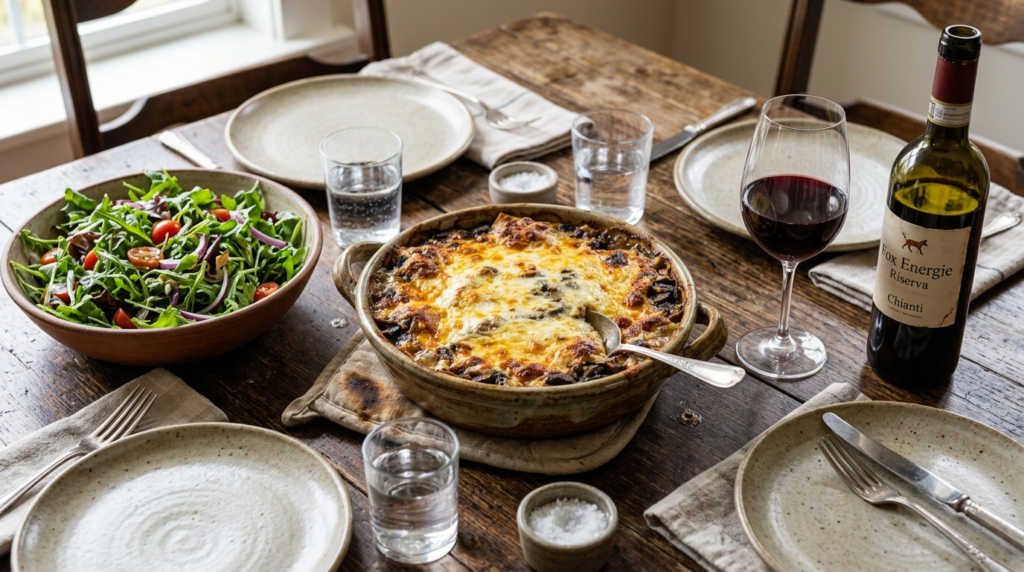
This comfort food recipe pairs beautifully with lighter, fresher sides that balance its richness:
- Garlic bread, for soaking up any extra béchamel
- A crisp Caesar salad
- A simple arugula salad with lemon and shaved Parmesan
- Roasted vegetables, such as asparagus or Brussels sprouts
- A glass of Chianti or an unoaked Chardonnay
If you want a side that echoes the same Italian, cheese-forward spirit, our Garlic Bread Pizza makes an easy, crowd-pleasing addition to the table. For a lighter vegetarian starter beforehand, try our Spinach Ricotta Stuffed Shells in a smaller portion, or keep things simple with a side salad.
Storage & Make-Ahead Tips
You can prep this vegetarian pasta bake well ahead of time, which makes it a great option for busy weeknights or entertaining. Assemble the lasagne up to a day in advance, cover tightly, and refrigerate unbaked; add about 10–15 minutes to the covered baking time if starting from cold. To freeze, assemble the lasagne in a freezer-safe dish, wrap tightly, and freeze unbaked for up to 3 months; bake from frozen, covered, adding significant extra time (roughly 45–60 minutes covered, then uncovered until golden), or thaw overnight in the refrigerator first for a more predictable bake time. Store baked leftovers in an airtight container in the refrigerator for up to 4 days, and reheat individual portions in the oven or microwave until warmed through. For best texture, avoid reheating at very high heat, which can dry out the pasta and cause the béchamel to separate.
Frequently Asked Questions
What is mushroom lasagne made of? Mushroom lasagne is made of lasagne sheets, sautéed mushrooms, a creamy béchamel sauce, and layers of Parmesan and mozzarella cheese.
What’s the difference between lasagne and lasagna? “Lasagne” refers to the pasta sheets in Italian and is used across most of Italy and the UK, while “lasagna” is the singular American spelling for the finished baked dish.
Which mushrooms work best for lasagne? A combination of cremini, shiitake, and portobello mushrooms provides the best balance of earthy flavor and meaty texture.
Can I use store-bought lasagne sheets? Yes — both dried and no-boil lasagne sheets work well, as long as there’s enough béchamel to fully hydrate no-boil sheets during baking.
Should mushrooms be cooked before adding them to the lasagne? Yes, mushrooms should always be sautéed and browned first to remove excess moisture and develop deeper flavor before layering.
How do you prevent watery mushroom lasagne? Cook the mushrooms in batches until fully browned and all their released liquid has evaporated before assembling the dish.
What cheese works best in mushroom lasagne? A combination of Parmesan for flavor and mozzarella for melt and stretch gives the best overall result.
Can mushroom lasagne be made ahead of time? Yes, you can assemble it up to a day ahead, refrigerate it unbaked, and bake it when ready, adding a little extra time if baking from cold.
Can mushroom lasagne be frozen? Yes, it can be frozen either unbaked or baked for up to 3 months; thawing overnight in the fridge gives the most predictable results.
How long should mushroom lasagne rest after baking? Let it rest for 10–15 minutes before slicing so the layers set and hold together.
What temperature should mushroom lasagne be baked at? 375°F (190°C) is ideal — hot enough to cook through and brown the top without burning it.
Is mushroom lasagne vegetarian? Yes, the base recipe is vegetarian, and it can be made vegan with plant-based butter, milk, and cheese substitutes.
Why is my béchamel lumpy? Lumps usually form when cold milk is added too quickly to a hot roux; adding warm milk gradually while whisking prevents this.
What’s the best way to reheat leftover mushroom lasagne? Reheat individual portions in the oven at a moderate temperature, or in the microwave, avoiding very high heat that can dry out the pasta.
Can I make this recipe gluten-free? Yes — substitute gluten-free lasagne sheets and use a gluten-free flour blend in place of regular flour in the béchamel.
Conclusion
Once you’ve made this mushroom lasagne recipe, you’ll see why it holds up so well against any meat-based version — the depth comes from properly browned mushrooms, not from cutting corners. Take the time to brown your mushrooms fully, build a smooth béchamel, and let the finished dish rest before slicing, and you’ll end up with a lasagne that’s creamy, rich, and genuinely satisfying. Gather your mushrooms, warm up your milk, and give this recipe a place at your dinner table this week.
8. Recipe Card
Mushroom Lasagne Recipe (Creamy Italian Vegetarian Comfort Food)
- Prep Time: 30 minutes
- Cook Time: 45 minutes
- Rest Time: 15 minutes
- Total Time: 90 minutes
- Servings: 8
- Cuisine: Italian
- Course: Main Course
- Difficulty: Intermediate
- Calories: Approximately 420 kcal per serving
- Equipment: Wide skillet, saucepan, whisk, 9×13-inch baking dish, aluminum foil
Ingredients:
- 12 lasagne sheets
- 2 lbs mixed mushrooms, sliced
- 1 medium onion, finely diced
- 3–4 garlic cloves, minced
- 4 tablespoons butter, divided
- 2 tablespoons olive oil
- 1/4 cup all-purpose flour
- 3 cups whole milk, warmed
- 1 cup Parmesan cheese, freshly grated
- 1.5 cups mozzarella cheese, shredded
- 1 cup ricotta cheese (optional)
- 1 tablespoon fresh thyme, chopped
- 2 tablespoons fresh parsley, chopped
- Pinch of freshly grated nutmeg
- Salt and black pepper, to taste
Instructions:
- Sauté the mushrooms in batches until browned; add onion and garlic near the end.
- Make the béchamel: roux, then warmed milk, whisked until thickened; season with nutmeg.
- Preheat oven to 375°F (190°C).
- Prepare pasta sheets if needed.
- Layer pasta, mushroom filling, béchamel, and Parmesan; repeat, finishing with béchamel and cheese.
- Bake covered 25 minutes, then uncovered 15–20 minutes until golden.
- Rest 10–15 minutes before slicing.
- Slice, garnish with parsley, and serve.
Chef Notes: Fully browning the mushrooms and warming your milk before adding it to the roux are the two steps that matter most for a rich, lump-free result.
Nutrition (estimated per serving): Calories 420 | Fat 24g | Carbohydrates 32g | Fiber 3g | Protein 17g | Sodium 460mg
Nutrition values are estimates; for precise figures on individual ingredients, consult USDA FoodData Central, the U.S. government’s official food composition database.