Classic Béarnaise Sauce Recipe: The Perfect Sauce for Steak
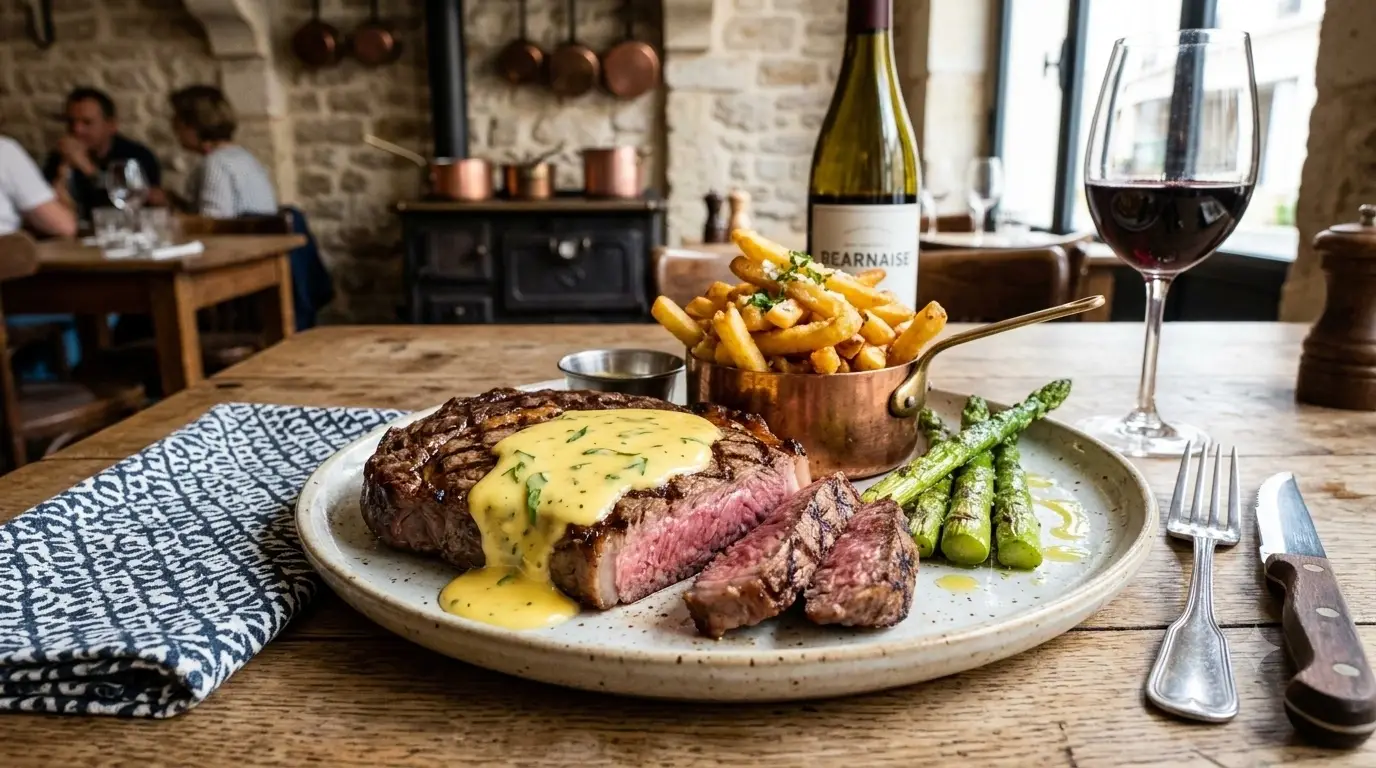
Pour a spoonful of classic Béarnaise sauce over a hot steak and watch what happens. It doesn’t sit there. It softens, slides slightly, and releases a wave of tarragon and shallot that hits you before the first bite even reaches your mouth. That’s Béarnaise sauce doing exactly what it was built to do, and it’s a small piece of theater that a good steak dinner shouldn’t be without.
Béarnaise has a reputation for being difficult, mostly because people picture it as some fragile, temperamental thing that collapses if you look at it wrong. It isn’t, once you understand what’s actually holding it together. This is an emulsion sauce, built on egg yolks, butter, and a tarragon-and-shallot reduction, and every step in making it well comes down to a handful of principles you can learn in one sitting and use for the rest of your cooking life.
This guide covers where Béarnaise sauce actually comes from, why it works at the molecular level, which ingredients matter and why, and exactly how to build it without it breaking on you. By the end, you’ll know this sauce well enough to make it from memory, and to fix it if something goes sideways.
Table of Contents
Table of Contents
- What Is Béarnaise Sauce?
- The History of Béarnaise Sauce
- Why Béarnaise Is So Special
- The Science of Emulsification
- Ingredients Explained
- Choosing the Best Butter
- Step-by-Step Technique
- Why Fresh Tarragon Matters
- Equipment Needed
- Common Mistakes
- Pro Chef Tips
- Variations
- What to Serve with Béarnaise Sauce
- Storage & Reheating
- Frequently Asked Questions
- Recipe Card
- Conclusion
What Is Béarnaise Sauce?
Béarnaise sauce is a warm, buttery emulsion built from egg yolks and clarified butter, flavored with a reduction of white wine vinegar, white wine, shallot, and fresh tarragon. It has a texture somewhere between a light custard and a rich hollandaise, and a flavor that’s tangy, herbal, and rounded out by the sweetness of shallot.
In classical French cooking, sauces are organized into families, and Béarnaise sits among the five “small sauces,” often called daughter sauces, that branch off from hollandaise. Hollandaise itself is one of the five mother sauces codified in classical French cuisine, and Béarnaise takes that same emulsion technique and shifts its flavor entirely, swapping lemon juice for a tarragon-and-vinegar reduction.
Ask most chefs to name the single best sauce for a steak, and Béarnaise comes up more often than any other answer. It has the richness to stand up to a thick cut of beef, the acidity to cut through the fat, and an herbal brightness that a plain pan sauce or peppercorn cream simply doesn’t offer. That combination is why it’s remained a steakhouse standard for close to two centuries.
The History of Béarnaise Sauce
Béarnaise sauce is traditionally credited to chef Jules Collinet, who is said to have created it at Le Pavillon Henri IV, a restaurant in Saint-Germain-en-Laye, just outside Paris, sometime in the 1830s. The restaurant itself sat on the grounds where King Henry IV was born, and its name honored him directly.
The sauce’s name refers to Béarn, the region in southwest France that was Henry IV’s home province before he became king. Henry IV was affectionately nicknamed “le Grand Béarnais,” and naming a new sauce after his home region, at a restaurant built on his birthplace, was a fitting piece of culinary tribute rather than any direct historical link between the king himself and the recipe.
Béarnaise is best understood as an evolution of hollandaise, built by a chef who took an existing emulsion technique and gave it a completely different flavor profile using a tarragon and vinegar reduction instead of hollandaise’s simple lemon and butter. That decision turned out to be one of the more influential moves in the history of French sauce-making, since Béarnaise itself went on to spawn several of its own variations, which we’ll get to later in this guide.
Why Béarnaise Is So Special
Rich, buttery texture. The emulsion of egg yolk and clarified butter creates a sauce that’s thick enough to cling to meat without being heavy, closer to a warm custard than a liquid sauce.
Bright acidity. The vinegar and wine reduction gives Béarnaise real tang, which keeps the richness of the butter from feeling one-note or overwhelming.
Fresh tarragon aroma. Tarragon has an unmistakable anise-like, slightly sweet aroma that defines the sauce’s character and separates it instantly from plain hollandaise.
Shallot sweetness. Cooked down in the reduction, shallots lose their sharpness and add a mellow, savory-sweet backbone underneath the tarragon and acidity.
Balance with grilled steak. A well-seared, fatty cut of beef needs something acidic and aromatic to cut through it, and Béarnaise delivers both at once, which is exactly why the pairing has lasted this long.
The Science of Emulsification
Understanding what’s actually happening in the pan takes the mystery out of this sauce, and makes it far easier to get right consistently.
What an emulsion is. An emulsion is a stable mixture of two liquids that don’t naturally combine, in this case fat (butter) and water (from the egg yolks and reduction). Left alone, they’d separate. Held together properly, they form a smooth, unified sauce.
Egg yolks as emulsifiers. Egg yolks contain lecithin, a compound with a structure that allows one end to bond with fat and the other to bond with water. That dual nature is what lets lecithin hold butterfat and the watery reduction together in a stable suspension instead of letting them separate.
Butterfat. As clarified butter is whisked slowly into the yolk mixture, it breaks into extremely small droplets, each one surrounded and stabilized by lecithin. The smaller and more even those fat droplets are, the smoother and more stable the final sauce.
Temperature control. Egg yolks need gentle, consistent heat to thicken properly. Too little heat, and the sauce stays thin and never sets up. Too much heat, and the proteins in the yolk overcook and curdle, breaking the emulsion outright.
Why sauces split. A broken Béarnaise almost always comes down to one of two things: the egg yolks got too hot and scrambled, or the butter was added too quickly for the yolks to properly absorb and emulsify it. Either way, the fat separates back out from the water, and the sauce looks curdled, greasy, or thin instead of smooth.
How to rescue a broken Béarnaise. In most cases, a split sauce can be saved. Start a fresh egg yolk with a teaspoon of water in a clean bowl, whisk it gently over low heat until slightly thickened, then very slowly whisk the broken sauce into this new base, a little at a time. The fresh lecithin in the new yolk typically re-establishes the emulsion.
Ingredients Explained
Unsalted butter is clarified and used as the primary fat, and using unsalted lets you control seasoning precisely rather than fighting a pre-salted stick. Egg yolks provide the lecithin that holds the entire emulsion together. White wine vinegar brings the sharp acidity that defines the sauce’s tang. Dry white wine rounds out that acidity with a touch of fruit and complexity that vinegar alone doesn’t provide. Shallots, finely minced, cook down into the reduction and lend a mellow sweetness. Fresh tarragon is the sauce’s signature aromatic, added both in the reduction and again at the end for maximum flavor. Fresh chervil, traditionally included alongside tarragon, adds a lighter, slightly peppery herbal note, though it’s often left out where chervil isn’t easy to find. Black peppercorns, cracked and added to the reduction, contribute a background heat that survives the straining process. Salt seasons the finished sauce to balance the acidity and richness. Lemon juice, added at the very end in small amounts, can brighten the finished sauce if it tastes slightly flat.
Choosing the Best Butter
| Butter Type | Fat Content | Result in Béarnaise |
|---|---|---|
| European-style butter | 82–86% | Richest, silkiest texture; recommended |
| American butter | ~80% | Good, slightly less rich than European |
| Clarified butter | ~99% fat (milk solids removed) | Cleanest emulsion, prevents watery breakdown |
| Whole (unclarified) butter | ~80%, with water and milk solids | Can thin the sauce and increase risk of splitting |
| Cultured butter | Varies, slight tang | Adds a subtle tang that can compete with the sauce’s acidity |
Clarified butter, made from a good European-style butter, produces the smoothest and most stable Béarnaise. Removing the milk solids and water eliminates excess moisture that can loosen or destabilize the emulsion, and the higher fat content in European-style butter gives the finished sauce a noticeably richer mouthfeel.
Step-by-Step Technique
1. Make the reduction. Combine white wine vinegar, dry white wine, minced shallot, half the tarragon, and cracked peppercorns in a small saucepan. Simmer until reduced by roughly two-thirds, leaving a concentrated, syrupy liquid.
2. Strain and cool. Strain out the solids, pressing to extract all the liquid, and let the reduction cool slightly so it won’t scramble the egg yolks on contact.
3. Clarify the butter. Melt butter gently and skim off the foam, then pour off the clear golden fat, leaving the milky solids and water behind in the pan.
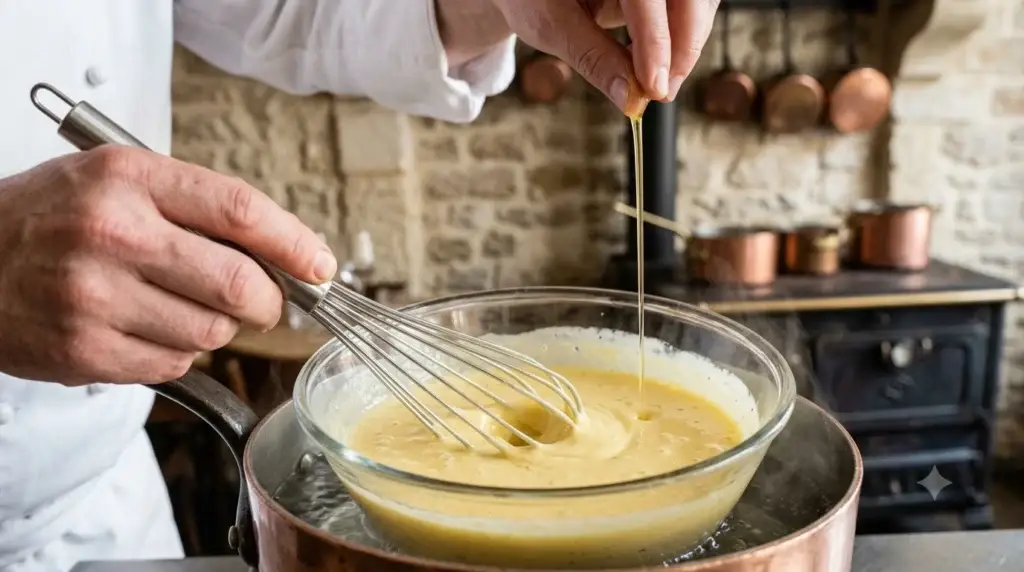
4. Whisk the yolks. In a heatproof bowl set over a pan of barely simmering water (never touching the water directly), whisk the egg yolks with the cooled reduction until pale, thick, and doubled in volume. This usually takes 3 to 5 minutes of steady whisking.
5. Build the emulsion. Off the heat, whisk in the warm clarified butter in a very slow, thin stream, whisking constantly. Adding it too quickly is the single most common cause of a split sauce at this stage.
6. Add the herbs. Once the emulsion is smooth and thick, fold in the remaining fresh tarragon (and chervil, if using), finely chopped.
7. Season. Taste and adjust with salt and, if needed, a small squeeze of lemon juice for extra brightness.
8. Hold the sauce. Keep it in a warm spot, such as near (not on) the stove, or in a thermos, since Béarnaise can’t be reheated hard without breaking.
9. Serve. Spoon over steak or vegetables immediately, while the sauce is still warm, glossy, and holding its emulsion.
Visual cues to trust: the finished sauce should look glossy and thick enough to coat the back of a spoon, holding a trail when you draw a finger through it. Texture cues: it should feel silky and rich on the tongue, never grainy or oily. Common mistakes at this stage: rushing the butter addition, letting the water underneath the bowl boil instead of simmer, and skipping the straining step, which leaves bits of shallot and peppercorn in a sauce that should be perfectly smooth.
Why Fresh Tarragon Matters
Fresh tarragon carries volatile essential oils that give it a distinct, slightly sweet, anise-like aroma. Those oils fade quickly once the leaves are cut or dried, which is exactly why dried tarragon tastes flat and dusty by comparison, missing most of the brightness that makes the fresh herb so distinctive.
Dried tarragon can be used in a pinch, but expect a muted, less aromatic result, and use roughly a third of the amount called for fresh, since dried herbs are more concentrated by volume.
For chopping, wait until just before you need it. Stack the leaves, roll them tightly, and slice thinly (a technique called chiffonade) rather than chopping roughly, which bruises the leaves and releases their oils too early, before they ever reach the sauce.
Equipment Needed
- Saucepan — for building and reducing the vinegar-wine mixture
- Fine mesh strainer — to strain the reduction to a perfectly smooth liquid
- Whisk — a balloon whisk works best for building volume in the egg yolks
- Heatproof bowl — for whisking the yolks over gentle, indirect heat
- Thermometer (optional) — useful for confirming the water bath stays well below a boil
- Small ladle — for adding the clarified butter in a slow, controlled stream
Common Mistakes
- Adding butter too fast. The yolks can’t absorb it quickly enough, and the sauce splits. Fix: pour in the slowest possible stream, whisking constantly.
- Letting the water boil under the bowl. Overheats and scrambles the yolks. Fix: keep the water at a bare simmer, never a rolling boil.
- Skipping the reduction step. Produces a flat, one-dimensional sauce lacking real tarragon depth. Fix: always build and strain a proper reduction first.
- Not straining the reduction. Leaves gritty bits of shallot and pepper in an otherwise silky sauce. Fix: strain thoroughly, pressing out all the liquid.
- Using whole butter instead of clarified. The extra water content can thin and destabilize the emulsion. Fix: always clarify the butter first.
- Using cold butter straight from the fridge. Cools the emulsion too fast and can cause it to seize. Fix: keep the butter warm and liquid throughout.
- Whisking too slowly while adding butter. Fat droplets stay too large, and the sauce turns oily instead of smooth. Fix: whisk briskly and continuously.
- Making the sauce too far in advance. Béarnaise doesn’t hold well for hours; it thins, separates, or develops an off flavor. Fix: make it as close to serving time as possible.
- Storing the sauce over direct heat to keep it warm. Direct heat will eventually break the sauce. Fix: hold it off to the side, away from direct flame or burner heat.
- Adding all the tarragon during the reduction. Long cooking mutes its bright aroma. Fix: reserve some fresh tarragon to fold in at the end.
- Using dried tarragon at full fresh quantity. Produces an overly intense, dusty flavor. Fix: use about a third of the amount if substituting dried for fresh.
- Under-seasoning. A flat-tasting Béarnaise is almost always under-salted or needs a touch more acid. Fix: taste and adjust right before serving.
- Not tempering the reduction before adding it to the yolks. A hot reduction can scramble the yolks on contact. Fix: let it cool slightly first.
- Trying to reheat a fully cooled, set Béarnaise over direct heat. This almost always breaks the sauce. Fix: rewarm very gently, ideally over a bain-marie, or make it fresh instead.
- Using a whisk that’s too small for the bowl. Makes it hard to properly incorporate air and butter evenly. Fix: use a full-sized balloon whisk suited to your bowl.
Pro Chef Tips
- Build the reduction ahead of time and keep it refrigerated until you’re ready to finish the sauce.
- Use a heavy-bottomed saucepan for the reduction to avoid scorching the shallots.
- Clarify more butter than you think you need — running out mid-emulsion is a common problem.
- Keep your clarified butter warm but not hot while adding it, around body temperature to slightly warmer.
- Whisk in a steady figure-eight motion for even incorporation across the whole bowl.
- Use a metal bowl over the bain-marie rather than glass, since metal conducts heat more evenly.
- Keep a small bowl of cold water nearby — if the yolks start to look like they’re overheating, pull the bowl off the heat immediately and whisk in a few drops.
- Taste the reduction on its own before adding it to the yolks, to make sure the acidity and tarragon flavor are where you want them.
- Chop tarragon at the very last minute to preserve its aroma.
- Reserve a spoonful of reduction to stir in at the end for an extra hit of brightness.
- Warm your serving plate slightly so the sauce doesn’t cool and thicken too fast once plated.
- Keep the finished sauce in a thermos if you need to hold it for more than 20 minutes.
- Add lemon juice only a few drops at a time — it’s easy to overdo the brightness.
- Practice the butter addition slowly the first few times until you get a feel for the right pace.
- Have all your ingredients prepped and ready before you start whisking the yolks — this sauce moves fast once it begins.
- Use fresh eggs; older yolks hold air and emulsify slightly less reliably.
- If the sauce seems too thick, whisk in a few drops of warm water to loosen it, rather than more butter.
- Keep whisking even after all the butter is incorporated, to fully smooth the texture.
- Serve Béarnaise the moment the steak comes off the heat, so both hit the plate at their best temperature.
- When in doubt about heat, go cooler and slower — you can always warm the sauce a bit more, but you can’t easily undo scrambled yolks.
Variations
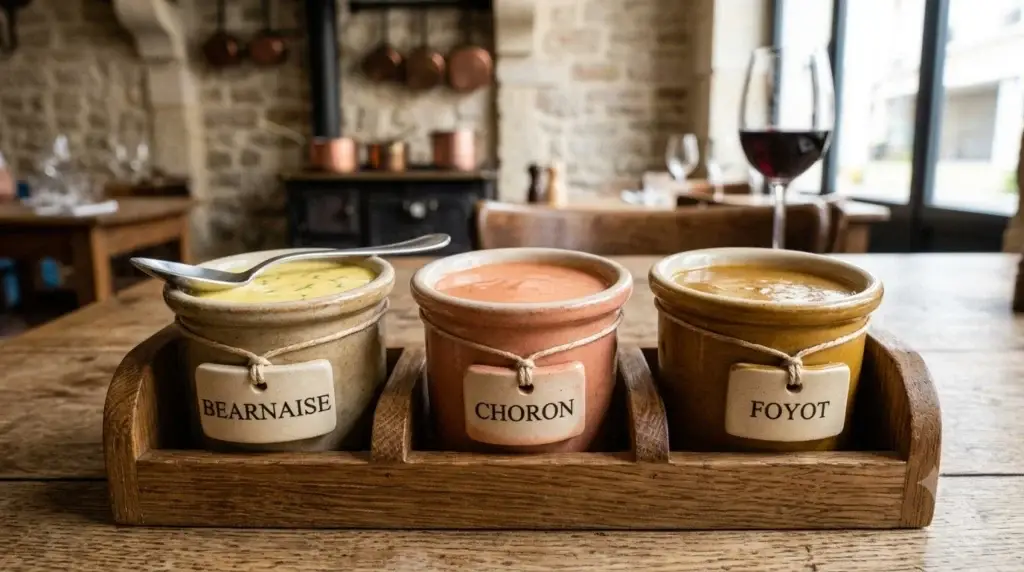
Sauce Choron adds fresh tomato purée to the finished Béarnaise for a sweeter, rounder, slightly pink sauce, popular with fish and lighter meats.
Foyot Sauce (also called Valois) stirs in a spoonful of meat glaze (glace de viande) at the end, giving the sauce a deeper, more savory backbone suited to richer cuts of beef.
Béarnaise with roasted garlic blends in a few cloves of soft roasted garlic for a mellow, sweeter garlic depth underneath the classic tarragon flavor.
Béarnaise with smoked butter uses butter that’s been gently smoked before clarifying, adding a subtle smokiness that pairs particularly well with grilled steak.
Blender Béarnaise uses a blender to combine warm egg yolks with hot clarified butter in a fast stream, producing a slightly less silky but much quicker version of the sauce.
Sous Vide Béarnaise holds the yolk and butter mixture at a precise, controlled temperature in a sealed bag, making it far easier to avoid overheating and splitting, especially for cooks new to the technique.
What to Serve with Béarnaise Sauce
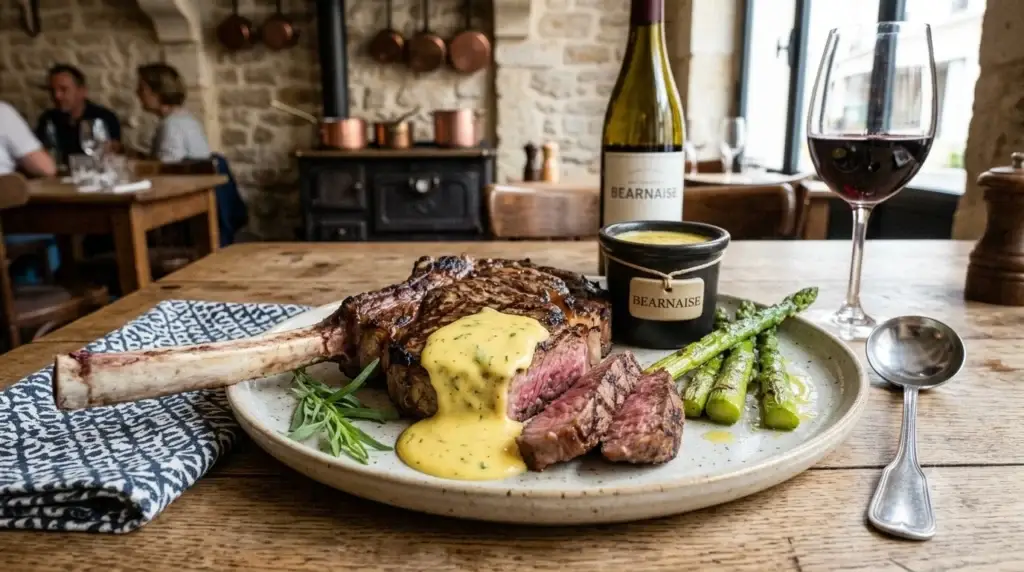
Steak cuts: Ribeye, filet mignon, porterhouse, and tomahawk steak are all classic Béarnaise pairings, since the sauce’s acidity cuts through the fat in each of these rich cuts. Prime rib also pairs beautifully, especially for a special-occasion dinner. Vegetables: Grilled asparagus and steamed or grilled artichokes are traditional accompaniments, both benefiting from the sauce’s brightness. Fish: Béarnaise also works surprisingly well with salmon, where the acidity balances the fish’s natural richness. Sides: Roasted potatoes and classic French fries both make excellent vehicles for extra sauce on the plate.
Wine pairings: A structured red Bordeaux or Cabernet Sauvignon stands up well to a rich steak and Béarnaise combination. A lighter Pinot Noir works nicely with leaner cuts like filet mignon. If serving Béarnaise with fish, a white Burgundy offers enough richness to match the sauce without overwhelming the dish.
Storage & Reheating
Refrigeration: Béarnaise doesn’t store especially well due to its egg-based emulsion, but it can be refrigerated in an airtight container for up to 2 days if necessary. Freezing is not recommended, since the emulsion almost always breaks upon thawing, leaving a separated, greasy sauce. Reheating: Warm refrigerated Béarnaise very gently over a bain-marie, whisking constantly, and expect the texture to be slightly less smooth than when freshly made. Food safety: Because the sauce contains lightly cooked egg yolks, it should not sit at room temperature for more than about 2 hours, and any leftovers should be refrigerated promptly.
Frequently Asked Questions
1. Why did my Béarnaise sauce split? Most often because the butter was added too quickly or the egg yolks got too hot and scrambled. Both cases break the emulsion holding the fat and water together.
2. Can I make Béarnaise ahead of time? It’s best made close to serving, since it doesn’t hold or reheat especially well. If needed, it can be held warm (not hot) for up to about 20 minutes.
3. Can I freeze Béarnaise sauce? It’s not recommended. Freezing and thawing almost always breaks the emulsion, leaving a separated, unappealing texture.
4. Can I use dried tarragon instead of fresh? Yes, in a pinch, using about a third of the amount called for fresh, though the flavor will be noticeably less bright and aromatic.
5. Can I use salted butter? You can, but it’s harder to control the final seasoning precisely. Unsalted butter is recommended so you can season the sauce to taste.
6. Can I make Béarnaise in a blender? Yes. Blending warm egg yolks with hot clarified butter in a steady stream produces a quicker, slightly less silky version of the classic sauce.
7. What’s the difference between Hollandaise and Béarnaise? Hollandaise is flavored simply with lemon juice, while Béarnaise uses a tarragon, shallot, vinegar, and white wine reduction, giving it a completely different, more herbal and tangy flavor.
8. Can pregnant women eat Béarnaise sauce? Because the sauce contains lightly cooked egg yolks that don’t reach a fully safe internal temperature, it’s generally advised that pregnant individuals speak with their healthcare provider about egg dishes like this one and consider pasteurized egg products as an alternative.
9. How do I fix a broken Béarnaise sauce? Whisk a fresh egg yolk with a little water over gentle heat until slightly thickened, then slowly whisk the broken sauce into it to rebuild the emulsion.
10. What can I substitute for tarragon if I don’t like its flavor? Fresh chervil alone, or a mix of parsley and a small amount of tarragon, can shift the flavor to be milder and less anise-forward.
11. Why is my Béarnaise sauce too thin? This usually means the yolks weren’t cooked long enough before the butter was added, or too much liquid was left in the reduction. Whisk a bit longer over gentle heat to thicken it further.
12. Can I use a hand blender or immersion blender instead of whisking by hand? Yes, an immersion blender can help build the emulsion quickly, though traditional hand-whisking gives you more control over texture and temperature.
13. Do I need chervil, or is tarragon enough on its own? Tarragon alone is enough to make a classic Béarnaise. Chervil is a traditional addition but far from mandatory, especially since it can be hard to find.
14. What’s the best way to keep Béarnaise warm before serving? Hold it in a thermos, or in a bowl set near (not directly on) a warm stovetop, checking and whisking occasionally.
15. Is Béarnaise the same as steak sauce from a bottle? No. Bottled steak sauces are typically vinegar- and tomato-based condiments, while Béarnaise is a fresh, warm egg-and-butter emulsion with an entirely different texture and flavor profile.
Recipe Card
Classic Béarnaise Sauce
| Prep Time | 15 minutes |
| Cook Time | 20 minutes |
| Total Time | 35 minutes |
| Yield | About 1 cup (4 servings) |
| Cuisine | French |
| Course | Sauce |
| Calories (estimated) | 210 per serving |
Ingredients
- 1/4 cup white wine vinegar
- 1/4 cup dry white wine
- 2 tablespoons minced shallot
- 3 tablespoons fresh tarragon, divided, finely chopped
- 1/2 teaspoon cracked black peppercorns
- 3 large egg yolks
- 1 cup unsalted butter, clarified and kept warm
- Salt, to taste
- A few drops of fresh lemon juice, optional
Instructions
- In a small saucepan, combine the vinegar, white wine, shallot, half the tarragon, and cracked peppercorns. Simmer until reduced by about two-thirds.
- Strain the reduction through a fine mesh strainer, pressing to extract all the liquid. Let it cool slightly.
- In a heatproof bowl set over a pan of barely simmering water, whisk the egg yolks together with the cooled reduction until pale, thick, and doubled in volume, about 3 to 5 minutes.
- Remove the bowl from the heat. Whisking constantly, add the warm clarified butter in a very slow, thin stream until fully incorporated and the sauce is thick and glossy.
- Fold in the remaining fresh tarragon.
- Season with salt and, if needed, a few drops of lemon juice to brighten the flavor.
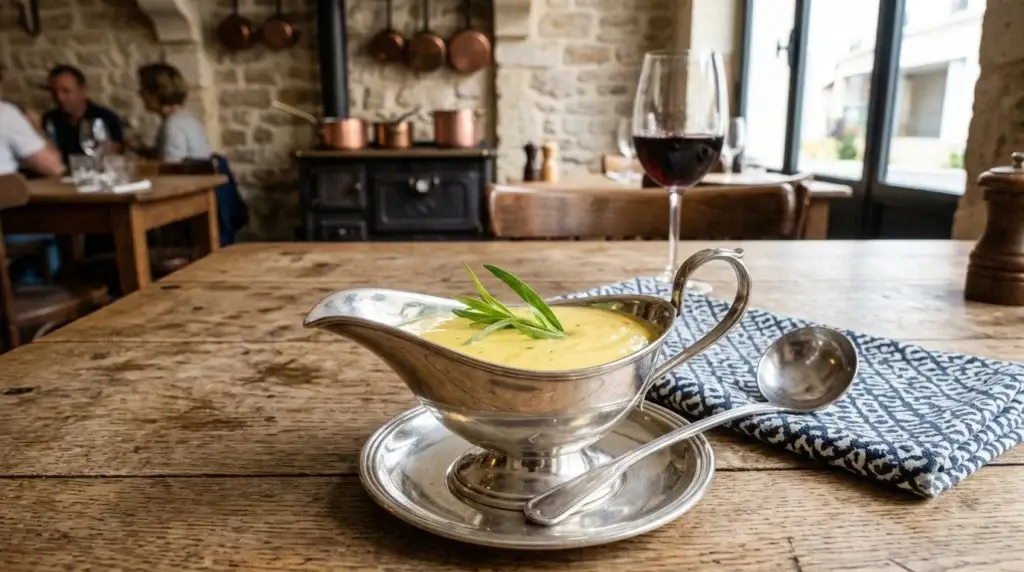
- Serve immediately, spooned over steak or vegetables while still warm.
Chef Notes: Keep the water underneath the bowl at a bare simmer throughout, and add the butter slower than feels necessary — patience here is what keeps the emulsion stable.
Storage Notes: Best served fresh. If needed, refrigerate up to 2 days and reheat very gently over a bain-marie, whisking constantly; freezing is not recommended.
Nutrition Disclaimer: Calorie and nutrition estimates are approximate and will vary based on specific ingredients and portion sizes used.
Conclusion
Béarnaise sauce has a reputation it doesn’t entirely deserve. It isn’t fragile so much as it is specific — a handful of steps that need to happen in the right order, at the right temperature, with a little patience at the point where the butter goes in. Understand the emulsion, respect the heat, and use real fresh tarragon, and you’ll have a sauce that turns any decent steak into something worth remembering.
Make it once, slowly and carefully, and you’ll see why cooks have kept coming back to this exact recipe for close to two hundred years. Few sauces reward a careful hand quite like a properly made Béarnaise.