
Osso Buco Recipe: 7 Secrets to Authentic Milanese Braised Veal Shanks
A good osso buco recipe starts with one non-negotiable: patience. This is a dish built on slow, gentle braising, where cross-cut veal shanks turn meltingly tender and the marrow inside the bone becomes a spoonable prize all its own. If you’ve only had a rushed or watered-down version at a chain restaurant, this authentic Milanese approach will change how you think about Italian braises entirely.
This recipe follows the traditional method used in Lombardy for generations — bone-in veal shanks, a classic soffritto base, white wine, and a bright, citrusy gremolata finish that cuts through the richness. You’ll learn exactly why each step matters, from browning the meat properly to knowing when the collagen has finally broken down into silky gelatin. Whether you’re cooking for a holiday table or simply want a Sunday dinner that feels like a trip to Milan, this guide walks you through every detail.
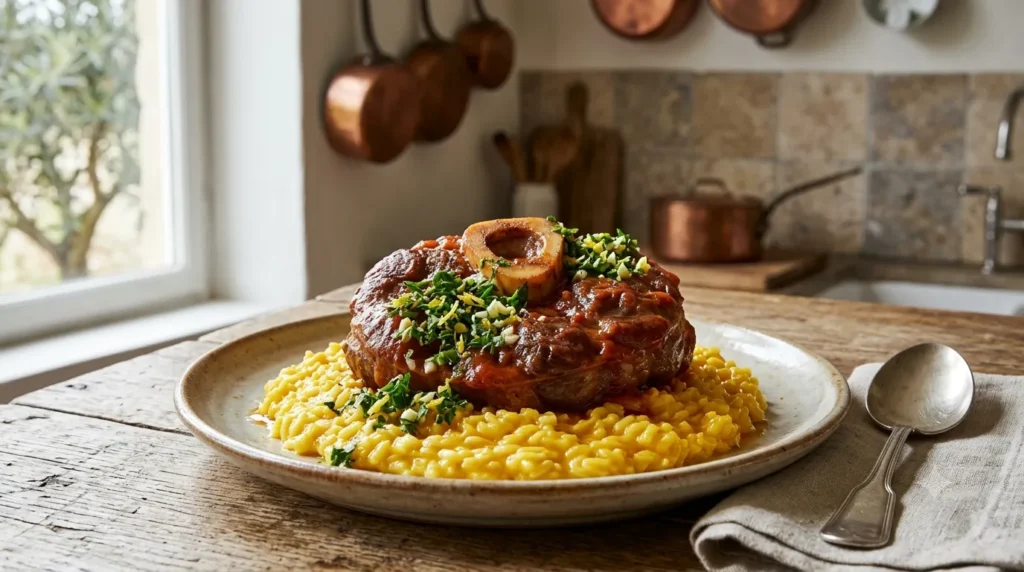
Table of Contents
WHAT IS OSSO BUCO ?
Osso buco translates literally from Italian as “bone with a hole,” referring to the hollow marrow cavity at the center of a cross-cut veal shank. It’s both the name of the cut and the name of the dish made from it.
Traditionally, the shank is cut crosswise into rounds about 1.5 to 2 inches thick, seasoned, dredged lightly in flour, seared, and then braised low and slow in a mixture of wine, stock, and aromatic vegetables until the meat is fork-tender and the marrow inside is soft enough to spread.
Regional origins: Osso buco comes from Milan, in the Lombardy region of northern Italy, where it has been a staple of home and restaurant kitchens since at least the 19th century.
Traditional preparation: The classic Milanese version, osso buco alla Milanese, is braised with white wine and finished with gremolata — a fresh mixture of lemon zest, garlic, and parsley. A tomato-based version also exists and is common outside Milan, though purists consider the white, tomato-free version the original.
WHY THIS OSSO BUCO RECIPE WORKS
- Bone-in veal shanks provide collagen-rich connective tissue that breaks down into gelatin, giving the braising liquid body without needing a thickener.
- A proper sear builds a deep, savory crust through the Maillard reaction, which becomes the flavor backbone of the sauce.
- Low, steady braising heat (around 325°F) allows collagen to convert slowly without drying out the muscle fibers, which happens if the pot runs too hot.
- Marrow bones intact mean the marrow itself bastes the meat from within as it renders.
- Fresh gremolata added at the end, rather than cooked in, keeps its citrus and herb notes vivid instead of muted.
THE HISTORY OF OSSO BUCO
Osso buco’s roots trace to Milanese home cooking of the 1800s, when nose-to-tail eating was standard practice and cross-cut shanks — an inexpensive, collagen-heavy cut — were braised to make them tender enough to eat. The dish was originally prepared without tomato, using white wine, broth, and a soffritto of onion, carrot, and celery.
Tomatoes entered the recipe later, likely influenced by cooking styles from farther south in Italy, and today both versions are widely served. The dish became closely associated with risotto alla Milanese, its classic saffron-scented accompaniment, and the pairing remains one of the most recognizable combinations in Northern Italian cuisine. Osso buco eventually spread well beyond Lombardy and is now a fixture on Italian restaurant menus worldwide, though the most faithful versions still hew closely to the original Milanese method.
KITCHEN SCIENCE BEHIND THE OSSO BUCO RECIPE
Maillard reaction: When you sear the shanks in hot fat, amino acids and sugars on the meat’s surface react to form hundreds of new flavor compounds, creating the deep brown crust that flavors the entire braise. Skipping this step results in a flatter, less complex sauce.
Collagen breakdown: Veal shanks are full of connective tissue called collagen. At temperatures around 160–200°F sustained over hours, collagen slowly converts into gelatin, which is what makes braised meat tender rather than tough and stringy.
Gelatin formation: As gelatin dissolves into the cooking liquid, it thickens the sauce naturally and gives it a glossy, silky mouthfeel — a hallmark of a well-executed braise.
Bone marrow: The marrow inside the shank bone renders slowly during cooking, basting the surrounding meat and adding richness. It’s traditionally eaten with a small spoon straight from the bone.
Chef Tip: Ask your butcher to tie a piece of kitchen twine around the circumference of each shank before cooking — it holds the meat to the bone through the long braise so nothing falls apart in the pot.
Wine reduction: Simmering wine before adding stock cooks off harsh alcohol notes and concentrates its acidity, which balances the richness of the marrow and meat.
Moisture retention: A tight-fitting lid traps steam, keeping the braising liquid at a gentle simmer rather than evaporating and scorching the pot.
OSSO BUCO RECIPE INGREDIENTS EXPLAINED
Veal shanks (4 pieces, about 1.5 inches thick): The star of the dish. Look for shanks with a good ring of marrow and even meat thickness so they cook uniformly. Buy from a butcher when possible for the best cut and quality grade. Store refrigerated up to two days before cooking, or freeze up to three months.
All-purpose flour: Used for a light dredge before searing. It helps form a crust and contributes body to the sauce as it cooks. Rice flour is a gluten-free substitute.
Olive oil and butter: Provide the fat for searing. The combination balances olive oil’s flavor with butter’s browning qualities.
Onion, carrot, celery (soffritto): The aromatic base of nearly all Italian braises. Dice finely and cook slowly to build sweetness without browning.
Garlic: Adds depth; added later in cooking to avoid burning.
Dry white wine: Traditional for Milanese-style osso buco. Choose something you’d drink, such as a Pinot Grigio or Sauvignon Blanc — avoid “cooking wine,” which is often oversalted.
Beef or veal stock: Forms the braising liquid. Our homemade beef stock or homemade chicken stock recipe will give noticeably better depth than boxed stock if you have time to make it ahead.
Bay leaf and fresh thyme: Provide subtle background aromatics through the long cook.
Lemon zest, garlic, and parsley (for gremolata): The traditional finishing garnish — bright, sharp, and essential to cutting the dish’s richness. See our full Italian gremolata recipe for ratios and variations.
Salt and black pepper: Season at multiple stages, not just at the end, for balanced flavor throughout.
CHOOSING THE BEST VEAL FOR THIS OSSO BUCO RECIPE
| Factor | Veal Shank | Beef Shank |
|---|---|---|
| Texture after braising | Delicate, tender | Heartier, chewier |
| Marrow richness | High, sweet | High, more intense |
| Cook time | 2–2.5 hours | 3–4 hours |
| Flavor profile | Mild, refined | Robust, beefy |
| Traditional to osso buco | Yes | Common substitute |
| Quality Grade | Characteristics |
|---|---|
| Prime | Finest marbling, most tender, priciest |
| Choice | Good marbling, widely available, excellent value |
| Select | Leaner, less marbling, best slow-braised |
Can beef shanks be substituted? Yes. Beef shanks make a heartier, still delicious version, though they require a longer braise and yield a slightly more robust flavor than the traditional veal preparation.
Bone size and thickness: Aim for shanks cut 1.5 to 2 inches thick with the bone centered — this ensures even cooking and a generous marrow portion in every serving.
STEP-BY-STEP OSSO BUCO RECIPE INSTRUCTIONS
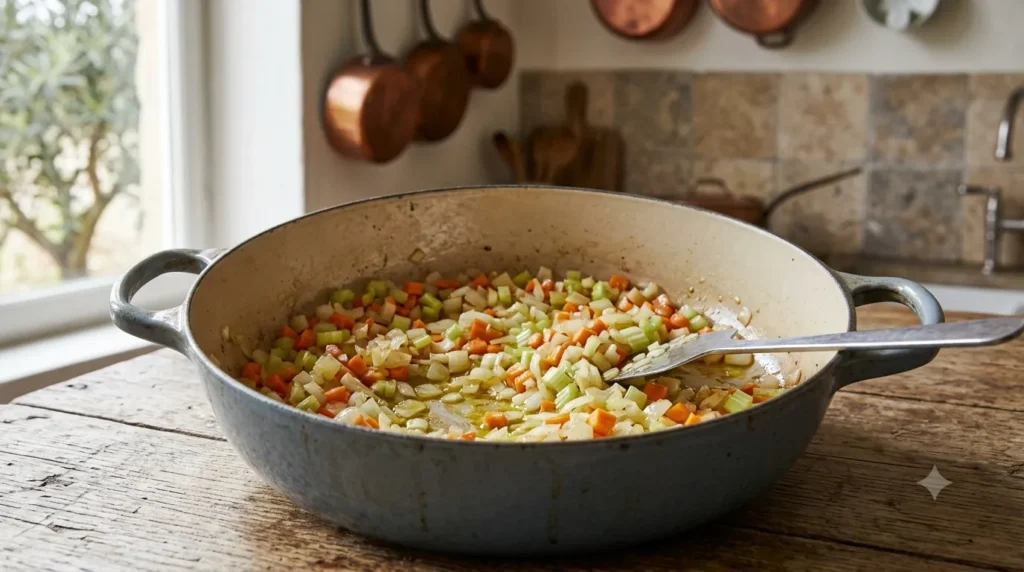
soffritto-cooking.jpg — ALT: “Diced onion, carrot, and celery cooking for osso buco” — Caption: “The classic Italian soffritto base.” — Prompt: Overhead shot of finely diced onion, carrot, and celery sautéing in a Dutch oven, warm lighting, rustic Italian kitchen counter, no text, 1344×768, 16:9.
1. Tie and season the shanks. Tie kitchen twine around each shank to help it hold its shape. Season generously with salt and pepper on both sides. Why: Seasoning early lets salt penetrate the meat rather than just sitting on the surface. Visual cue: Meat should look evenly coated, not clumped with seasoning in spots.
2. Dredge in flour. Lightly coat each shank in flour, shaking off the excess. Common mistake: Too much flour creates a gummy, pasty crust instead of a crisp sear.
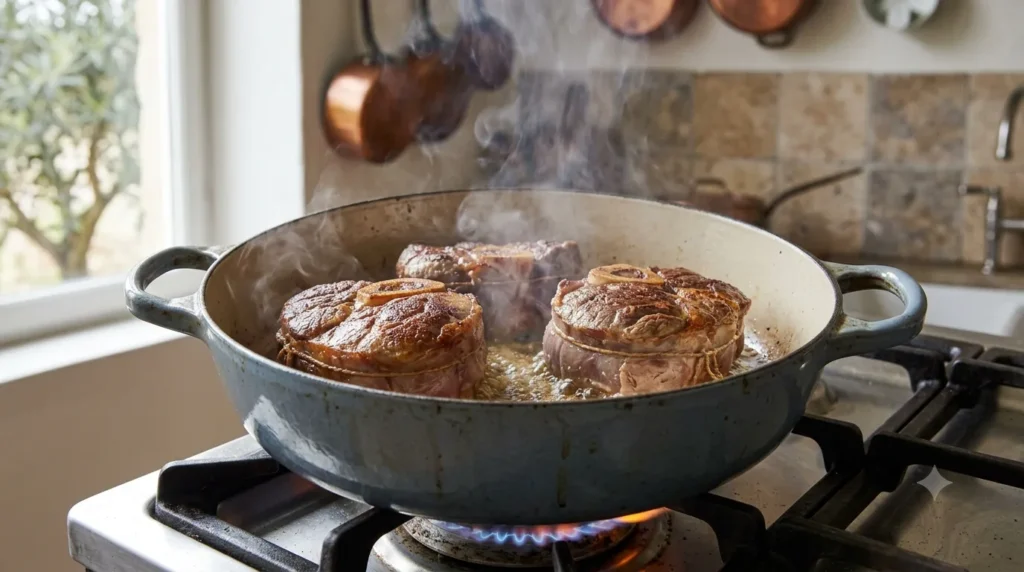
3. Sear the shanks. Heat olive oil and butter in a Dutch oven over medium-high heat. Sear shanks 3–4 minutes per side until deeply browned. Why: This builds the Maillard-driven flavor base for the entire dish. Visual cue: A deep mahogany crust, not just tan. Work in batches to avoid crowding the pot, which steams the meat instead of browning it.
4. Remove and set aside. Transfer shanks to a plate. Professional tip: Don’t wipe out the pot — the browned bits (fond) are pure flavor.
5. Build the soffritto. In the same pot, cook diced onion, carrot, and celery over medium heat until softened, 6–8 minutes. Why: Slow cooking here develops natural sweetness that balances the acidity of the wine.
6. Add garlic and tomato paste (if using). Cook 1 minute until fragrant. Common mistake: Burnt garlic turns bitter and can’t be fixed later in the braise.
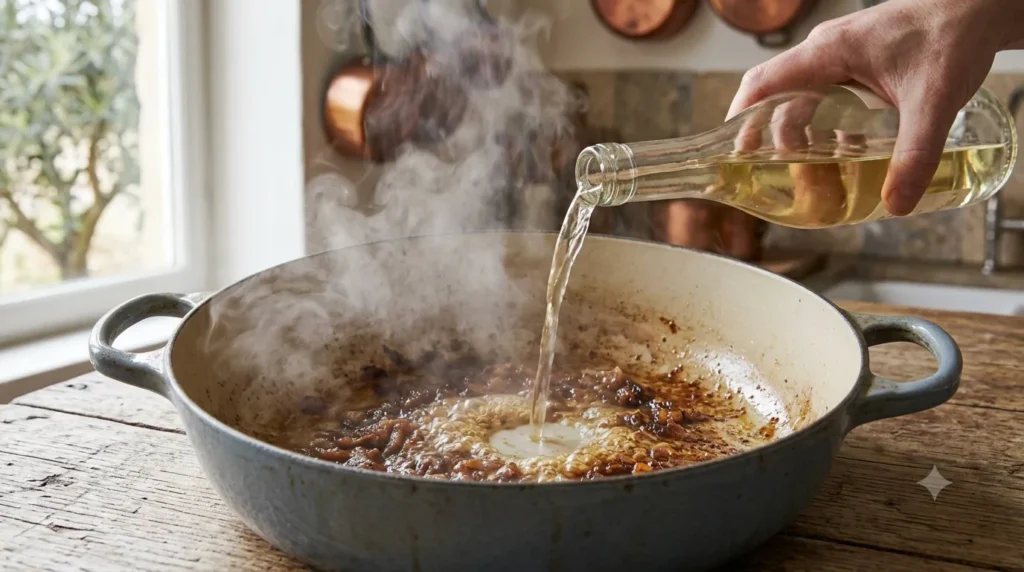
7. Deglaze with wine. Pour in white wine, scraping up the browned bits with a wooden spoon. Simmer 3–4 minutes to cook off harsh alcohol. Visual cue: Liquid should reduce slightly and smell sweet, not sharp.
8. Add stock and herbs. Pour in stock, add bay leaf and thyme, and return the shanks to the pot, nestling them so they’re mostly submerged.
9. Bring to a simmer, then cover and transfer to the oven. Bring to a gentle simmer on the stovetop, cover tightly, and braise at 325°F for 2 to 2.5 hours. Why: Low, steady heat allows collagen to convert to gelatin without toughening the muscle fibers.
10. Check for doneness. The meat should be fork-tender and just beginning to pull from the bone, but not falling apart completely. Common mistake: Overcooking until the meat disintegrates loses the texture that defines the dish.
11. Rest briefly, then reduce the sauce if needed. Remove shanks, tent with foil, and reduce the braising liquid on the stovetop if it’s thin. Season to taste.
12. Finish with gremolata. Just before serving, sprinkle each shank generously with fresh gremolata. Why: Adding it raw at the end preserves its bright citrus punch.
OSSO BUCO RECIPE CHEF TIPS
- Tie the shanks with twine before searing to keep them intact through the braise.
- Pat the meat completely dry before dredging for a better sear.
- Sear in batches — a crowded pot steams instead of browns.
- Use a heavy Dutch oven for even, consistent heat retention.
- Choose a wine you’d actually drink; poor wine makes a poor sauce.
- Reduce the wine fully before adding stock to mellow its sharpness.
- Keep the braise at a bare simmer, not a rolling boil, to protect the texture.
- Braise in the oven rather than the stovetop for more even, consistent heat.
- Check liquid levels once during cooking; shanks should stay mostly submerged.
- Don’t skip the marrow — it’s meant to be eaten, not discarded.
- Make the gremolata fresh, just before serving, for maximum brightness.
- Zest the lemon before juicing anything else to avoid bitterness from pith.
- Let the dish rest 10 minutes before serving so the sauce settles.
- Skim excess fat from the sauce surface before plating for a cleaner finish.
- Serve on warmed plates — braises cool quickly once portioned.
- Double the gremolata; leftovers brighten roasted vegetables or grilled fish too.
COMMON OSSO BUCO RECIPE MISTAKES
- Skipping the sear — results in a flat, one-dimensional sauce. Always brown the meat first.
- Using cooking wine — often oversalted and low quality; use a real drinking wine.
- Braising at too high a temperature — toughens the meat instead of tenderizing it; keep the oven at 325°F.
- Overcrowding the pot when searing — steams rather than browns the meat; sear in batches.
- Removing the twine before cooking — the shank can fall apart during the long braise.
- Under-seasoning — season at each stage, not just the end.
- Boiling instead of simmering — a hard boil breaks down the sauce’s texture and can toughen the meat.
- Not scraping the fond — leaving browned bits in the pot wastes flavor.
- Skipping the gremolata — the dish loses its signature brightness without it.
- Adding gremolata too early — cooking it dulls the citrus and garlic notes.
- Using pre-ground pepper or old dried herbs — diminishes overall flavor complexity.
- Not tying the shanks — meat can separate from the bone mid-braise.
- Overcooking until the meat disintegrates — losing the intended tender-but-intact texture.
- Using a thin pot — uneven heat can scorch the sauce.
- Forgetting to skim fat — leaves the sauce greasy rather than silky.
- Serving on cold plates — the sauce congeals and loses its glossy texture.
OSSO BUCO RECIPE VARIATIONS
Traditional Milanese (white wine, no tomato): The original version — cleaner, brighter, focused on wine and marrow flavor.
Red wine osso buco: Substitute red wine for white for a deeper, more robust sauce, often paired with heartier sides.
Tomato-rich osso buco: Add crushed tomatoes to the braising liquid for a version more common outside Milan, with a rounder, slightly sweeter sauce.
Slow cooker osso buco: Sear the shanks first, then transfer everything to a slow cooker on low for 6–7 hours.
Dutch oven osso buco (this recipe’s method): The traditional stovetop-to-oven approach, giving the most control over texture.
Instant Pot osso buco: Sear using the sauté function, then pressure cook on high for 45 minutes with a natural release.
Beef shank version: A heartier, more affordable substitute; extend braising time to 3–4 hours.
WHAT TO SERVE WITH OSSO BUCO
- Risotto alla Milanese — the classic, traditional pairing, its saffron flavor balancing the richness of the shanks.
- Creamy polenta — soaks up the braising sauce beautifully.
- Garlic mashed potatoes — a comforting, familiar alternative to risotto.
- Arugula salad — a peppery, acidic contrast to the rich braise.
- Homemade focaccia or Italian bread — ideal for mopping up extra sauce.
- Roasted vegetables — a simple, seasonal side that rounds out the plate.
- To finish the meal, tiramisu or panna cotta make classic, not-too-heavy Italian desserts.
OSSO BUCO RECIPE STORAGE & MAKE-AHEAD
Refrigeration: Store cooled osso buco in an airtight container for up to 4 days. Flavor often improves after a day as the sauce continues to meld.
Freezing: Freeze in a freezer-safe container for up to 3 months. Thaw overnight in the refrigerator before reheating.
Reheating: Warm gently in a covered pot over low heat, or in a 300°F oven, until heated through — high heat can toughen the meat.
Meal prep: Osso buco is an excellent make-ahead dish for entertaining; braise it up to 2 days in advance and reheat gently before serving, adding fresh gremolata just before the meal.
OSSO BUCO RECIPE FAQS
1. What is osso buco? Osso buco is a Northern Italian dish of cross-cut veal shanks braised slowly in wine, stock, and aromatic vegetables until tender.
2. What does “osso buco” mean? It translates to “bone with a hole,” referring to the marrow cavity in the center of the shank.
3. Can I use beef shanks instead of veal? Yes, though beef shanks need a longer braise and produce a heartier, more robust flavor than the traditional veal version.
4. Why is bone marrow important to the dish? Marrow renders during cooking, adding richness, and is traditionally eaten straight from the bone with a small spoon.
5. Do I have to sear the meat first? Searing builds deep flavor through the Maillard reaction and is a key step for a rich, well-developed sauce.
6. What wine is best for osso buco? A dry white wine such as Pinot Grigio or Sauvignon Blanc is traditional for the Milanese version.

7. What is gremolata? A fresh garnish of lemon zest, garlic, and parsley, added at the end to brighten the rich braise.
8. How long does osso buco take to cook? Veal shanks typically braise for 2 to 2.5 hours at 325°F until fork-tender.
9. Can osso buco be made ahead? Yes — it reheats well and often tastes even better the next day.
10. Can osso buco be frozen? Yes, it freezes well for up to 3 months in an airtight container.
11. What’s the best side dish for osso buco? Risotto alla Milanese is the traditional pairing, though creamy polenta and mashed potatoes also work well.
12. Why braise instead of roast? Braising slowly breaks down the shank’s tough connective tissue into gelatin, which roasting alone would not achieve.
13. Can I make osso buco in a slow cooker? Yes — sear the shanks first, then slow cook on low for 6–7 hours.
14. What’s the difference between Milanese and tomato-based osso buco? The Milanese version uses white wine with no tomato; the tomato-based version, more common outside Milan, adds crushed tomatoes for a rounder sauce.
15. How do I know when osso buco is done? The meat should be fork-tender and just beginning to pull from the bone, without fully disintegrating.

OSSO BUCO RECIPE CARD
Osso Buco (Authentic Italian Braised Veal Shanks)
- Prep Time: 25 minutes
- Cook Time: 2.5 hours
- Rest Time: 10 minutes
- Total Time: About 3 hours
- Servings: 4
- Cuisine: Italian (Lombardy)
- Course: Main Course
- Calories: Approximately 520 per serving
Ingredients:
- 4 veal shanks, 1.5–2 inches thick, tied
- Salt and black pepper, to taste
- ½ cup all-purpose flour, for dredging
- 3 tbsp olive oil
- 2 tbsp butter
- 1 onion, finely diced
- 2 carrots, finely diced
- 2 celery stalks, finely diced
- 3 cloves garlic, minced
- 1 cup dry white wine
- 2½ cups beef or veal stock
- 1 bay leaf
- 2 sprigs fresh thyme
Gremolata:
- Zest of 1 lemon
- 1 clove garlic, minced
- ¼ cup fresh parsley, finely chopped
Instructions:
- Tie and season the shanks; dredge in flour.
- Sear in olive oil and butter until deeply browned; set aside.
- Cook onion, carrot, and celery until softened.
- Add garlic; cook 1 minute.
- Deglaze with wine; simmer to reduce.
- Add stock, bay leaf, and thyme; return shanks to the pot.
- Cover and braise at 325°F for 2–2.5 hours.
- Rest 10 minutes; reduce sauce if needed.
- Combine gremolata ingredients and sprinkle over shanks before serving.
Chef Notes: For the most authentic texture, resist the urge to rush the braise — low and slow is what makes the meat tender without turning stringy.
Nutrition (per serving, approximate): Calories 520, Protein 45g, Fat 28g, Carbohydrates 12g, Sodium 610mg