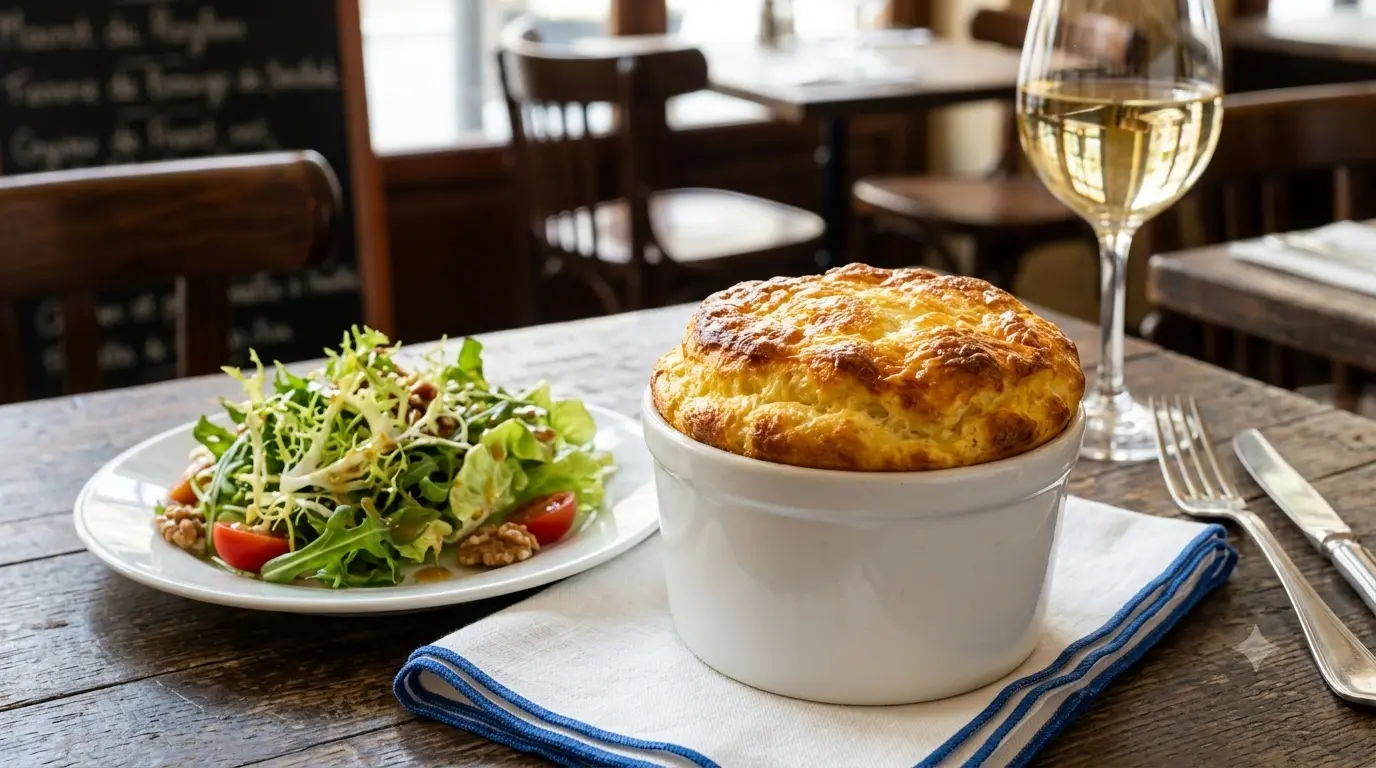
Twice-Baked Cheese Soufflé Recipe: Easy French Classic
Most home cooks avoid soufflés for one reason: the timing. Guests need to be seated the exact moment it comes out of the oven, because a few minutes later, that beautiful rise is gone. A Twice-Baked Cheese Soufflé solves that problem entirely. You bake it, let it fall on purpose, and set it aside — sometimes a full day ahead. Then, right before serving, a quick second bake puffs it back up, browns the top, and leaves the center soft and almost custardy underneath.
I’ve served this version at more dinner parties than I can count, precisely because it removes the one variable that makes a classic soufflé stressful: timing it to the second. The first bake does the structural work. The second bake is where the magic actually happens, and it’s the part that makes this dish taste even better than a traditional single-bake soufflé, not just more convenient.
This guide walks through the full technique — the science of why egg whites hold air, why the second bake creates that creamy interior, which cheese to use, and where cooks typically go wrong. By the end, you’ll have a Twice-Baked Cheese Soufflé recipe you can genuinely make ahead of time and serve with total confidence.
Table of Contents
What Is a Twice-Baked Cheese Soufflé?
A savory cheese soufflé is a baked dish built on a cheese-enriched béchamel sauce, lightened with whipped egg whites, that puffs up dramatically in the oven as trapped air expands under heat. It’s airy, rich, and known as much for its dramatic rise as for its flavor.
A twice-baked version takes that same base and changes the timing entirely. The soufflé is baked once in individual ramekins, allowed to cool and deflate on purpose, then turned out and baked a second time, usually with a bit of cream spooned over the top. That second bake puffs it back up and creates a texture that’s genuinely different from a single-bake soufflé: a light, golden exterior around a soft, almost molten center.
It’s become a favorite in French restaurant kitchens for a very practical reason — it lets a kitchen prep dozens of soufflé bases well ahead of service, then finish each one to order in a fraction of the time a full soufflé would take from scratch. That same practicality is exactly why it’s ideal for home entertaining. You do the harder work a day ahead, and the second bake, the fast and easy part, happens right before your guests sit down.
The History of the French Soufflé
The soufflé’s roots trace back to French cuisine in the 18th and 19th centuries, a period when French cooking was becoming increasingly codified and technical. Marie-Antoine Carême, one of the most influential chefs of that era, helped establish much of the structured, technique-driven approach to French cooking that soufflés depend on, even though the dish’s exact invention isn’t attributed to any single chef with certainty.
What started primarily as a sweet dish gradually expanded into savory versions built around cheese, vegetables, and seafood, following the same fundamental technique of a flavored base lightened with whipped egg whites. Savory soufflés became a hallmark of formal French dining, prized for both their flavor and their theatrical presentation at the table.
Twice-baked soufflés became popular in fine dining kitchens specifically because they solved the industry’s biggest problem with the dish: a classic soufflé has to be served the instant it leaves the oven, which is nearly impossible to coordinate across a room full of tables. Baking, cooling, and then finishing soufflés to order let restaurants serve this dramatic, labor-intensive dish reliably and at scale, and that same solution translates perfectly into a home kitchen preparing for guests.
Why Twice-Baked Soufflés Are Better for Entertaining
Can be made a day ahead. The entire first bake and cooling process can happen the day before, leaving only a quick second bake on the day itself.
Less stressful than classic soufflés. There’s no need to time a dinner party around a single, unforgiving oven moment. The second bake takes just minutes and holds up better than a traditional soufflé’s brief window.
More stable texture. Because the structure has already been set once, the twice-baked version doesn’t deflate nearly as dramatically or unpredictably as a classic single-bake soufflé.
Richer flavor after the second bake. The cream added before the second bake seeps into the soufflé as it reheats, adding richness and creating a noticeably more luxurious texture than the first bake alone produces.
Easier timing for dinner parties. You can pull the soufflés from the fridge, get them into the oven for the second bake as your guests are seated, and have them on the table minutes later, with far less last-minute pressure than a traditional soufflé demands.
The Science Behind a Perfect Soufflé
Understanding what’s actually holding a soufflé together makes the technique far less mysterious.
Egg proteins. Egg whites are made up largely of water and proteins that, when whipped, unfold and link together to form a network capable of trapping air.
Whipped egg whites. As you whip egg whites, you’re incorporating air into that protein network, building thousands of tiny bubbles suspended in a stable foam.
Air bubbles. Those trapped air bubbles are the entire reason a soufflé rises. Heat causes the air inside them to expand, and the surrounding egg-white structure stretches along with it.
Steam expansion. Moisture in the batter also converts to steam in the oven’s heat, adding additional expansion on top of the air already trapped by the whipped egg whites.
Why folding gently matters. Folding, rather than stirring or whisking the whipped whites into the cheese base, preserves as much of that trapped air as possible. Aggressive mixing collapses the bubbles before they ever reach the oven.
Why overmixed batter collapses. Once those air pockets are deflated through overmixing, there’s nothing left to expand under heat, and the soufflé won’t rise properly no matter how well everything else was executed.
Why the second bake creates a creamy center. During the first bake, the soufflé sets and then deflates as it cools. On the second bake, the added cream soaks into that already-set structure, and the gentle reheating puffs the eggs back up around a center that stays soft and custardy rather than fully re-drying, producing a texture genuinely distinct from a single-bake soufflé.
Choosing the Best Cheese
| Cheese | Melting Ability | Flavor | Best Use |
|---|---|---|---|
| Gruyère | Excellent, smooth | Nutty, slightly sweet | Traditional and most reliable choice |
| Comté | Excellent | Nutty, fruitier than Gruyère | Excellent substitute or blend partner |
| Parmesan | Good, doesn’t stretch | Sharp, salty, concentrated | Best used in small amounts for depth |
| Cheddar | Good, can turn slightly oily | Sharp, tangy | Works well, gives a bolder flavor |
| Emmental | Very good | Milder, slightly sweet | Good blended with Gruyère |
| Goat cheese | Fair, softens rather than melts | Tangy, bright | Distinct variation, less classic |
| Blue cheese | Fair, can be strong | Bold, pungent | Best in smaller amounts or as a variation |
Gruyère remains the classic and most reliable choice, melting smoothly without turning greasy and offering a nutty flavor that doesn’t overpower the eggs. Comté works beautifully as a substitute or blending partner. Parmesan, used in smaller amounts alongside Gruyère, adds a sharp, savory depth. Cheddar produces a bolder, more American-leaning flavor, while Emmental offers a milder alternative. Goat cheese and blue cheese shift the dish toward more distinct variations rather than the classic version, since both behave differently under heat and carry much stronger, more assertive flavors.
Best combinations: a blend of mostly Gruyère with a smaller portion of Parmesan gives both smooth melting and extra savory depth, which is the combination most classic French kitchens rely on.
Ingredients Explained
Butter builds the base of the béchamel and greases the ramekins, which helps the soufflé climb the sides evenly. Flour thickens the béchamel into a stable base capable of supporting the whipped egg whites. Milk is the liquid component of the béchamel, providing body and richness. Eggs, separated, provide both the structural yolks (enriching the base) and the whipped whites (providing lift). Cheese is the primary flavor of the dish and should be grated finely for even melting. Mustard, typically Dijon, adds a subtle sharpness that complements the cheese without tasting distinctly of mustard itself. Nutmeg, used sparingly, is a classic, traditional seasoning in French béchamel-based dishes, adding warmth in the background. Cayenne, in a small pinch, adds background heat that brightens the overall flavor. Salt and pepper season the base properly. Fresh herbs, such as chives or thyme, can be folded in for extra flavor and color.
Step-by-Step Technique
1. Prepare the ramekins. Butter them generously and, if desired, dust lightly with grated Parmesan, which helps the soufflé climb the sides during baking.
2. Make the béchamel. Melt butter, whisk in flour, and cook briefly to remove the raw flour taste, then gradually whisk in warm milk until smooth and thickened.
3. Add cheese. Off the heat, stir in the grated cheese, mustard, nutmeg, cayenne, salt, and pepper until fully melted and combined.
4. Separate the eggs. Whisk the egg yolks into the slightly cooled cheese base, one at a time.
5. Whip the egg whites. In a clean, dry bowl, whip the egg whites to soft, glossy peaks. Overwhipping to a dry, clumpy stage makes them harder to fold in evenly.
6. Fold. Fold about a third of the whipped whites into the cheese base to lighten it, then gently fold in the rest, working just until no white streaks remain.
7. Fill the ramekins. Divide the batter evenly among the prepared ramekins, filling almost to the top.
8. First bake. Bake in a preheated oven, typically around 375°F, until well-risen and set, usually 15 to 18 minutes.
9. Cool. Let the soufflés cool completely at room temperature; they will deflate naturally, which is expected and part of the process.
10. Remove the soufflés. Gently run a knife around the edge of each ramekin and turn the cooled, deflated soufflés out onto a baking dish.
11. Add cream. Spoon a small amount of heavy cream over and around each soufflé before the second bake.
12. Second bake. Bake again at a slightly higher temperature, around 400°F, for about 10 to 15 minutes, until puffed again and golden on top.
13. Serve. Serve immediately while the exterior is golden and the center is soft and creamy.
Visual cues: the first bake should look well-risen with a light golden top; the second bake should show a similar rise with a deeper golden-brown color. Texture cues: the finished soufflé should have a light, airy exterior around a soft, slightly molten center. Color cues: watch for even browning across the top during the second bake, rotating the dish if your oven heats unevenly.

Why Gruyère Is the Traditional Choice
Gruyère brings a nutty, slightly sweet flavor that complements eggs and cream without overwhelming them, which is exactly the balance a soufflé depends on. Its melting properties are ideal here: it turns smooth and creamy rather than stringy or greasy, blending evenly through the béchamel base.
Its subtle stretch, noticeable when the soufflé is cut into, adds a satisfying textural detail without making the dish feel heavy. If Gruyère isn’t available, Comté makes an excellent substitute with a very similar profile, and Emmental works as a milder alternative, particularly when blended with a smaller amount of Parmesan for extra depth.
Equipment Needed
- Ramekins — individual ceramic dishes needed for both the first and second bakes
- Mixing bowls — one for the béchamel base, a separate clean, dry bowl for whipping egg whites
- Whisk — for building a smooth béchamel and whisking in egg yolks
- Rubber spatula — essential for gently folding the egg whites into the base without deflating them
- Saucepan — for making the béchamel
- Stand mixer (optional) — speeds up whipping egg whites to stiff, glossy peaks, though a hand mixer or whisk works fine too
- Kitchen scale — useful for weighing cheese and flour precisely for consistent results
Common Mistakes
- Overwhipping the egg whites. Produces a dry, clumpy texture that’s difficult to fold in evenly. Fix: whip only to soft, glossy peaks.
- Overmixing when folding. Deflates the air that’s supposed to make the soufflé rise. Fix: fold gently, stopping as soon as no white streaks remain.
- Using a greasy or wet bowl for whipping whites. Prevents whites from whipping properly at all. Fix: make sure the bowl and whisk are completely clean and dry.
- Not buttering the ramekins thoroughly. Can cause the soufflé to stick and rise unevenly. Fix: butter generously, including up the sides.
- Adding cold egg yolks straight from the fridge. Can seize the warm cheese base. Fix: let eggs come closer to room temperature, or temper them gradually into the base.
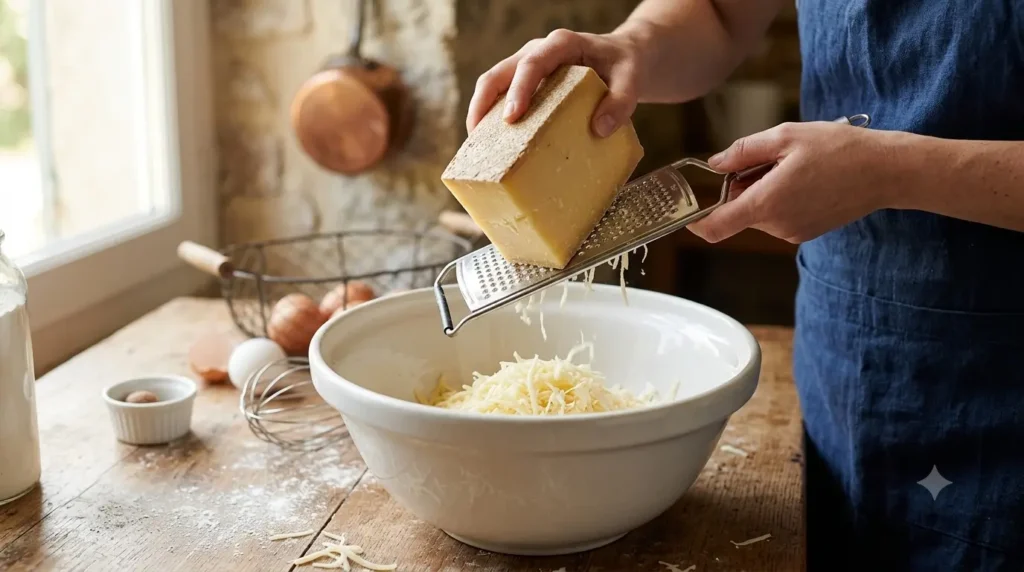
- Using pre-shredded cheese. Anti-caking starch prevents smooth melting. Fix: grate cheese fresh from a block.
- Skipping the resting and cooling step. Rushing straight to the second bake without letting the soufflé cool and set first misses the intended texture change. Fix: let it cool fully before removing and finishing.
- Opening the oven door during the first bake. Can cause a temperature drop that affects the rise. Fix: resist checking until near the end of the estimated bake time.
- Using too much flour in the béchamel. Results in a dense, heavy base that resists rising properly. Fix: measure flour carefully and don’t overdo the initial roux.
- Under-seasoning the base. A soufflé with a lot of egg and cheese needs proper seasoning to avoid tasting flat. Fix: taste the base (safely, before adding raw egg whites) and adjust salt and seasoning.
- Not draining excess cream during the second bake. Too much cream can make the base soggy rather than creamy. Fix: use a modest, controlled amount.
- Overbaking during the second round. Dries out the center that should stay soft and creamy. Fix: watch closely and pull it as soon as it’s puffed and golden.
- Handling the cooled soufflés roughly when turning them out. Can cause them to break apart. Fix: run a thin knife carefully around the edge and turn out gently.
- Serving straight from the fridge without the second bake. Misses the entire point of the technique — the second bake is what restores the texture and richness. Fix: always finish with the second bake before serving.
- Using a soufflé dish that’s too large for the batter. Prevents a proper rise, since there’s too much surface area relative to volume. Fix: use appropriately sized ramekins for the amount of batter.
Pro Chef Tips
- Make sure your mixing bowl and whisk are completely grease-free before whipping egg whites.
- Bring egg whites closer to room temperature before whipping for better volume.
- Butter ramekins in upward strokes, which helps the soufflé climb evenly as it rises.
- Dust buttered ramekins with a little grated Parmesan for extra flavor and grip on the sides.
- Cook the roux for the béchamel just long enough to remove the raw flour taste, without browning it.
- Add cheese to the base off the heat to prevent it from turning grainy or separating.
- Fold in thirds: lighten the base first with a small portion of whites, then fold in the rest gently.
- Fill ramekins almost to the top for the most dramatic rise.
- Run your thumb around the rim of the filled ramekin before baking to help the soufflé rise straight up rather than unevenly.
- Bake on a preheated baking sheet for more even bottom heat.
- Resist opening the oven door early during the first bake.
- Let the first bake cool completely and naturally; don’t rush this step by refrigerating them while still warm.
- Store the cooled, deflated soufflés covered in the refrigerator until ready for the second bake.
- Use good-quality heavy cream for the second bake, since it adds real richness to the finished dish.
- Preheat the oven fully before the second bake to ensure a proper, quick rise.
- Watch the second bake closely; it moves faster than the first.
- Serve immediately after the second bake, while the exterior is still golden and the center soft.
- Warm your serving plates slightly so the soufflés don’t cool too quickly once plated.
- Garnish with a few fresh herbs right before serving for color and aroma.
- Practice the folding technique with a small test batch if you’re new to it — a gentle hand here makes the biggest difference in the final rise.
Variations
Goat Cheese Soufflé: Swap in a portion of soft goat cheese for a tangier, brighter flavor profile.
Blue Cheese Soufflé: Use a smaller amount of a milder blue cheese blended with Gruyère for a bold but balanced result.
Cheddar Soufflé: A sharper, more familiar flavor that works particularly well for a more casual entertaining occasion.
Herb Soufflé: Fold in a generous amount of fresh chives, tarragon, or chervil for a brighter, herbaceous version.
Spinach Cheese Soufflé: Stir in well-drained, finely chopped cooked spinach for added color and a classic pairing with Gruyère.
Mushroom Soufflé: Fold in finely chopped, well-sautéed mushrooms for an earthy depth.
Truffle Soufflé: A few drops of truffle oil or a small amount of shaved truffle folded into the base turns this into a genuinely luxurious version for a special occasion.
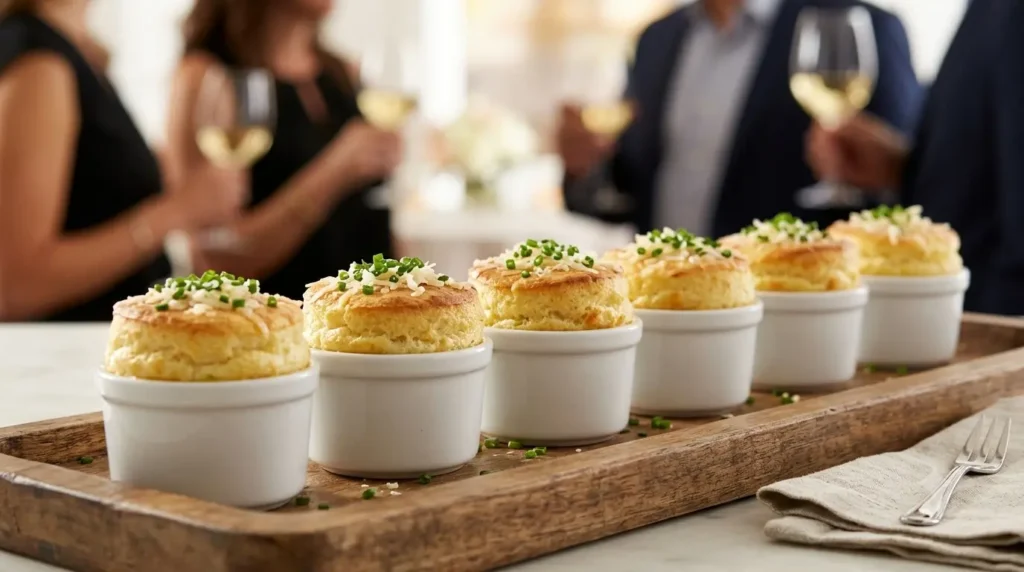
Mini Soufflés: Use smaller ramekins for individual bite-sized portions, ideal for a passed appetizer at a larger gathering.
Storage & Make-Ahead Tips
Making one day ahead: This is the entire advantage of the twice-baked method. Complete the first bake, let the soufflés cool and deflate, then refrigerate them, covered, until you’re ready for the second bake. Refrigeration: The cooled, first-baked soufflés keep well in the refrigerator for up to 24 hours, and can typically hold for up to 2 days if needed. Freezing: The first-baked, cooled soufflés can be frozen for up to a month; thaw in the refrigerator overnight before proceeding with the second bake. Reheating: The second bake itself is the reheating step; there’s no need for any additional reheating beyond that. Transporting: If preparing these for an event elsewhere, transport the cooled, first-baked soufflés in their ramekins, well covered, and complete the second bake on-site. Food safety: Keep the first-baked soufflés refrigerated until shortly before the second bake, and make sure the second bake brings them through to a properly heated, fully warmed center.
What to Serve with Twice-Baked Cheese Soufflé
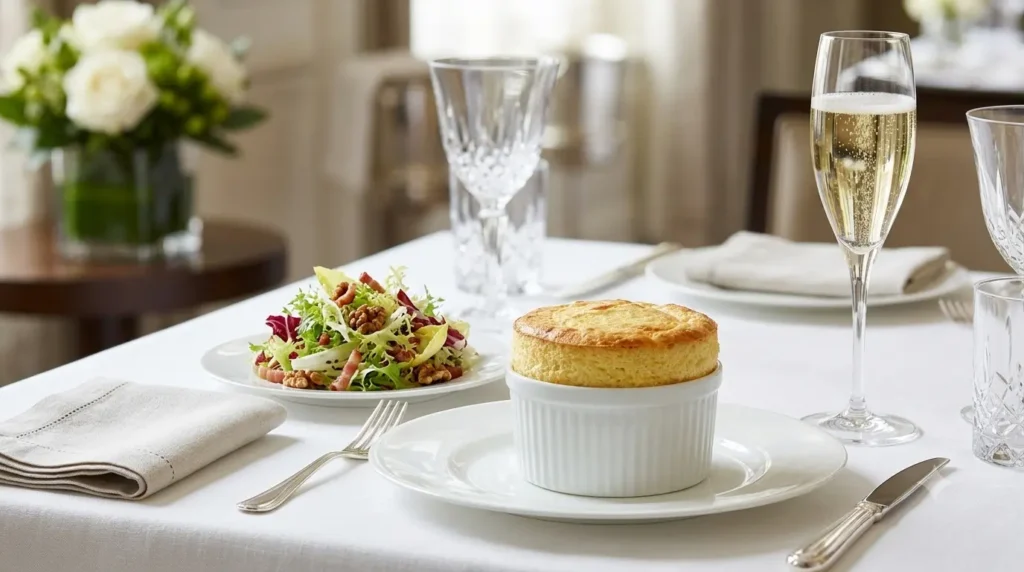
A simple frisée salad or arugula salad with a sharp vinaigrette provides a peppery, acidic contrast to the rich soufflé. Roasted asparagus or green beans add color and a lighter vegetable component to the plate. A tomato salad brings brightness, especially in summer. Crusty French bread is a natural accompaniment for any extra sauce or cream on the plate. For a more substantial starter course, a small portion of smoked salmon alongside the soufflé makes for an especially elegant pairing.
Wine pairings: Champagne makes a celebratory, classic pairing for a dinner party starter. A crisp Chablis or Sancerre complements the richness of the cheese without competing with it. A fuller white Burgundy works well for a more substantial version of the dish, and a lighter Pinot Noir is a solid choice if you’d prefer red wine.
Frequently Asked Questions
1. Can I make a Twice-Baked Cheese Soufflé ahead of time? Yes, that’s the entire advantage of this method. The first bake can be done up to a day (or even two) ahead, with only the quick second bake happening right before serving.
2. Can I freeze a Twice-Baked Cheese Soufflé? Yes, the first-baked, cooled soufflés freeze well for up to a month. Thaw in the refrigerator before completing the second bake.
3. Why did my soufflé collapse during the first bake? This usually points to overmixing the egg whites into the base, which deflates the air that’s supposed to make it rise. Fold gently and stop as soon as the mixture is combined.
4. Can I use pre-shredded cheese? It’s not recommended, since pre-shredded cheese is coated in anti-caking starch that prevents it from melting as smoothly into the base.
5. Can I use skim milk instead of whole milk? You can, though the béchamel will be noticeably less rich. Whole milk produces a fuller, creamier base.
6. Can I make this dish gluten-free? Yes, by substituting a gluten-free flour blend for the roux in equal measure.
7. Can I bake this in one large dish instead of individual ramekins? Yes, though the bake time will need to increase, and the dramatic individual presentation of single-serving soufflés will be lost.
8. How do restaurants make soufflés so fluffy? Careful attention to properly whipped egg whites, gentle folding technique, and not overmixing the base are the biggest factors, along with practice and consistency in execution.
9. Why does my soufflé have a dense, heavy texture? This is often caused by overmixing the roux with too much flour, overwhipping the egg whites past the glossy stage, or folding too aggressively and losing trapped air.
10. Do I need to serve a Twice-Baked Cheese Soufflé immediately after the second bake? Yes, similarly to a classic soufflé, it’s best served right away while the top is freshly golden and the center is still soft.
11. Can I add vegetables like spinach or mushrooms to the base? Yes, well-drained, finely chopped vegetables can be folded into the cheese base before adding the egg whites, as described in the variations section.
12. What’s the ideal cheese for a classic version? Gruyère is the traditional and most reliable choice, offering excellent melting properties and a balanced, nutty flavor.
13. Can I make a larger batch for a bigger dinner party? Yes, the recipe scales well; just make sure you have enough ramekins and don’t crowd the oven, which can affect even baking.
14. Why is my second bake not rising as much as the first? Some settling is expected and normal on the second bake since the structure was already set once; a lower rise on the second bake is still typical and doesn’t affect the flavor or texture negatively.
15. Can I prepare the béchamel base in advance, separate from the eggs? Yes, the cheese-enriched béchamel can be made ahead and refrigerated; bring it to room temperature before adding egg yolks and folding in freshly whipped whites.
Recipe Card
Twice-Baked Cheese Soufflé
| Prep Time | 25 minutes |
| Cook Time | 30 minutes (combined first and second bakes) |
| Cooling Time | 1 hour (or overnight) |
| Total Time | Approximately 2 hours (or next-day, if made ahead) |
| Servings | 6 |
| Cuisine | French |
| Course | Appetizer, Starter |
| Calories (estimated) | 290 per serving |
Ingredients
- 3 tablespoons butter, plus extra for the ramekins
- 3 tablespoons all-purpose flour
- 1 1/4 cups whole milk, warmed
- 1 1/2 cups Gruyère cheese, freshly grated
- 1/4 cup Parmesan, freshly grated
- 1 teaspoon Dijon mustard
- 1/4 teaspoon nutmeg
- Pinch of cayenne pepper
- Salt and black pepper, to taste
- 4 large eggs, separated
- 1/2 cup heavy cream, for the second bake
- Fresh chives, for garnish
Instructions
- Preheat the oven to 375°F. Butter six ramekins generously and dust lightly with Parmesan.
- In a saucepan, melt the butter over medium heat, then whisk in the flour, cooking for 1 to 2 minutes.
- Gradually whisk in the warm milk until smooth and thickened, about 3 to 4 minutes.
- Remove from heat and stir in the Gruyère, Parmesan, mustard, nutmeg, cayenne, salt, and pepper until melted and combined.
- Whisk in the egg yolks one at a time, letting the base cool slightly first.
- In a clean, dry bowl, whip the egg whites to soft, glossy peaks.
- Fold about a third of the whipped whites into the cheese base to lighten it, then gently fold in the remaining whites just until no streaks remain.
- Divide the batter evenly among the prepared ramekins, filling nearly to the top.
- Bake for 15 to 18 minutes, until well-risen and set. Let cool completely to room temperature; the soufflés will deflate naturally.
- Once cooled, run a thin knife around the edge of each ramekin and gently turn the soufflés out onto a baking dish. Refrigerate, covered, until ready to finish (up to 24 hours).
- When ready to serve, preheat the oven to 400°F. Spoon the heavy cream over and around each soufflé.
- Bake for 10 to 15 minutes, until puffed again and golden on top.
- Garnish with fresh chives and serve immediately.
Chef Notes: The first bake sets the structure; the second bake is where the flavor and creamy texture really come together, so don’t skip the resting period in between.
Storage Notes: Refrigerate first-baked soufflés up to 2 days, or freeze up to 1 month, before completing the second bake.
Nutrition Disclaimer: Calorie and nutrition estimates are approximate and will vary based on specific ingredients and portion sizes used.
Conclusion
A Twice-Baked Cheese Soufflé takes one of French cooking’s most intimidating dishes and turns it into something you can genuinely plan around. The first bake sets the structure, a rest in the refrigerator lets you get ahead, and the second bake, quick and forgiving, is what actually finishes the dish and gives it that soft, creamy center.
Make it once, and you’ll wonder why anyone stresses over timing a classic soufflé to the minute. This version gives you all of the drama and richness of the original, with almost none of the risk, and that combination is exactly why it belongs in your dinner party rotation.