
Greek Lemon Rice: The Bright, Fluffy Mediterranean Side Dish That Goes with Everything
When you step into a traditional Greek taverna, whether on the sun-drenched shores of Naxos or in the bustling streets of Athens, you quickly discover that side dishes are far more than an afterthought. They are integral to the meal. Among these culinary treasures, Greek Lemon Rice—known in Greece as Ryzi Lemonato—stands out as one of the most versatile and beloved staples of Mediterranean cooking.
At its core, authentic Greek lemon rice transforms humble long-grain rice into a vibrant, highly aromatic centerpiece. Infused with robust extra virgin olive oil, rich broth, fragrant garlic, fresh dill, parsley, and an unmistakable hit of bright lemon juice and zest, this dish delivers a ideal balance of savory depth and citrusy brightness.
Unlike dry, plain white rice or heavy, butter-laden sides, fluffy lemon rice brightens the palate and cuts through the richness of grilled meats, seafood, and roasted vegetables. Whether you are hosting a weeknight dinner, preparing meals for the week ahead, or cooking a festive holiday feast, mastering this easy Greek side dish will change how you view simple grains forever.
In this guide, we will break down the culinary techniques, food science, and traditional methods needed to cook restaurant-quality homemade Greek lemon rice right in your own kitchen.
Table of Contents
- What Is Greek Lemon Rice?
- Why This Recipe Works
- Ingredients Breakdown
- Best Rice to Use: A Comparative Guide
- The Science Behind Fluffy Rice
- Step-by-Step Technique & Cooking Guide
- Expert Chef Tips for Cooking Perfection
- Delicious Flavor Variations
- 10 Common Mistakes and How to Avoid Them
- What to Serve with Greek Lemon Rice
- Storage, Reheating, and Food Safety
- Nutritional Breakdown
- Frequently Asked Questions
- Printable Recipe Card
- Internal & External Culinary Resources
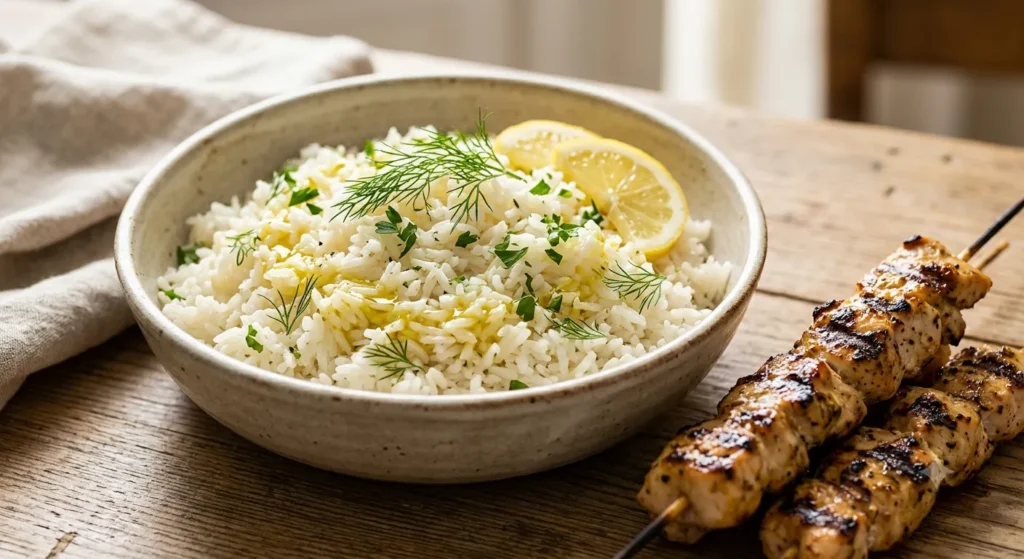
- ALT Text: Authentic Greek lemon rice garnished with fresh herbs and lemon slices served in a ceramic bowl.
- File Name: greek-lemon-rice-hero.jpg
What Is Greek Lemon Rice?
Greek lemon rice (Ryzi Lemonato) is a traditional rice pilaf that anchors everyday family meals across Greece and the wider Mediterranean. While standard rice is often boiled simply in salted water, Greek rice is built on layer after layer of aromatic flavor.
Origins and Regional Nuances
In traditional Greek home kitchens, rice was historically cooked using the pilaf method: gently sautéing aromatics in locally pressed olive oil before braising the grains slowly in rich animal broths. Because citrus trees thrive across the southern Greek countryside, fresh lemons became a primary seasoning agent used to preserve, brighten, and flavor grains, meats, and soups (such as the famous Avgolemono).
How It Differs from Other Lemon Rice Dishes
It is common to confuse Mediterranean lemon rice with Indian lemon rice (Chitranna), but their culinary foundations are distinctly different:
- Indian Lemon Rice: Uses pre-cooked rice tossed with mustard seeds, turmeric, curry leaves, roasted peanuts, and lemon juice. The resulting dish is dry, spiced, and yellow from turmeric.
- Greek Lemon Rice: Employs a pilaf cooking process where uncooked rice absorbs stock, garlic, onion, and olive oil while simmering. Fresh lemon juice, aromatic lemon zest, and soft Mediterranean herbs like dill and parsley are folded in, creating a moist, tender, highly aromatic grain.
Taverna Style vs. Home Style
If you have dined at a Greek-American restaurant, you may have noticed lemon rice that appears bright yellow. Commercial kitchens often add a pinch of turmeric or saffron for visual flair. Traditional Greek home cooks, however, rely strictly on natural ingredients: translucent yellow onions, golden extra virgin olive oil, fresh lemon zest, and deep green herbs. Both styles are delicious, but the traditional home style prioritizes pure, clean Mediterranean flavors.
Why This Recipe Works
Achieving a true fluffy lemon rice texture with a balanced, non-bitter citrus flavor requires a solid understanding of basic kitchen science. Here is why this specific recipe succeeds every single time:
- Ideal Liquid-to-Rice Ratio: Many home recipes call for too much liquid, resulting in sticky, mushy grains. We use a precise ratio that allows the rice to cook through while steam finishes the job.
- The Toasting Step: Sautéing raw rice in extra virgin olive oil coats each grain in fat. This creates a protective seal that prevents excess starches from leeching out and turning the pan gummy.
- Broth Over Water: Cooking rice in a seasoned chicken broth or rich vegetable stock infuses flavor deep inside the endosperm of the grain, rather than just seasoning the exterior.
- Two-Phase Lemon Addition: Adding all your citrus juice at the start can toughen the grains and cause a bitter, cooked-lemon flavor. By steeping lemon zest during simmering and folding fresh lemon juice in at the very end, you capture bright acidity and sweet citrus aromas without any bitterness.
- The Steam and Rest Cycle: Letting the pot sit covered off the heat allows the moisture distribution inside the pan to equalize, ensuring every single grain is tender and distinct.
Ingredients Breakdown
Every ingredient in this recipe serves a specific functional and culinary purpose. Using high-quality ingredients transforms a simple side dish into an exceptional one.
Ingredients & Purpose Table
| Ingredient | Role in the Dish | Recommended Choice |
| Long-Grain Rice | Main carbohydrate structure; yields separate, fluffy grains. | Standard Long-Grain White or Extra-Long Basmati |
| Extra Virgin Olive Oil | Adds rich mouthfeel, coats grains to prevent gumminess, provides fruity aroma. | Cold-pressed Greek EVOO (e.g., Koroneiki variety) |
| Yellow Onion | Builds a sweet, savory aromatic base. | Finely diced sweet or yellow onion |
| Fresh Garlic | Delivers background pungent savory depth. | Freshly minced garlic cloves (avoid jarred garlic) |
| Chicken or Veg Broth | Provides savory umami base instead of plain salted water. | Low-sodium organic chicken stock or dark vegetable broth |
| Fresh Lemon Juice | Adds clean, sharp acidity to balance rich olive oil and stock. | Freshly squeezed lemons (never bottled) |
| Lemon Zest | Contains aromatic citrus oils that linger long after cooking. | Microplaned zest of unwaxed lemons |
| Fresh Dill | Signature Greek herb offering a sweet, feathery, anise-like finish. | Freshly chopped dill fronds |
| Fresh Flat-Leaf Parsley | Brings grassy freshness, color, and a subtle pepperiness. | Italian flat-leaf parsley |
| Sea Salt & Black Pepper | Essential mineral seasonings that highlight and balance flavor. | Fine sea salt and freshly cracked black pepper |
| Dried Oregano (Optional) | Adds a warm, earthy, classic Mediterranean herb note. | Greek mountain oregano (Origanum vulgare) |
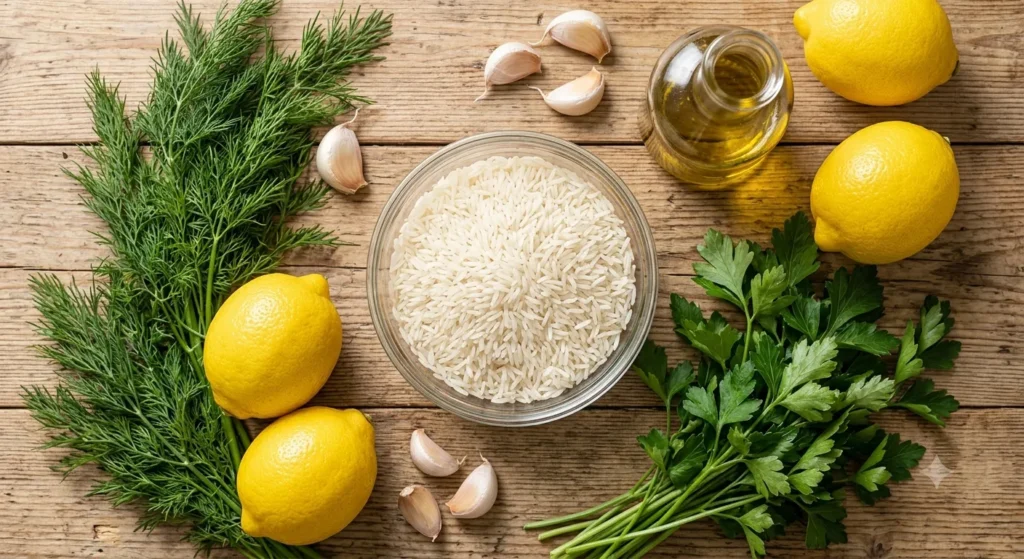
- ALT Text: Raw ingredients for making Greek lemon rice including rice, lemons, garlic, olive oil, and fresh herbs.
- File Name: ingredients-greek-lemon-rice.jpg
Best Rice to Use: A Comparative Guide
Selecting the right rice variety dictates whether your finished dish is light and airy or heavy and clumped. Rice varieties differ in their ratio of two main starches: amylose and amylopectin.
- Amylose: Long, straight starch molecules that cook up firm, dry, and separate.
- Amylopectin: Branched starch molecules that break down easily, releasing sticky gelatinized starch during cooking.
1. Extra Long-Grain White Rice (Best All-Around Classic)
Standard long-grain white rice contains a high percentage of amylose. When cooked properly, the grains expand lengthwise, remain firm, and separate effortlessly. It absorbs broth well without turning soft.
2. Basmati Rice (Best for Maximum Fluffiness)
Basmati is aged to reduce moisture content and boasts a high amylose profile. It yields exceptionally long, delicate, non-sticky grains with a subtle nutty aroma that pairs beautifully with citrus and olive oil.
3. Jasmine Rice (Good Alternative, Soft Finish)
Jasmine rice has a lower amylose content than Basmati. While aromatic, it naturally holds more moisture and cooks into a slightly softer, stickier texture. If using Jasmine, reduce your liquid ratio slightly.
4. Medium-Grain White Rice (Traditional, Softer Texture)
In many home kitchens across rural Greece, medium-grain rice (Rizi Karolinas) is used. It creates a creamier, softer pilaf. It is comforting, but requires careful attention to avoid overcooking into porridge.
5. Arborio / Short-Grain Rice (Not Recommended)
Arborio is packed with amylopectin, designed specifically to create creamy risottos. It will release too much surface starch, making a fluffy pilaf nearly impossible.
The Science Behind Fluffy Rice
Cooking rice is an act of controlled starch gelatinization and hydration. Understanding what happens inside the pot helps you master the technique.
1. Removing Surface Starch (Rinsing)
When rice grains rub against each other during milling and shipping, they create a fine dust of loose surface starch. If introduced directly to boiling liquid, this starch dissolves instantly, creating a thick, gummy paste that binds grains together. Rinsing raw rice under cold water until the runoff turns clear removes this excess starch.
2. Gelatinization and Hydrophobic Barriers
Starch gelatinization occurs when starch granules absorb water and heat, swelling until they burst. By sautéing the rinsed, dry rice in extra virgin olive oil before adding liquid, you wrap each grain in a hydrophobic (water-repelling) lipid barrier. This slows down moisture absorption slightly, preventing the outer layer of the grain from breaking down before the interior is fully cooked.
3. The Steam and Rest Cycle
When cooking ends and you remove the pot from the heat, the rice at the top of the pan is drier than the rice resting at the wet bottom. Removing the lid immediately allows essential heat and steam to escape, leaving the top layer undercooked and the bottom layer soggy.
By leaving the lid tightly secured off the heat for 10 minutes, the trapped internal steam circulates evenly. The moist bottom layer dries out slightly while the top layer absorbs remaining moisture, equalizing the texture throughout the entire pot.
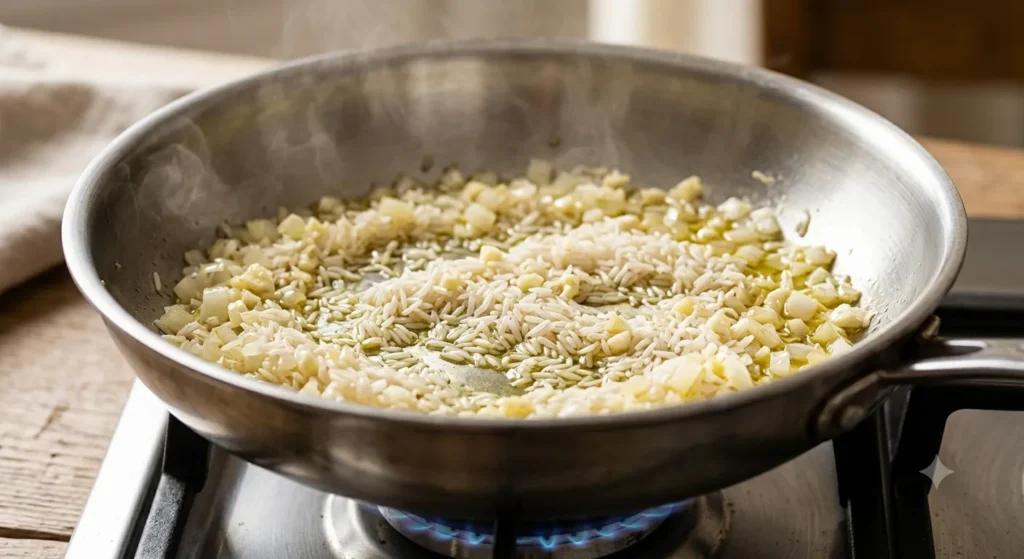
- ALT Text: Toasting rice, onions, and garlic in olive oil inside a stainless steel pan.
- File Name: toasting-rice-in-pan.jpg
Step-by-Step Technique & Cooking Guide
Recipe Details
- Prep Time: 10 minutes
- Cook Time: 20 minutes
- Resting Time: 10 minutes
- Total Time: 40 minutes
- Yield: 6 side-dish servings
Step 1: Rinse and Drain the Rice
Place 1.5 cups of long-grain white or Basmati rice in a fine-mesh strainer. Submerge in a bowl of cold water or hold under running tap water, gently agitating the grains with your fingers. Continue rinsing for 60–90 seconds until the water runs completely clear. Shake off all excess water and let the rice dry in the strainer for 5 minutes.
Step 2: Sweat the Aromatics
Set a wide, heavy-bottomed saucepan or deep skillet over medium heat. Add 3 tablespoons of extra virgin olive oil. Once shimmering, add 1 finely diced yellow onion. Cook for 4 to 5 minutes, stirring occasionally, until soft and translucent (do not brown). Stir in 3 cloves of finely minced garlic and cook for another 60 seconds until fragrant.
Step 3: Toast the Rice
Add the thoroughly drained rice into the pan with the aromatics. Cook for 2 to 3 minutes, stirring constantly with a wooden spoon. Ensure every grain is coated in olive oil. You will hear a soft crackling sound, and the edges of the rice grains will turn slightly translucent while the centers remain opaque.
Step 4: Add Broth and Seasoning
Pour in 2.75 cups of low-sodium chicken broth (or vegetable broth). Add 1 teaspoon of microplaned lemon zest, 1 teaspoon of fine sea salt, 1/4 teaspoon of black pepper, and 1/2 teaspoon of dried oregano (if using). Stir once to combine and release any grains sticking to the bottom.
Step 5: Bring to a Boil, Cover, and Simmer
Turn the heat up to high and bring the liquid to a rolling boil. As soon as it boils, cover the pot with a tight-fitting lid and immediately reduce the heat to low. Simmer gently for 15 to 17 minutes. Do not lift the lid or stir the rice during this period.
Step 6: Off-Heat Steam Rest
After 15–17 minutes, remove the pot from the burner without removing the lid. Let it rest undisturbed for 10 full minutes. The residual heat will continue to steam the rice to perfection.
Step 7: Finish with Fresh Lemon and Herbs
Remove the lid. Pour 3 tablespoons of freshly squeezed lemon juice evenly over the rice. Sprinkle 1/3 cup of finely chopped fresh parsley and 3 tablespoons of finely chopped fresh dill across the surface.
Using a table fork (never a spoon or spatula), gently fluff the rice from the bottom up, folding the fresh herbs and citrus juice into the warm grains. Cover loosely for 2 minutes to let the fresh herbs warm through, then serve immediately.
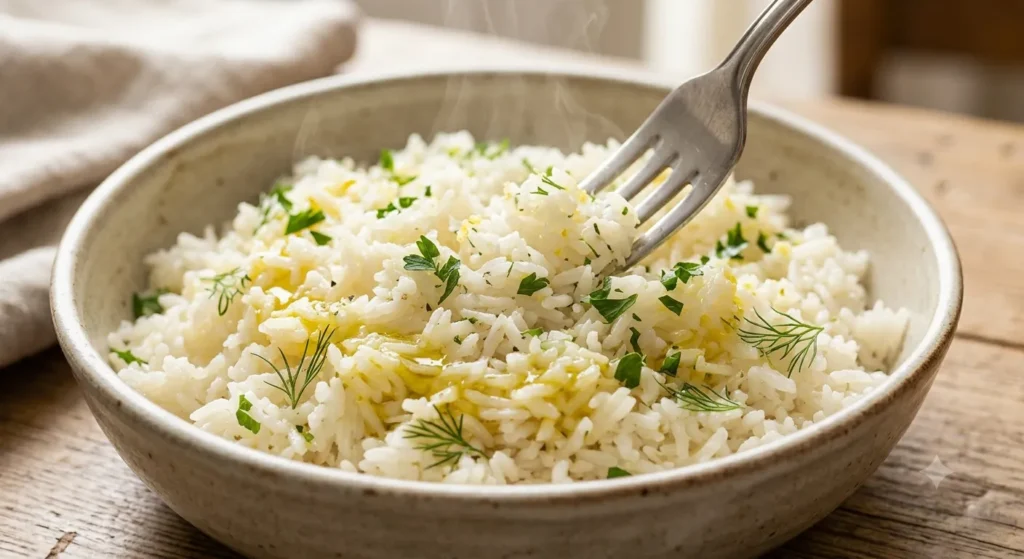
- ALT Text: Fluffing cooked Greek lemon rice with a fork to reveal distinct, light grains.
- File Name: fluffing-greek-lemon-rice-fork.jpg
Expert Chef Tips for Cooking Perfection
Chef’s Golden Rule
Never use a spoon to stir cooked rice. Spoons crush tender swollen grains, squeezing out starch and turning an otherwise fluffy pilaf into a gummy mass. Always use a long-tined fork to gently lift and separate grains from the bottom of the pot.
- Test Your Lid Seal: If your pot lid is loose or has a steam vent hole, steam will escape too fast, leaving your rice dry and undercooked. Cover the pot with a piece of aluminum foil before placing the lid on top to create an airtight seal.
- Control the Acidity: Always use fresh lemons. Bottled lemon juice oxidizes quickly, creating a harsh, metallic acid taste that ruins delicate grains.
- Avoid Bitter Zest: When zesting lemons, grate only the bright yellow outer skin. Stop as soon as you reach the white pith underneath, which contains bitter compounds that intensify as they warm.
- Warm the Broth: Adding cold stock to hot, toasted rice drops the cooking temperature instantly and leads to uneven cooking. Heat your broth in a small saucepan or microwave before adding it to the skillet.
- Adjust Salt Based on Stock: If using full-sodium stock, reduce added sea salt to 1/2 teaspoon. Taste your broth before pouring it over the rice—it should taste like a well-seasoned soup.
Delicious Flavor Variations
While classic Greek lemon rice is exceptional on its own, you can easily adapt the base recipe to suit different dietary needs or meal plans.
                  ┌── Spanakorizo (Add spinach & nutmeg)
                  ├── Garlic-Herb Lover's (Double garlic, add mint)
                  ├── Brown Rice Pilaf (Increase liquid to 3.25 cups, cook 45m)
Greek Lemon Rice ─┼── Protein-Boosted (Fold in cooked chickpeas)
                  ├── Feta & Olive (Top with crumbled sheep's feta)
                  └── Greek Orzo-Rice Blend (50/50 Orzo & Basmati)
1. Greek Lemon Rice with Spinach (Spanakorizo Inspired)
Incorporate 4 cups of fresh baby spinach leaves into the pan during the last 2 minutes of simmering, or fold chopped cooked spinach in with the herbs at the end. This adds vibrant color, dietary fiber, and vitamins while honoring classic Greek Spanakorizo.
2. Garlic Lover’s Lemon Rice
Increase garlic to 6 cloves. Mince half for the sauté step, and slice the other half thinly to toast alongside the rice grains. Finish with a extra tablespoon of raw extra virgin olive oil folded in at the end.
3. Vegan / Vegetarian Version
Swap chicken broth for a rich vegetable stock or mushroom broth. Ensure your vegetable stock is well-seasoned to maintain deep savory flavor.
4. Whole Grain Brown Rice Version
Brown rice retains its outer bran and germ layers, requiring more liquid and a longer cook time. Use 1.5 cups of brown long-grain rice to 3.25 cups of broth. Simmer covered on low for 42 to 45 minutes, followed by a 10-minute steam rest.
5. Orzo and Rice Pilaf Blend
Substitute 1/2 cup of long-grain rice with 1/2 cup of uncooked dried Greek orzo pasta. Toast the orzo alongside the raw rice in olive oil until golden brown before adding liquid. The toasted pasta adds an appealing texture and rich nutty flavor.
6. Feta and Chickpea Power Bowl Base
Fold 1 can (15 oz) of rinsed, drained chickpeas into the cooked rice along with the fresh lemon juice and herbs. Top each serving with 1/4 cup of crumbled authentic sheep’s milk feta cheese and pitted Kalamata olives for a complete, protein-rich meal.
10 Common Mistakes and How to Avoid Them
1. Using Bottled Lemon Juice
- The Error: Reaching for store-bought lemon juice from a squeeze bottle.
- The Result: Harsh, metallic acid taste that lacks aromatic citrus notes.
- The Fix: Use fresh lemons. One medium lemon yields roughly 3 tablespoons of fresh juice and 1 tablespoon of zest.
2. Skipping the Rinsing Process
- The Error: Pouring raw rice straight from the bag into the hot pan.
- The Result: Excess surface starch gelatinizes into a gummy layer that binds grains into clumps.
- The Fix: Always rinse rice under cold water until the runoff is clear.
3. Adding Lemon Juice Too Early
- The Error: Pouring lemon juice into the stock before boiling.
- The Result: High acidity can inhibit starch gelatinization, leaving rice grains with a hard, chalky core. The heat also muted the fresh citrus notes.
- The Fix: Stir lemon zest into the liquid for aroma during simmering, but save the fresh lemon juice for folding in at the very end.
4. Peeking Under the Lid
- The Error: Removing the lid during simmering to check progress.
- The Result: Essential steam escapes instantly, dropping internal temperature and leaving rice undercooked.
- The Fix: Trust the timer and heat settings. Keep the lid sealed tight until the rest period ends.
5. Over-Stirring
- The Error: Stirring the rice while it simmers like a risotto.
- The Result: Scrapes starch off the grains, turning the pan into a thick paste.
- The Fix: Stir once when adding broth to prevent sticking, then leave it alone until finished.
6. Incorrect Heat Level
- The Error: Boiling the rice rapidly the entire time or simmering on too high heat.
- The Result: Liquid evaporates long before grains cook, scorching the bottom of the pan.
- The Fix: Bring liquid to a boil, then drop heat immediately to the lowest setting to maintain a gentle simmer.
7. Stirring with a Wooden Spoon at the End
- The Error: Folding herbs and juice in with a wide spoon or heavy spatula.
- The Result: Crushes warm, delicate grains.
- The Fix: Fluff and fold exclusively with a long-tined metal fork.
8. Oversaturating with Liquid
- The Error: Guessing measurements or using too much stock.
- The Result: Soggy, heavy rice that loses all grain separation.
- The Fix: Use precise measuring cups. Stick strictly to a 1 : 1.83 ratio (1.5 cups rice to 2.75 cups liquid).
9. Skipping the Rest Period
- The Error: Serving rice immediately after turning off the burner.
- The Result: Uneven moisture distribution—soggy on bottom, dry on top.
- The Fix: Let covered pot rest off the burner for 10 full minutes.
10. Cooking on High Heat in Thin Pans
- The Error: Using thin aluminum pots that create hot spots.
- The Result: Burnt rice at the center before edges finish cooking.
- The Fix: Use heavy-bottomed stainless steel, enameled cast iron, or an Dutch oven for uniform heat distribution.
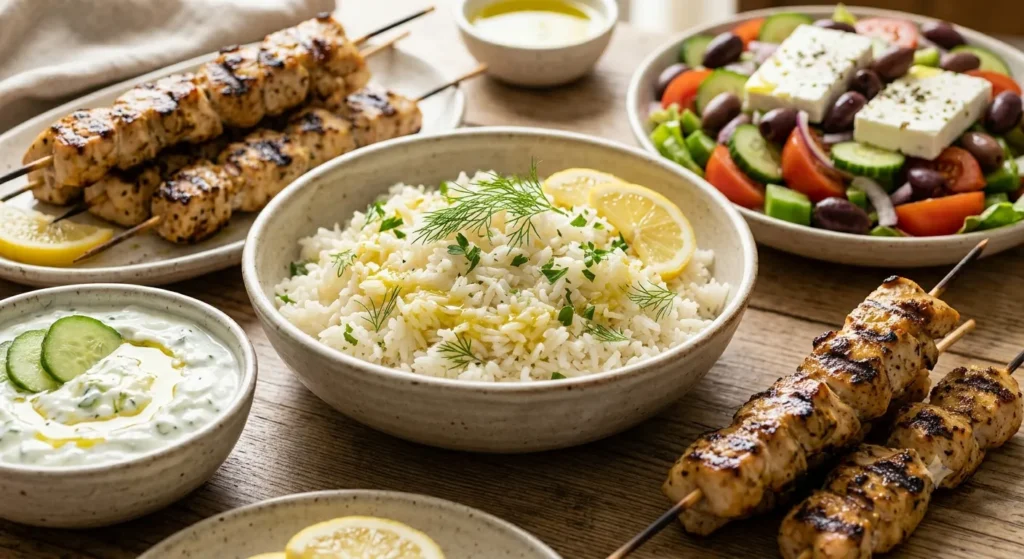
- ALT Text: Greek Lemon Rice served alongside chicken souvlaki, tzatziki, and Greek salad.
- File Name: greek-lemon-rice-meal-pairing.jpg
What to Serve with Greek Lemon Rice
Greek lemon rice is remarkably versatile. Its bright acidity and herbal profile make it an exceptional pairing across Mediterranean, Middle Eastern, and American cuisines.
Classic Greek Pairings
- Chicken Souvlaki & Gyros: The bright citrus in the rice complements savory, oregano-marinated grilled chicken or pork skewers.
- Rack of Lamb or Lamb Chops: Rich, fatty meats like grilled lamb benefit from the palate-cleansing acidity of lemon and dill.
- Grilled Salmon & Seafood Skewers: Fish, shrimp, and octopus pair naturally with lemon, garlic, and fresh olive oil.
- Greek Roasted Chicken: Serve rice alongside lemon-garlic roasted chicken, pouring savory pan juices directly over the grains.
Mediterranean Vegetarian Pairings
- Authentic Greek Salad (Horiatiki): Crisp cucumbers, vine-ripened tomatoes, red onions, Kalamata olives, and sheep’s feta contrast wonderfully with warm rice.
- Grilled Halloumi Cheese: Salty, warm halloumi pairs beautifully with bright, herb-loaded rice.
- Falafel & Chickpea Patties: Offers a fluffy, fragrant carb base for crispy vegetarian proteins.
- Homemade Tzatziki: Swirling a spoon of cool cucumber-garlic yogurt into warm lemon rice creates a creamy, delicious combination.
Storage, Reheating, and Food Safety
Cooked rice requires careful handling to maintain quality and ensure food safety.
Food Safety Notice: Bacillus cereus
Uncooked rice frequently carries spores of Bacillus cereus, a bacteria strain that can survive normal cooking temperatures. If cooked rice sits at room temperature for extended periods, these spores can multiply and produce toxins.
Storage Safety Guidelines
- Cool Rapidly: Never leave cooked rice at room temperature for longer than 1 hour.
- Refrigerate Promptly: Spread leftover rice out on a baking sheet to cool quickly, then transfer to airtight containers and refrigerate within 60 minutes.
Refrigeration and Freezing
- Refrigeration: Store in an airtight glass or plastic container for up to 4 days.
- Freezing: Cooked lemon rice freezes very well. Let rice cool completely, then transfer portioned amounts into freezer-safe zip-top bags. Press flat, seal, and freeze for up to 3 months. Thaw overnight in the refrigerator before reheating.
Reheating Techniques
- Stovetop (Best Method): Place leftover rice in a saucepan. Add 1 to 2 tablespoons of water or broth per cup of rice to restore lost moisture. Cover tightly and heat on low for 5–7 minutes, fluffing with a fork halfway through.
- Microwave: Transfer rice to a microwave-safe bowl. Splash with 1 tablespoon of water, cover with a damp paper towel, and microwave on high in 60-second intervals until steaming hot throughout.
Nutritional Breakdown
The following values are estimated per serving (based on 6 side-dish servings using low-sodium chicken broth and extra virgin olive oil).
Nutrition Facts Table
| Nutritive Component | Quantity Per Serving | % Daily Value (%DV) |
| Calories | 225 kcal | — |
| Total Carbohydrates | 36 g | 13% |
| Dietary Fiber | 1.5 g | 5% |
| Sugars | 1 g | — |
| Protein | 4.5 g | 9% |
| Total Fat | 7.5 g | 10% |
| Saturated Fat | 1.1 g | 6% |
| Monounsaturated Fat | 5.2 g | — |
| Cholesterol | 0 mg | 0% |
| Sodium | 420 mg | 18% |
| Vitamin C | 12 mg | 15% |
| Iron | 1.8 mg | 10% |
Frequently Asked Questions
1. Can I make Greek lemon rice in a rice cooker?
Yes. Add rinsed rice, aromatics sautéed in olive oil, salt, pepper, zest, and liquid into the rice cooker inner pot. Use a standard “White Rice” cycle. Once cooked, let it rest on “Warm” for 10 minutes, then open and fold in fresh lemon juice and fresh herbs with a fork.
2. Is Greek lemon rice gluten-free?
Yes, this recipe is naturally 100% gluten-free. Always double-check store-bought chicken or vegetable broths to ensure no gluten additives are present.
3. Can I use dried herbs instead of fresh herbs?
While fresh dill and parsley yield superior flavor and color, you can use dried herbs in a pinch. Use 1 teaspoon of dried dill and 1 tablespoon of dried parsley. Add dried herbs during Step 4 with the stock so they rehydrate during cooking.
4. Why did my lemon rice turn out mushy?
Mushy rice stems from three potential issues: using too much liquid, failing to rinse surface starch off raw grains, or over-stirring the rice while it simmers. Stick strictly to measured ratios and use a fork to fluff.
5. How can I fix rice that is still hard or crunchy after cooking?
If liquid is fully absorbed but grains remain hard, splash 3 tablespoons of warm broth or water over the rice, cover tightly, and return to the lowest burner setting for an additional 5 minutes. Then let it steam off-heat for 5 minutes.
6. Can I prepare this recipe ahead of time for meal prep?
Yes! Greek lemon rice holds up well for meal prep. Store portioned servings alongside grilled chicken or vegetables in airtight containers for up to 4 days. Reheat with a splash of water to restore fluffiness.
7. What if I do not have chicken or vegetable stock?
Water can be used, but you will miss savory depth. If using water, add an extra tablespoon of extra virgin olive oil, an extra clove of minced garlic, and increase salt slightly to compensate.
8. Can I add butter to Greek lemon rice?
Traditional Greek home recipes rely strictly on extra virgin olive oil. However, folding 1 tablespoon of unsalted butter in with fresh herbs at the end adds an appealing, velvety richness popular in restaurant versions.
9. What is the best way to zest a lemon without getting the bitter pith?
Use a fine microplane grater. Hold the lemon against the microplane and grate lightly, rotating the fruit constantly. Stop as soon as the yellow skin disappears—do not grate down to the white skin beneath.
10. Can I use Jasmine rice instead of long-grain white or Basmati?
Yes, but Jasmine rice holds more natural moisture and cooks up softer. Reduce your broth from 2.75 cups down to 2.5 cups to prevent it from becoming sticky.
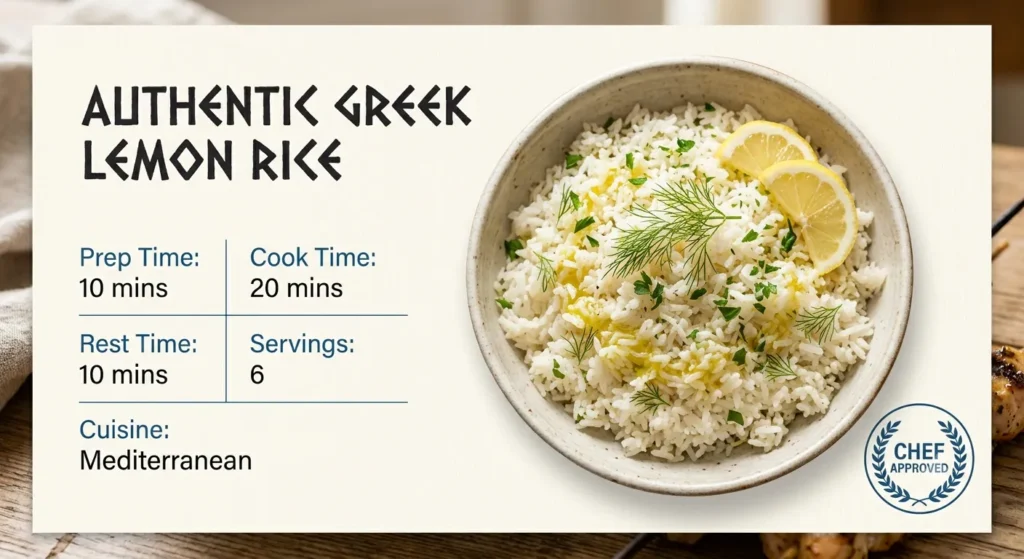
- ALT Text: Printable recipe card image for authentic Greek lemon rice.
- File Name: greek-lemon-rice-recipe-card.jpg
Printable Recipe Card
===============================================================================
                       AUTHENTIC GREEK LEMON RICE
===============================================================================
Yield: 6 Servings | Prep Time: 10 Mins | Cook Time: 20 Mins | Rest Time: 10 Mins
Cuisine: Greek / Mediterranean | Course: Side Dish | Author: Mediterranean Chef

INGREDIENTS:
- 1.5 cups Long-Grain White Rice or Basmati Rice (rinsed and drained)
- 3 tbsp Extra Virgin Olive Oil
- 1 medium Yellow Onion (finely diced)
- 3 cloves Garlic (minced)
- 2.75 cups Low-Sodium Chicken Broth or Vegetable Broth
- 1 tbsp Fresh Lemon Zest (from 1 medium lemon)
- 3 tbsp Fresh Lemon Juice (from 1-2 lemons)
- 1/3 cup Fresh Flat-Leaf Parsley (finely chopped)
- 3 tbsp Fresh Dill (finely chopped)
- 1 tsp Fine Sea Salt
- 1/4 tsp Freshly Cracked Black Pepper
- 1/2 tsp Dried Greek Oregano (optional)

INSTRUCTIONS:
1. RINSE: Wash rice in a fine-mesh strainer under cold water until water runs
   completely clear (about 60-90 secs). Drain thoroughly.
2. SWEAT: Heat olive oil in a wide, heavy saucepan over medium heat. Add onion;
   cook 4-5 mins until soft. Stir in garlic; cook 1 min until fragrant.
3. TOAST: Add drained rice. Cook 2-3 mins, stirring constantly, to coat grains
   in oil until translucent around edges.
4. BOIL: Stir in broth, lemon zest, sea salt, black pepper, and oregano.
   Bring to a rolling boil over high heat.
5. SIMMER: Immediately cover with a tight lid, turn heat down to LOW, and simmer
   for 15-17 mins. DO NOT LIFT THE LID.
6. STEAM REST: Remove pot from heat. Leave covered and rest for 10 mins.
7. FLUFF & FINISH: Remove lid. Pour fresh lemon juice over rice and sprinkle
   fresh parsley and dill on top. Gently fluff and fold with a fork.
   Rest 2 mins, then serve warm.

NUTRITION (Estimated per serving):
Calories: 225 | Carbs: 36g | Protein: 4.5g | Fat: 7.5g | Fiber: 1.5g | Sodium: 420mg
===============================================================================
Internal & External Culinary Resources
Suggested Internal Links
- Complement this rice dish with our authentic, step-by-step Greek Chicken Souvlaki Recipe.
- Serve alongside our homemade, extra-garlicky Authentic Greek Tzatziki Sauce.
- Pair with a crisp, refreshing Traditional Greek Salad (Horiatiki).
- Explore our easy weeknight main: Lemon Garlic Oven-Roasted Chicken Thighs.
Respected Culinary & Scientific Authority References
- Learn more about starch science and grain preparation techniques at America’s Test Kitchen culinary guides.
- For detailed food science breakdowns on amylose and amylopectin in rice varieties, reference Serious Eats: The Food Lab.
- Review nutritional profiles for long-grain rice and fresh herbs on the USDA FoodData Central Database.
- Explore health research on olive oil and whole foods through the Harvard T.H. Chan School of Public Health – Mediterranean Diet Hub.
Conclusion
Greek Lemon Rice is proof that simple, fresh ingredients can transform basic staples into something memorable. By mastering a few core culinary steps—rinsing surface starches, coating grains in extra virgin olive oil, braising in rich broth, and finishing with fresh lemon juice and herbs—you can reliably make a bright, airy side dish that complements almost any meal.
Whether serving it alongside grilled meats, seafood skewers, or crisp fresh salads, this recipe brings the warm, comforting tastes of the Mediterranean right to your family table.
Have you tried this Authentic Greek Lemon Rice recipe? We would love to hear from you! Leave a comment below, rate the recipe card, and share your favorite main dishes to pair with this Mediterranean side dish. Kali Orexi (Bon Appétit)!