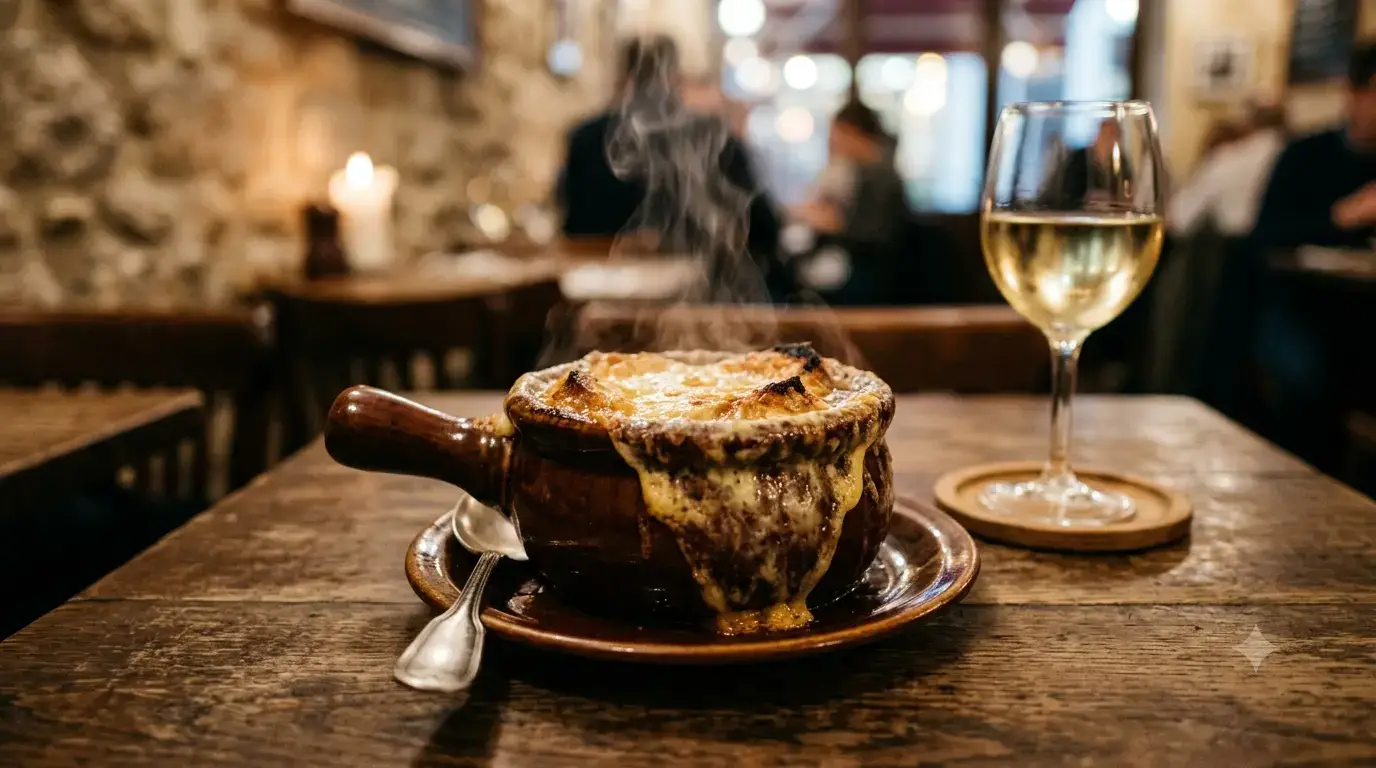
Classic French Onion Soup Recipe: The Secret Is in the Caramelized Onions
French onion soup is one of those rare dishes where a handful of humble ingredients can produce extraordinary depth. The secret isn’t complicated: slowly caramelized onions, a rich broth, toasted bread, and plenty of Gruyère.
There’s a moment in every good bowl of French onion soup where the spoon breaks through a sheet of molten Gruyère, and underneath it, the broth is dark as coffee and smells like a kitchen that’s been working for hours. That moment is the whole point of French onion soup. Everything before it — the slicing, the standing at the stove, the patience — exists to earn that spoonful.
I’ve made this soup more times than I can count, in restaurant kitchens where we’d have three pots going for the dinner rush, and in my own kitchen on a Sunday with nothing else planned. It’s one of the few dishes where the ingredient list is short but the technique is everything. Onions, stock, bread, cheese. That’s it. And yet most home versions come out thin, pale, and forgettable, because the one non-negotiable step — real caramelization — gets rushed.
This article walks through French onion soup the way I’d teach it to a new cook standing next to me at the stove: what’s actually happening in the pot, why it takes as long as it does, which onions and stocks make the biggest difference, and where most people go wrong. By the end, you’ll understand this soup well enough to make it without a recipe.
Table of Contents
Table of Contents
- What Is French Onion Soup?
- Why French Onion Soup Is So Delicious
- The Science of Caramelizing Onions
- Choosing the Best Onions
- Building a Rich Broth
- Step-by-Step Cooking Guide
- Cheese Guide
- Bread Guide
- Equipment Needed
- Common Mistakes
- Pro Chef Tips
- Variations
- Storage
- What to Serve with French Onion Soup
- Frequently Asked Questions
- Recipe Card
- Conclusion
What Is French Onion Soup?
French onion soup started as something much humbler than the dish you’ll find on a Parisian bistro menu today. Onions have always been cheap, they store well through winter, and they turn a pot of water into something with actual flavor. That combination made onion soup a staple of French farmhouse kitchens and working-class tables for centuries, long before it had any claim to elegance.
The version most people recognize — deep broth, a slice of toasted bread, and a cap of melted cheese — took shape in and around Paris, where it became associated with Les Halles, the city’s old central marketplace. Market workers, butchers, and late-night revelers ate it in the small hours, when a hot bowl of something rich and warming was exactly what the job demanded. From there it moved into restaurant kitchens, got dressed up with better stock and better cheese, and became the dish that now opens menus at French bistros around the world.
What’s kept it alive for so long isn’t complexity. It’s the opposite. French onion soup proves that a handful of humble ingredients, treated with patience, can outperform dishes with twenty components and none of the same payoff. That’s the lesson worth carrying into your own kitchen: technique beats ingredient count almost every time.
Why French Onion Soup Is So Delicious
Good French onion soup works because it hits four different flavor and texture notes at once, and none of them fight each other.
Onion sweetness. Raw onion is sharp and a little unpleasant. Slow-cooked onion is a completely different food — sweet, almost jammy, with a depth that tastes closer to caramel than vegetable. That transformation is the backbone of the whole dish.
Rich beef stock. The broth needs enough body to stand up to the onions and enough savoriness to round the whole bowl out. A thin, watery stock leaves the soup tasting like onion water. A properly reduced, well-seasoned stock gives it weight.
Gruyère cheese. Nutty, slightly sweet, and famous for melting into long, stretchy strands without turning greasy or rubbery. It’s the finishing note that ties the broth and bread together.
Toasted baguette. Bread that’s been dried out and browned first holds its shape under broth and cheese instead of dissolving into mush. It gives the soup something to chew, which matters more than people expect.
Balance is what separates a great bowl from a mediocre one. Too much salt from the stock and the onions taste flat. Too little acid and the whole thing feels heavy. Too much cheese and you lose the broth entirely. The best versions are built like a musical chord — sweet, savory, salty, and a little bit sharp, all present at the same time.

The Science of Caramelizing Onions
This is the step that makes or breaks the soup, and it’s also the step most home cooks rush. Understanding what’s actually happening in the pan will change how you cook it.
Caramelization vs. the Maillard reaction. These get confused constantly, and they’re not the same process. Caramelization is the breakdown of sugars alone, under heat, once enough moisture has cooked off. The Maillard reaction is a separate browning reaction between amino acids (proteins) and sugars, and it’s responsible for a lot of the deep, savory, almost meaty notes you taste in well-cooked onions. Real onion caramelization in the pan is mostly a Maillard-driven process with true sugar caramelization happening at the edges, especially on any bits that stick and darken on the bottom of the pot.
Why it takes 45 to 60 minutes. Onions are roughly 90% water. All of that water has to evaporate before real browning can start, because water in the pan keeps the temperature capped near the boiling point — nowhere near hot enough to brown anything. Only once the moisture has cooked off does the pan temperature climb high enough for Maillard browning to kick in. There’s no way to shortcut this chemistry. High heat before the moisture is gone just gives you scorched edges and a raw, watery center.
Temperature control. Medium to medium-low is the right range for most of the process. High heat browns the surface of the onions before the interior softens, which gives you burnt bits mixed with undercooked ones — the single most common reason home versions taste bitter.
Moisture evaporation. In the first 15 to 20 minutes, onions release liquid and go from firm to translucent and floppy. This stage smells sharp and a little sulfurous. Don’t rush past it by cranking the heat.
Sugar development. Once most of the water is gone, natural sugars concentrate and start to brown. This is where the color and flavor actually build, and it happens gradually over the back half of the cook.
Color stages to watch for:
| Stage | Approximate Time | Appearance | Aroma |
|---|---|---|---|
| Softening | 0–15 min | Translucent, pale gold | Sharp, oniony |
| Golden | 15–30 min | Light amber | Sweeter, mellowing |
| Deep caramel | 30–50 min | Rich brown, jammy | Toasty, nutty |
| Fond building | 50–60 min | Dark brown bits on pan bottom | Deep, almost roasted |
Chef’s tip: Those dark brown bits stuck to the bottom of the pot are called fond, and they’re pure flavor. Don’t scrape them up too early — let them build, then deglaze to lift them into the soup. That fond is doing more work than people give it credit for.
Choosing the Best Onions
Not every onion caramelizes the same way, and the type you use shapes the final flavor more than most recipes admit.
Yellow onions are the standard choice, and for good reason. They have a strong onion flavor to start, a good sugar content, and they hold up over a long, slow cook without turning to mush. This is the workhorse onion for the soup.
Sweet onions (Vidalia, Walla Walla) caramelize a little faster because they carry more natural sugar, but that sugar can also push the finished soup toward candy-sweet if you’re not careful with cook time. Good in a blend, less good as the only onion.
White onions are sharper and thinner-fleshed. They caramelize fine but bring less depth than yellow onions and can turn slightly stringy over a long cook.
Red onions caramelize beautifully and add a subtle wine-like sweetness, but they also tint the broth a dull purple-brown, which most people find unappealing in a clear onion soup. Better used sparingly, mixed with yellow.
The best combination: a mix of roughly 80% yellow onions and 20% sweet onions gives you the depth and body of yellow onions with a rounder sweetness from the sweet variety, without tipping the balance too far in either direction. If you only have one kind on hand, straight yellow onions will never let you down.
Building a Rich Broth
The onions get all the attention, but the broth is doing just as much work. A weak stock will flatten even perfectly caramelized onions.
Beef stock is the traditional base and gives the soup its dark color and savory backbone. A beef and chicken stock blend softens that intensity slightly and adds a rounder, less aggressive flavor — useful if you find straight beef stock too heavy. Homemade stock, simmered for hours from roasted bones, will always give you the deepest, most gelatin-rich result, but it’s a project of its own and not required for a very good bowl of soup.
For store-bought stock in US grocery stores, quality varies a lot, and the brand you choose genuinely changes the outcome:
Why acidity matters. A long-cooked, sweet, savory soup like this needs something sharp to cut through it, or every spoonful starts to taste heavy after a few bites. That’s the job of the alcohol added at the deglazing stage.
- Better Than Bouillon (beef base) — concentrated, deeply savory, and easy to adjust strength by adding more or less paste. A reliable favorite among home cooks who want restaurant depth without simmering bones all day.
- Kitchen Basics — unsalted, clean-tasting stock that gives you full control over seasoning.
- Pacific Foods — organic, mild, and a solid everyday option, though slightly less concentrated than the others.
- Swanson — widely available and consistent, best doctored with extra aromatics since it leans a little flat on its own.
- White wine brings bright acidity and is the most common, food-safe choice for a lighter finish.
- Dry sherry adds a nutty, slightly oxidized depth that pairs beautifully with the caramelized onions — a classic move in French kitchens.
- Cognac gives a warmer, more rounded sweetness with less sharp acidity than wine; often added at the end rather than during deglazing, for aroma more than acid balance.

Step-by-Step Cooking Guide
1. Prepare the onions. Peel and halve them pole to pole (through the root and stem), then slice into even half-moons about 1/8 to 1/4 inch thick. Even, consistent slicing means even cooking — thick and thin pieces in the same pot will caramelize at different rates.
2. Start the cook. Melt butter (or butter with a splash of oil, which raises the smoke point) in a heavy pot over medium heat. Add the onions with a pinch of salt, which helps draw out moisture early.
3. Soften. Stir occasionally for the first 15 to 20 minutes as the onions release liquid and turn translucent. Don’t walk away yet — this stage still needs attention.
4. Caramelize. Drop the heat to medium-low and keep cooking, stirring every few minutes, for another 30 to 45 minutes. The onions will shrink dramatically, turn golden, then deep amber, then a rich mahogany brown. If the pan starts to look dry or the fond is browning too fast, add a splash of water or stock to loosen it and keep stirring.
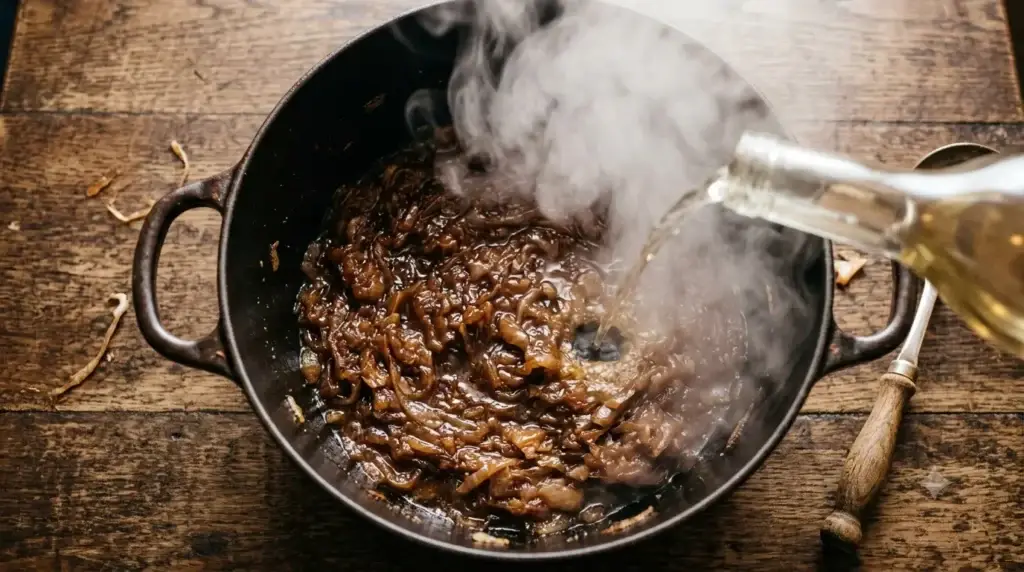
5. Deglaze. Once the onions are deeply caramelized, pour in your wine or sherry and scrape up every bit of fond from the bottom of the pot. Let it reduce for a couple of minutes.
6. Add broth. Pour in the stock, along with a bay leaf and fresh thyme. Bring to a simmer.
7. Simmer. Let the soup simmer gently, uncovered, for 30 to 45 minutes so the flavors marry. This is not a step to skip — the soup tastes noticeably better after it’s had time to sit and simmer than it does the moment the stock goes in.
8. Season. Taste and adjust with salt, black pepper, and a small splash of sherry vinegar or extra wine if it needs brightness.
9. Assemble and broil. Ladle the soup into oven-safe crocks, top with toasted bread, pile on grated Gruyère, and broil until the cheese is melted, bubbling, and browned in spots — usually 3 to 5 minutes, watched closely.
Color and texture cues to trust: onions should look glossy and deep brown, never grey or scorched black. The broth should be a clear, dark amber, not cloudy. The cheese on top should have browned blisters, not a flat, uniform melt — those blisters are where the flavor concentrates.
Common mistakes at this stage: rushing the caramelization, adding stock too early (before the onions are fully browned), and broiling on too high a rack, which burns the cheese before it melts through.
Cheese Guide
| Cheese | Melting Quality | Flavor | Stretch | Browning |
|---|---|---|---|---|
| Gruyère | Excellent, smooth | Nutty, slightly sweet, complex | Long, stretchy | Browns beautifully |
| Comté | Excellent | Nutty, fruity, more mellow than Gruyère | Long, stretchy | Browns well |
| Emmental | Very good | Milder, slightly sweet | Good stretch | Browns lightly |
| Swiss (domestic) | Good | Mild, one-note | Moderate stretch | Can turn oily |
Gruyère is the traditional and best choice — it melts evenly, browns without turning greasy, and has enough flavor to stand up to the broth. Comté is an excellent substitute with a slightly softer, fruitier character. Emmental melts well but is milder, and works best blended with Gruyère rather than alone. Domestic Swiss cheese is the easiest substitution to find in a standard grocery store, but it browns less attractively and has a flatter flavor, so it’s better as a backup than a first choice.
If you can only find one, Gruyère is worth seeking out specifically. It’s the cheese that made this soup famous for a reason.
Bread Guide
Baguette is traditional because its dense, chewy crumb and thin crust hold up under broth without turning to paste. A soft sandwich loaf simply cannot survive contact with hot soup the way a proper baguette can.
The bread needs to be toasted or dried out first, either in the oven or under the broiler, until it’s firm and lightly golden all the way through. Skipping this step is one of the fastest ways to end up with a soggy, disintegrating mess.
Cut slices about 3/4 inch to 1 inch thick. Too thin, and the bread turns to mush the moment it hits the broth. Too thick, and it stays doughy in the center even after toasting.
To prevent sogginess: toast the bread until it’s genuinely dry and firm, not just lightly browned on the surface. Some cooks also brush it lightly with olive oil or rub it with a cut garlic clove before toasting, which adds flavor and a bit of a moisture barrier.
Equipment Needed
- Dutch oven — heavy, even heat distribution is essential for a long, slow caramelization without scorching.
- Soup crocks (oven-safe ceramic bowls) — needed for broiling the cheese directly over the soup.
- Cheese grater — freshly grated cheese melts far more evenly than pre-shredded, which is coated in anti-caking starch.
- Broiler — for that final bubbling, browned cheese cap.
- Chef’s knife — a sharp knife makes slicing onions faster and safer.
- Mandoline (optional) — speeds up slicing a large batch of onions to a uniform thickness, though a steady hand with a knife works just as well.
Common Mistakes
- Rushing the caramelization. Trying to brown onions in 15 minutes on high heat produces bitter, unevenly cooked results. Fix: commit to the full 45 to 60 minutes on medium-low.
- Slicing onions unevenly. Different thicknesses cook at different rates. Fix: slice consistently, ideally with a sharp knife or mandoline.
- Overcrowding the pot. Too many onions piled too deep steam instead of browning. Fix: use a wide, heavy pot that gives the onions room to spread out.
- Not salting early. Salt helps draw out moisture, speeding the early softening stage. Fix: season lightly at the start, not just at the end.
- Skipping the deglaze. The fond on the bottom of the pot holds enormous flavor. Fix: always deglaze with wine, sherry, or stock and scrape thoroughly.
- Using weak stock. Thin, low-sodium stock leaves the soup tasting like onion water. Fix: use a well-seasoned, full-bodied stock or concentrate a weaker one by simmering it down.
- Adding stock too early. Pouring in liquid before the onions are fully caramelized locks in an underdeveloped flavor. Fix: caramelize fully first, then add liquid.
- Not simmering long enough. A rushed 10-minute simmer tastes thin compared to a full 30 to 45 minutes. Fix: give the broth time to come together.
- Skipping the acid. Without wine, sherry, or a splash of vinegar, the soup can taste flat and one-dimensional. Fix: always include an acidic element.
- Using pre-shredded cheese. Anti-caking starch keeps it from melting smoothly. Fix: grate Gruyère fresh from the block.
- Untoasted bread. Raw bread disintegrates into the broth almost instantly. Fix: toast or dry the bread thoroughly before adding it.
- Broiling too close to the heat. The cheese burns on top before it melts through. Fix: position the rack a few inches below the broiler, not directly against it.
- Not tasting before serving. Skipping a final seasoning check often means the soup is under-salted or lacks brightness. Fix: taste and adjust just before serving.
- Using the wrong pot. Thin pots scorch onions instead of caramelizing them evenly. Fix: use a heavy-bottomed Dutch oven.
- Serving in a bowl that isn’t oven-safe. Standard ceramic bowls can crack under a broiler. Fix: use proper oven-safe crocks or ramekins.
Pro Chef Tips
- Salt the onions early to speed moisture release.
- Use a wide pot so the onions have room to spread and brown rather than steam.
- Stir less often than you’d think during the browning stage — constant stirring can actually slow browning by cooling the pan.
- Let fond build on the pot’s bottom before deglazing; it’s concentrated flavor.
- Deglaze in stages if the fond builds up more than once during a long cook.
- A pinch of sugar can help onions along if they’re not caramelizing well, though it’s rarely necessary with good yellow onions.
- Add a splash of water to loosen overly dark fond instead of letting it burn.
- Fresh thyme added late keeps its aroma brighter than thyme simmered the whole time.
- A bay leaf goes in with the stock, not with the onions, since it doesn’t need long cooking to release its flavor.
- Finish with a small splash of sherry vinegar for brightness if the broth tastes heavy.
- Toast bread the day before if you’re making a big batch — day-old bread is naturally drier and toasts more evenly.
- Rub toasted bread with a cut garlic clove for a subtle background note.
- Grate cheese cold, straight from the fridge, for the cleanest shred.
- Layer two cheeses (Gruyère and a little Comté) for extra depth.
- Broil with the door slightly ajar if your oven runs hot, to avoid burning the cheese before it melts through.
- Warm your crocks before ladling in hot soup so they don’t crack under the broiler.
- Make the onion base a day ahead — the flavor deepens overnight in the fridge.
- Skim any excess butter fat off the top of the finished broth for a cleaner finish.
- Use low-sodium stock and season by hand, so you control salt precisely rather than fighting a pre-salted broth.
- Serve the moment it comes out from under the broiler — the textural contrast between molten cheese and crisp bread fades fast.
Variations
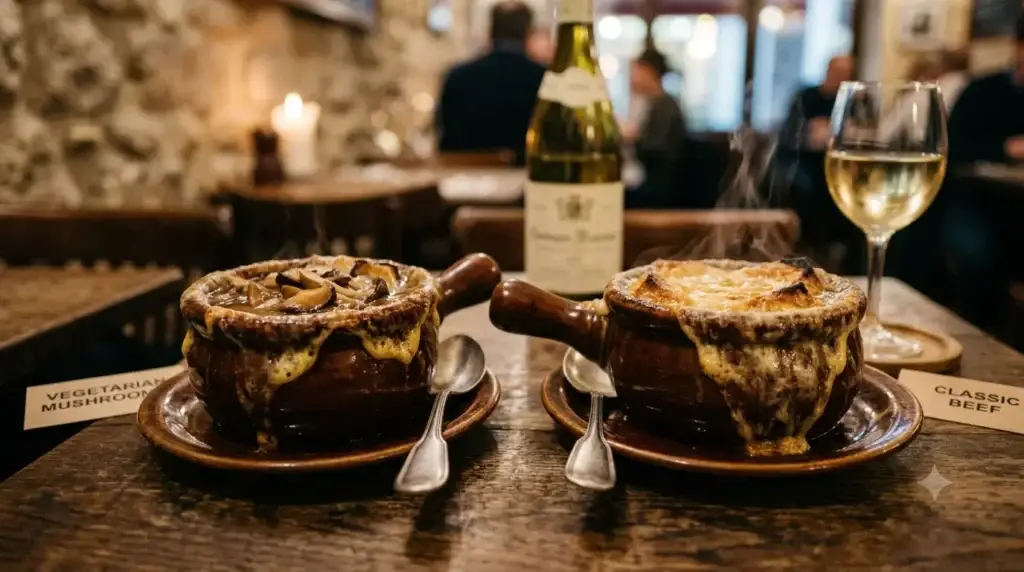
Vegetarian version: Swap beef stock for a rich mushroom or roasted vegetable stock, and use a splash of soy sauce or miso to bring back some of the savory depth beef stock normally provides.
Chicken stock version: A lighter, less intense soup that still benefits enormously from fully caramelized onions — good for those who find beef stock too heavy.
Wine-free version: Deglaze with a splash of stock plus a little extra vinegar for acidity instead of wine, keeping the same depth without the alcohol.
Extra cheesy version: Layer cheese both inside the crock, under a slice of bread, and again on top before broiling, for a two-layer cheese pull.
Slow cooker adaptation: Caramelize the onions on the stovetop first (this step can’t be skipped or shortcut in a slow cooker), then transfer everything to the slow cooker with stock and let it simmer on low for 4 to 6 hours.
Instant Pot adaptation: Use the sauté function to caramelize the onions in stages, stirring frequently, then add stock and pressure cook on high for 10 minutes with a natural release.
Storage
Refrigeration: Store the onion and broth base (without bread or cheese) in an airtight container for up to 4 days.
Freezing: The soup base freezes well for up to 3 months. Freeze it without bread or cheese, since both lose their texture after thawing.
Reheating: Warm the base gently on the stovetop, then ladle into oven-safe crocks, top with fresh toasted bread and cheese, and broil as usual. Reheating already-assembled soup rarely works well — the bread turns to mush and the cheese loses its texture.
Make-ahead tips: The caramelized onion base actually improves after resting overnight, as the flavors continue to meld. Making the base a day or two in advance is a smart move for entertaining.
What to Serve with French Onion Soup
Salads: A simple green salad with a sharp vinaigrette balances the soup’s richness nicely.
Sandwiches: A roast beef or ham and Gruyère sandwich keeps the meal in the same flavor family without repeating it exactly.
Steak: A classic bistro pairing — onion soup as a starter, followed by a seared steak with a simple pan sauce.
Roast chicken: A lighter main course that lets the soup remain the star of the meal.
Wine pairings: A dry white like Chablis or a light-bodied red such as Pinot Noir both complement the caramelized sweetness without overwhelming it.
Beer pairings: A malty amber ale or a French-style biere de garde mirrors the toasty, caramelized notes in the soup.
Desserts: Something simple and not too heavy — a tarte Tatin or a plain crème caramel keeps the meal from feeling overloaded after such a rich starter.
Frequently Asked Questions
1. What is French onion soup made of? Classic French onion soup is made from slowly caramelized onions, beef stock, wine or sherry, toasted baguette, and Gruyère cheese, finished under a broiler.
2. Why does my French onion soup taste bland? Bland soup is almost always the result of undercooked onions or weak stock. Both caramelization and stock quality need to be right for the finished flavor to have depth.
3. Can I make French onion soup without wine? Yes. Deglaze with a splash of stock and a little extra vinegar for acidity instead. The flavor will be slightly less complex but still good.
4. What onions are best for French onion soup? Yellow onions are the standard choice, ideally blended with a smaller portion of sweet onions for a rounder finish.
5. How long does it really take to caramelize onions properly? Plan on 45 to 60 minutes of active, attentive cooking. There’s no reliable shortcut for real caramelization.
6. Can I use a slow cooker for French onion soup? Yes, but the onions still need to be caramelized on the stovetop first. A slow cooker can’t replicate that browning process on its own.
7. What’s the best cheese for French onion soup? Gruyère is the traditional and best-performing choice, with Comté as a very close substitute.
8. Why is my soup broth thin and watery? This usually points to under-caramelized onions, weak stock, or too short a simmer time. All three steps add body to the final broth.
9. Can I make French onion soup vegetarian? Yes, using mushroom or roasted vegetable stock in place of beef stock, with a splash of soy sauce or miso for added savoriness.
10. How do I keep the bread from turning to mush? Toast it thoroughly until dry and firm before it ever touches the broth.
11. Can I freeze French onion soup? Yes, but freeze only the onion and broth base — add fresh bread and cheese after reheating.
12. What’s the difference between French onion soup and regular onion soup? The French version is defined by deep caramelization, a rich beef-based broth, and the signature broiled bread-and-cheese topping, rather than just cooked onions in broth.
13. Do I need a special bowl to make this soup? Oven-safe crocks or ramekins are strongly recommended, since standard ceramic bowls can crack under a broiler.
14. Can I use pre-shredded cheese? It will melt, but not as smoothly, due to the anti-caking starch coating. Freshly grated cheese gives a noticeably better result.
15. Is French onion soup gluten-free? Not as traditionally made, since it relies on baguette. A gluten-free bread substitute can work if toasted well first.
Recipe Card
Classic French Onion Soup
| Prep Time | 20 minutes |
| Cook Time | 1 hour 45 minutes |
| Total Time | 2 hours 5 minutes |
| Yield | 4 servings |
| Cuisine | French |
| Course | Soup, Starter |
| Calories (estimated) | 380 per serving |
Ingredients
- 4 large yellow onions, thinly sliced
- 1 sweet onion, thinly sliced
- 3 tablespoons unsalted butter
- 1 tablespoon olive oil
- 1 teaspoon salt, plus more to taste
- 1/2 cup dry white wine or dry sherry
- 6 cups beef stock (or beef and chicken stock blend)
- 1 bay leaf
- 2 sprigs fresh thyme
- Freshly ground black pepper, to taste
- 1 baguette, sliced into 1-inch rounds and toasted
- 2 cups Gruyère cheese, freshly grated
Instructions
- Melt the butter and olive oil in a Dutch oven over medium heat. Add the sliced onions and salt, stirring to coat.
- Cook, stirring occasionally, for 15 to 20 minutes until the onions soften and turn translucent.
- Reduce heat to medium-low and continue cooking, stirring every few minutes, for 45 to 60 minutes until the onions are deeply caramelized and mahogany brown.
- Pour in the wine or sherry, scraping up any browned bits from the bottom of the pot. Let it reduce for 2 to 3 minutes.
- Add the beef stock, bay leaf, and thyme. Bring to a simmer and cook uncovered for 30 to 45 minutes.
- Remove the bay leaf and thyme sprigs. Season with salt and pepper to taste.
- Preheat the broiler. Ladle the soup into oven-safe crocks, top each with a slice of toasted baguette, and cover generously with grated Gruyère.
- Broil for 3 to 5 minutes, watching closely, until the cheese is melted, bubbling, and browned in spots.
- Serve immediately.
Chef Notes: Letting the caramelized onion base rest overnight in the fridge before finishing the soup deepens the flavor considerably. Fresh thyme and freshly grated cheese make a noticeable difference over dried substitutes.
Nutrition Disclaimer: Calorie and nutrition estimates are approximate and will vary based on specific ingredients and brands used.
Conclusion
French onion soup rewards patience more than any other dish I can think of. There’s no clever trick that replaces the 45 minutes it takes onions to actually caramelize, no substitute for a well-built stock, and no shortcut that gets you real fond on the bottom of the pot. But once you understand what each step is doing, the recipe stops being a list of instructions and becomes something you just know how to cook.
Make it once the slow way, with good onions, a real stock, and fresh Gruyère, and you’ll understand immediately why this humble soup has survived for centuries and still opens menus at serious restaurants. That first spoonful through the melted cheese is worth every minute standing at the stove.