Italian Porchetta: Authentic Crispy Italian Roast Pork Recipe
Say the word Porchetta out loud — por-KET-tah — and you’re already halfway to understanding why this dish has drawn crowds at Italian festivals for centuries. It’s a whole boneless pork roast, stuffed with garlic, rosemary, fennel, and sage, rolled tight, and slow-roasted until the skin turns into a sheet of blistered, glass-crisp crackling while the meat underneath stays impossibly juicy. This isn’t a quick weeknight dinner. It’s a project worth doing right, and once you understand the technique, it’s far more approachable than it looks.
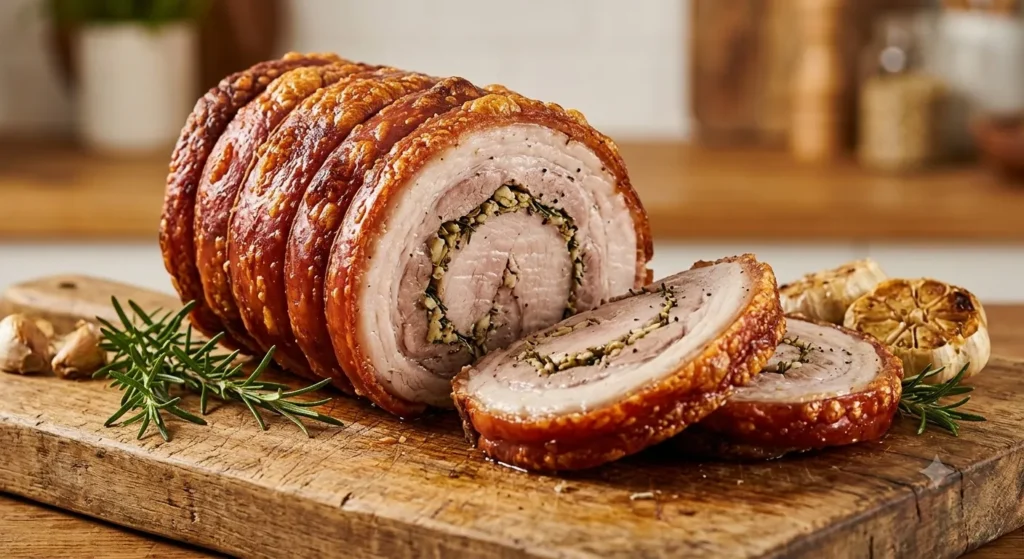
Table of Contents
I’ve spent years studying and cooking traditional Italian roasts, and Porchetta rewards patience more than any other dish I know. Get the drying, the rolling, and the roasting stages right, and you’ll produce something that rivals what you’d find at a Roman market stall. This guide walks through the history, the food science, and every step you need for authentic, crispy, deeply flavorful Italian Porchetta at home.
What Is Italain Porchetta?
Italian Porchetta is a savory, boneless Italian pork roast made by deboning a whole pig, or a large cut like belly and loin, then seasoning it generously with garlic, herbs, and salt before rolling it into a tight cylinder and slow-roasting it for hours. The name itself comes from the feminine form of “porco,” since tradition called for a female pig.
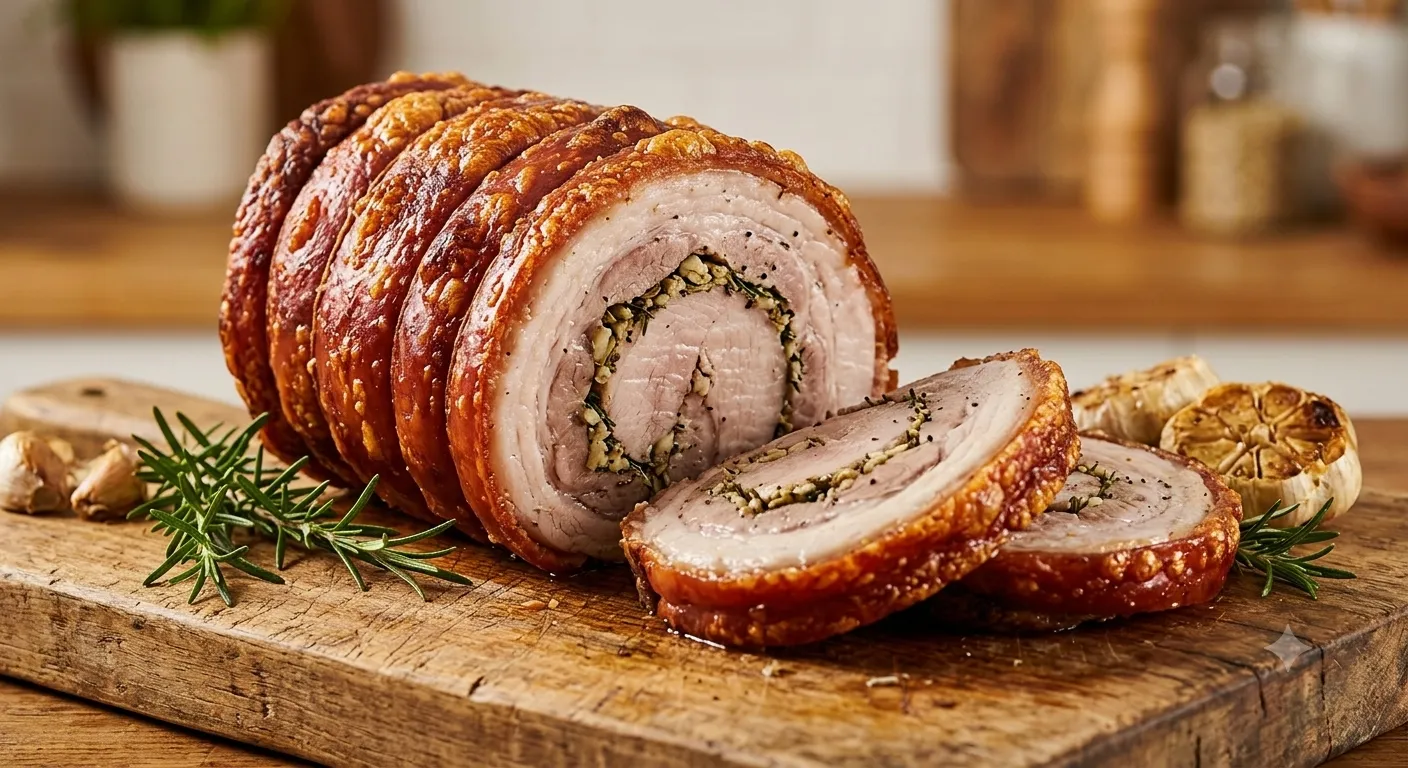
What sets true Porchetta apart from ordinary roast pork is the contrast built into every slice: a thin, brittle layer of crackling on the outside, then a ring of tender, fat-marbled pork belly, and finally a core of lean, herb-scented loin. Ordinary roast pork rarely delivers all three textures at once, which is exactly why Italian Porchetta has earned its reputation as one of Italy’s most celebrated dishes.
How It Differs from a Simple Roast
A basic pork roast is seasoned on the outside and cooked as one piece. Italian Porchetta is deboned, seasoned inside and out, rolled so the herbs run through the center, and tied so the skin wraps the entire circumference. That rolling technique is what produces its signature spiral of meat, fat, and herbs in every slice.
The History of Italian Porchetta
Italian Porchetta’s roots reach back roughly two thousand years to ancient Rome, where whole roasted pigs appeared at both feasts and ritual offerings. Over the centuries, pig farming became central to daily life across Lazio, Umbria, and Abruzzo, and the dish evolved into the rolled, herb-stuffed roast recognized today.
The town of Ariccia, in the Castelli Romani hills near Rome, has long claimed the strongest connection to the dish. Ariccia’s version, known as Italian Porchetta di Ariccia IGP, earned Protected Geographical Indication (PGI) status, meaning only Italian Porchetta produced under strict traditional methods in the designated area can use the official name. Since 1950, the town has hosted an annual festival celebrating the dish, drawing crowds from across the region.
Regional Claims and Variations
Umbria, particularly the town of Norcia, has its own long-standing pork-roasting tradition and lays claim to its own version of Italian Porchetta’s origin. Norcia’s style often includes chopped liver and wild fennel in the stuffing, giving it a deeper, more savory character than the simpler Ariccia recipe. Tuscany and Abruzzo have their own regional twists as well, each shaped by local herbs and farming traditions.
Chef Tip Box: Respecting the Tradition
Because Italian Porchetta carries such strong regional identity in Italy, home cooks outside those regions have more freedom to adapt it. This recipe draws on the classic Lazio-style seasoning of garlic and rosemary while adding fennel seed, a common addition in several other central Italian versions.
Why This Recipe Works
This recipe balances three things that are notoriously hard to get right at the same time: crackling that shatters when you bite into it, meat that stays moist through a long roast, and herb flavor that reaches all the way to the center instead of sitting only on the surface.
The drying step before roasting is what makes the skin crisp instead of chewy. Meanwhile, rolling the belly around the loin protects the leaner cut from drying out, since the fattier belly bastes it gently from the outside in as it cooks.
A Roast Built for Special Occasions
Porchetta takes time, but very little of it is hands-on. Once it’s seasoned, rolled, and in the oven, it mostly cooks itself, which makes it a genuinely practical centerpiece for a holiday table or a weekend gathering.
The Science Behind Perfect Italian Porchetta
Crisp crackling depends on removing as much surface moisture as possible before the pork goes into a hot oven. Skin that’s still damp will steam rather than crackle, so an uncovered rest in the refrigerator for several hours, or even overnight, dries the surface enough for real crispness to develop.
As the roast cooks, fat beneath the skin slowly renders and bastes the meat from within, while the exposed surface undergoes the Maillard reaction, the same browning process responsible for a seared steak’s crust. A final blast of high heat at the end of roasting drives off any remaining surface moisture and finishes the crackling.
Why Resting Matters
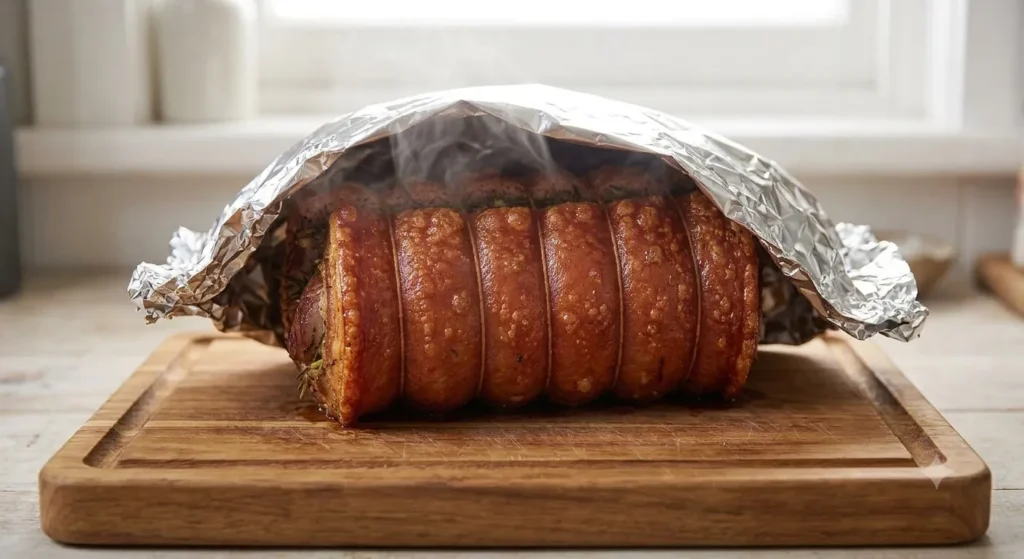
Carryover cooking means the internal temperature keeps climbing for several minutes after the roast leaves the oven. Resting the Porchetta, loosely tented, allows the juices to redistribute through the meat instead of running out onto the cutting board the moment you slice it.
Choosing the Best Pork Cut
| Cut | Fat Content | Texture | Ease of Prep | Best For |
|---|---|---|---|---|
| Pork belly alone | High | Very rich, fatty | Easy to roll | Maximum crackling, smaller roasts |
| Pork loin alone | Low | Lean, can dry out | Easy to roll | Not ideal alone; needs added fat |
| Belly + loin combination | Balanced | Rich outside, lean center | Moderate, needs butterflying | Classic, traditional result |
| Boneless shoulder | Moderate-high | Tender, forgiving | Easy | Budget-friendly, less crackling |
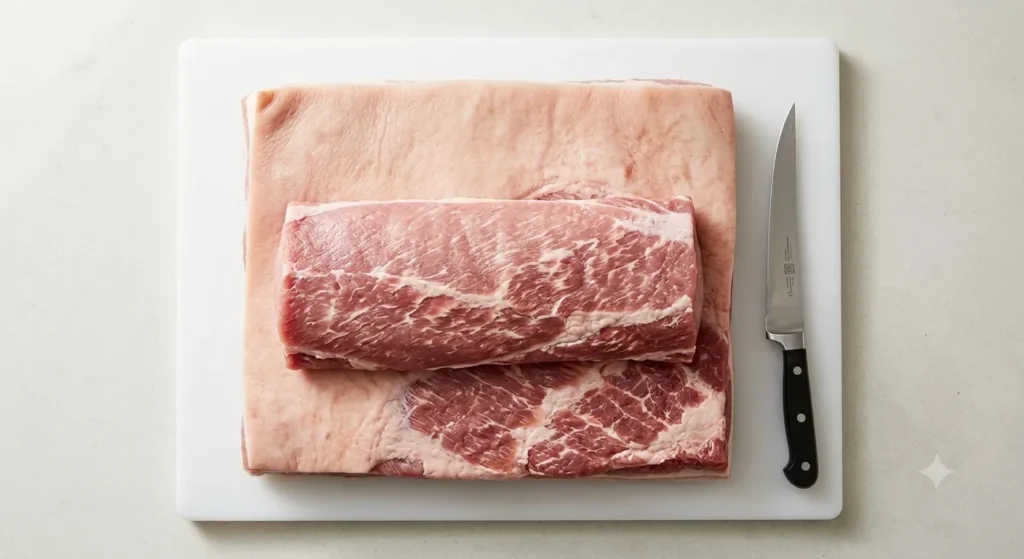
The belly-and-loin combination is the traditional choice because it delivers both textures in a single slice. Pork belly alone gives you incredible crackling and richness but can feel one-note over a large portion, while shoulder is a reasonable, more forgiving substitute if belly and loin aren’t available together.
Ingredients Explained
| Ingredient | Purpose |
|---|---|
| Pork belly (skin-on) | Wraps the roast and produces the crackling |
| Pork loin | Provides the lean, tender center |
| Fennel seeds | Adds classic anise-forward Italian aroma |
| Fresh rosemary | Sharp, piney backbone flavor |
| Fresh sage | Earthy depth that pairs with rich pork fat |
| Fresh thyme | Subtle, savory herbal note |
| Garlic | Pungent, essential Italian foundation |
| Lemon zest | Brightens the richness of the fat |
| Olive oil | Helps herbs adhere and promotes browning |
| Coarse salt | Seasons deeply and draws out surface moisture |
| Black pepper | Adds sharp, warm heat |
| Chili flakes (optional) | Adds gentle background heat |
Using fresh herbs rather than dried makes a real difference here, since the rolled roast locks in their aroma for hours, and fresh rosemary and sage release far more fragrant oil than their dried counterparts.
Step-by-Step Instructions
Step 1: Butterfly the Pork
Lay the pork belly skin-side down and, if needed, butterfly it to an even thickness so it lies flat. Score the skin in a tight diamond pattern, cutting through the fat but not into the meat, which helps the crackling shatter cleanly later.
Step 2: Season the Interior
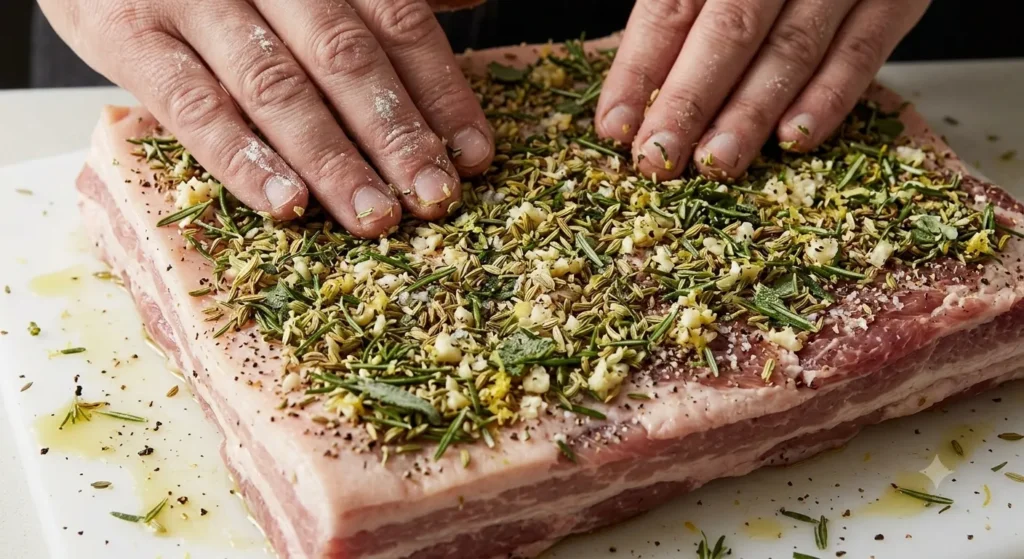
Rub the inside surface generously with crushed fennel seeds, minced garlic, chopped rosemary, sage, thyme, lemon zest, salt, and pepper. Press the seasoning firmly into the meat so it doesn’t fall away during rolling.
🖼️ [IMAGE 3 — SEASONING THE INTERIOR]
porchetta-seasoning-herbs.webp· ALT: “Seasoning porchetta with garlic and herbs” Close-up of pork belly opened flat, generously coated with a rustic mixture of crushed fennel seed, minced garlic, chopped rosemary, and lemon zest, hands pressing the seasoning into the meat.
Step 3: Add the Loin and Roll
Place the pork loin along the center of the belly, then roll the belly tightly around it, keeping the seam centered underneath. A tight roll is essential, since gaps lead to uneven cooking and a looser slice.
Step 4: Tie the Roast
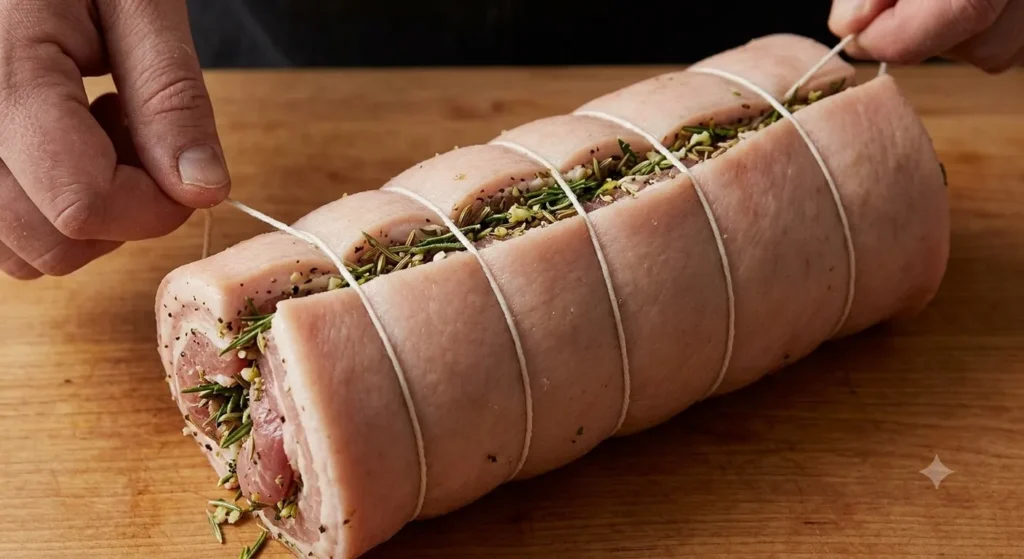
Tie the roll with kitchen twine at even 1-inch intervals, working from the center outward. Consistent spacing keeps the roast’s shape uniform as it cooks and shrinks.
Step 5: Dry the Skin
Pat the exterior completely dry, rub the skin with salt and a little oil, and refrigerate uncovered for at least 4 hours, or ideally overnight. This drying stage is the single most important step for crackling.
Step 6: Roast Low, Then High
Roast the Italian Porchetta at a low temperature first to render fat and cook the interior gently, then increase the oven to high heat for the final 20 to 30 minutes to blister and crisp the skin.
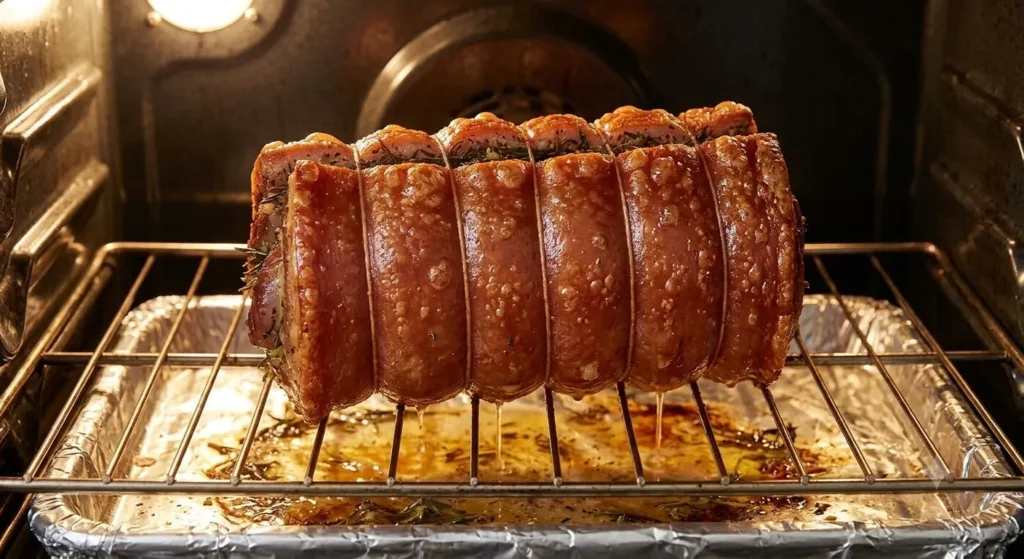
Step 7: Check Temperature and Rest
Use an instant-read thermometer inserted into the center of the loin to confirm it reaches the USDA safe minimum internal temperature for whole cuts of pork before resting.
Step 8: Slice and Serve
Slice with a sharp serrated or carving knife, cutting straight down through the crackling in firm, even strokes so it doesn’t shatter unevenly, revealing the spiral of meat, fat, and herbs.
Cooking Timeline
| Stage | Time |
|---|---|
| Butterflying and seasoning | 20–30 minutes |
| Rolling and tying | 15 minutes |
| Skin drying (refrigerated) | 4–12 hours |
| Low roast | 2–2.5 hours |
| High roast (crisping) | 20–30 minutes |
| Resting | 15–20 minutes |
Equipment Needed
- Roasting pan with a wire rack
- Kitchen twine
- Sharp boning or chef’s knife
- Instant-read thermometer
- Carving knife
- Cutting board with a juice groove
Common Mistakes to Avoid
- Skipping the skin-drying step, which leaves crackling chewy instead of crisp.
- Rolling the roast too loosely, causing uneven cooking and messy slices.
- Under-seasoning the interior, since the center is easy to forget once it’s rolled shut.
- Scoring the skin too deeply, cutting into the meat and letting juices escape.
- Not tying at even intervals, which creates a lumpy, uneven shape.
- Roasting at high heat the entire time, which burns the skin before the interior finishes.
- Skipping the low-and-slow stage, leaving the center undercooked or tough.
- Not using a thermometer, guessing at doneness instead of checking it directly.
- Slicing immediately after roasting, losing juices that should redistribute during resting.
- Using dried herbs only, which produces a flatter, less aromatic result.
- Choosing pork belly with too little fat, leading to dry, less flavorful crackling.
- Not patting the skin fully dry, leaving pockets of steam that prevent crisping.
- Cutting the twine too early, which lets the roll loosen before serving.
- Ignoring carryover cooking, pulling the roast off right at target temperature instead of slightly under.
- Overcrowding the roasting pan, which traps steam and softens the skin.
Common Mistake Box
The most common failure point is rushing the drying stage. Even an extra hour of uncovered refrigeration can be the difference between soft skin and true, shattering crackling.
Pro Chef Tips
- Score the skin the night before to save time on roasting day.
- Toast fennel seeds briefly before crushing them for a deeper aroma.
- Use a mortar and pestle to crush garlic and herbs into a rough paste.
- Salt the skin heavily; most of it renders away during roasting.
- Choose a belly with even thickness for the most consistent roll.
- Tuck the ends of the roll under before tying for a neater shape.
- Let the roast come closer to room temperature before it goes in the oven.
- Use a rack, never a flat pan, so hot air circulates underneath the roast.
- Rotate the pan halfway through roasting for even browning.
- Watch the crackling closely during the high-heat stage; it can burn quickly.
- Keep a spray bottle of oil nearby to touch up dry patches on the skin.
- Save rendered fat from the pan for roasting potatoes.
- Let the thermometer probe rest in the center of the loin, not near the fat.
- Tent loosely with foil while resting so the crackling doesn’t steam and soften.
- Use a serrated knife for the crackling, then switch to a sharp carving knife for the meat.
- Slice thicker than you think you need; Porchetta holds together better in generous slices.
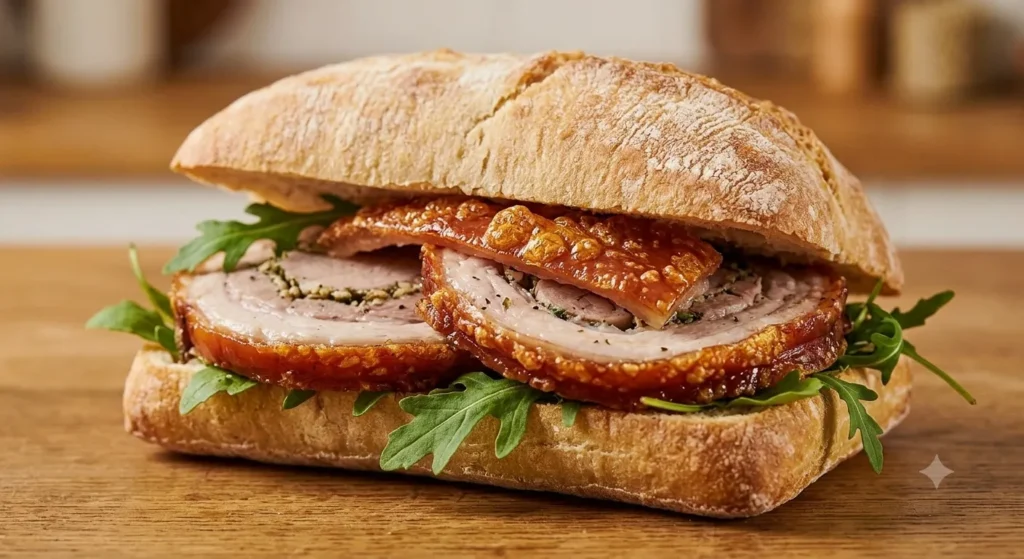
- Warm sandwich bread slightly before serving Porchetta on it, so the fat doesn’t seize up.
- Save trimmed pork scraps for stock instead of discarding them.
- Double the herb paste and freeze half for your next roast.
- Let leftover crackling sit uncovered briefly before reheating to help it re-crisp.
Delicious Variations
Umbrian Style Porchetta
Add chopped pork liver and extra wild fennel to the stuffing for the deeper, more savory character associated with Norcia’s tradition.
Roman Style Porchetta
Keep the seasoning simple with just garlic, rosemary, and black pepper, in the spirit of the Ariccia recipe.
Garlic-Heavy Porchetta
Double the garlic in the interior rub for a bolder, more pungent version that stands up well to crusty bread.
Herb-Crusted Porchetta
Press extra chopped rosemary, sage, and thyme onto the outside of the skin before the final high-heat roast for a fragrant, herb-flecked crust.
Smoked Porchetta
Finish the low-roast stage on a smoker instead of an oven for a subtle smoky note beneath the traditional herb flavor.
Rotisserie Porchetta
Cook the tied roast on a rotisserie spit for continuous, even self-basting and exceptionally crisp all-around skin.
BBQ Porchetta
Roast over indirect heat on a grill, adding wood chips for smoke, then finish directly over high heat to crisp the skin.
Storage & Reheating
Let leftover Porchetta cool completely, then wrap it tightly and refrigerate for up to 4 days, or freeze for up to 3 months. Keep the crackling separate from the meat if possible, since it softens faster when stored together with moist leftovers.
To reheat, warm slices gently in a low oven until heated through, then finish under a hot broiler for a minute or two to re-crisp the skin. According to the USDA, leftover pork should always be reheated to an internal temperature of 165°F to ensure food safety.
Kitchen Science Box: Reviving Crackling
Crackling loses crispness in the refrigerator because it reabsorbs moisture from the meat around it. A short blast of dry, high heat is the only reliable way to drive that moisture back out and restore the crunch.
What to Serve with Italian Porchetta
- Crispy [Internal Link: Crispy Roast Potatoes] roasted in the rendered pork fat
- Bright [Internal Link: Italian Salsa Verde] to cut through the richness
- A crunchy fennel and orange salad for contrast
- Warm [Internal Link: Homemade Focaccia] or ciabatta for sandwiches
- [Internal Link: Italian Herb Roasted Vegetables] on the side
- Creamy polenta or simple white beans
- [Internal Link: Classic Tiramisu] to finish the meal
For wine, a medium-bodied Chianti or Montepulciano complements the richness of the pork, while a crisp Pinot Grigio offers a lighter, more refreshing pairing.
Frequently Asked Questions
1. What does Porchetta taste like? It’s rich and savory, with garlic, rosemary, and fennel running through tender pork and a crisp, salty crackling exterior.
2. Is Italian Porchetta the same as pulled pork? No, Porchetta is rolled and sliced, with a defined crackling layer, while pulled pork is shredded and typically lacks crisp skin.
3. Can I make Italian Porchetta with just pork belly? Yes, pork belly alone works well and produces excellent crackling, though the result is richer without the leaner loin center.
4. Why is my crackling not crispy? The skin likely wasn’t dried long enough before roasting, or the final high-heat stage wasn’t hot enough.
5. How long does Italian Porchetta take to cook? Plan for roughly 2.5 to 3 hours of roasting, plus several hours of drying time beforehand and a rest afterward.
6. Can I prepare Italian Porchettaa day ahead? Yes, you can season and roll it a day ahead, then let it dry uncovered in the refrigerator until you’re ready to roast.
7. What temperature should Italian Porchetta reach? The center of the loin should reach at least 145°F, with the roast then resting to allow carryover cooking to finish the job.
8. Can I freeze raw, seasoned Italian Porchetta? Yes, you can freeze it rolled and tied before roasting, then thaw it fully in the refrigerator before cooking.
9. What’s the difference between Roman and Umbrian Italian Porchetta? Roman-style keeps seasoning simple with garlic and rosemary, while Umbrian-style often adds liver and extra fennel for a deeper flavor.
10. Can I use boneless pork shoulder instead? Yes, shoulder is a forgiving substitute, though it produces less dramatic crackling than a belly-and-loin combination.
11. Why did my roast come out dry? It was likely overcooked past the target internal temperature, or it wasn’t rested long enough before slicing.
12. Is Italian Porchetta traditionally served hot or cold? Both are traditional; it’s often served warm at home and at room temperature from street vendors and market stalls.
13. What’s the best knife for slicing Italian Porchetta? A serrated knife handles the crackling cleanly, while a sharp carving knife works best for the meat underneath.
14. Can I make a smaller Italian Porchetta? Yes, you can scale down the belly-and-loin size, though cooking time will be shorter, so check temperature earlier.
15. What is the origin of the name Italian Porchetta? It comes from the feminine form of the Italian word for pig, reflecting the traditional use of a female pig in the original recipe.
Recipe Card
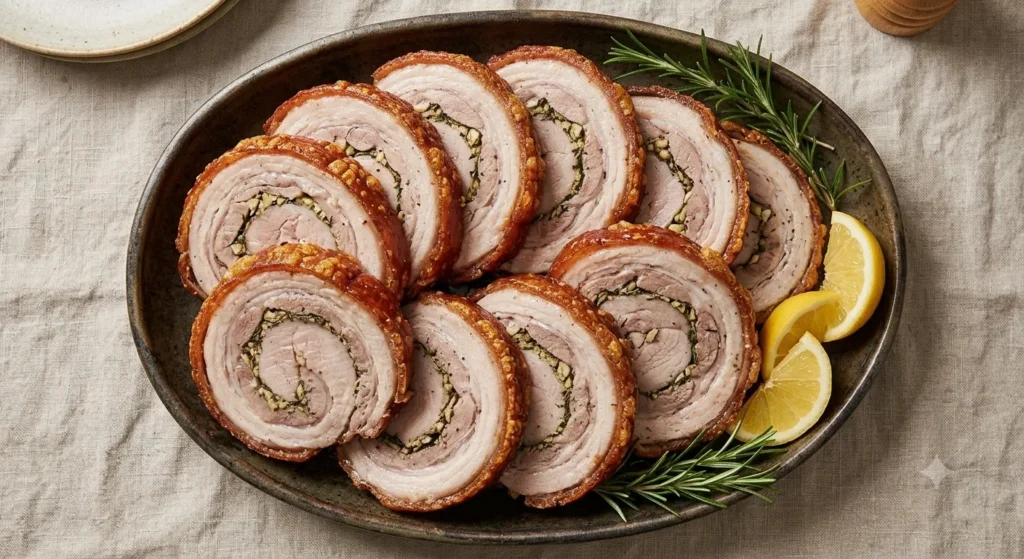
Italian Porchetta
Prep Time: 40 minutes Drying Time: 4–12 hours Cook Time: 2.5–3 hours Rest Time: 20 minutes Total Time: Approximately 8 hours (including drying) Servings: 8 Calories (per serving, approximate): 420
Ingredients
| Ingredient | Amount |
|---|---|
| Pork belly, skin-on | 4 lbs |
| Pork loin | 2 lbs |
| Fennel seeds, crushed | 2 tbsp |
| Fresh rosemary, chopped | 3 tbsp |
| Fresh sage, chopped | 2 tbsp |
| Fresh thyme, chopped | 1 tbsp |
| Garlic, minced | 8 cloves |
| Lemon zest | 2 lemons |
| Olive oil | 3 tbsp |
| Coarse salt | 3 tbsp, divided |
| Black pepper | 1 tbsp |
| Chili flakes (optional) | 1 tsp |
Instructions
- Butterfly the pork belly and score the skin in a diamond pattern.
- Mix fennel, rosemary, sage, thyme, garlic, lemon zest, olive oil, half the salt, pepper, and chili flakes; rub over the interior.
- Place the loin in the center and roll the belly tightly around it.
- Tie the roast with kitchen twine at 1-inch intervals.
- Pat the skin dry, rub with remaining salt, and refrigerate uncovered for 4 to 12 hours.
- Roast at 325°F for about 2 to 2.5 hours, then increase to 475°F for 20 to 30 minutes to crisp the skin.
- Rest the roast, loosely tented, for 15 to 20 minutes before slicing.
Chef Notes
For the crispest possible crackling, dry the skin overnight rather than for just a few hours, and make sure the roasting pan isn’t crowded so air can circulate freely around the roast.
Storage Notes
Refrigerate leftovers for up to 4 days or freeze for up to 3 months. Reheat gently, then broil briefly to restore crisp skin.
Nutrition Disclaimer: Nutrition values are estimates and will vary based on the exact cut, fat trim, and portion size used.
Conclusion
Italian Porchetta asks for patience, but it gives back far more than it takes. That first cut through crackling that shatters like glass, into meat that’s been perfumed with garlic and rosemary for hours, is worth every step of drying, rolling, and slow roasting. Whether you’re building a holiday centerpiece or just want to bring a taste of a Roman market stall into your own kitchen, this Italian Porchetta recipe delivers the real thing. Once you’ve made it once, don’t be surprised if it becomes the roast your family requests every year.