Salade de Chèvre Chaud: Classic Warm French Goat Cheese Salad
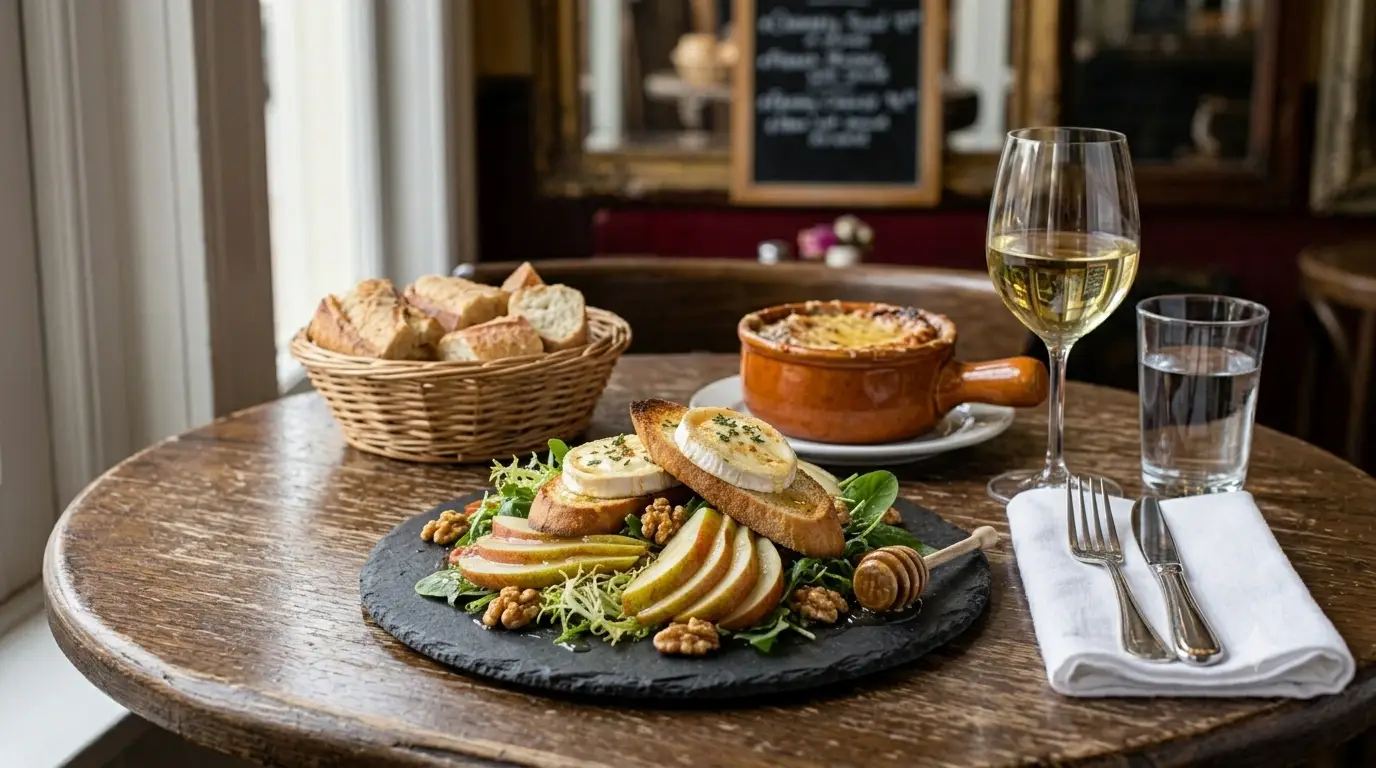
Salade de Chèvre Chaud, the classic warm French goat cheese salad, is one of those dishes that looks almost too simple to be this good. At a Paris bistro, it arrives with crisp greens, toasted baguette, and rounds of warm goat cheese just starting to soften under the heat.
Warm French Goat’s Cheese Salad works because it does one thing extremely well instead of trying to do many things at once. The contrast between cold, crisp greens and warm, soft cheese is the entire idea, and getting that contrast right comes down to a few details most home versions get wrong. Overheat the cheese and it collapses into a puddle. Skip toasting the bread properly and the whole thing turns soggy before it reaches the table.
This guide walks through Salade de Chèvre Chaud the way I’d teach it at the pass: which goat cheese to buy, how to warm it without losing its shape, how to build a proper French vinaigrette, and where most home cooks go wrong. By the end, you’ll be able to put this together confidently, with no guesswork.

Table of Contents
Table of Contents
- What Is Salade de Chèvre Chaud?
- The History of Salade de Chèvre Chaud
- Why This French Salad Is So Special
- Choosing the Best Goat Cheese
- Ingredients Explained
- The Science Behind Perfect Warm Goat Cheese
- Step-by-Step Technique
- The Perfect French Vinaigrette
- Equipment Needed
- Common Mistakes
- Pro Chef Tips
- Delicious Variations
- Storage & Make-Ahead Tips
- What to Serve with Warm French Goat’s Cheese Salad
- Frequently Asked Questions
- Recipe Card
- Conclusion
What Is Salade de Chèvre Chaud?
Salade de Chèvre Chaud translates directly to “warm goat cheese salad,” and that name describes the dish exactly. It’s a simple plate of mixed greens tossed in a sharp Dijon vinaigrette, topped with rounds of toasted baguette bearing warm, softened goat cheese, usually finished with walnuts and a touch of honey.
It’s one of the most common salads on French bistro menus, served as either a starter or a light lunch on its own. Its popularity comes down to how reliably it delivers: a handful of ingredients, almost none of them complicated, arranged so that texture and temperature do most of the work.
The dish is closely tied to the Loire Valley, a region running through the center of France that’s long been known for its goat farming and the many styles of chèvre produced there. Using local goat cheese on toasted bread over a simple green salad was a natural, practical way to serve the region’s signature product, and it eventually spread well beyond the Loire to become a French bistro staple nationwide.
What keeps this salad relevant is exactly what makes it easy to underestimate. There’s no long ingredient list and no complicated technique, just good cheese, good bread, fresh greens, and a vinaigrette built with care. Done properly, that simplicity is the whole point.
The History of Salade de Chèvre Chaud
Goat farming has deep roots in the French countryside, and the Loire Valley in particular has been closely associated with goat cheese production for a very long time, producing well-known styles like Crottin de Chavignol, Sainte-Maure de Touraine, and Valençay. Rural households across France have long paired fresh farmhouse cheese with simple greens as an easy, satisfying meal.
As French café and bistro culture developed through the 20th century, dishes built around a single strong regional ingredient became popular ways for menus to showcase local products simply and affordably. Warm goat cheese on toast, set over a green salad, fit that mold perfectly: inexpensive to prepare, quick to plate, and immediately appealing on a menu.
The dish became a favorite light lunch across France in large part because it satisfies without being heavy. It has enough richness from the cheese to feel like a real meal, but the greens and vinaigrette keep it from feeling like too much for a midday plate, which is exactly why it remains a fixture on café menus at lunchtime throughout the country today.
Why This French Goat Cheese Salad Is So Special?
Creamy warm goat cheese. Gently warmed, chèvre turns soft and slightly molten at the edges while staying intact enough to hold its shape, giving you a texture unlike almost anything else on a salad plate.
Crisp toasted baguette. The bread underneath the cheese needs to stay crisp enough to support it, providing a textural anchor against the softness of the cheese.
Fresh greens. A mix of slightly bitter and peppery greens balances the richness of the warm cheese rather than getting lost underneath it.
Tangy Dijon vinaigrette. Sharp, mustard-forward dressing cuts through the richness of the cheese, keeping every bite from tasting one-note.
Crunch from walnuts. Toasted walnuts add another textural layer and a slightly bitter, earthy note that complements goat cheese particularly well.
Sweetness from honey (optional). A light drizzle of honey plays off the cheese’s natural tang, especially if using a milder or younger goat cheese.
Balance of warm and cold. The core appeal of this dish is temperature contrast — warm cheese and toast against cold, crisp greens — and that contrast is exactly why it’s remained popular for so long.
Choosing the Best Goat Cheese
| Type | Flavor | Texture When Warmed | Best Use |
|---|---|---|---|
| Fresh chèvre (log) | Mild, tangy, creamy | Softens evenly, holds shape well | Best all-around choice for this salad |
| Aged goat cheese | Sharper, more concentrated | Can soften unevenly, sometimes oily | Better suited to grating or crumbling |
| Crottin de Chavignol | Earthy, nutty, more assertive with age | Holds shape nicely when young; melts more when aged | Traditional Loire Valley choice |
| American-style goat cheese logs | Mild, consistent | Reliable, softens predictably | Widely available, very workable substitute |
Fresh, log-style chèvre is the most reliable and widely recommended option for this dish. It has enough moisture to soften and turn creamy under gentle heat without collapsing into liquid, and its mild tang won’t overwhelm the greens or vinaigrette.
Crottin de Chavignol, a small, round goat cheese specifically from the Loire Valley, is the traditional choice in the dish’s home region, particularly when still young and mild. Aged versions turn sharper and drier, better suited to other preparations than this one.
Aged goat cheese in general tends to have less moisture, which can cause it to warm unevenly or release oil rather than softening smoothly, so it’s not the best choice here.
For US grocery store shopping, look for a plain, log-style fresh goat cheese, widely available from brands carried in most standard supermarkets, rather than a crumbled or heavily flavored version, which won’t slice or hold its shape the same way.
Ingredients Explained
Goat cheese, sliced into rounds, is the centerpiece of the dish. French baguette, sliced and toasted, supports the cheese and adds crunch. Mixed greens form the base of the salad and should include some texture and bite rather than a single soft lettuce. Frisée, with its curly, slightly bitter leaves, is a traditional component that adds both texture and a mild bitterness that plays well against the cheese. Arugula contributes peppery bite. Baby spinach adds a mild, slightly earthy backdrop if you want to soften the overall bitterness of the mix. Walnuts, toasted, bring crunch and a slightly bitter, nutty note. Dijon mustard is the backbone of the vinaigrette, both for flavor and as an emulsifier. Red wine vinegar provides sharp, classic French acidity. White wine vinegar can be used instead for a slightly milder, brighter tang. Olive oil rounds out the vinaigrette’s richness. Honey, used sparingly, balances the vinaigrette’s acidity and complements the cheese. Fresh thyme, sprinkled over the cheese before baking, adds an herbal aroma that pairs naturally with goat cheese. Black pepper and sea salt season both the cheese and the finished salad.
The Science Behind Perfect Warm Goat Cheese
Goat cheese behaves differently under heat than many other cheeses, and understanding why makes it far easier to get the texture right.
Why goat cheese softens without completely melting. Fresh chèvre has a relatively low fat content and a structure held together more by moisture and protein than by fat alone, unlike cheeses such as mozzarella or Gruyère, which are built to stretch and flow when melted. Under gentle heat, goat cheese softens and turns creamy at the surface while largely holding its shape, rather than liquefying the way a higher-fat, more elastic cheese would.
The importance of toasting the bread. Bread that isn’t properly dried and toasted first will absorb moisture from the warming cheese and turn soft, undermining the entire textural contrast the dish depends on.
Heat control. A hot oven or broiler, watched closely for just a few minutes, is enough to warm the cheese through and lightly brown its surface without pushing it past the point of holding its shape.
Preventing the cheese from collapsing. Overheating, or leaving it under a broiler too long, pushes past the point of gentle softening and causes the cheese to lose its structure entirely, spreading out into a puddle instead of sitting neatly on the toast.
How warm cheese changes flavor and aroma. Warming goat cheese intensifies its aroma considerably, releasing more of its characteristic tang and creaminess than you’d notice from the cold cheese alone, which is part of why this dish tastes so much more indulgent than a simple cold cheese plate.
Step-by-Step Technique
1. Prepare the bread. Slice a baguette into rounds about 3/4 inch thick.
2. Toast the bread. Toast the slices in a 375°F oven for about 5 to 7 minutes, until lightly golden and firm, or use a toaster if working with a small batch.
3. Slice the goat cheese. Cut a log of fresh chèvre into rounds roughly the same diameter as the toasted bread, about 1/2 inch thick.
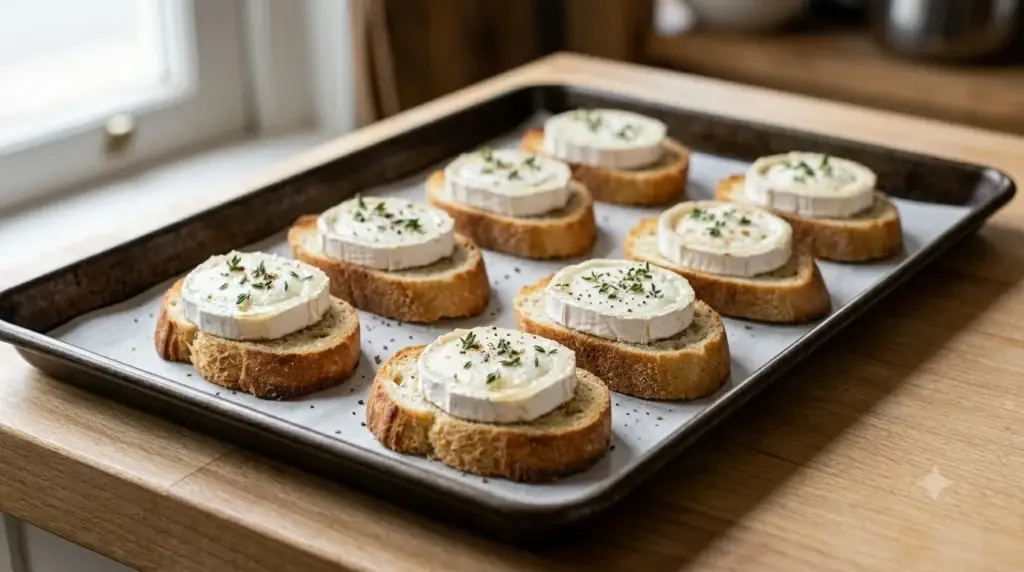
4. Assemble the toasts. Place a round of goat cheese on each piece of toasted bread. Sprinkle with fresh thyme and a light grind of black pepper.
5. Bake or broil. Bake at 400°F for 5 to 7 minutes, or broil for 2 to 3 minutes, watching closely, until the cheese is warmed through and just beginning to soften and lightly brown on top.
6. Prepare the vinaigrette. Whisk together Dijon mustard, vinegar, salt, and pepper, then slowly whisk in olive oil until emulsified.
7. Dress the greens. Toss the mixed greens with just enough vinaigrette to coat lightly, without drowning them.
8. Assemble the salad. Arrange the dressed greens on plates, then top with the warm goat cheese toasts, scattered toasted walnuts, and a light drizzle of honey if using.
9. Serve immediately. This salad needs to reach the table while the cheese is still warm and the greens are still crisp.
Visual cues: the cheese should look glossy and slightly golden on top, not deflated or oozing. Texture cues: it should hold its round shape when lifted with a spoon, softening only at the very edges. Timing: don’t leave the toasts under the broiler unattended even briefly — the difference between perfectly warmed and collapsed can be less than a minute.
The Perfect French Vinaigrette
A classic French vinaigrette runs roughly three parts oil to one part vinegar, though this ratio can shift slightly toward more acidity for a dish like this one, where the vinaigrette needs to cut through rich, warm cheese rather than dress a lighter salad on its own.
Dijon mustard does more than add flavor. Its natural emulsifiers help bind the oil and vinegar together into a stable, creamy dressing rather than a mixture that separates the moment you stop whisking.
Seasoning matters more than people expect in a vinaigrette this simple. Since there are only a handful of ingredients, under-salting or skipping pepper entirely is immediately noticeable in the finished dressing.
The defining difference between a proper French vinaigrette and many American-style creamy dressings is texture and weight: a vinaigrette stays light and pourable, letting the greens’ own flavor come through, rather than coating them in a heavy, mayonnaise-based dressing that mutes everything underneath it.
Equipment Needed
- Baking sheet — for toasting the bread and baking the assembled goat cheese toasts
- Chef’s knife — for slicing the baguette and the goat cheese log cleanly
- Mixing bowl — for tossing the dressed greens
- Whisk — for building a properly emulsified vinaigrette
- Small saucepan (optional) — useful if warming honey slightly to make it easier to drizzle
- Salad spinner — for thoroughly drying washed greens, since wet greens won’t hold dressing properly
Common Mistakes
- Overheating the goat cheese. Causes it to collapse into a puddle instead of holding its shape. Fix: watch closely and pull it the moment it softens and lightly browns.
- Using aged goat cheese instead of fresh. Can melt unevenly or release oil. Fix: use a fresh, log-style chèvre.
- Skipping the bread toasting step. Leads to soggy, mushy toast under the warm cheese. Fix: always toast the bread until firm before adding cheese.
- Slicing the bread too thin. Can’t support the weight of the cheese and turns soggy quickly. Fix: cut slices at least 3/4 inch thick.
- Dressing the greens too early. Wilts them before serving. Fix: dress immediately before plating, not in advance.
- Over-dressing the salad. Drowns the greens and overwhelms the delicate balance of the dish. Fix: add vinaigrette gradually, tossing and tasting as you go.
- Not drying washed greens thoroughly. Excess water dilutes the vinaigrette and prevents it from clinging properly. Fix: use a salad spinner and pat dry if needed.
- Using a bland or overly mild vinaigrette. Fails to balance the richness of the warm cheese. Fix: don’t skimp on the mustard and vinegar.
- Leaving the cheese under the broiler unattended. Can go from perfect to collapsed in under a minute. Fix: stay close and check frequently.
- Adding walnuts untoasted. Misses out on their full flavor and aroma. Fix: toast walnuts briefly in a dry pan before adding.
- Assembling the salad too far in advance. The warm cheese cools and the toast softens before serving. Fix: assemble and serve immediately.
- Using too much honey. Turns the dish overly sweet and masks the cheese’s natural tang. Fix: use just a light drizzle, not a heavy pour.
- Choosing overly bitter greens exclusively. Can overwhelm the dish if not balanced with milder greens. Fix: mix bitter greens like frisée or arugula with something milder like baby spinach.
- Not seasoning the cheese before baking. Leaves it tasting flat compared to the rest of the plate. Fix: add a pinch of salt, pepper, and fresh thyme before baking.
- Using pre-shredded or crumbled cheese instead of a log. Won’t hold a clean round shape on the toast. Fix: buy a log-style chèvre and slice it yourself.
Pro Chef Tips
- Chill the goat cheese log briefly before slicing for cleaner, more even rounds.
- Use a knife dipped in hot water to slice goat cheese without it sticking or crumbling.
- Toast the bread fully before adding the cheese, even if it takes a few extra minutes.
- Watch the broiler closely; a few seconds too long makes a real difference here.
- Warm honey slightly before drizzling for smoother, more even coverage.
- Whisk the vinaigrette just before serving for the best emulsion.
- Taste the vinaigrette on its own before dressing the greens to check the balance.
- Toast walnuts in a dry skillet over medium heat, watching closely, until fragrant.
- Use a mandoline for perfectly even bread slices if cutting a large batch.
- Season the greens themselves lightly with a pinch of salt before adding vinaigrette.
- Serve on chilled plates to help maintain the temperature contrast a little longer.
- Add a small pinch of sugar to the vinaigrette if using a more acidic vinegar, to round out the sharpness.
- Use fresh thyme rather than dried for a brighter aromatic finish on the baked cheese.
- Keep the cheese rounds a consistent thickness so they all warm at the same rate.
- Have the vinaigrette and toasted walnuts fully ready before the cheese goes under the broiler, since timing matters at the end.
- Use two smaller rounds of cheese per plate rather than one large one for more even heating.
- A light drizzle of good olive oil over the finished plate adds shine and extra richness.
- Rest bread at room temperature before toasting if it’s been refrigerated, for more even toasting.
- Use a offset spatula to transfer the warm toasts without disturbing the softened cheese.
- Serve the moment the toasts come out of the oven — this dish doesn’t wait well.
Delicious Variations
With pears: Thin slices of ripe pear add a juicy sweetness that pairs beautifully with the cheese’s tang.
With apples: Crisp apple slices offer a similar sweetness with more crunch, especially good with a slightly sharper goat cheese.
With roasted beets: Earthy roasted beets add color and a subtle sweetness that complements goat cheese particularly well.
With bacon lardons: Crisp, rendered bacon adds a smoky, savory note that turns the salad into a heartier main course.
With figs: Fresh or lightly roasted figs bring a jammy sweetness that’s a classic pairing with chèvre.
With toasted pecans: A softer, sweeter alternative to walnuts, especially nice with a honey drizzle.
Gluten-free version: Use a gluten-free baguette or bread, toasted the same way, to support the warm cheese.
Vegetarian adaptations: The classic version is already vegetarian; simply omit any variations that include bacon.

Storage & Make-Ahead Tips
Preparing the vinaigrette ahead: The vinaigrette keeps well in a sealed container in the refrigerator for up to a week; just whisk or shake it again before using, since it will separate slightly on standing. Storing ingredients: Greens can be washed and dried in advance and stored in the refrigerator, wrapped loosely in a paper towel, for a couple of days. Goat cheese can be sliced ahead and kept covered in the refrigerator until ready to bake. Can leftovers be saved? The greens and vinaigrette don’t hold up once combined, but any unused toasted bread and sliced cheese can be stored separately and assembled fresh another day. Why the assembled salad should be served immediately: Once dressed and combined with the warm cheese toasts, the salad starts wilting and cooling within minutes, losing the exact contrast that makes the dish work.
What to Serve with Warm French Goat’s Cheese Salad
As a starter, this salad pairs naturally with heartier French mains like French onion soup, Quiche Lorraine, or a simple tomato tart. Alongside a bowl of French lentil soup or a serving of roast chicken, it makes for a well-rounded, casually elegant lunch. A side of crusty baguette never hurts, especially for guests who want extra bread beyond what’s already in the salad.
Wine pairings: A crisp Sancerre or other Sauvignon Blanc from the Loire Valley is the traditional, natural pairing, since both the wine and the cheese often come from the same region and share a similar bright acidity. Other Loire Valley whites work well for the same reason. A light rosé is a good warm-weather alternative, and a light-bodied Pinot Noir can work if you prefer red wine with a lunch salad.
Frequently Asked Questions
1. What does Salade de Chèvre Chaud mean? It translates to “warm goat cheese salad,” describing the dish’s central feature of warm, softened goat cheese served over cold greens.
2. Can I use feta instead of goat cheese? Feta has a different texture and won’t soften the same way under heat. Fresh, log-style goat cheese is strongly recommended for the correct texture and flavor.
3. Can I make this salad ahead of time? The vinaigrette and prepped ingredients can be made ahead, but the salad itself should be assembled and served immediately once the cheese is warmed.
4. Can I grill the goat cheese toasts instead of baking them? Yes, a hot grill or grill pan can work well for a few minutes, though it requires close attention since the cheese can soften quickly over direct heat.
5. Can I use an air fryer for the goat cheese toasts? Yes, an air fryer at around 375°F for 3 to 4 minutes works well and is a quick, convenient alternative to the oven or broiler.
6. Why did my goat cheese melt too much? This usually means it was left under heat too long, or an aged, drier cheese was used instead of fresh chèvre, which behaves differently under heat.
7. Can I use dried thyme instead of fresh? Yes, in a smaller quantity, though the aroma won’t be as bright or fragrant as fresh thyme.
8. What greens work best for this salad? A mix of frisée, arugula, and baby spinach gives a good balance of bitterness, peppery bite, and mild backdrop, though any combination of fresh, crisp greens will work.
9. Can I serve this salad as a main course? Yes, especially with an added protein like bacon lardons, or simply with a larger portion of cheese toasts, which turns it into a satisfying light meal.
10. What’s the best bread to use if I can’t find a baguette? Any firm, crusty white bread that can be sliced and toasted until sturdy will work, though a real baguette gives the most authentic texture.
11. Can I prepare the cheese toasts in advance and reheat them later? It’s best to bake them fresh just before serving, since reheating tends to overcook the cheese and dry out the bread.
12. Do I need to peel the crust off the goat cheese? No, the thin rind on most fresh chèvre logs is edible and softens along with the rest of the cheese.
13. Can I substitute the walnuts with another nut? Yes, pecans or toasted almonds both work well as substitutes, each bringing a slightly different flavor.
14. Is this salad gluten-free? Not in its classic form, since it relies on baguette, but a gluten-free bread substitute, toasted the same way, works well.
15. How many toasts should I serve per person? Two to three rounds of goat cheese toast per person is standard for a starter portion, with more for a main-course serving.
Recipe Card
Warm French Goat’s Cheese Salad (Salade de Chèvre Chaud)
| Prep Time | 15 minutes |
| Cook Time | 10 minutes |
| Total Time | 25 minutes |
| Servings | 4 |
| Cuisine | French |
| Course | Starter, Lunch |
| Calories (estimated) | 380 per serving |
Ingredients
- 1 baguette, sliced into 3/4-inch rounds (about 8 to 12 slices)
- 1 log (8 to 10 oz) fresh goat cheese, sliced into rounds
- 1 teaspoon fresh thyme leaves
- Black pepper, to taste
- 6 cups mixed greens (frisée, arugula, and baby spinach)
- 1/2 cup walnuts, toasted
- 1 tablespoon honey, for drizzling (optional)
- 1 tablespoon Dijon mustard
- 3 tablespoons red wine vinegar
- 9 tablespoons olive oil
- Sea salt, to taste
Instructions
- Preheat the oven to 400°F. Arrange the baguette slices on a baking sheet and toast for 5 to 7 minutes, until lightly golden and firm.
- Top each toasted slice with a round of goat cheese. Sprinkle with fresh thyme and a light grind of black pepper.
- Return to the oven and bake for 5 to 7 minutes, or broil for 2 to 3 minutes, watching closely, until the cheese is warmed through and just beginning to soften and lightly brown.
- Meanwhile, whisk together the Dijon mustard, red wine vinegar, and a pinch of salt and pepper. Slowly whisk in the olive oil until fully emulsified.
- Toss the mixed greens with just enough vinaigrette to coat lightly.
- Divide the dressed greens among plates. Top each with warm goat cheese toasts, toasted walnuts, and a light drizzle of honey if using.
- Serve immediately.
Chef Notes: Watch the cheese closely under the broiler — a few extra seconds can be the difference between perfectly warmed and completely melted.
Storage Notes: Vinaigrette keeps refrigerated for up to a week. Assemble and serve the finished salad immediately; it does not hold or store well once combined.
Nutrition Disclaimer: Calorie and nutrition estimates are approximate and will vary based on specific ingredients and portion sizes used.
Conclusion
Warm French Goat’s Cheese Salad proves that a great dish doesn’t need a long ingredient list or a complicated technique, just good components handled with a little care. Toast the bread properly, warm the cheese just enough and not a second longer, and build a vinaigrette with real acidity, and you’ve got a plate that tastes like it came straight out of a Loire Valley bistro.
Make it once, get the timing right on that cheese, and you’ll understand exactly why Salade de Chèvre Chaud has stayed a fixture on French lunch menus for so long. Simple, done well, is still the whole point.