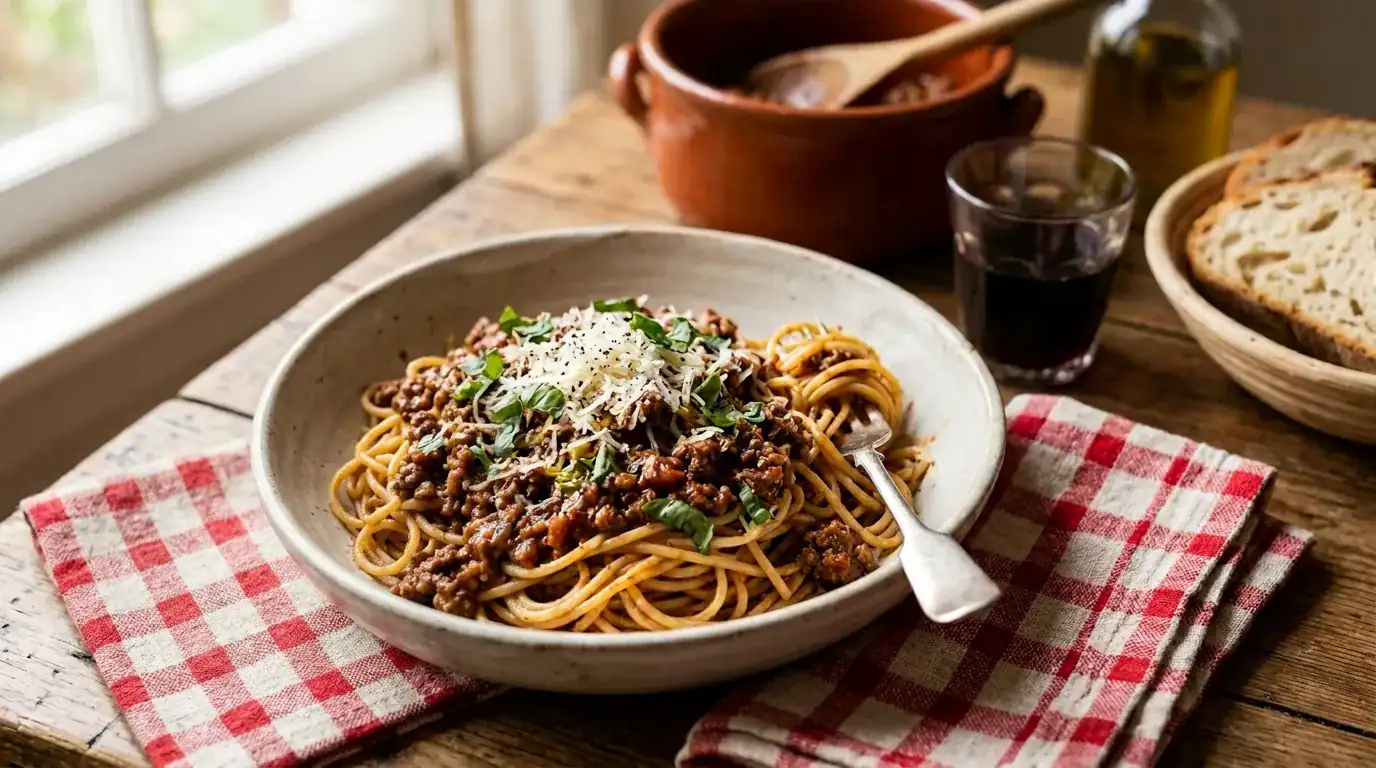
Spaghetti Bolognese: Rich Slow-Simmered Italian Sauce 30-Minute Recipe
Few dishes travel as far from home and still get called by the same name as Spaghetti Bolognese. Around the world, it means rich, slow-simmered ground beef in tomato sauce over spaghetti, and it’s one of the most beloved comfort foods anywhere. In Bologna itself, though, the story is a little different, and understanding that difference is exactly what will make your Spaghetti Bolognese taste better.
I grew up cooking in Bologna, where ragù simmers on the stove most Sundays and gets served over tagliatelle, not spaghetti. That said, I understand why the world fell in love with Spaghetti Bolognese, and this guide teaches you both: the authentic Ragù alla Bolognese tradition my family has always known, and the beloved international Spaghetti Bolognese you’re likely searching for. Neither version is wrong; they’re simply two branches of the same delicious tree.
Table of Contents
What Is Spaghetti Bolognese?
Spaghetti Bolognese refers to spaghetti tossed with a rich, slow-simmered meat sauce inspired by Bologna’s famous ragù. It has become one of the world’s most popular pasta dishes, showing up on menus and family tables from London to Los Angeles, precisely because it’s hearty, comforting, and forgiving enough for home cooks at any skill level.
The dish’s global popularity, however, doesn’t match its Italian roots exactly. Authentic Ragù alla Bolognese, the sauce this dish descends from, is traditionally served with tagliatelle in Bologna, not spaghetti, and Italians in the region rarely call it “Spaghetti Bolognese” at all.
Spaghetti Bolognese vs. Authentic Ragù alla Bolognese
| Feature | Spaghetti Bolognese | Ragù alla Bolognese |
|---|---|---|
| Traditional pasta | Spaghetti | Tagliatelle |
| Origin | International adaptation | Bologna, Italy |
| Documentation | No fixed recipe | Officially registered recipe |
| Sauce texture | Varies widely | Thick, clinging to wide ribbons |
| Global recognition | Extremely high | High within Italy, respected abroad |
Why Italians Traditionally Serve Bolognese with Tagliatelle
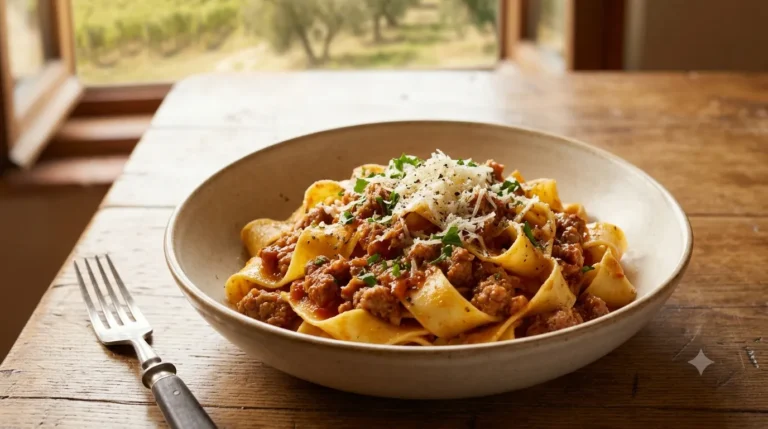
Wide, flat tagliatelle ribbons hold onto a thick, meat-forward ragù far better than round spaghetti strands do, since the ragù’s texture is closer to a rich meat topping than a thin, pourable sauce. That practical pairing has held for generations in Bologna’s home kitchens and trattorias.
Why Spaghetti Became the International Favorite
Spaghetti, being widely available, easy to cook, and already familiar to international audiences, became the default pasta for Bolognese-style sauce as the dish spread beyond Italy, particularly through Italian immigrant communities abroad.
The History of Bolognese Sauce
Ragù alla Bolognese takes its name from Bologna, the Emilia-Romagna city where this rich meat sauce developed as a regional specialty. Concerned about the dish’s identity being lost amid countless international variations, the Bolognese delegation of the Accademia Italiana della Cucina formally registered an official recipe with the Bologna Chamber of Commerce on October 17, 1982, aiming to preserve the sauce’s traditional character for future generations.
That 1982 recipe remained the reference standard for decades until the Accademia Italiana della Cucina updated it on April 20, 2023, following extensive research by a dedicated study committee, and deposited the revised version at the same Chamber of Commerce. Both versions describe a soffritto-based sauce built on pancetta, onion, carrot, and celery, slowly combined with beef, wine, and a modest amount of tomato, simmered patiently rather than rushed.
Traditional Ingredients and Protected Culinary Traditions
The official recipe calls for finely chopped pancetta, a classic vegetable soffritto, ground beef, dry wine, milk, and tomato, simmered together for hours until the sauce thickens into something substantial enough to coat wide pasta ribbons. Registering the recipe reflected a broader Italian tradition of protecting regional dishes from losing their identity as they gain popularity elsewhere.
Evolution into the International Spaghetti Bolognese
As Italian immigrants carried their culinary traditions abroad, particularly through the 20th century, regional dishes like ragù alla Bolognese were often adapted to ingredients and pasta shapes more readily available in new countries. Spaghetti, already a familiar and widely stocked pasta shape internationally, became strongly associated with Bolognese-style sauce well outside of Bologna itself, evolving into the dish now recognized worldwide as Spaghetti Bolognese.
Chef Tip Box: Two Traditions, Equally Worth Knowing
I don’t think either version needs defending against the other. Ragù alla Bolognese represents a specific, documented Bolognese tradition, while Spaghetti Bolognese represents its own successful international evolution. This recipe teaches you both, so you can choose the version that fits your table.
Why This Recipe Works
Slow simmering is what separates a genuinely good Bolognese-style sauce from a rushed weeknight substitute. Given enough time, the meat’s connective tissue softens, the vegetables melt into the background, and the tomato loses its raw sharpness, leaving behind a sauce with real depth.
A rich soffritto of onion, carrot, and celery forms the aromatic backbone, while a splash of wine and a portion of milk each play a specific, balancing role. Wine adds brightness and helps deglaze the pan, while milk tempers the tomato’s acidity and helps keep the meat tender through the long simmer.
Balanced Meat Flavor and Perfect Pasta Pairing
Using quality ground beef, sometimes blended with pork or pancetta, gives the sauce a fuller flavor than beef alone. Finished with good Parmesan and paired with pasta that suits its texture, whether that’s traditional tagliatelle or beloved spaghetti, this sauce delivers real, satisfying depth either way.
The Science Behind Perfect Bolognese
Browning the meat properly triggers the Maillard reaction, developing hundreds of new flavor compounds that give the sauce its deep, savory backbone rather than a flat, boiled taste. As the meat browns, its fat renders into the pan and carries flavor through the vegetables cooking alongside it.
A long, gentle simmer allows collagen in the meat to slowly break down into gelatin, which is what gives a well-made Bolognese-style sauce its characteristic silkiness and body. Wine reduction concentrates flavor while cooking off its sharper alcohol notes, and tomato acidity, balanced carefully by the addition of milk, keeps the finished sauce from tasting too sharp or thin.
Kitchen Science Box: Why Milk Matters So Much
Milk’s proteins and fat help tenderize the meat during the long simmer while also neutralizing some of the tomato’s acidity, resulting in a rounder, less sharp-tasting sauce than tomato and meat alone would produce.
Pasta Starch Emulsification
Reserved, starchy pasta water, stirred in just before serving, helps bind the sauce to the pasta, whether that’s spaghetti or tagliatelle, creating a cohesive coating instead of a sauce that pools separately at the bottom of the bowl.
Choosing the Best Meat
| Meat | Fat Content | Flavor | Traditional? | Best For |
|---|---|---|---|---|
| Ground beef | Moderate | Rich, straightforward | Core ingredient | The most accessible, reliable base |
| Ground pork | Higher | Sweet, mild | Common addition | Extra richness alongside beef |
| Beef and pork blend | Balanced | Full, rounded | Very traditional | A classic, well-balanced choice |
| Veal | Lower | Delicate | Sometimes used | A lighter, more refined result |
| Pancetta | High | Salty, savory | Essential to soffritto | Foundational flavor, not the main meat |
| Italian sausage | Higher | Spiced, bold | A modern variation | Those wanting extra herby depth |
A beef and pork blend remains the most traditional and well-balanced choice, offering richness from the pork alongside beef’s straightforward savoriness. For beginners, ground beef alone, cooked patiently with a proper soffritto, is entirely capable of producing a deeply flavorful sauce.
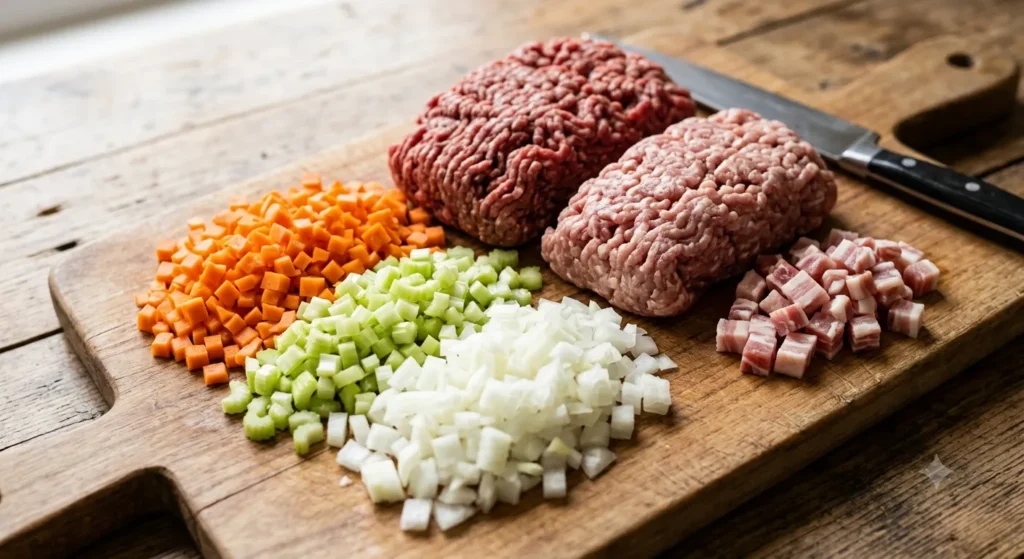
Ingredients Explained
| Ingredient | Purpose |
|---|---|
| Ground beef | The primary savory base of the sauce |
| Ground pork | Adds sweetness and extra richness |
| Pancetta | Foundational salty depth in the soffritto |
| Onion | Sweetness and aromatic base |
| Carrot | Subtle sweetness that balances acidity |
| Celery | Earthy, herbal backbone |
| Garlic (optional) | Not traditional in the classic recipe, though many modern versions include it |
| Tomato paste | Concentrated flavor and color |
| Crushed tomatoes | Body and gentle acidity |
| Milk | Tenderizes the meat and balances acidity |
| Dry white wine | Brightens the sauce and deglazes the pan |
| Olive oil | Base fat for building flavor |
| Butter | Adds richness alongside the olive oil |
| Bay leaf | Background depth during simmering |
| Nutmeg | A traditional, subtle warmth in the sauce |
| Parmesan | Salty, savory finish |
| Spaghetti | The internationally popular pasta pairing |
Garlic doesn’t appear in the traditional, registered recipe, though many modern versions, especially outside Italy, include a clove or two. Including or omitting it comes down to personal preference rather than strict authenticity.
The Secret to Authentic Bolognese
Proper soffritto, finely diced and cooked low and slow until soft and fragrant rather than browned, forms the foundation everything else builds on. Browning the meat thoroughly afterward, in batches if necessary, develops far more flavor than simply cooking it until it’s no longer pink.
Deglazing with wine lifts every flavorful browned bit stuck to the pot, while adding milk partway through the simmer tenderizes the meat and balances the tomato’s acidity. Long, patient simmering, ideally two hours or more, is what transforms these individually simple ingredients into a sauce with real depth and body.
Chef Tip Box: Using Quality Parmesan and Finishing with Pasta Water
Finish the dish with freshly grated Parmesan and a splash of reserved pasta water, tossing the pasta directly in the sauce rather than spooning sauce over plated pasta. This final step is what gives the dish its glossy, cohesive finish.
Step-by-Step Instructions
Step 1: Prepare the Vegetables
Finely dice the onion, carrot, and celery into a uniform soffritto. Finely chop the pancetta separately, since it cooks first and renders its fat into the pot.
Step 2: Cook the Soffritto
Melt the pancetta in a Dutch oven over medium heat until its fat renders, then add olive oil or butter along with the diced onion, carrot, and celery. Cook gently until softened, about 8 to 10 minutes.
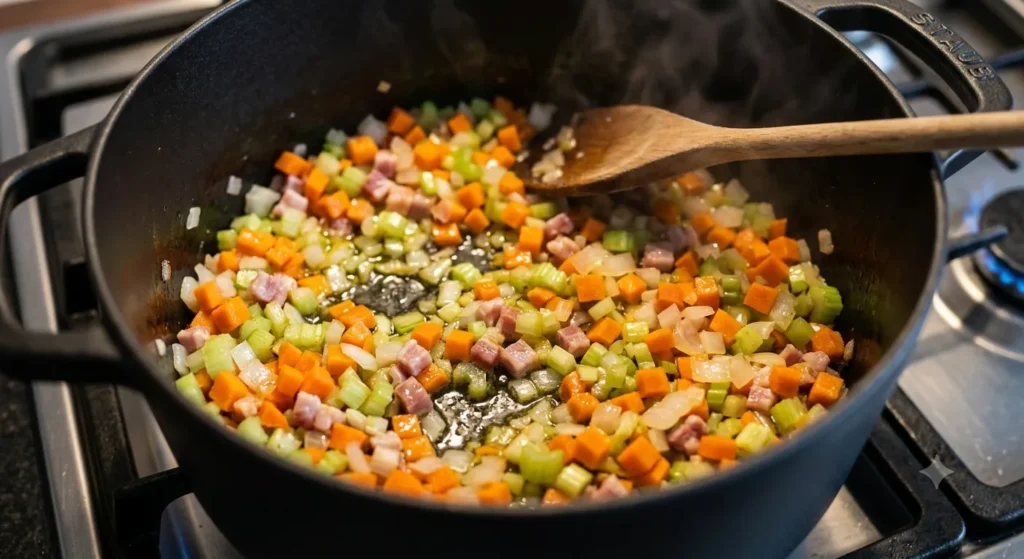
Step 3: Brown the Meat
Add the ground beef and pork to the pot, breaking it apart with a wooden spoon, and cook until deeply browned, about 8 to 10 minutes, stirring occasionally.
Step 4: Deglaze with Wine
Pour in the dry white wine, scraping up the browned bits from the bottom of the pot, and let it simmer until the sharp alcohol smell fades, about 3 to 4 minutes.
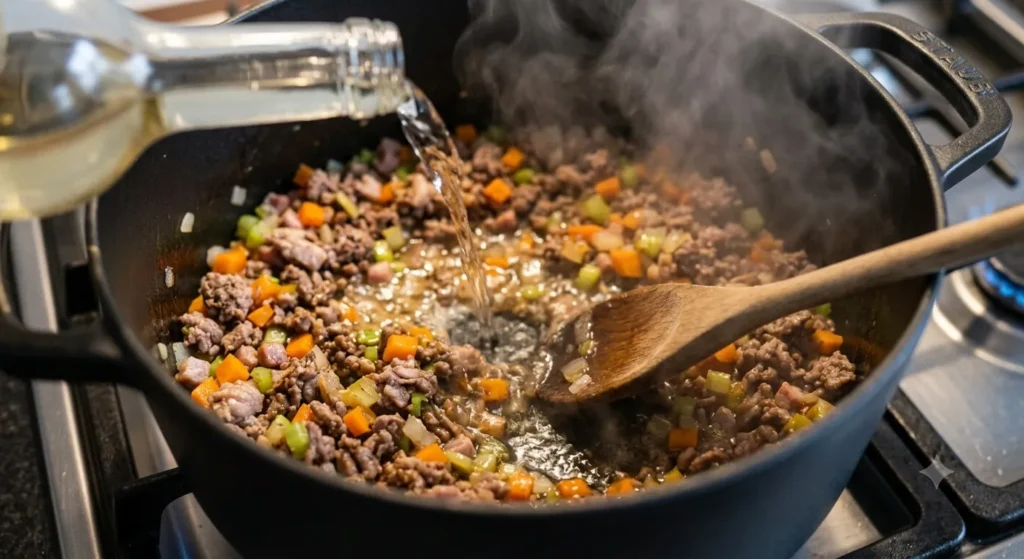
Step 5: Add Tomatoes and Milk
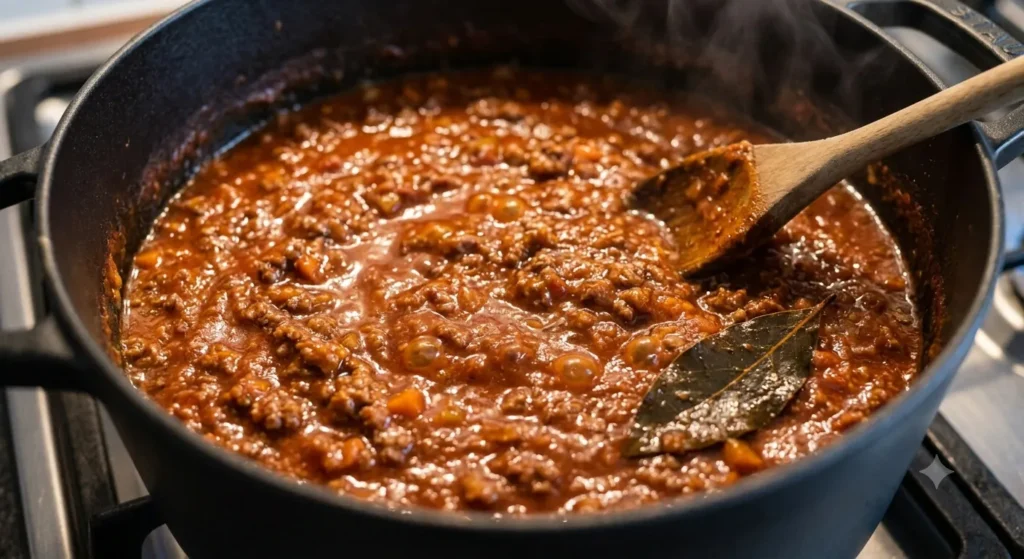
Stir in the tomato paste, crushed tomatoes, bay leaf, and a pinch of nutmeg. Once the sauce comes to a gentle simmer, add the milk gradually, stirring it in over the next stage of cooking.
Step 6: Simmer Low and Slow
Reduce the heat to low and let the sauce simmer gently, partially covered, for at least 2 hours, stirring occasionally, until it thickens and deepens in color.
Step 7: Cook the Pasta
While the sauce finishes simmering, cook the spaghetti in well-salted boiling water until just al dente. Reserve a cup of pasta water before draining.
Step 8: Combine and Serve
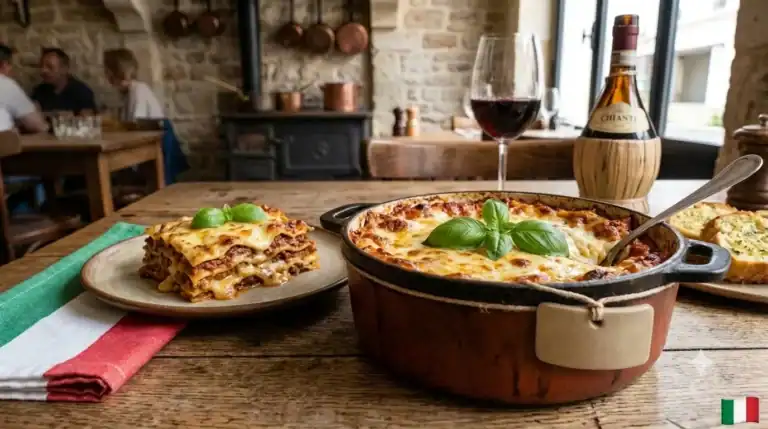
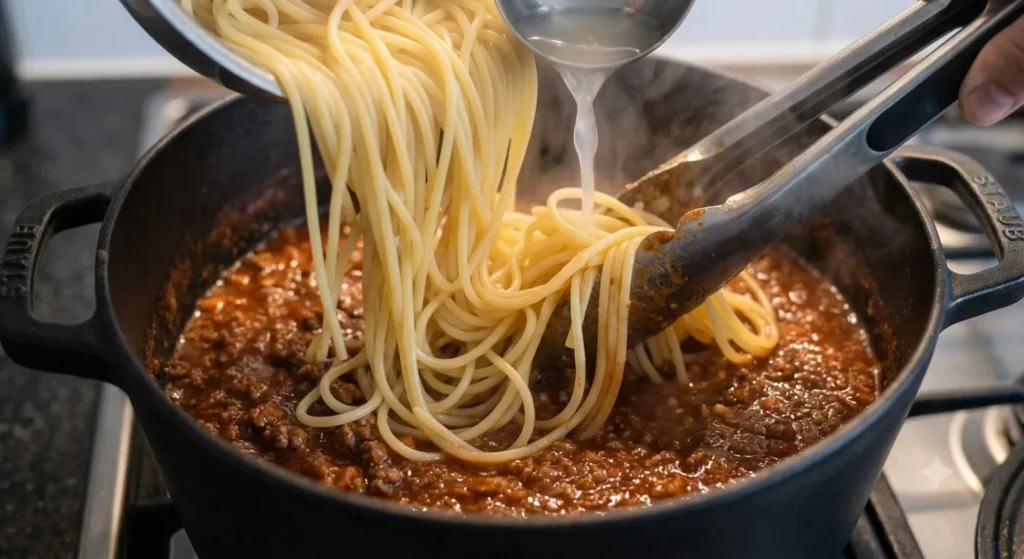
Toss the drained spaghetti directly into the sauce along with a splash of reserved pasta water, coating every strand. Serve immediately, finished with freshly grated Parmesan.
Cooking Timeline
| Time | Task |
|---|---|
| 0–10 min | Prep vegetables and pancetta |
| 10–20 min | Cook the soffritto |
| 20–30 min | Brown the meat |
| 30–34 min | Deglaze with wine |
| 34–40 min | Add tomatoes and begin adding milk |
| 40–160 min | Simmer the sauce |
| 150–160 min | Cook the pasta (overlapping) |
| 160–163 min | Combine and serve |
Best Pasta for Bolognese
| Pasta Shape | Sauce Grip | Traditional? | Best For |
|---|---|---|---|
| Tagliatelle | Excellent | Yes, the classic Bolognese pairing | Authentic Ragù alla Bolognese |
| Spaghetti | Moderate | No, but internationally beloved | Spaghetti Bolognese as searched worldwide |
| Pappardelle | Excellent | A close cousin to tagliatelle | Those wanting wide ribbons |
| Fettuccine | Very good | Similar width to tagliatelle | A widely available alternative |
| Rigatoni | Good | Not traditional | Those who prefer tube pasta |
| Penne | Moderate | Not traditional | A quick, familiar substitute |
Tagliatelle remains the traditional pairing in Bologna, since its wide ribbons hold onto a thick ragù far better than round spaghetti strands. That said, Spaghetti Bolognese has earned its own place internationally, and there’s no reason not to enjoy the sauce with whichever pasta you have on hand.
Equipment Needed
- Dutch oven or heavy-bottomed pot
- Large saucepan
- Pasta pot
- Colander
- Sharp chef’s knife
- Wooden spoon
- Cheese grater
Common Mistakes to Avoid
- Rushing the soffritto, leaving the vegetables underdeveloped and the sauce flatter overall.
- Skipping the browning step, resulting in a sauce that tastes boiled rather than deeply savory.
- Adding all the tomato at once without restraint, turning the dish into a tomato sauce with meat rather than a meat sauce with tomato.
- Skipping the milk, missing out on tenderized meat and balanced acidity.
- Cutting the simmer time short, leaving the sauce thin and underdeveloped.
- Using pre-ground, low-quality meat, which can taste flat compared to freshly ground options.
- Over-salting early, since the sauce reduces significantly and concentrates its seasoning over time.
- Skipping the deglaze, losing flavorful browned bits stuck to the pot.
- Boiling the sauce hard instead of a gentle simmer, risking a broken, greasy texture.
- Overcooking the pasta, resulting in mushy noodles that can’t hold up to a hearty sauce.
- Skipping reserved pasta water, leaving the sauce unable to cling properly to the pasta.
- Using pre-shredded cheese, which melts less smoothly than freshly grated Parmesan.
- Serving the dish immediately without resting, missing the chance for flavors to settle.
- Not skimming excess fat, leaving the finished sauce greasy rather than silky.
- Assuming Spaghetti Bolognese and Ragù alla Bolognese are identical, missing the chance to appreciate both traditions on their own terms.
Common Mistake Box
The most common shortfall home cooks run into is impatience with the simmer. Even an extra 30 minutes of low, gentle cooking noticeably deepens the sauce’s flavor and thickens its texture toward something closer to the authentic Bolognese standard.
Pro Chef Tips
- Dice the soffritto vegetables uniformly for even, consistent cooking.
- Let the pancetta render fully before adding the remaining vegetables.
- Brown the meat in batches if your pot is crowded, so it sears rather than steams.
- Use a dry wine you’d actually drink; a poor wine makes a poor sauce.
- Add milk gradually, letting it absorb into the sauce rather than dumping it all at once.
- Keep the simmer gentle, never a rolling boil, to protect the sauce’s texture.
- Stir occasionally to prevent sticking, especially as the sauce thickens.
- Skim excess fat from the surface partway through simmering.
- Taste and adjust salt again near the end, since the sauce concentrates as it reduces.
- Reserve more pasta water than you think you’ll need.
- Grate Parmesan fresh rather than using pre-shredded bags.
- Add a pinch of nutmeg for the traditional, subtle warmth in the background.
- Remove the bay leaf before serving.
- Let the sauce rest briefly off heat before combining with pasta.
- Cook pasta slightly under al dente, since it finishes briefly in the hot sauce.
- Toss pasta directly in the pot rather than plating and spooning sauce over the top.
- Double the batch and freeze half; this sauce freezes exceptionally well.
- Use fresh tagliatelle if you want the most traditional presentation.
- Warm serving bowls slightly so the sauce doesn’t cool too quickly.
- Let leftovers rest overnight; the flavor often deepens noticeably by the next day.
Delicious Variations
Traditional Ragù alla Bolognese
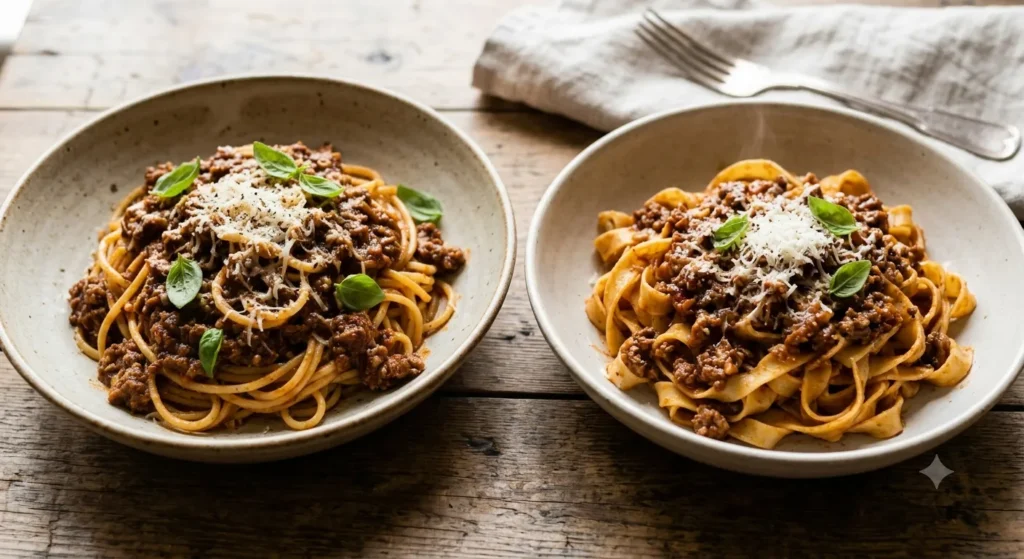
Follow the classic method exactly as registered, served over tagliatelle, for the most historically accurate version of this sauce.
Spaghetti Bolognese
Prepare the same sauce and toss it with spaghetti instead, honoring the beloved international adaptation of the dish.
White Bolognese (Ragù Bianco)
Skip the tomato entirely and build the sauce on wine, milk, and stock for a lighter, paler variation with a milder flavor.
Mushroom Bolognese
Add finely chopped mushrooms to the soffritto for an earthy, umami-rich addition to the traditional sauce.
Turkey Bolognese
Substitute ground turkey for beef and pork for a leaner version, adding a touch of olive oil to compensate for the reduced fat.
Sausage Bolognese
Replace a portion of the ground meat with crumbled Italian sausage for a spiced, more assertive flavor profile.
Slow Cooker Bolognese
Brown the meat and soffritto on the stovetop first, then transfer everything to a slow cooker on low for 6 to 8 hours for a hands-off approach.
Instant Pot Bolognese
Use the sauté function to brown the soffritto and meat, then pressure cook for about 30 minutes for a significantly faster version of the traditional slow simmer.
Gluten-Free Bolognese
Serve the sauce over a quality gluten-free pasta shape, adjusting boiling time slightly according to the package instructions.
Storage & Reheating
Let leftover sauce cool completely before transferring it to an airtight container. Refrigerate for up to 4 days, or freeze the sauce, separate from cooked pasta, for up to 3 months for the best texture once reheated.
To reheat, warm the sauce gently over low heat on the stovetop, adding a splash of water or broth to loosen it if needed. According to the USDA Food Safety and Inspection Service, leftover ground meat dishes should be reheated to an internal temperature of 165°F to ensure food safety.
Kitchen Science Box: Why Bolognese Tastes Better the Next Day
As the sauce rests overnight, fat and liquid redistribute through the meat and vegetables, allowing flavors that were still separate during cooking to fully meld, which is why many cooks consider day-two Bolognese even richer than fresh.
What to Serve with Spaghetti Bolognese
- Warm [Internal Link: Homemade Garlic Bread] for scooping up extra sauce
- Fresh [Internal Link: Homemade Focaccia] alongside the meal
- A crisp [Internal Link: Caesar Salad] to balance the richness
- An Italian chopped salad for a tangy, textured contrast
- Fresh burrata served simply with olive oil and salt
- Roasted vegetables for a lighter side dish
- [Internal Link: Classic Tiramisu] to finish the meal on a traditional note
For wine, a Chianti Classico or Sangiovese both pair naturally with the dish’s tomato and meat combination, while Barbera d’Alba and Montepulciano d’Abruzzo offer slightly softer, fruitier alternatives. For a non-alcoholic pairing, sparkling water with lemon or an Italian soda both offer a refreshing contrast to the sauce’s richness.
Frequently Asked Questions
1. Is Spaghetti Bolognese authentic Italian? Spaghetti Bolognese is inspired by authentic Italian ragù, but it developed primarily outside Italy; the traditional Bolognese version is served with tagliatelle, not spaghetti.
2. Why do Italians use tagliatelle instead of spaghetti? Tagliatelle’s wide, flat ribbons hold onto a thick, meat-forward ragù far more effectively than round spaghetti strands.
3. Can I freeze Bolognese sauce? Yes, freeze the sauce separately from cooked pasta for up to 3 months for the best texture when reheated.
4. Can I use only beef, without pork or pancetta? Yes, ground beef alone works well, though a beef and pork blend, along with pancetta in the soffritto, delivers a more traditional depth of flavor.
5. How long should Bolognese sauce simmer? Plan for at least 2 hours, though longer, gentler simmering generally produces an even richer, more developed sauce.
6. Why does the recipe include milk? Milk tenderizes the meat and helps balance the tomato’s acidity, resulting in a rounder, less sharp-tasting sauce.
7. Can I make Bolognese sauce ahead of time? Yes, the sauce actually improves after resting a day in the refrigerator, as the flavors continue to meld together.
8. Can I use red wine instead of white? Yes, some traditional versions call for either dry white or red wine; red wine will produce a slightly deeper, bolder flavor.
9. What’s the best pasta for this dish? Tagliatelle is the traditional choice in Bologna, while spaghetti remains the most internationally popular pairing.
10. Why is my sauce watery? The sauce likely didn’t simmer long enough to reduce and thicken properly, or too much liquid was added relative to the meat.
11. Is Ragù alla Bolognese the same recipe everywhere in Italy? No, while an official version has been registered with the Bologna Chamber of Commerce, home cooks across the region still maintain their own family variations.
12. What cheese works best in this recipe? Freshly grated Parmigiano Reggiano PDO offers the deepest, most traditional finish for this dish.
13. Can I double this recipe? Yes, though you’ll need a very large pot, and the simmer time may need to increase slightly to properly reduce the larger volume.
14. How long does leftover Bolognese sauce keep in the fridge? It keeps well for up to 4 days when stored in an airtight container in the refrigerator.
15. Where can I learn more about the official Bolognese recipe? The Accademia Italiana della Cucina maintains the officially registered recipe for true Ragù alla Bolognese, deposited with the Bologna Chamber of Commerce.
Recipe Card
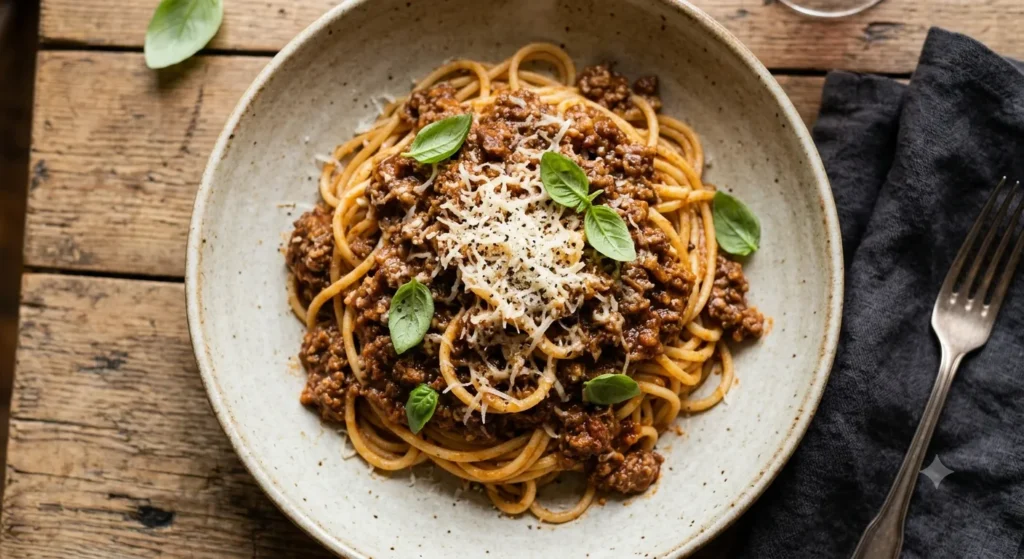
Spaghetti Bolognese
Prep Time: 20 minutes Cook Time: 2 hours 20 minutes Total Time: 2 hours 40 minutes Servings: 6 Cuisine: Italian Course: Main Course Calories (per serving, approximate): 560
Ingredients
| Ingredient | Amount |
|---|---|
| Ground beef | 1 lb |
| Ground pork | ½ lb |
| Pancetta, finely chopped | 4 oz |
| Onion, finely diced | 1 medium |
| Carrot, finely diced | 1 medium |
| Celery, finely diced | 2 stalks |
| Tomato paste | 2 tbsp |
| Crushed tomatoes | 14 oz can |
| Whole milk | 1 cup |
| Dry white wine | ½ cup |
| Olive oil | 2 tbsp |
| Butter | 1 tbsp |
| Bay leaf | 1 |
| Nutmeg | A small pinch |
| Parmesan, grated | ½ cup, plus more for serving |
| Spaghetti | 1 lb |
| Salt and pepper | To taste |
Instructions
- Dice the onion, carrot, and celery into a fine soffritto. Chop the pancetta separately.
- Render the pancetta in a Dutch oven, then add olive oil, butter, and the soffritto. Cook until softened, 8 to 10 minutes.
- Add ground beef and pork, breaking it apart, and brown thoroughly, 8 to 10 minutes.
- Deglaze with white wine, scraping the bottom, and simmer 3 to 4 minutes.
- Stir in tomato paste, crushed tomatoes, bay leaf, and nutmeg. Bring to a gentle simmer.
- Gradually stir in the milk. Reduce heat to low and simmer, partially covered, for at least 2 hours.
- Cook spaghetti until al dente. Reserve 1 cup pasta water and drain.
- Toss pasta into the sauce with a splash of pasta water. Remove bay leaf, stir in Parmesan, and serve.
Chef Notes
For the most authentic result, follow the same sauce recipe but serve it over tagliatelle instead of spaghetti; the pairing genuinely changes how the dish feels at the table.
Storage Notes
Refrigerate leftover sauce for up to 4 days or freeze for up to 3 months, separate from cooked pasta for the best texture.
Nutrition Disclaimer: Nutrition values are estimates and will vary based on exact meat blend, portion size, and ingredient substitutions used.
Conclusion
Spaghetti Bolognese earns its worldwide popularity honestly: it’s rich, comforting, and deeply satisfying, built on a foundation of patient technique rather than complicated ingredients. Understanding its roots in authentic Ragù alla Bolognese, traditionally served over tagliatelle in Bologna, only deepens your appreciation for the dish, whichever pasta ends up in your bowl. Give this Spaghetti Bolognese a try, and don’t be surprised if it becomes one of the most requested meals at your table, exactly the way it has in homes around the world for generations.