Croque Monsieur Recipe: The Classic French Ham and Cheese Sandwich
A Croque Monsieur is the classic French ham and cheese sandwich, built with Béchamel, Gruyère, and a blistered golden top.
An American grilled cheese is a fine thing. Butter, bread, cheese, a hot pan, done in five minutes. But a Croque Monsieur is what happens when that same basic idea gets sent through French culinary school. Instead of just butter and cheese, you get a rich Béchamel sauce, layers of good ham, a blanket of nutty melted Gruyère, and a few minutes under the broiler until the top turns golden and blistered. It’s still, fundamentally, a ham and cheese sandwich. It just grew up.
This is the sandwich that makes people pause mid-bite. It shows up on Parisian café menus at every hour of the day, tucked between the espresso and the wine list, and it has earned that spot for a real reason: it’s decadent without being fussy, and once you understand the two or three techniques that make it work, it’s genuinely doable on a weeknight. You’re not making a restaurant-only dish here. You’re making a sandwich with a proper French sauce, and that’s a skill worth having in your back pocket for the rest of your cooking life.
By the time you finish this post, you’ll know exactly why the bread matters as much as the cheese, how to build a Béchamel that never goes lumpy, and how one fried egg turns this into an entirely different, equally beloved dish. Let’s get into it.
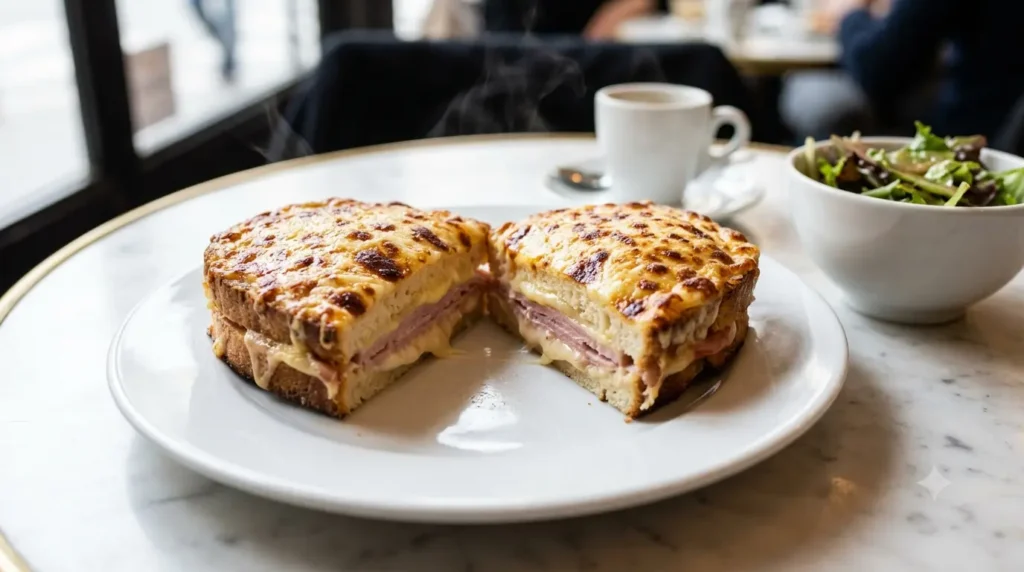
Table of Contents
What Is a Croque Monsieur, Exactly?
The name translates literally to “crunch mister,” and depending on which food historian you ask, it either refers to the crisp, golden crust the sandwich develops under heat, or it’s a slightly tongue-in-cheek nod to an old, possibly apocryphal story about a construction worker’s lunch that ended up in a Parisian café’s kitchen. Either way, the “crunch” part is honest. It’s the whole point of the dish.
The sandwich first appeared on Paris café menus in the early 1900s, most commonly credited to a café on Boulevard des Capucines around 1910, right in the middle of Paris’s booming café culture, when brasseries and bistros were becoming the social center of the city, places where people lingered over coffee, read the newspaper, and needed something more substantial than a pastry but faster than a full sit-down meal. A ham and cheese sandwich already existed, of course, but a French kitchen wasn’t going to leave it at that. The addition of a Béchamel sauce, one of French cuisine’s five mother sauces, and the decision to finish the sandwich in the oven rather than just in a pan, is what separated it from a basic grilled sandwich and gave it a permanent place in French culinary tradition.
That’s really the core distinction worth understanding: an American grilled cheese is a stovetop sandwich, browned in butter, entirely contained to the pan. A Croque Monsieur is part stovetop, part oven. The bread gets a light toast first, but the real transformation happens under the broiler, where the Béchamel and cheese on top don’t just melt, they blister, bubble, and develop that specific golden brown color you can’t get from a skillet alone. The sauce is what makes it rich and custardy inside. The broiler is what makes it dramatic on top.
Why the Béchamel Changes Everything
It’s worth sitting with this for a second, because it’s the detail that explains why this sandwich tastes so different from a regular one. A basic grilled ham and cheese relies entirely on the cheese itself for moisture and richness once it melts. A Croque Monsieur has an entire separate sauce doing that work, which means the inside stays lush and saucy even after the outside gets crisp and browned. You’re essentially building a savory custard into your sandwich. That’s not an exaggeration, it’s the actual technique.
Ingredient Deep-Dive: What You Actually Need and Why
Every component in this sandwich earns its place. Skimp on any one of them and the whole thing tips out of balance.
The Bread
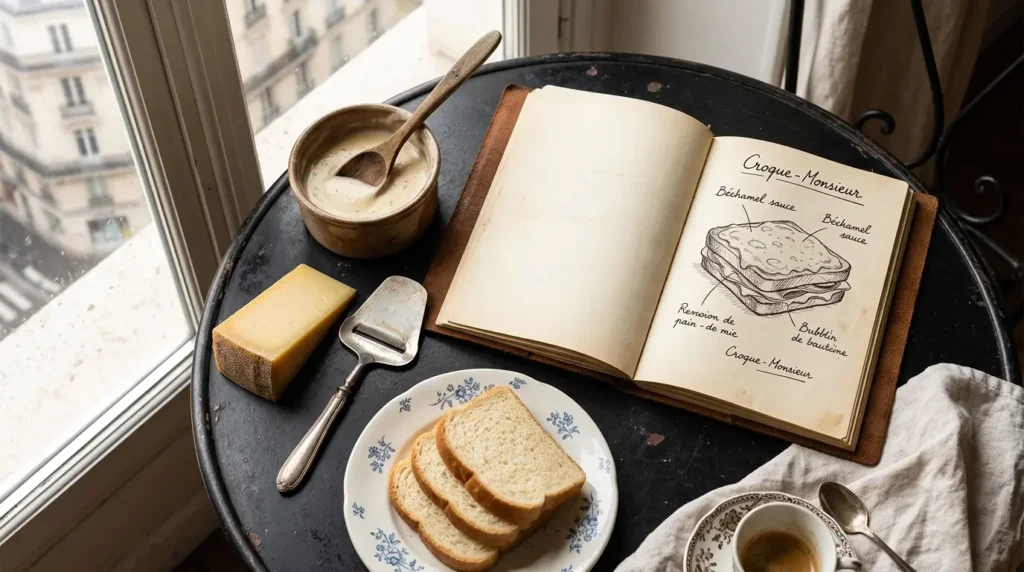
This is where a lot of home versions go wrong before they’ve even started cooking. A Croque Monsieur needs to hold a wet, warm sauce on top of it and still come out of the oven with structural integrity, which means a soft, thin sandwich bread simply isn’t built for the job. You want something sturdy, with a tight, dense crumb that won’t turn to mush the second it meets Béchamel.
Pain de mie is the traditional choice, a French sandwich loaf with a fine, tight crumb and a soft but sturdy structure, close in spirit to American Pullman bread. If you can find it, use it. Brioche is a close second, and its slight sweetness and rich, buttery crumb actually plays beautifully against the savory ham and nutty cheese, though it’s a touch more delicate, so cut it a little thicker to compensate. A tight-crumb sourdough, sliced from a boule rather than a pre-sliced loaf, is a very solid substitute if the first two aren’t available at your grocery store, since its dense structure holds up well under sauce. Whatever you choose, slice it thick, about three-quarters of an inch, and avoid anything airy or full of large holes, since those will just soak the Béchamel straight through and leave you with a soggy center instead of distinct, saucy layers.
The Cheese
Gruyère is the traditional star here, an aged Swiss cheese with a firm texture, a deep, slightly nutty and faintly sweet flavor, and genuinely excellent melting properties, meaning it goes smooth and stretchy rather than greasy or separated when heated. Comté, a French cheese made from the same base milk tradition as Gruyère, brings a similar profile with a bit more complexity and a slightly fruitier note, and it’s a fantastic substitute or blend partner if you can find it. Emmental, the cheese most people actually picture when they think “Swiss cheese,” those characteristic big holes, is milder and a little more elastic when melted, and it’s traditionally used alongside Gruyère in some regional versions rather than on its own.
If your grocery store’s cheese selection is limited, a good quality Swiss cheese from the deli counter, not the pre-sliced plastic-wrapped kind, is your best accessible substitute, and it melts reasonably close to Gruyère. Fontina is another strong option, it melts exceptionally well and has a mild, buttery flavor that won’t clash with anything else in the sandwich. Whatever you choose, grate it yourself rather than buying pre-shredded cheese. Pre-shredded cheese is coated in anti-caking agents like cellulose that measurably hurt how smoothly it melts, and for a dish where a smooth, blistered cheese top is the entire visual and textural payoff, that matters.
The Ham
You want a ham with real flavor and a firm enough texture to hold its shape between the layers, not something wet, overly salty, or shredded thin as paper. Jambon de Paris, a French-style, delicately cured and cooked ham, is the traditional choice, and it’s increasingly available at specialty grocery stores and better deli counters in the US. If you can’t find it, a good quality, thin-sliced deli ham with a bit of smoke to it works very well as a substitute, black forest ham in particular has enough character to hold its own against the Béchamel and cheese. Avoid anything overly processed or watery, since a weak ham will get lost entirely once the sauce and cheese are involved, and you’ll end up tasting mostly dairy instead of a balanced sandwich.
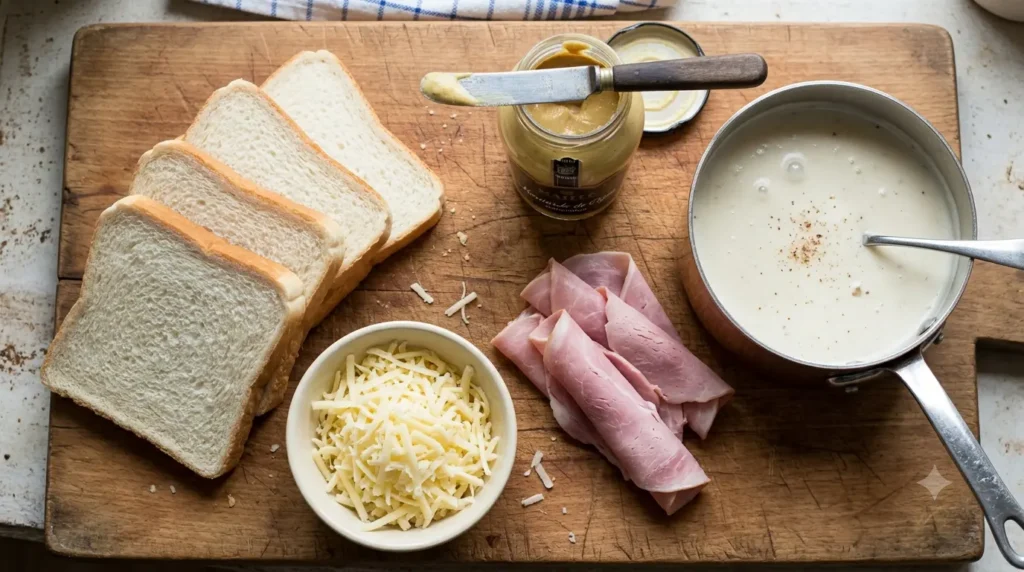
Béchamel is one of the five French mother sauces, meaning it’s a foundational sauce that other sauces branch off from, and once you understand how to make it, you’ve unlocked a technique that shows up across French cooking, from lasagna to gratins to soufflés. It’s simpler than it sounds, but the details matter.
Building the Roux
A roux is just equal parts fat and flour, cooked together, and it’s the thickening base for the whole sauce. Melt butter in a saucepan over medium heat, then whisk in an equal weight of all-purpose flour. You’re not looking for color here, unlike a roux for gumbo or a dark sauce, a Béchamel roux should only cook for a minute or two, just long enough to lose its raw, pasty flour taste, while staying pale and blond. Cooking it too long will darken it and actually reduce its thickening power, since the starch molecules that do the thickening work start breaking down at higher, longer heat exposure.
Incorporating the Milk Without Lumps
This is the step that intimidates people, and it’s genuinely simple once you understand the logic behind it. Lumps happen when cold milk hits a roux and the starch granules on the outside of each lump seize and gelatinize instantly, sealing in dry flour before it has a chance to hydrate evenly. The fix is straightforward: warm your milk first, either in the microwave or in a separate small pot, so there’s no dramatic temperature shock when it meets the roux. Then add it gradually, in small splashes, whisking constantly and making sure each addition is fully incorporated and smooth before you add the next. Once about a third of the milk is in and the mixture is smooth, you can add the rest in a slightly faster, steady stream, still whisking. Bring it to a gentle simmer, whisking occasionally, and let it cook for 5 to 8 minutes, until it coats the back of a spoon and no longer tastes like raw flour.
Turning It Into a Mornay Sauce
A few key additions transform a basic Béchamel into something specifically built for this sandwich. Dijon mustard, whisked in off the heat, adds a sharp, tangy backbone that keeps the whole sauce from tasting flat or one-dimensional against the richness of the cheese. A pinch of freshly grated nutmeg is a classic, traditional addition to Béchamel specifically, its warm, slightly sweet aromatic quality rounds out dairy-based sauces in a way that’s subtle but genuinely noticeable if you leave it out. Finally, stirring in a handful of grated Gruyère until fully melted turns your Béchamel into a Mornay sauce, technically its own named sauce in French cooking, and it’s this cheese-enriched version that gives the sandwich its full flavor rather than a plain white sauce that would taste comparatively bland.
Step-by-Step Assembly
Here’s where everything comes together. This part moves quickly once your Béchamel is made and your ingredients are prepped.
Toast the bread lightly first. A quick pass in a dry skillet or under the broiler for about a minute per side, just until it’s lightly golden, not fully toasted. This does two things: it gives the bread a head start on structure so it holds up better against the sauce, and it prevents the finished sandwich from tasting doughy or raw in the center once it comes out of the oven.
Spread a thin layer of Dijon mustard on the inside of both bread slices. Just a light, even layer, this is a base flavor note, not the star.
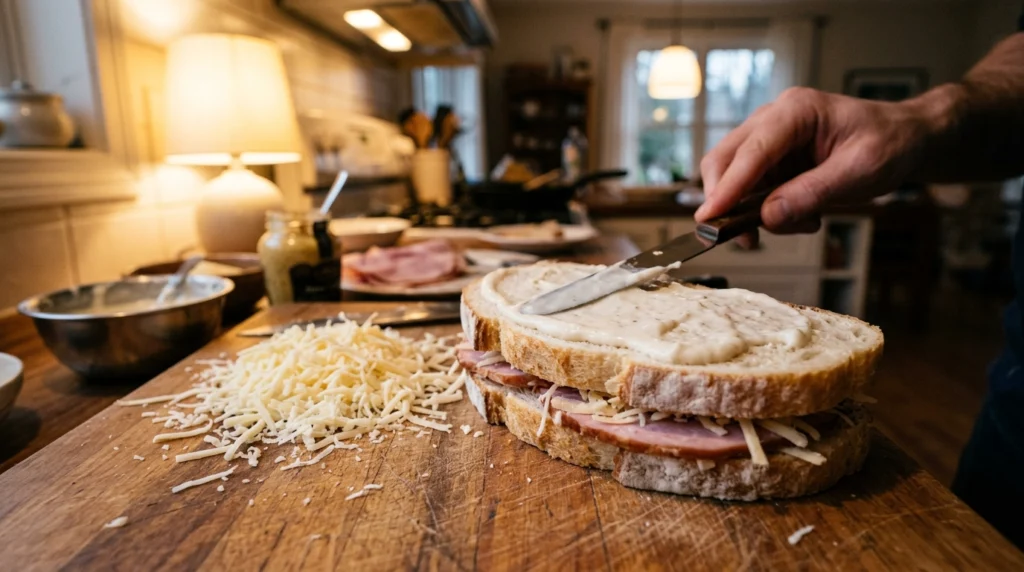
Add a thin layer of Béchamel to the inside of the bottom slice. Enough to lightly coat it, not so much that it pools and makes the bread soggy before it even goes in the oven.
Layer the ham. Fold the slices rather than laying them flat, folding creates little pockets and a bit of height, which gives the finished sandwich a better bite than flat, compressed ham.
Add a layer of grated Gruyère over the ham. This is your interior cheese layer, separate from the cheese that goes on top later.
Cap the sandwich with the second slice of bread, mustard side down.
Spread Béchamel generously over the entire top of the sandwich, all the way to the edges. This is different from a typical grilled cheese, you’re essentially frosting the top of this sandwich with sauce, and it’s what creates that signature golden, bubbling crust.
Top with a generous layer of grated Gruyère, covering the Béchamel completely.
Broil until deeply golden and blistered, watching closely, this usually takes 3 to 5 minutes depending on your broiler’s intensity. You’re looking for real color, deep gold with some darker, blistered spots, not just melted cheese.
The Croque Madame Variation
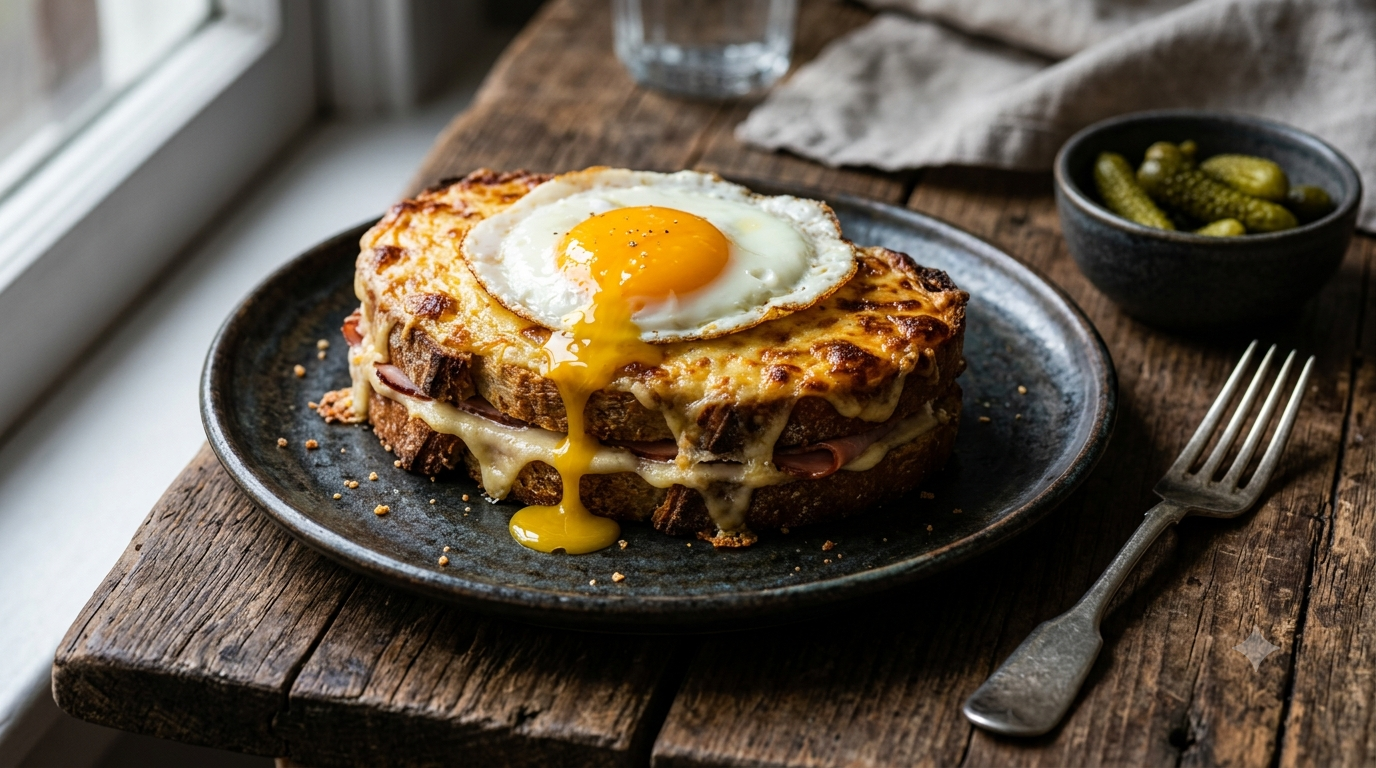
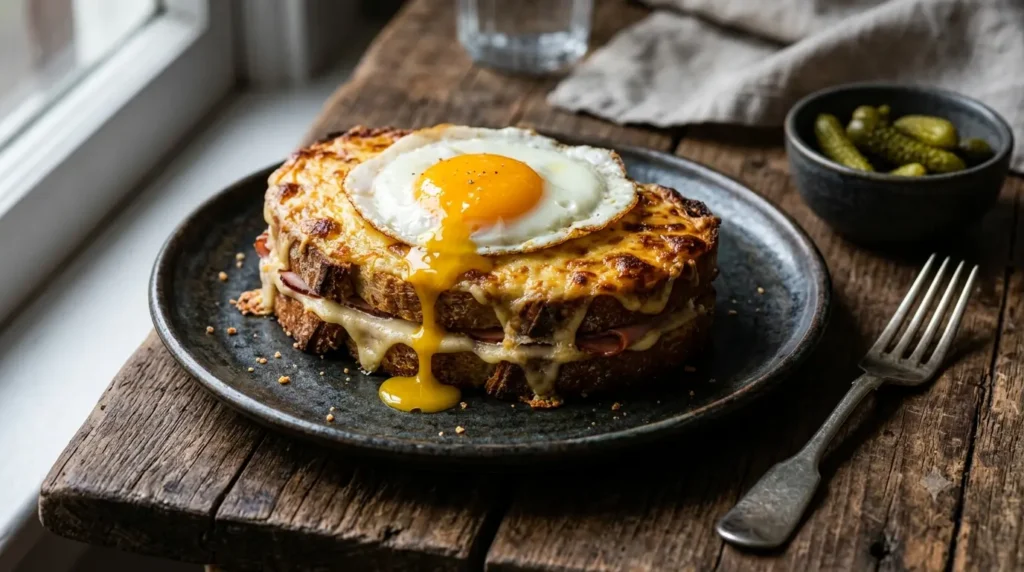
If you’ve made it this far, you already have everything you need to make a Croque Madame, and it’s worth understanding this variation specifically because it’s one of the most commonly searched terms connected to this dish. A Croque Madame is exactly the same sandwich, built exactly the same way, with one addition: a sunny-side-up fried egg placed directly on top right before serving.
The story behind the name is playful, French culinary tradition suggests the fried egg on top vaguely resembles a hat, and the sandwich topped that way reminded people of a woman’s hat of the era, hence “Madame” instead of “Monsieur.” Whether or not that story is entirely accurate, the name has stuck for over a century.
Practically speaking, fry your egg separately in a small pan with a little butter, keeping the yolk runny, while your Croque Monsieur finishes under the broiler. Slide the egg on top the moment the sandwich comes out of the oven. When you cut into it, that runny yolk breaks and mixes into the Béchamel, adding an extra layer of richness that makes the whole dish feel even more like a proper knife-and-fork meal rather than a sandwich you’d eat standing up. If you’re deciding between the two versions for a weekend brunch specifically, the Croque Madame is almost always the better call, since brunch practically expects an egg somewhere on the plate.
Pro Tips and Troubleshooting
How do I keep the bottom of the sandwich from getting soggy? This comes down to two things: not overloading the interior Béchamel layer, and giving the bread that initial light toast before assembly. A thin, even layer of sauce on the inside is plenty, since the bread is also absorbing moisture from the ham and the top layer of sauce as it bakes. If you’re prone to heavy-handed saucing, err on the side of less on the inside and more on the top, where the broiler will help set and crisp it rather than let it soak in.
My Béchamel turned out lumpy, can I fix it? Yes, in most cases. If you catch it early, a vigorous whisk, really working the whisk hard against the bottom and sides of the pan, can smooth out mild lumps by breaking them apart mechanically. For a more stubborn batch, pour the sauce through a fine mesh strainer, pressing it through with the back of a spoon, which will catch any remaining lumps and leave you with a smooth sauce. Going forward, the fix is prevention: warm milk, added gradually, with constant whisking, is what avoids the problem in the first place.
My Béchamel is too thick or too thin. Too thick, usually because it cooked a bit too long or the roux-to-milk ratio was slightly off, is easily fixed by whisking in a splash of warm milk until it loosens back to a smooth, pourable-but-not-runny consistency. Too thin generally means it needs more time on the heat, let it simmer a few minutes longer, whisking occasionally, and it will continue to thicken as more moisture cooks off.
How do I get that perfect golden, blistered cheese top without burning it? Position your oven rack in the upper third of the oven, not directly against the broiler element, and keep the oven door slightly ajar if your broiler runs especially hot, this gives you a bit more control and prevents the very top layer of cheese from scorching before the layers underneath have had a chance to properly melt and bubble. Watch it closely rather than setting a timer and walking away, broilers vary enormously between ovens, and cheese can go from perfectly golden to burnt in under a minute.
My cheese slid off before it could set. This usually means the Béchamel layer underneath wasn’t tacky enough to hold the cheese in place. Make sure your top layer of Béchamel isn’t piping hot when you add the cheese, slightly cooled sauce has a bit more grip, and press the grated cheese down gently so it makes good contact with the sauce beneath it before it goes under the broiler.
Perfect Sides and Pairings
Because this sandwich is rich, dense with dairy, butter, and cheese, the best pairings lean bright and acidic to cut through all that weight rather than add to it.
A simple green salad with a sharp French vinaigrette is the classic pairing for good reason, something like mixed greens with a Dijon vinaigrette made with red wine vinegar echoes the mustard already in the sandwich while giving you something crisp and acidic to balance every rich bite.
Cornichons, those small, tart French pickles, are a traditional accompaniment served right alongside the sandwich on the plate. Their sharp acidity works the same way a good pickle works next to a burger, cutting through richness and resetting your palate between bites.
A crisp, dry white wine, something like a Sancerre or a dry Alsatian Riesling, makes an excellent pairing if you’re serving this for a weekend lunch or light dinner. The wine’s acidity performs the same balancing function as the salad and cornichons, just in liquid form.
A light tomato soup is a less traditional but genuinely well matched pairing, especially in colder months, its acidity and lighter body complement the sandwich the same way tomato soup famously complements a grilled cheese, just with more sophistication on both sides of the pairing.
Frequently Asked Questions
Can I make a Croque Monsieur ahead of time? You can prep components ahead, which makes this a realistic option for entertaining. Make the Béchamel up to two days in advance and store it covered in the refrigerator, pressing plastic wrap directly onto the surface to prevent a skin from forming. You can also fully assemble the sandwiches, minus the final broiling step, and refrigerate them, covered, for a few hours before your event. When you’re ready to serve, broil straight from the fridge, just add an extra minute or two to account for the colder starting temperature.
What’s the actual difference between a Croque Monsieur and a grilled cheese? Beyond the addition of ham, the defining difference is the Béchamel sauce and the oven-broiling technique. A grilled cheese is browned entirely in a pan and relies on melted cheese alone for its richness. A Croque Monsieur incorporates a separate French mother sauce, thickened with a roux and often enriched further into a Mornay sauce with cheese folded in, and finishes under a broiler rather than in a skillet, which produces a completely different texture, a custardy, saucy interior alongside a blistered, deeply browned top that a stovetop method simply can’t replicate.
Is a Croque Monsieur supposed to be served with a fork and knife, or as a handheld sandwich? In French cafés, it’s typically served as a knife-and-fork dish, largely because the Béchamel makes it too rich and saucy to comfortably eat by hand without losing half the filling. Don’t feel obligated to eat it standing at the counter the way you might a regular sandwich, this one’s meant to be sat down with.
Can I freeze a Croque Monsieur? It’s possible, though the texture takes a noticeable hit, since Béchamel, like most cream and dairy-based sauces, can turn slightly grainy after freezing and thawing. If you want to freeze a batch, assemble the sandwiches fully, minus the final broiling step, wrap them individually and tightly in plastic wrap followed by foil, and freeze for up to a month. Thaw overnight in the refrigerator before broiling straight through, rather than trying to broil from frozen, which will scorch the top before the center properly heats.
Can I make this recipe gluten-free? Yes, with two adjustments. Use a good quality gluten-free sandwich bread with a tight, sturdy crumb, since a crumbly gluten-free loaf will struggle to hold the sauce the way a traditional loaf does. For the Béchamel, substitute a 1:1 gluten-free flour blend for the all-purpose flour in the roux, the technique and ratios stay exactly the same, gluten-free blends generally thicken a Béchamel just as effectively as wheat flour does.
The Recipe Card
Classic Croque Monsieur A French ham and cheese sandwich layered with Béchamel, folded ham, and Gruyère, then broiled until golden and blistered.
Prep Time: 20 minutes Cook Time: 20 minutes Total Time: 40 minutes Yield: 4 sandwiches
Ingredients
For the Béchamel sauce:
- 3 tablespoons unsalted butter
- 3 tablespoons all-purpose flour
- 1 1/2 cups whole milk, warmed
- 1 tablespoon Dijon mustard
- 1/4 teaspoon freshly grated nutmeg
- 1/2 cup Gruyère cheese, grated
- Salt and white pepper, to taste
For the sandwiches:
- 8 thick slices pain de mie, brioche, or tight-crumb sourdough
- 2 tablespoons Dijon mustard, for spreading
- 8 to 12 slices jambon de Paris or smoky deli ham
- 1 1/2 cups Gruyère cheese, grated, divided
- Optional: 4 large eggs, for Croque Madame
Instructions
- Make the Béchamel. Melt the butter in a saucepan over medium heat. Whisk in the flour and cook for 1 to 2 minutes, until pale and no longer smelling of raw flour. Gradually whisk in the warmed milk, a splash at a time, making sure each addition is smooth before adding more. Once about a third of the milk is incorporated, add the rest in a steady stream, still whisking.
- Bring to a gentle simmer and cook, whisking occasionally, for 5 to 8 minutes, until thickened enough to coat the back of a spoon. Remove from heat and whisk in the Dijon mustard, nutmeg, and 1/2 cup Gruyère until melted and smooth. Season with salt and white pepper. Set aside.
- Toast the bread. Lightly toast the bread slices in a dry skillet or under the broiler for about 1 minute per side, until just golden, not fully browned.
- Assemble. Spread a thin layer of Dijon mustard on one side of each slice of bread. On four slices, spread a thin layer of Béchamel over the mustard, then layer the folded ham and a portion of the remaining grated Gruyère. Top with the remaining bread slices, mustard side down.
- Top and broil. Preheat the broiler and position a rack in the upper third of the oven. Spread the remaining Béchamel generously over the top of each sandwich, all the way to the edges. Sprinkle the remaining Gruyère evenly over the top. Broil for 3 to 5 minutes, watching closely, until deeply golden and blistered.
- For Croque Madame: While the sandwiches broil, fry the eggs sunny-side up in a separate pan with a little butter, keeping the yolks runny. Place one egg on top of each sandwich immediately after broiling.
- Serve hot, with a green salad and cornichons on the side.
Notes: Béchamel can be made up to 2 days ahead and refrigerated with plastic wrap pressed directly onto its surface. Assembled, unbroiled sandwiches can be refrigerated for a few hours before baking; add an extra minute or two under the broiler if starting cold.