

One Pot Greek Chicken and Lemon Rice – The Best Chicken and Rice You’ll Ever Make
If you want juicy, golden chicken and fluffy lemon-scented rice without a sink full of dishes, One Pot Greek Chicken and Lemon Rice is the dinner you’ve been missing. Everything cooks in a single pan: the chicken renders its fat, the rice toasts in that fat, and a splash of lemon and broth ties it all together into something that tastes like it simmered all day in a Greek taverna kitchen.
This isn’t a shortcut version of a good recipe. It’s built the way a Greek cook actually builds flavor — searing first, layering aromatics, and letting the rice do its job of soaking up everything good left in the pot. By the end, you’ll understand not just how to make One Pot Greek Chicken and Lemon Rice, but why each step matters, so you can repeat these results every single time.
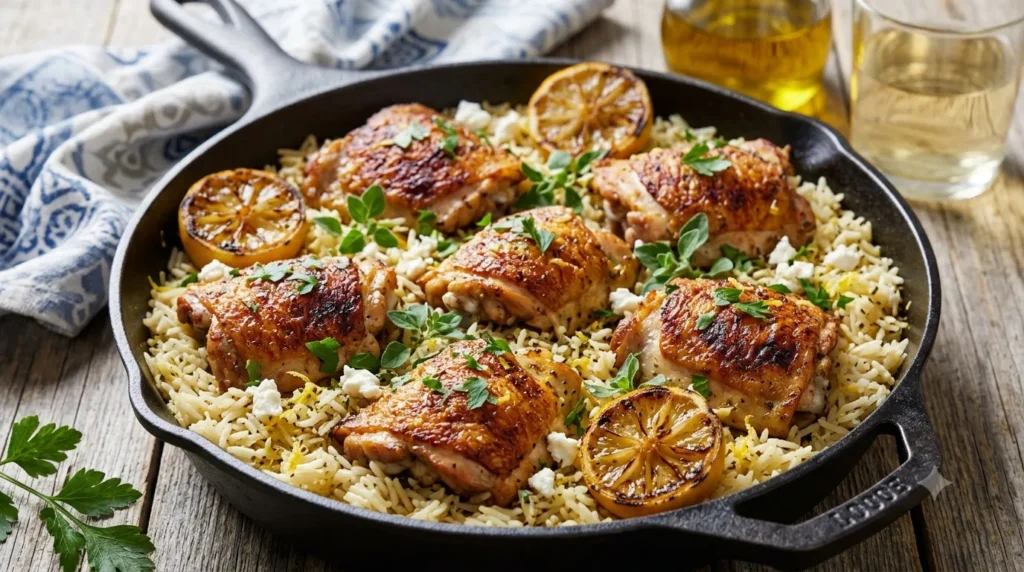
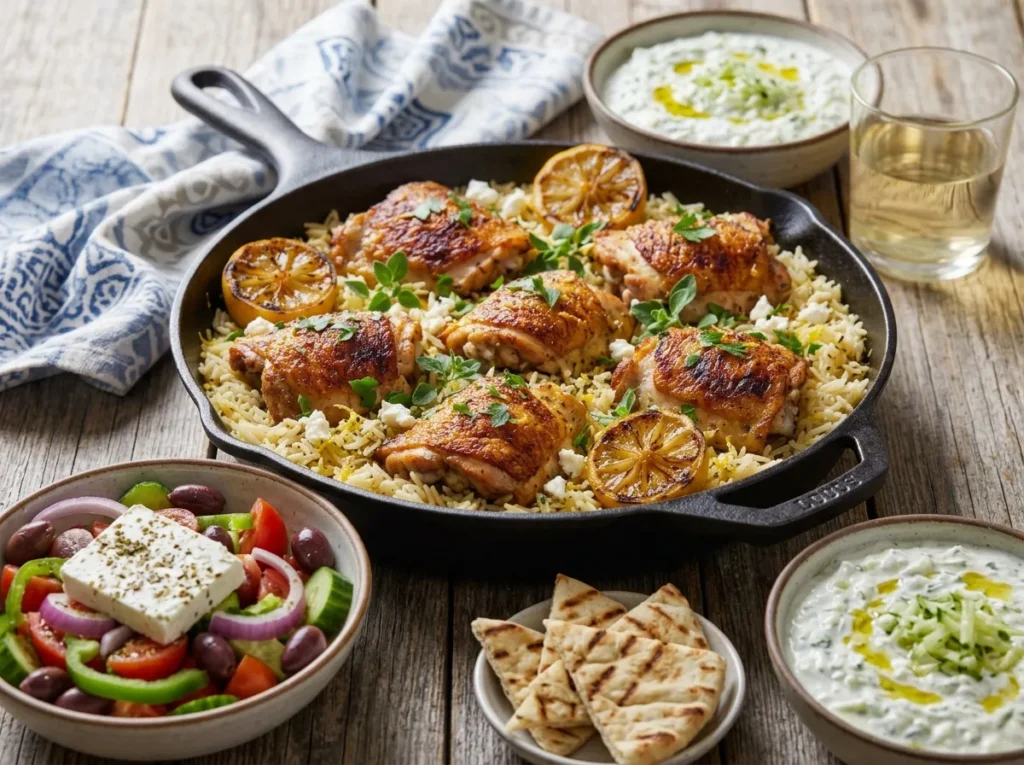
[Image Placeholder – 16:9 Hero Image: Crispy golden Greek chicken thighs resting over fluffy lemon rice in a rustic cast-iron skillet, garnished with fresh parsley, oregano, grilled lemon halves, and crumbled feta on a traditional Mediterranean wooden table.]
- ALT text: One Pot Greek Chicken and Lemon Rice in a cast-iron skillet with lemon and parsley
- SEO filename: one-pot-greek-chicken-lemon-rice-hero.jpg
Table of Contents
- What Is One Pot Greek Chicken and Lemon Rice?
- The Story Behind Greek Lemon Chicken
- Why You’ll Love This Recipe
- The Science Behind Perfect Chicken and Rice
- Choosing the Best Chicken
- Ingredients Explained
- Step-by-Step Cooking Guide
- Equipment Needed
- Common Mistakes
- Pro Greek Chef Tips
- Delicious Variations
- Storage and Reheating
- What to Serve With Greek Chicken and Lemon Rice
- Frequently Asked Questions
- Recipe Card
- Conclusion
What Is One Pot Greek Chicken and Lemon Rice?
One Pot Greek Chicken and Lemon Rice is a skillet dinner built around three pillars of Greek cooking: good olive oil, plenty of lemon, and rice or potatoes cooked in broth until they’ve absorbed every bit of flavor around them. Bone-in chicken thighs are seared until the skin turns deep gold, then rice is toasted right in the same pan before broth, lemon juice, garlic, and oregano go in to simmer everything together.
The “one pot” part isn’t just about convenience, though that’s a real benefit for busy weeknights. It’s also a technique. The rice cooks directly in chicken fat and pan drippings, which means it picks up flavor that plain boiled rice never could. Mediterranean cooking has long relied on this kind of layered, one-vessel cooking, where a single pot builds depth in stages rather than combining pre-cooked components at the end.
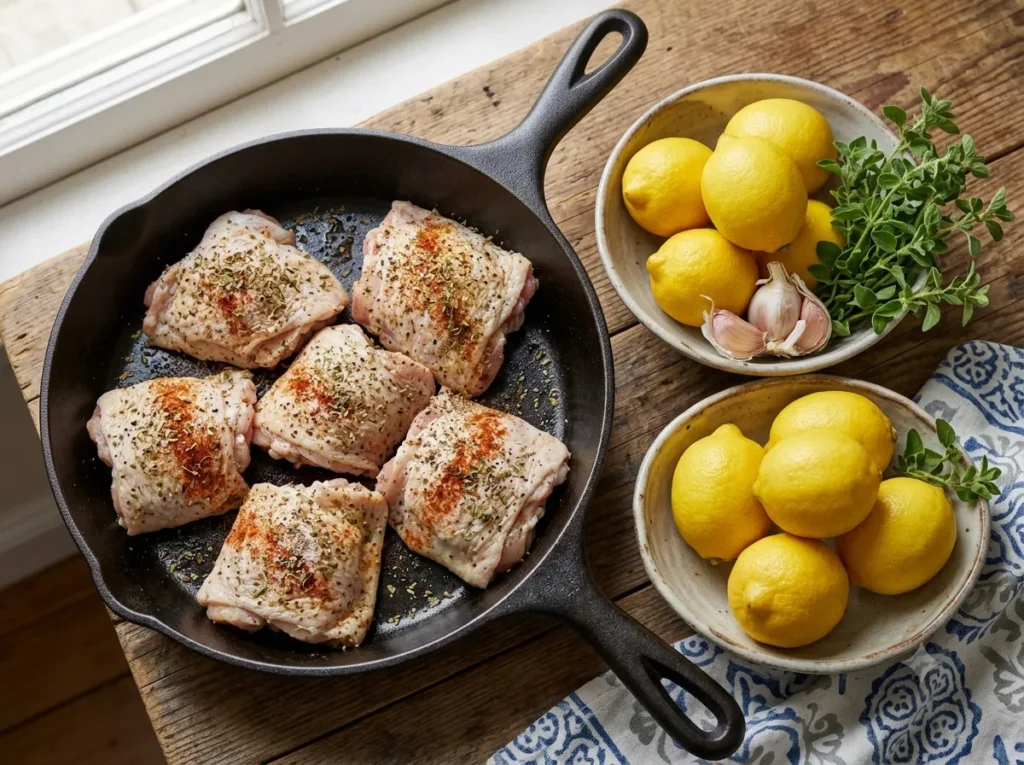
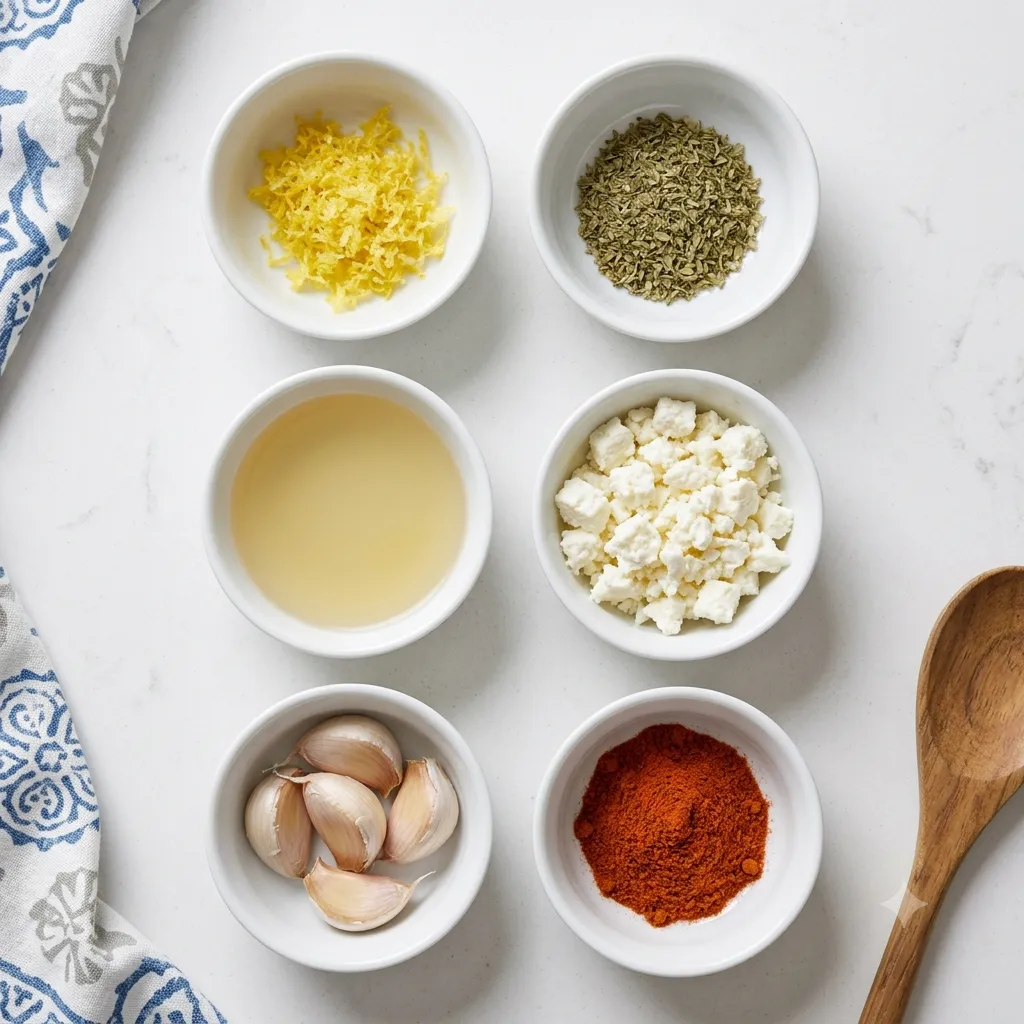
[Image Placeholder – 4:3 Image: Overhead shot of a skillet showing raw chicken thighs seasoned with oregano and paprika next to a small bowl of lemons and garlic cloves, styled for a rustic Mediterranean kitchen counter.]
- ALT text: Ingredients for Greek chicken and lemon rice including lemons, garlic, and oregano
- SEO filename: greek-chicken-lemon-rice-ingredients.jpg
The Story Behind Greek Lemon Chicken
Lemon holds a central place in Greek cooking. Along the coasts and islands, lemon trees grow abundantly, and Greek cooks have long used fresh lemon juice to brighten roasted meats, soups, and sauces. The classic avgolemono sauce — egg and lemon whisked into broth — shows just how much Greek cuisine leans on lemon’s acidity to balance rich, savory dishes.
Olive oil is the other constant. It’s used generously, both to cook with and to finish dishes, and it carries flavor in a way that other fats don’t. Oregano, especially the wild variety grown on Greek hillsides, is used dried far more often than fresh, since drying concentrates its aromatic oils. Garlic is used with a light hand in many traditional dishes, added early so it mellows rather than dominates.
Rice appears throughout Greek cooking too, from stuffed vegetables like gemista to pilafs served alongside roasted meats. Traditional Greek lemon rice is often a side dish cooked separately from the meat. What we’re doing here is a modern one-pot adaptation: taking those same core flavors — lemon, olive oil, garlic, oregano — and combining the chicken and rice into a single skillet for a faster, weeknight-friendly version. It’s inspired by tradition, not a direct copy of any one regional dish, and it’s worth being upfront about that distinction.
Why You’ll Love This Recipe
- One pan, less cleanup. Everything from searing to simmering happens in the same skillet.
- Juicy chicken every time. Bone-in, skin-on thighs are nearly impossible to overcook.
- Fluffy, flavorful rice. No bland side dish here — the rice does double duty as the sauce.
- Bright, balanced lemon flavor. Acidity cuts through the richness of the chicken fat.
- Family friendly. Mild seasoning that kids tend to enjoy, with lemon and herbs adults love.
- Meal prep friendly. Reheats well and holds its texture for a few days.
- Budget friendly. Chicken thighs, rice, and pantry staples keep the cost low per serving.
The Science Behind Perfect Chicken and Rice
Understanding the why behind each step is what separates a good cook from someone just following a list of instructions.
Why chicken thighs stay juicy. Thighs have more intramuscular fat and connective tissue than breasts, and that fat bastes the meat from the inside as it cooks. This gives you a wider window of “done” before the meat dries out, which is exactly why thighs are so forgiving for beginners.
Why searing matters — the Maillard reaction. When chicken skin hits a hot, oiled pan, proteins and sugars on the surface rearrange and brown, creating dozens of new flavor compounds. This is the Maillard reaction, and it’s responsible for the deep, savory taste of seared meat that boiling or steaming can never produce.
Why rice absorbs broth so well. Rice grains are largely starch. As they heat in liquid, the starch granules absorb water and swell, a process called gelatinization. Toasting the rice briefly in fat before adding broth coats the grains, slowing water absorption just enough that they cook evenly instead of turning mushy on the outside before the centers are done.
Why resting matters. Chicken continues cooking briefly after it leaves the heat, and resting lets juices that were pushed toward the center during cooking redistribute throughout the meat. Cut into it too early and those juices spill onto the cutting board instead of staying in the meat.
Why lemon acidity works here. Acid brightens rich, fatty dishes by cutting through the fat’s coating effect on your tongue, making every other flavor easier to taste. Added at the end rather than the beginning, lemon juice keeps its sharp, fresh character instead of mellowing out over a long simmer.
Why fresh herbs finish the dish. Fresh parsley and oregano contain volatile aromatic oils that break down with sustained heat. Adding them at the very end preserves their brightness, while the dried oregano cooked in earlier builds a deeper, more savory herbal base.
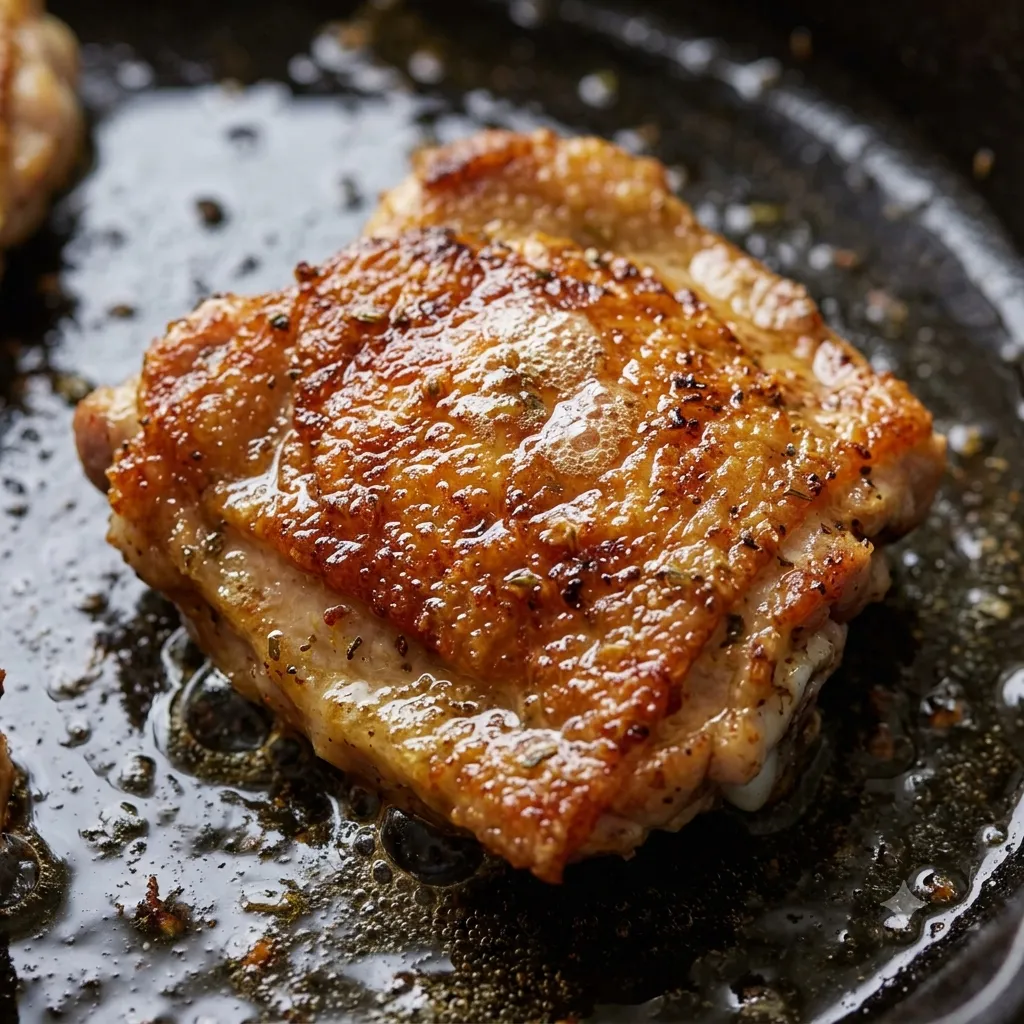
[Image Placeholder – 1:1 Image: Close-up macro shot of chicken thighs searing in a skillet with visible golden-brown crispy skin and bubbling olive oil.]
- ALT text: Searing chicken thighs for crispy skin in Greek chicken and rice recipe
- SEO filename: searing-chicken-thighs-greek-recipe.jpg
Choosing the Best Chicken
| Cut | Flavor | Moisture | Cook Time | Best For Beginners |
|---|---|---|---|---|
| Bone-in, skin-on thighs | Richest, deepest flavor | Very high | ~35–40 min | Yes — most forgiving |
| Boneless, skinless thighs | Good flavor, less crisp texture | High | ~20–25 min | Yes — faster option |
| Chicken breasts | Milder | Lower, easy to overcook | ~20–25 min | Moderate — needs a thermometer |
| Drumsticks | Rich, more skin-to-meat ratio | High | ~35–40 min | Yes, but longer to eat around bone |
| Whole legs | Very rich | Very high | ~40–45 min | Moderate — larger pieces, uneven fit in pan |
Bone-in, skin-on thighs are the best choice for this recipe. The bone insulates the meat and slows cooking just enough to prevent drying out, while the skin crisps beautifully and renders fat that flavors the rice. If you prefer a leaner option, boneless thighs work well and cook faster, though you’ll lose some of that rendered fat flavor. Chicken breasts can work in a pinch, but they need close attention since they overcook quickly in a one-pot simmer.
Ingredients Explained
- Chicken (bone-in, skin-on thighs): The backbone of the dish — provides flavor, fat, and juiciness.
- Olive oil: Used for searing and as a flavor carrier; a good extra-virgin olive oil adds fruity depth.
- Garlic: Adds savory depth; added after the onion so it doesn’t scorch.
- Yellow onion: Builds a sweet, savory base as it softens in the chicken fat.
- Chicken broth: The cooking liquid for the rice; use low-sodium so you can control the final saltiness.
- Long-grain rice: Holds its shape and stays fluffy rather than turning gluey.
- Fresh lemon juice: The dish’s signature brightness, added toward the end to preserve its acidity.
- Lemon zest: Adds concentrated lemon aroma without extra liquid or sourness.
- Fresh oregano: Adds a bright, herbal top note when added near the end.
- Dried oregano: Adds a deeper, earthier oregano flavor when cooked into the dish early.
- Fresh parsley: A fresh, slightly peppery garnish that lightens the finished dish.
- Butter (optional): Stirred in at the end for a rounder, silkier finish.
- Salt: Essential for seasoning both the chicken and the rice separately.
- Black pepper: Adds mild heat and rounds out the seasoning.
- Paprika: Adds color and a subtle sweetness to the seared chicken skin.
Step-by-Step Cooking Guide
1. Prepare the chicken. Pat the thighs completely dry with paper towels. Dry skin is essential — any surface moisture will steam instead of sear, and you’ll lose that crispy texture.
2. Season generously. Season both sides with salt, pepper, and paprika. Don’t be shy — this is your only chance to season the meat itself before it joins the rice.
3. Sear skin-side down. Place the chicken skin-side down in a hot, oiled skillet and don’t move it. Let it sear undisturbed for 6–8 minutes until the skin releases easily from the pan and looks deep golden brown. If it sticks, it’s not ready yet.
4. Flip and sear briefly. Flip and sear the other side for 3–4 minutes, then remove the chicken to a plate. It won’t be fully cooked yet — that happens later in the broth.
5. Cook the onion. In the same pan, using the rendered fat, cook the diced onion until soft and translucent, about 4–5 minutes.
6. Add the garlic. Stir in the garlic and cook for just 30–60 seconds, until fragrant. Garlic burns quickly, so keep it moving.
7. Toast the rice. Add the rice directly to the pan and stir for 1–2 minutes until the grains look slightly translucent at the edges. This coats each grain in fat, which helps it cook evenly later.
8. Add the broth and lemon. Pour in the chicken broth along with lemon juice and lemon zest, scraping up any browned bits from the bottom of the pan — that’s concentrated flavor you don’t want to leave behind.
9. Return the chicken and simmer. Nestle the chicken back on top, skin-side up, so the skin stays out of the liquid and remains crisp. Cover and simmer over low heat for 20–25 minutes.
10. Check doneness. The rice is done when it’s tender and the liquid is mostly absorbed. Chicken is done when an instant-read thermometer reads 165°F at the thickest part.
11. Rest. Remove from heat, cover, and let everything rest for 5–10 minutes before serving. This lets the chicken’s juices settle and gives the rice a moment to finish absorbing any remaining liquid.
12. Garnish and serve. Finish with fresh oregano, chopped parsley, and an extra squeeze of lemon juice right before serving.
[Image Placeholder – 16:9 Image: Step-by-step cooking collage showing searing chicken, toasting rice, and simmering the finished dish in one skillet.]
- ALT text: Step by step process of making one pot Greek chicken and lemon rice
- SEO filename: greek-chicken-lemon-rice-process-steps.jpg
Equipment Needed
- Dutch oven or deep, oven-safe skillet
- Large sauté pan with a tight-fitting lid
- Chef’s knife
- Microplane for zesting
- Instant-read thermometer
- Wooden spoon for scraping the pan
Common Mistakes
Chef Tip Callout: Read through all 15 mistakes before you cook — most of them happen in the first five minutes.
- Wet chicken skin before searing. Happens when chicken isn’t patted dry. Prevent it by drying thoroughly with paper towels; fix it by searing longer until moisture cooks off.
- Moving the chicken too soon. Happens from impatience. Prevent it by waiting for the skin to release naturally; if stuck, give it another minute before checking again.
- Overcrowding the pan. Happens when using too small a skillet. Prevent it by searing in batches if needed; overcrowded chicken steams instead of browns.
- Skipping the sear entirely. Happens when rushing. Prevent it by always searing first — it’s where most of the dish’s flavor comes from.
- Burning the garlic. Happens from adding it too early or leaving heat too high. Prevent it by adding garlic after the onion softens and stirring constantly.
- Not toasting the rice. Happens when skipping straight to broth. Prevent it by toasting rice 1–2 minutes; untoasted rice turns gummier.
- Using short-grain rice. Happens from using what’s on hand. Prevent it with long-grain rice, which holds its shape better in this method.
- Adding lemon juice too early. Happens from adding all ingredients at once. Prevent it by holding back some lemon juice for the end; long simmering mutes acidity.
- Too much liquid. Happens from imprecise measuring. Prevent it by following the ratio in the recipe card; fix mushy rice by simmering uncovered a few extra minutes.
- Too little liquid. Happens from evaporation during a long sear. Prevent it by checking liquid levels halfway through simmering and adding a splash of broth if needed.
- Lifting the lid too often. Happens from checking impatiently. Prevent it by trusting the timer — every lid-lift releases steam needed for even cooking.
- Skipping the rest period. Happens from wanting to serve immediately. Prevent it by resting 5–10 minutes; cutting too soon lets juices run out.
- Not checking internal temperature. Happens from guessing by color. Prevent it with an instant-read thermometer at 165°F.
- Using pre-shredded or bottled lemon juice. Happens from convenience. Prevent it with fresh lemons; bottled juice tastes flat and less aromatic.
- Adding herbs too early. Happens from wanting one less step. Prevent it by adding fresh herbs at the very end to preserve their brightness.
Pro Greek Chef Tips
- Salt the chicken at least 15 minutes before cooking for better seasoning penetration.
- Use a heavy-bottomed pan for more even heat distribution.
- Always use fresh garlic, not jarred, for cleaner flavor.
- Zest the lemon before juicing it — it’s much harder to zest afterward.
- Rinse rice briefly if it’s very starchy, but don’t rinse if you want extra creaminess.
- Keep the chicken skin-side up during simmering so it stays crisp.
- Use a splash of white wine when deglazing for added depth, if desired.
- Taste the broth before adding rice — it should taste slightly saltier than you want the final dish.
- Don’t skip resting the chicken, even if you’re hungry.
- A mix of fresh and dried oregano gives more complexity than either alone.
- Warm your lemons slightly before juicing for more yield.
- Use low-sodium broth so you control salt levels precisely.
- Add a knob of butter at the end for a silkier finish.
- Keep extra lemon wedges on the table for guests who like more acidity.
- Let the pan get properly hot before adding chicken — a cold pan won’t sear.
- Use tongs, not a fork, to flip chicken so you don’t pierce the skin.
- Scrape the pan thoroughly after searing; those browned bits carry flavor.
- If the rice looks dry before it’s tender, add broth in small splashes rather than all at once.
- Fluff rice gently with a fork after resting, not a spoon, to avoid mashing grains.
- Garnish generously — fresh herbs and lemon at the end make the dish taste finished.
[Image Placeholder – 4:3 Image: A Greek chef’s hands squeezing fresh lemon juice over a finished skillet of chicken and rice, with steam rising.]
- ALT text: Squeezing fresh lemon juice over Greek chicken and lemon rice
- SEO filename: fresh-lemon-juice-greek-chicken-rice.jpg
Delicious Variations
- Chicken breasts: Use boneless breasts and reduce simmer time to prevent drying out.
- Bone-in thighs: The classic version described above.
- Boneless thighs: Faster cooking, slightly less rendered fat flavor.
- Brown rice: Requires more liquid and a longer simmer time.
- Orzo version: Substitute orzo for rice; watch closely since orzo cooks faster.
- Vegetable version: Add bell peppers and zucchini alongside the onion.
- Spinach version: Stir in fresh spinach during the last few minutes of simmering.
- Feta version: Crumble feta over the top just before serving.
- Artichoke version: Add canned or jarred artichoke hearts with the broth.
- Olive version: Stir in Kalamata olives for a briny contrast.
- Sun-dried tomato version: Add chopped sun-dried tomatoes with the garlic.
- Spicy version: Add a pinch of crushed red pepper flakes with the paprika.
- Slow cooker adaptation: Sear chicken first, then transfer everything to a slow cooker on low for 4–5 hours, adding rice in the last hour.
- Instant Pot adaptation: Sauté using the built-in function, then pressure cook on high for 10 minutes with a natural release.
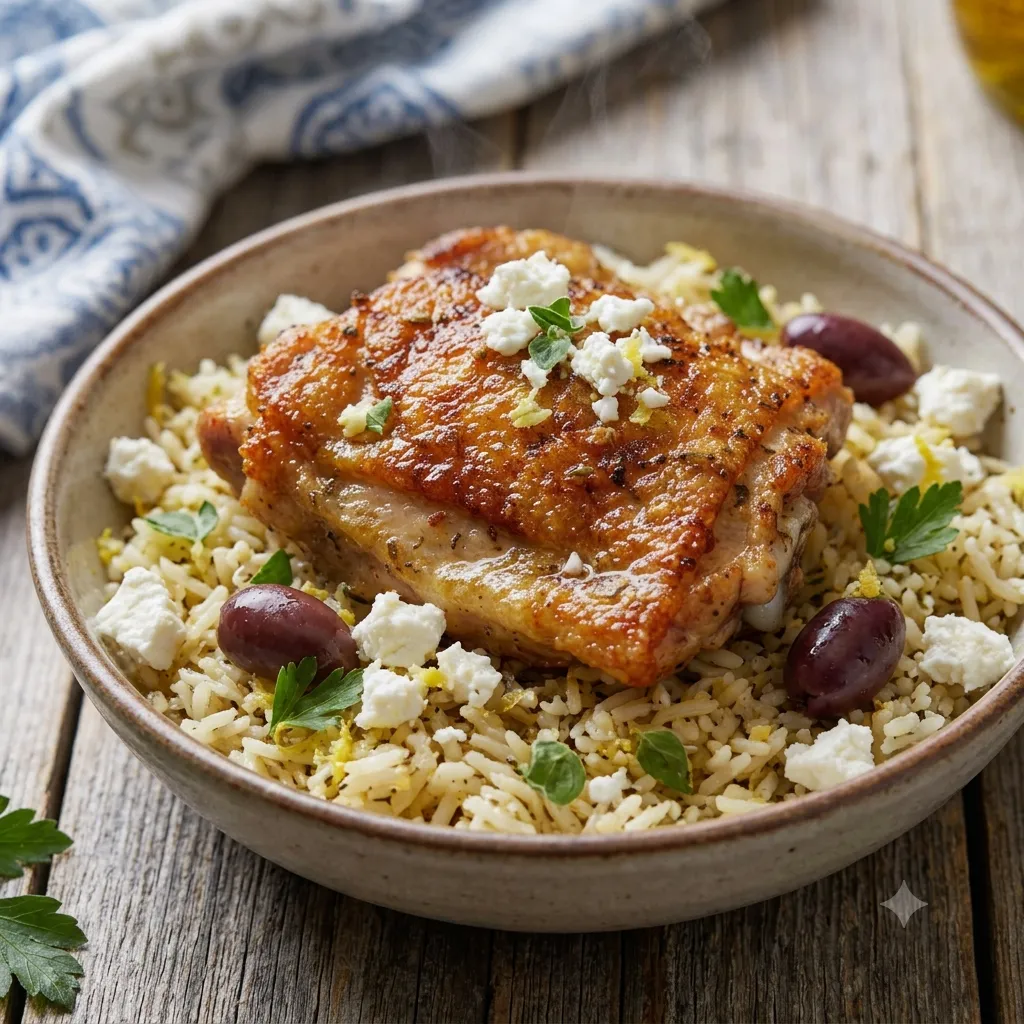
[Image Placeholder – 1:1 Image: Feta and olive variation of Greek chicken and lemon rice served in a bowl with crumbled feta and Kalamata olives.]
- ALT text: Feta and olive variation of Greek chicken and lemon rice
- SEO filename: feta-olive-greek-chicken-rice-variation.jpg
Storage and Reheating
Refrigeration: Store leftovers in an airtight container for up to 4 days.
Freezing: Freeze in a sealed, freezer-safe container for up to 3 months; rice texture softens slightly after thawing but remains enjoyable.
Meal prep: Portion into individual containers once fully cooled for easy grab-and-go lunches.
Reheating: Reheat gently in a covered skillet with a splash of broth over medium-low heat, or microwave in short intervals, stirring between each.
Food safety: Cool leftovers within two hours of cooking and always reheat to an internal temperature of 165°F.
Keeping chicken juicy: Reheat covered and avoid high heat, which dries out the meat quickly.
Keeping rice fluffy: A splash of broth or water before reheating helps rehydrate rice without turning it mushy.
What to Serve With Greek Chicken and Lemon Rice
- [Internal Link: Greek Village Salad] (Horiatiki)
- [Internal Link: Authentic Homemade Tzatziki]
- Roasted vegetables
- Grilled zucchini
- [Internal Link: Homemade Pita Bread]
- Crumbled feta
- Marinated olives
- Dolmades
- Gigantes plaki
- Greek yogurt on the side
Drink pairings: A crisp Assyrtiko or Sauvignon Blanc complements the lemon and olive oil beautifully. For non-alcoholic options, sparkling lemonade or Greek mountain tea both pair nicely with the dish’s bright, herbal notes.
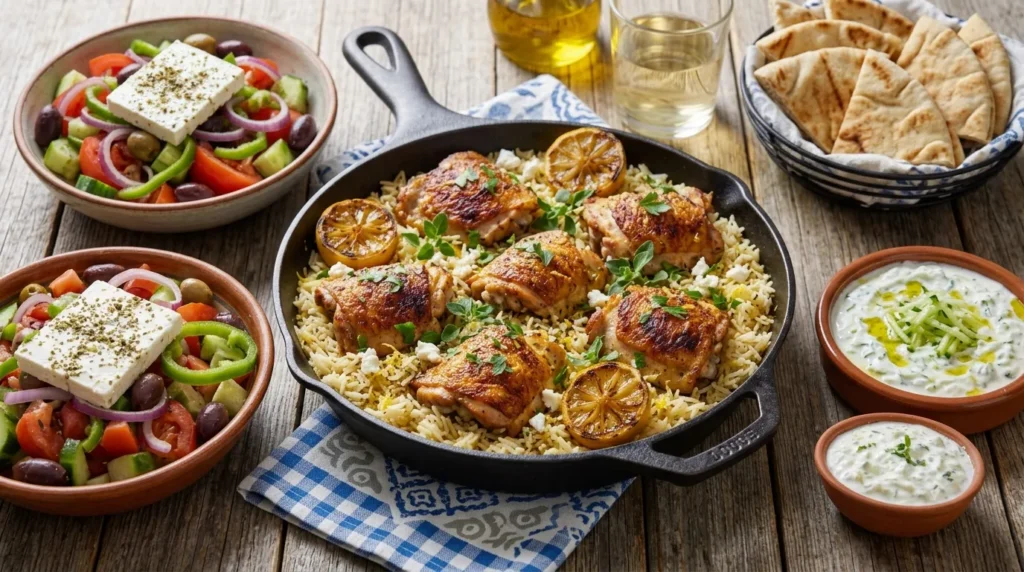
[Image Placeholder – 16:9 Image: Full Mediterranean spread featuring Greek chicken and lemon rice alongside a Greek salad, tzatziki, pita bread, and a glass of white wine.]
- ALT text: Greek chicken and lemon rice served with Greek salad and tzatziki
- SEO filename: greek-chicken-lemon-rice-dinner-spread.jpg
Frequently Asked Questions
Can I use chicken breasts instead of thighs? Yes, though breasts cook faster and can dry out more easily. Reduce the simmer time and check the internal temperature early.
Can I use brown rice? Yes, but brown rice needs more liquid and a longer simmer time, typically 40–45 minutes instead of 20–25.
Can I freeze One Pot Greek Chicken and Lemon Rice? Yes, it freezes well for up to 3 months in an airtight container. Thaw overnight in the refrigerator before reheating.
Can I make this ahead of time? Yes, it reheats well and can be made up to 2 days ahead and stored in the refrigerator.
Why is my rice mushy? This usually means too much liquid was used or the rice simmered too long. Reduce liquid slightly next time and check doneness a few minutes early.
Can I use orzo instead of rice? Yes, orzo works well but cooks faster, so reduce the simmer time and check for doneness sooner.
Can I bake this instead of simmering on the stovetop? Yes, after searing and combining ingredients, transfer to a covered oven-safe dish and bake at 375°F for about 30 minutes.
Can I use fresh oregano instead of dried? You can use both for the best flavor — dried oregano cooked into the dish and fresh oregano added at the end.
Can I make this dairy free? Yes, simply omit the optional butter or substitute a dairy-free alternative.
Can I cook this in a Dutch oven? Yes, a Dutch oven works excellently and holds heat evenly throughout the simmer.
How do I know when the chicken is fully cooked? Use an instant-read thermometer; the thickest part of the thigh should read 165°F.
Can I add vegetables to this dish? Yes, bell peppers, zucchini, or spinach all work well added at different stages, as noted in the variations section.
What’s the best rice for this recipe? Long-grain white rice holds its shape best and produces the fluffiest texture.
Can I double this recipe? Yes, though you’ll need a larger pan and slightly longer simmer time to account for the increased volume.
Why did my chicken skin turn out soggy instead of crispy? This usually happens when the chicken isn’t dried thoroughly before searing, or when it’s simmered skin-side down instead of skin-side up.
Recipe Card
One Pot Greek Chicken and Lemon Rice
| Detail | Information |
|---|---|
| Prep Time | 15 minutes |
| Cook Time | 40 minutes |
| Rest Time | 10 minutes |
| Total Time | 65 minutes |
| Servings | 4 |
| Cuisine | Greek, Mediterranean |
| Course | Main Dish |
| Calories (estimated) | Approximately 520 per serving |
Ingredients
- 4 bone-in, skin-on chicken thighs
- 2 tablespoons olive oil
- 1 yellow onion, diced
- 3 cloves garlic, minced
- 1 cup long-grain rice
- 2 cups chicken broth
- Juice of 1 lemon
- Zest of 1 lemon
- 1 teaspoon dried oregano
- 1 tablespoon fresh oregano, chopped
- 2 tablespoons fresh parsley, chopped
- 1 tablespoon butter (optional)
- Salt, to taste
- Black pepper, to taste
- 1 teaspoon paprika
Instructions
- Pat chicken dry and season with salt, pepper, and paprika.
- Sear skin-side down in olive oil, 6–8 minutes, then flip and sear 3–4 minutes. Remove to a plate.
- Cook onion in the same pan until soft, about 4–5 minutes.
- Add garlic and cook 30–60 seconds until fragrant.
- Add rice and toast for 1–2 minutes.
- Pour in broth, lemon juice, lemon zest, and dried oregano, scraping up browned bits.
- Nestle chicken back in, skin-side up. Cover and simmer on low for 20–25 minutes.
- Check that chicken reaches 165°F and rice is tender.
- Remove from heat, cover, and rest 5–10 minutes.
- Garnish with fresh oregano and parsley, and an extra squeeze of lemon before serving.
Chef Notes For extra crisp skin, run the finished chicken briefly under a broiler before serving.
Storage Notes Refrigerate up to 4 days or freeze up to 3 months in an airtight container.
Nutrition Disclaimer Nutritional values are estimates only and will vary based on specific ingredients and brands used.
[Image Placeholder – 1:1 Image: Overhead flat-lay of the finished recipe card dish plated with garnish, styled for social sharing.]
- ALT text: Recipe card image of One Pot Greek Chicken and Lemon Rice
- SEO filename: one-pot-greek-chicken-lemon-rice-recipe-card.jpg
[Image Placeholder – 9:16 Image: Vertical Pinterest-style image of Greek chicken and lemon rice with bold text overlay space at the top for the recipe title.]
- ALT text: Pinterest pin for One Pot Greek Chicken and Lemon Rice recipe
- SEO filename: one-pot-greek-chicken-lemon-rice-pinterest.jpg
[Image Placeholder – 4:3 Image: Side view of a single plated serving showing a chicken thigh over lemon rice, garnished with parsley and a lemon wedge.]
- ALT text: Plated serving of Greek chicken and lemon rice with lemon wedge
- SEO filename: plated-greek-chicken-lemon-rice.jpg
[Internal Link: Mediterranean Roasted Vegetables]
Conclusion
One Pot Greek Chicken and Lemon Rice brings together everything that makes Greek cooking so satisfying: good olive oil, bright lemon, fragrant oregano, and a technique that lets one pan do all the work. Once you understand why each step matters, from searing the chicken to resting it at the end, you’ll be able to make this dish confidently, again and again, with the same golden, juicy results every time.
If your family loved this one, save the recipe for your next weeknight dinner, leave a comment letting us know how it turned out, and explore more Greek and Mediterranean recipes on Foxenergie.com.